
 It’s an all-action issue, with McGovern giving way too many pop culture lines to the hipster demon. It gets annoying on the first page the character shows up; by the end of the issue, it’s practically intolerable. McGovern doesn’t have anything for the character–at least the protagonist and antagonist have some kind of back story and the humans are sympathetic human characters… a sidekick, good demon? No story. Just annoying.
For the action, which is mostly the two good demons fighting bad demons, Leandri does rather well. Nightworld is a good looking comic and it moves well, it’s just really shallow. And McGovern doesn’t try to go any deeper with it, which is nice.
However, when there’s not much to it, any little thing hurts–like confusion during the humans in distress scene and especially the annoying demon. Facebook references are too much.
But it still works out.
B
CREDITS
One Hundred Demons; writer, Adam McGovern; artist and letterer, Paolo Leandri; colorist, Dominic Regan; publisher, Image Comics.

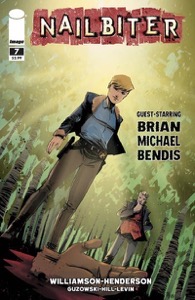

 Williamson does a Powers homage, with Brian Michael Bendis guest starring as himself. I think the Warren Ellis Powers issue is number seven too (yep, thanks Google). Bendis is in town researching a book and Williamson uses him as the protagonist. It’s a way to delay a return to norm for the comic–only the epilogue has the FBI agent back in lead–and also for Williamson to have some fun.
 All of a sudden, Nailbiter is something different. Williamson changes protagonists and gives the issue a narrator in Alice, the teenager (or slightly older) possible future serial killer. She teams up with the sheriff to track down some crazy woman.
 It’s an awesome issue with Judge Death getting freed. The story has clear chapters, from the original 2000 AD progs, but the way Wagner brings it together–the changing focus on the first few–the both awesome and lackluster finish… it works out beautifully.
 This issue has Moonshadow and Ira getting forced into military service. It’s an intergalactic war, which gives Muth a lot of great stuff to draw. Moonshadow is conceptually low-tech and almost junky in how it shows extraterrestrial civilization, but Muth does find occasion for some really beautiful details. Space travel through individual bubbles, for example, is breathtaking.
 This issue has stories where Dredd is stationed on the moon. There’s a bit too much of the Wild West mentality to it–which early 2000 A.D. progs often did with Americans in the future, so I guess it fits; the cowboy hats are still annoying.
 Things get a little too slow this issue, with Moon stuck in an asylum and Ira, his combination sidekick and antagonist, has to break him out. Why? Because Ira needs Moon to work odd jobs to support them. In the meantime, Moon has some encounters with his fellow inmates and there’s a lovely sequence when he plays the flute for them.
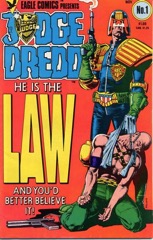 Of the three stories in this issue–this Judge Dredd series being a reprint series, the first one is the best, but the third one has the best writing from John Wagner.


 Kinski is a strange comic. The content–a business guy on the road doing a pitch and finding a lost dog–is strange. It’s even stranger given Gabriel Hardman’s stark, realistic black and white art. Hardman’s writing also ignores the quirky nature of the story and goes for realism. The awkwardness of the protagonist, now obsessed with the dog, is both off-putting and tragic.
 Either the reader is going to buy into Gaiman’s setup for this issue or the reader is going to reject it. Even before Gaiman gets into the “meat” of the issue, which is basically a lengthy monologue from Dream about the importance of Death. Both as a natural event and as Dream’s sister.
 Ah, the big fight issue. Doctor Destiny versus Dream for control of the Dreamworld. Or whatever it’s called. After the two stand-off in the diner, after some glimpses of the world going mad, Doctor Destiny has a trippy dream he’s Caesar and then the big fight. It’s the two of them against a white background. Not the most visceral setting for a comic book fight scene.
 The issue takes place over a day at a diner. Doctor Destiny is trying to bring about the end of the world and he traps a bunch of people in the diner and slowly drives them mad. Or not slowly.
 Gaiman’s strings show a little too much this issue. The Justice League guest stars–well, just Martian Manhunter and Mister Miracle. Turns out while Dream was away, someone became a supervillain with one of his gadgets. It ties things into the DC universe a little too much. There’s a great bit where Mister Miracle is dreaming of Apokolips and Kieth and Malcolm Jones III do a fantastic Kirby homage.
 Dream goes to Hell, which requires the Demon as a guest star. Gaiman doesn’t have anything for him to do, past rhyme a little for the protagonist and cause some mischief. It’s a pointless cameo, though Kieth and Dringenberg do fine on the Demon. They don’t do so well later, when they have to draw every demon in Hell. Actually, they do fine on the demons… they lose their hold on Dream at that point. He feels too out of place.
 Dream’s quest brings him into a John Constantine story–and with Constantine comes a return of Kieth’s improbably proportions for people’s legs–but it’s the strongest issue so far. Gaiman writes Constantine really well, with enough nods to his adventures and the DC universe but never to the point he’s just filling in.
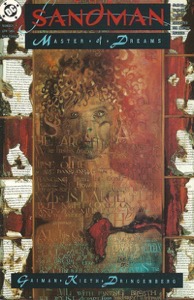
 For the second issue, with Dream ending up needing help from Cain and Abel–who appropriately bookend the tale–Gaiman doesn’t do a lot except continue to setup Dream’s eventual quest. He needs to regain his talismans or whatnot; all the exposition about what’s happened to his world in his absence is secondary.
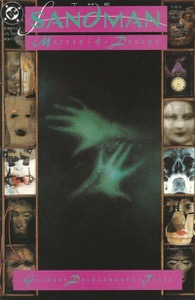
 Neil Gaiman starts Sandman with the world changing. Except it’s in flashback, so it’s entirely possible the reader has been living in this changed world without realizing it. Except it’s sort of in DC continuity–the Golden Age Sandman shows up–so the reader isn’t really in that world anyway. Gaiman plays with the ideas a little, but doesn’t go particularly far with them.




 ★★½
★★½
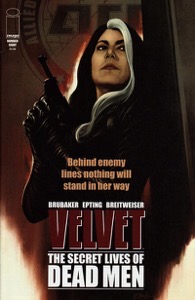
 I guess Brubaker has seen The Rock. Maybe he’s hoping no one else remembers it….
 Once again, there are occasional moments where this issue of Robocop feels a little bit too much like Robocop 2. Not even the action, but the way Williamson is moving things along for Murphy. The evil OCP conspiracy, him having to get fixed. In terms of action, however, there is an ED–209 fight and Murphy having a super-nightstick instead of a gun.
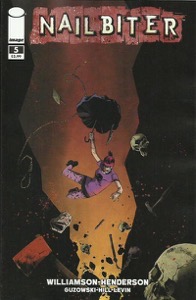
 It’s the best issue of Nailbiter in a while as Williamson wraps up his first arc. He’s set up the series now–Finch, the visitor, isn’t just staying but now there’s new shocking new information about him. Williamson, for better or worse, seems to be positioning the series–with its variety of characters but relatively few locations–for a TV series option.
 The Stop Button