• War Stories (2014) #8

    Ws08

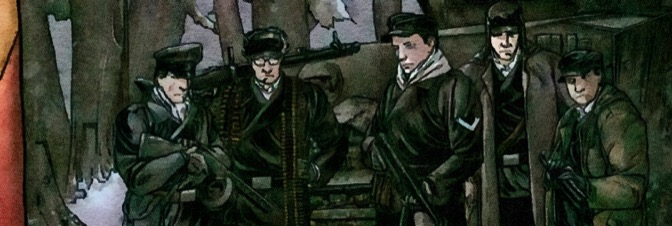
    This issue of War Stories, with Ennis exploring the dynamics of the German tankies and their civilian charges while hiding from Russians invading Germany, it’s essential war comics reading. Ennis’s characterizations, how he paces the issue, how he relieves and creates tension–it’s all top-notch writing. The dialogue’s great, so’s Ennis’s plotting of the scenes and their action.

    But the art is atrocious.

    When the comic starts, it seems like it might be better if Aira’s art were in black and white. The coloring doesn’t work with it so why not black and white? Because it’s soon clear even if some of Aira’s art did look better without the coloring, it’d still be terrible because he can’t visually set up action sequences, not with such an indistinct cast.

    Some great lettering in this issue too. The way the protagonist’s narration looks is perfect.

    The writing overcomes the art problems.

  • College (1927, James W. Horne)

    The best sequence in College is also the longest. Protagonist Buster Keaton, after failing at baseball (he’s a bookworm who needs to get athletic to impress a girl), goes out for track and field. Keaton observes other men succeed at the various events, tries them himself, fails miserably (and comically), keeps trying, presumably assuming he’ll eventually get something right.

    And the viewer assumes it too. That sequence, which does eventually have a fantastic payoff, plays with the viewer’s expectations. Its length and thoroughness serves to fully vest the viewer in the film (the sequence is around the halfway point). Keaton’s success is more important to the viewer than it is to Keaton’s protagonist.

    College is a little light on plot–after setting up Keaton as unable to afford college without working his way through and showcasing his misadventures at odd jobs, the film drops the subject. Ditto the girl–played by Anne Cornwall–and her problems with her jerk jock boyfriend, Harold Goodwin. The latter comes back into the film for the finale, but the college financing stuff doesn’t.

    And Keaton doesn’t really have a story arc. He tries sports to get the girl. Either it’s going to work out or it isn’t. There’s just enough story to get the viewer interested and then Keaton’s attempts (and failures) are funny enough to keep it going. College has about enough story for a short, it just has long form comedic sequences.

    The film always moves, always looks great. The finish rocks.

    3.5/4★★★½

    CREDITS

    Directed by James W. Horne; written by Carl Harbaugh and Bryan Foy; director of photography, Bert Haines and Devereaux Jennings; edited by Sherman Kell; produced by Joseph M. Schenck; released by United Artists.

    Starring Buster Keaton (Ronald), Anne Cornwall (Mary Haynes), Harold Goodwin (Jeff), Flora Bramley (Mary’s friend), Snitz Edwards (Dean Edwards) and Florence Turner (Ronald’s mother).


    RELATED

  • War Stories #8This issue of War Stories, with Ennis exploring the dynamics of the German tankies and their civilian charges while hiding from Russians invading Germany, it’s essential war comics reading. Ennis’s characterizations, how he paces the issue, how he relieves and creates tension–it’s all top-notch writing. The dialogue’s great, so’s Ennis’s plotting of the scenes and their action.

    But the art is atrocious.

    When the comic starts, it seems like it might be better if Aira’s art were in black and white. The coloring doesn’t work with it so why not black and white? Because it’s soon clear even if some of Aira’s art did look better without the coloring, it’d still be terrible because he can’t visually set up action sequences, not with such an indistinct cast.

    Some great lettering in this issue too. The way the protagonist’s narration looks is perfect.

    The writing overcomes the art problems.

    CREDITS

    The Last German Winter, Part Two: Pitch & Sulphur; writer, Garth Ennis; artist, Tomas Aira; colorist, Digikore Studios; letterer, Kurt Hathaway; publisher, Avatar Press.

  • Rat God 3 (April 2015)

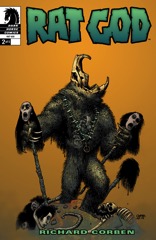
    Rat God #3Everything changes in this issue of Rat God. And not just because the coloring looks more traditionally Corben. It changes because Corben makes his rube of a lead, Elwood Clark, the protagonist of the series. Only took three issues but it’s worth the wait.

    At first glance, this issue–and its cult–seems familiar. Shades of Wicker Man, shades of the Cat People remake. But it’s Corben, so he’s running these more modern horror movies through a filter–it looks like a mix of Val Lewton and Will Eisner (the cultists’ robes are particular).

    The series didn’t previously seem so cinematic–it was more a American Gothic Lovecraft thing. That element is still present, but with an actual protagonist the tone changes. Especially since Corben forces the reader to reexamine him.

    As does the coloring style. It’s shaded lusciously alongside Corben’s already luscious lines. It’s maximal, not minimal. Fantastically so.

    CREDITS

    Writer and artist, Richard Corben; colorists, Corben and Beth Corben Reed; letterer, Nate Piekos; editors, Jemiah Jefferson, Shantel LaRoque and Scott Allie; publisher, Dark Horse Comics.

  • Copperhead (2014) #7

    Ch07

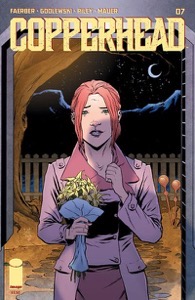
    I resent this issue of Copperhead being so good. It’s an all-action issue, it probably reads in four or five minutes. Clara goes on a date, it gets interrupted by bad guys. Boo is in trouble. There’s some setup–with Faerber maybe even implying Clara’s ex-husband is in a maximum security prison somewhere–and then it’s just the date.

    And it works. It works really well. Godlewski draws a fantastic action sequence when the bad guys show up (it’s actually the first time Copperhead, for all its successes, has had an excellent action sequence).

    But it’s so short. It’s all setup for the cliffhanger resolution, which probably won’t take the whole next issue just because it’s an action-oriented standoff.

    But it’s so good.

    The little character moments for Boo and Clara are both good and the first part of her date’s really funny.

    Copperhead continues its awesomeness.

  • Le Garcon Dans Le Lac
  • Video | Le Garcon Dans Le Lac
  • Friday the 13th: The Final Chapter (1984, Joseph Zito)

    Friday the 13th: The Final Chapter never tries to be scary. It tries to be gory… but not too gory. It saves the biggest gore moment for the last, when any number of the other ones throughout the film would’ve given Tom Savini better material. It’s supposed to be gory, but not too gory. It still has to be mainstream.

    And The Final Chapter is a desperate attempt to fulfill the mainstream expectations of a Friday the 13th movie. There’s pointless nudity, dumb coeds, scary music, a kid with a horror movie fixation. Except Zito can’t do any of it right. He does best on the exploitation of his female cast, but even that is inept because of his direction. Zito shoots everything in a medium-long shot, straight on so the pan and scan video release won’t miss any of the technically competent, but entirely unimaginative gore.

    Worse, Zito has a screenwriter in Barney Cohen who give him okay scary setups. Zito flops on all of them. Occasionally it’ll be something as simple as needing Harry Manfredini’s (admittedly somewhat lame this entry) score over a scene instead of the scenic sound. There’s not a single good thing Zito does in the film.

    Except the opening tracking shot tying it to the previous series entry.

    Lots of bad acting, but also an almost good one from Crispin Glover and okay ones from Kimberly Beck and Barbara Howard.

    One scare out of The Final Chapter shouldn’t have been asking too much.

  • Journey to the Unknown (1968) s01e01 – Eve

    For all of its problems, Eve rarely feels stagy. Director Robert Stevens makes the most of his location shooting, whether it’s town or country, and there are enough scenes out doors to make up for the utter lack of establishing shots. It’s for television, it’s on a budget.

    It’s also got a rather poorly conceived narrative. Writers Michael Ashe and Paul Wheeler seem like they’re trying to keep Eve interesting–it’s about listless young man Dennis Waterman falling in love with a mannequin. Murder and madness ensue. Carol Lynley plays the mannequin in his imagination and Ashe, Wheeler and possibly Stevens make the odd choice of keeping her quiet.

    Waterman’s in need of an imaginary friend due to the Swinging Sixties going on around him; he just wants classy romance. And Lynley is fully capable of the performance, she just doesn’t get the chance.

    At least Michael Gough has some fun.

  • Copperhead #7I resent this issue of Copperhead being so good. It’s an all-action issue, it probably reads in four or five minutes. Clara goes on a date, it gets interrupted by bad guys. Boo is in trouble. There’s some setup–with Faerber maybe even implying Clara’s ex-husband is in a maximum security prison somewhere–and then it’s just the date.

    And it works. It works really well. Godlewski draws a fantastic action sequence when the bad guys show up (it’s actually the first time Copperhead, for all its successes, has had an excellent action sequence).

    But it’s so short. It’s all setup for the cliffhanger resolution, which probably won’t take the whole next issue just because it’s an action-oriented standoff.

    But it’s so good.

    The little character moments for Boo and Clara are both good and the first part of her date’s really funny.

    Copperhead continues its awesomeness.

    CREDITS

    Writer, Jay Faerber; artist, Scott Godlewski; colorist, Ron Riley; letterer, Thomas Mauer; publisher, Image Comics.

  • The Unbeatable Squirrel Girl 4 (June 2015)

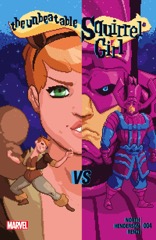
    The Unbeatable Squirrel Girl #4Writer North understands the lunacy of Squirrel Girl fighting Galactus but he’s also writing a comic called The Unbeatable Squirrel Girl so he’s got to come up with something good. And he does. He doesn’t take the comic too seriously, which helps because Squirrel Girl doesn’t need to be realistic, it needs to obey internal logic and amuse.

    It does both.

    North turns Galactus into a great banter partner for Squirrel Girl–and Tippy Toe–while keeping a decent amount of action in the comic. Henderson’s style doesn’t seem a fit for comic book space opera but she really gets it. The Galactus encounter on the moon is full of memorable shots and set pieces.

    There’s even tension–which should be difficult since North has a bunch of framing devices but it all works out rather nicely. If Squirrel Girl can take on Galactus and win, it can do anything.

    CREDITS

    Writer, Ryan North; artist, Erica Henderson; colorist, Rico Renzi; letterer, Clayton Cowles; editors, Jon Moisan and Wil Moss; publisher, Marvel Comics.

  • Birthright (2014) #6

    Birthright  6

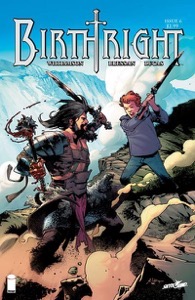
    It’s too soon to say I’m worried about Birthright, but I guess I’m starting to get concerned. Or maybe I wasn’t concerned but this issue is concerning.

    Williamson is accelerating the story of the evil villain controlling Conan and accelerating Conan’s younger big brother figuring out something’s wrong with his brother. There’s some nice stuff with Williamson writing the character–Conan–as he remembers things from his past on Earth, many years before; it suggests there was probably a story here without the whole betrayal subplot, just not as long of one.

    Or as action-packed?

    There’s a really lame scene between the parents. Williamson doesn’t have the mother’s character down, which is getting to be a big problem. The parents are both generic–Dad good, Mom bad–and there’s too much time spent on them here.

    Nice art from Bressan as usual.

    Hopefully Birthright’s just stumbling, not falling.

  • Birthright #6It’s too soon to say I’m worried about Birthright, but I guess I’m starting to get concerned. Or maybe I wasn’t concerned but this issue is concerning.

    Williamson is accelerating the story of the evil villain controlling Conan and accelerating Conan’s younger big brother figuring out something’s wrong with his brother. There’s some nice stuff with Williamson writing the character–Conan–as he remembers things from his past on Earth, many years before; it suggests there was probably a story here without the whole betrayal subplot, just not as long of one.

    Or as action-packed?

    There’s a really lame scene between the parents. Williamson doesn’t have the mother’s character down, which is getting to be a big problem. The parents are both generic–Dad good, Mom bad–and there’s too much time spent on them here.

    Nice art from Bressan as usual.

    Hopefully Birthright’s just stumbling, not falling.

    CREDITS

    Writer, Joshua Williamson; artist, Andrei Bressan; colorist, Adriano Lucas; letterer, Pat Brosseau; editors, Mike Williamson and Sean Mackiewicz; publisher, Image Comics.

  • Bringing Up Baby (1938, Howard Hawks)

    I’m hard pressed to think of a better comedy than Bringing Up Baby. Between Hawks’s direction, Dudley Nichols and Hagar Wilde’s script, the acting (particularly from Katharine Hepburn, who’s so funny, one just starts laughing when she starts talking to save the trouble of having to laugh after her line), it’s probably not possible to be any better than Baby.

    The film opens with a hen-pecked Cary Grant getting his mission for the film–get May Robson to donate a million dollars to the museum. What Grant doesn’t know is how Hepburn’s going to get in his way, for how long and how intensely (not to mention she’s Robson’s niece). So Baby is a perfect blend of screwball and situational comedy. There’s enough room for everything, with Hawks and editor George Hively keeping it moving a brisk pace.

    After Grant’s established, Hepburn sort of takes over as protagonist, though once Charles Ruggles shows up as this delightful dip, Hawks hovers between characters. They’re hunting a leopard in New England after all.

    Baby is never mean-spirited–except maybe about Virginia Walker as Grant’s fianceé–all of the characters mean well and Hepburn either confuses them or they’re inept (or both). The approach gives the comedy has edge without ruthlessness. And Walker’s barely in it, otherwise dismissing her wouldn’t work.

    Some great supporting performances–Robson, Barry Fitzgerald, Fritz Feld, Walter Catlett–it’s a big cast and Hawks handles them masterfully.

    Baby is a singular motion picture, brilliantly made, absolutely hilarious.


    This post is part of the Great Katharine Hepburn Blogathon 2015 hosted by margaretperry.org.

  • Rat God 2 (March 2015)

    Rat God #2It’s a weird issue of Rat God, which is also a lot of Corben’s point. He isn’t mixing genres, but he is throwing Lovecraft alongside some Native American folklore and just plain old wives tales. And who better to illustrate it than Corben himself.

    The issue’s confusing–if the guy walking in the snow is the series’s frame, it didn’t make enough of an impact last issue (so much so going through a couple times, there’s always a disconnect between a couple scenes)–but it’s also got really good scenes. Corben’s dialogue contributes to the setting. As “British” as it might feel, it also feels undeniably American.

    And not just because of the town full of rat people, something Corben doesn’t even hint at resolving yet. By the end of the second issue, he still hasn’t revealed why the series is called Rat God.

    He’s doing some great work here.

    CREDITS

    Writer and artist, Richard Corben; colorists, Corben and Beth Corben Reed; letterer, Nate Piekos; editors, Jemiah Jefferson, Shantel LaRoque and Scott Allie; publisher, Dark Horse Comics.

  • The Karate Kid (1984, John G. Avildsen)

    James Crabe’s photography gets The Karate Kid through the rough patches. The film’s incredibly uneven–Bill Conti’s score initially seems like it’ll be a plus, ends up being a minus, and the editing is strange. Director Avildsen, with two other editors, can’t seem to figure out how to cut the climatic fight sequence. Like many sequences in the film, it’s set to a pop song (only one of those sequences works out), but it’s almost like Avildsen didn’t consider how to cut the film together when shooting.

    But, like I said, Crabe’s there to make up for Avildsen’s questionable composition. There are a few times he goes for painfully obvious symbolism–poor Ralph Macchio dejectedly walking away alone–but mostly Avildsen goes for pedestrian. Crabe’s photography and William J. Cassidy’s production design give the film most of its personality.

    The rest of the personality comes from Macchio and Pat Morita. Robert Mark Kamen’s script is far from great (and not particularly close to good either), but Macchio and Morita’s relationship does keep the film together through its lengthy runtime. Kamen and Avildsen prefer telling the story in summary, which makes it hard to care about Macchio right off. They seem to understand and loose William Zabka to mercilessly bully Macchio from the second or third scene.

    There are some nice moments, eventually–not for a while–with Elisabeth Shue and Macchio.

    Macchio’s performance is more appealing than good, ditto poor Morita (who’s basically playing Yoda). A better finish would’ve helped.

  • Crossed + One Hundred 4 (March 2015)

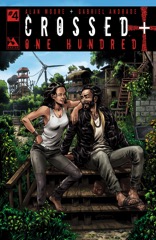
    Crossed +100 #4In this issue, Moore drops Future and company in a Muslim settlement (the only religious community in the world… AFAWK). Future’s got a thing going with the archivist there, giving Moore and Andrade a chance to mix talking head Crossed history in with a sex scene. There’s some stuff with the Crossed in the issue–the tape, finding out the Crossed can breed (for me anyway)–but it’s Future’s romantic interlude is the action standout.

    And Moore ends on that same gentle note. Given Future’s narration of the comic is in her journal and Moore loves playing with how storytelling works, it’s unlikely the comic will ever end an issue on a different note. Or, if he does… well, it means the comic’s changed.

    Of course, Moore’s not threatening Future either.

    It’s a strange, thoughtful comic. This issue has lots of dialogue, but also lots of character moments.

    Awesome again.

    CREDITS

    Writer, Alan Moore; artist, Gabriel Andrade; colorist, Digikore Studios; letterer, Jaymes Reed; publisher, Avatar Press.

  • Paths of Glory (1957, Stanley Kubrick)

    Paths of Glory takes place over four days, runs just under ninety minutes and has thirteen or so significant characters. It’s hard to identify the most significant character–Kirk Douglas’s protagonist the viewer’s way into the film, but he’s not the most significant.

    The film opens with George Macready (who, along with Wayne Morris, is my vote for most significant character) and Adolphe Menjou. The film then moves on Morris’s story (with Ralph Meeker); Douglas shows up in this period too. At no point is the film’s second half, a court martial trial, forecast. Director Kubrick and co-screenwriters Calder Willingham and Jim Thompson pace the film brilliantly–everything is immediate. In the penultimate scene, when Menjou proposes to Douglas the idea of the opposite, it confounds Douglas and reveals the cognitive disconnect to the viewer.

    Then Kubrick gives the viewer–and Douglas–some hope for the human race in the last scene. He handles it carefully–he and editor Eva Kroll cut Glory sublimely. There’s never a wasted moment, but Kubrick never gives the sense of being too precise or reductive. He just balances it all.

    Great photography from Georg Krause.

    In the lead, Douglas is fantastic. He gets a big trial scene, but his quiet seething scenes are even better. His often cautious reactions to Macready and Menjou are phenomenal. And they’re both great. Macready more, just because he gets the most to do in the film.

    It’s a perfect film. Every moment is spectacular, quiet or loud.

  • Red One 2 (April 2015)

    Red One #2This issue of Red One is far superior to the first one, just because Dorison’s made most of his sexist jokes. This time he tries to go the other way and mock the fascist fundamentalist Christians out to attack gays and fails miserably. For what’s supposed to be a period piece–think Boogie Nights with less story–Dorison doesn’t get any details right.

    At least the Dodsons are doing very seventies hair on the people. It’s almost like Dorison doesn’t know how to write the period and, instead of fixing the script, the art is just supposed to cover for it.

    But Vera’s a strong character and the old man she takes care for is a strong character and it works out. None of the supporting cast Dorison implied would be important last issue have much to do here. Thank goodness.

    The ending’s off, but it’s a nice trip there.

    CREDITS

    Welcome to America, Part Two; writer, Xavier Dorison; penciller and colorist, Terry Dodson; inker, Rachel Dodson; letterer, Clayton Cowles; publisher, Image Comics.

  • Big Man Plans 2 (April 2015)

    Big Man Plans #2The first half of the issue is a whole lot better than the second half. The second half has our hero–called Big Man in the letter pages–enduring a whole bunch of torture. Page after page of it. Powell goes from drawing five or six panels a page to three. He doesn’t do backgrounds. He’s going for emphasis.

    Being tortured is bad. I’m not sure what other lesson the reader’s supposed to get from the second half of the issue. Except maybe to appreciate Big Man’s toughness–except the reader is rooting for him already, the reader isn’t happy about Powell and Wiesch’s script requiring Big Man to be really dumb.

    It’s an okay issue. I want it to be better, because the series will probably go on just fine, it’s just not a good comic. It’s an okay comic–wasted pages in an otherwise good limited series. Hopefully

    CREDITS

    Writers, Eric Powell and Tim Wiesch; artist and letterer, Powell; publisher, Image Comics.

  • The Surface 1 (March 2015)

    The Surface #1I’m really hoping the monkey isn’t just a tease in The Surface. It seems like it’s not going to be a tease. The comic really needs a smart monkey.

    Actually, a smart monkey is about the only thing the comic doesn’t have. Not really, but sort of. The Surface is set in the near-ish future; Earth has gone to pot, the United States has broken down, everybody is plugged into the Internet (or whatever it’s called), there are Starbucks everywhere and the coffee’s even sweeter.

    (Okay, the Starbucks are called Starnuts, complete with a squirrel mascot).

    Writer Ales Kot gets through a lot of political stuff, a lot of social stuff, before he gets to the actual story. These three listless young adults–figure early twenties–are searching for the meaning of the universe.

    Nice art from Langdon Foss; stylized but deliberate and thoroughly executed.

    It’s pretentious but competent.

    CREDITS

    In a Beautiful Place out of Country; writer, Ales Kot; artist, Langdon Foss; colorist, Jordie Bellaire; letterer, Clayton Cowles; publisher, Image Comics.

  • Cluster (2015) #4

    Cluster  4

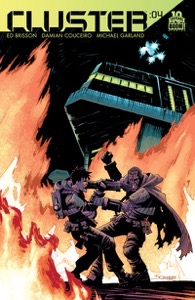
    Brisson picks a really weird place to do a cliffhanger this issue. It’s the most predictable spot–so predictable, it doesn’t even constitute an actual cliffhanger anymore. He spends the entire issue counting down to a plot point and then ends with that plot point. Literally counting down.

    Other than that big, awkward finish–maybe it’s not even a fail, it’s like Brisson forgot to assemble the issue’s flashback framing correctly because the alien prison planet stuff is so much more interesting. But other than it, the issue’s pretty strong. There’s some useless (i.e. too supporting) character stuff and some of the tone doesn’t match Couceiro’s very sci-fi art, but it’s a good issue.

    Couceiro has some problems with the battling spaceships and all, but he’s not really a machines versus machines kind of artist. The human stuff works, even when it’s too predictable.

    It’s a good mixed bag.

  • Cluster #4Brisson picks a really weird place to do a cliffhanger this issue. It’s the most predictable spot–so predictable, it doesn’t even constitute an actual cliffhanger anymore. He spends the entire issue counting down to a plot point and then ends with that plot point. Literally counting down.

    Other than that big, awkward finish–maybe it’s not even a fail, it’s like Brisson forgot to assemble the issue’s flashback framing correctly because the alien prison planet stuff is so much more interesting. But other than it, the issue’s pretty strong. There’s some useless (i.e. too supporting) character stuff and some of the tone doesn’t match Couceiro’s very sci-fi art, but it’s a good issue.

    Couceiro has some problems with the battling spaceships and all, but he’s not really a machines versus machines kind of artist. The human stuff works, even when it’s too predictable.

    It’s a good mixed bag.

    CREDITS

    Writer and letterer, Ed Brisson; artist, Damian Couceiro; colorist, Michael Garland; editors, Cameron Chittock and Eric Harburn; publisher, Boom! Studios.

  • Dekalog (1989) s01e05 – Five

    One has to admire Kieslowski’s dedication to his goal. Sure, Five–which is the “Thou shall not kill” episode of “Dekalog”–is a terrible rumination on the death penalty, but Kieslowski is all in. For his flashback, he does a whole sepia tone filter thing. It’s not good in terms of how it shapes the film, but it’s competently executed by Slawomir Idziak. Sometimes even really well executed.

    The sepia tone isn’t enough, however. The foreshadowing explaining why Miroslaw Baka just has to plot to murder a taxi driver (after causing a traffic accident from an overpass because he’s bored) gets repeated in the conclusion, in painfully bad exposition. For most of Five, Baka is a disaffected, sullen sociopathic punk rock kid. At the end, he’s the pleading Catholic who has lost his way.

    And Kieslowski really misses the boat with Krzysztof Globisz’s crusading attorney.

    Five’s a dreadful hour.

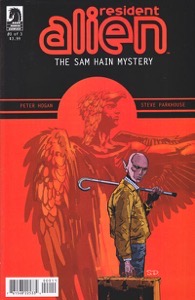
  • Resident Alien: The Sam Hain Mystery (2015) #0

    Resident Alien The Sam Hain Mystery  0

    Even though this issue is Sam Hain Mystery zero, most of the comic is spent on Harry the Alien’s backstory. How did he change from duplicated bills to bills he could use without raising suspicion. Why did he even come to Earth in the first place. Is he believable as a town doctor.

    Okay, that last one takes place in what seems to be the present–writer Peter Hogan assumes everyone is well-versed in Harry and Resident Alien; this issue occasionally has boxes explaining the time period, but there either aren’t enough of them or it just doesn’t work. The comic needs fades, fading in, fading out; Hogan’s jumping all over the place.

    He doesn’t just jump around Harry, he jumps around Asta too, which is simultaneously cool (she’s a good character) and not enough (she only gets a few pages to herself).

    It’s undeniably pleasant, its problems forgivable.

  • Resident Alien: The Sam Hain Mystery #0Even though this issue is Sam Hain Mystery zero, most of the comic is spent on Harry the Alien’s backstory. How did he change from duplicated bills to bills he could use without raising suspicion. Why did he even come to Earth in the first place. Is he believable as a town doctor.

    Okay, that last one takes place in what seems to be the present–writer Peter Hogan assumes everyone is well-versed in Harry and Resident Alien; this issue occasionally has boxes explaining the time period, but there either aren’t enough of them or it just doesn’t work. The comic needs fades, fading in, fading out; Hogan’s jumping all over the place.

    He doesn’t just jump around Harry, he jumps around Asta too, which is simultaneously cool (she’s a good character) and not enough (she only gets a few pages to herself).

    It’s undeniably pleasant, its problems forgivable.

    CREDITS

    Writer, Peter Hogan; artist, Steve Parkhouse; editors, Roxy Polk and Philip R. Simon; publisher, Dark Horse Comics.

  • Captain Victory and the Galactic Rangers 6 (March 2015)

    Captain Victory and the Galactic Rangers #6I wish Joe Casey loved Jack Kirby a little less. Captain Victory ends with the origin of Captain Victory (as the young version sees it unfold). What’s it like? Well, there are nods to Darkseid, the New Gods, probably something from Marvel, whatever. It’s a bunch of Kirby homage and it’s all in summary and none of it’s in scene.

    There are eight guest artists doing this history section and it’s disconcerting. It never lets the issue find of good visual vibe because Fox is back on the space ship and not doing much in the series’s actual settings. Well, there’s one great shot of the World Trade Center.

    Is it a good finish to the series?

    Not at all. Everything goes toward the homage aspect. Casey doesn’t care about any of his characters.

    Is it a good Kirby homage?

    Doubt it; he’d probably prefer people get a good read.

    CREDITS

    Writer, Joe Casey; artists, Nathan Fox and friends; colorist, Brad Simpson; letterer, Simon Bowland; editors, Molly Mahan, Hannah Elder and Joseph Rybandt; publisher, Dynamite Entertainment.

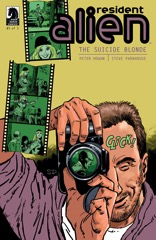
  • Resident Alien: The Suicide Blonde 3 (November 2013)

    Resident Alien: Suicide Blonde #3Hogan manages to find a sensational but also completely not finish to Suicide Blonde. The resolution of the mystery is genial, even as the suspect recounts a somewhat salacious story. Harry’s just too good of a guy for it to be anything but genial.

    Only then Hogan brings in the Men in Black and Harry’s a target again. Only he doesn’t know it. Hogan doesn’t even get around to dealing with Asta. He hints at that subplot but doesn’t spend any real time on it. The resolution to the mystery and Hogan’s sensitive handling of the suspect and Harry’s reaction to it, it’s where the energy goes.

    Parkhouse’s art isn’t great. He gets bored with all the talking heads. There’s nothing for him to do–that somewhat salacious story is barely salacious and he and Hogan are actually rather respectful.

    It’s a nice finish; Resident Alien is a unique book.

    CREDITS

    Writer, Peter Hogan; artist, Steve Parkhouse; editors, Everett Patterson and Philip R. Simon; publisher, Dark Horse Comics.

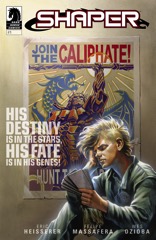
  • Shaper 1 (March 2015)

    Shaper #1Eric Heisserer turns in a perfectly serviceable script for Shaper. Kid graduating high school (or the future, interplanetary equivalent) from a bad home, can’t get a prime gig, finds out he’s a magical war creature and that his favorite teacher’s been lying to him and she’s his mom.

    At least I think he doesn’t know she’s his mom. I’m not sure. Heisserer has some clarity issues. But he’s also got Felipe Massafera’s strong sci-fi artwork, which forgives a lot of those clarity issues.

    Shaper is derivative and disposable, but Heisserer’s script is competent enough a good artist can make it work. Massafera’s more than a good artist, he’s a good sci-fi artist; he knows the balance between space ships and future cities and aliens. He’s got a good action style and he’s perfectly decent with talking heads stuff (focusing on the sci-fi setting).

    It’s perfectly serviceable stuff.

    CREDITS

    Writer, Eric Heisserer; artist, Felipe Massafera; colorist, Wes Dzioba; letterer, Michael Heisler; editors, Freddye Lins, Everett Patterson and Randy Stradley; publisher, Dark Horse Comics.

  • The Last Detail (1973, Hal Ashby)

    Even though Jack Nicholson gets top billing and the most bombastic role in The Last Detail, Otis Young has the harder job. He’s got to temper Nicholson, both for the sake of the audience and of the narrative. The film introduces the two men simultaneously–Robert Towne’s script almost immediately establishes an unspoken bond between the two, even though it takes them well through the first act to get to know each other.

    The Last Detail is an atypical buddy picture for many reasons, with the two buddies getting thrown together being one of the more immediate ones. But more, the film is practically a parenting outing. Nicholson’s the crazy, fun dad, Young’s the responsible mother (who you don’t want to cross) and Randy Quaid’s the kid. Of course, Nicholson and Young are escorting Quaid to the stockade.

    Along the way, Nicholson and Young do not go on an odyssey of self discovery. Their efforts in humanizing Quaid don’t lead to big momentous changes in their lives. Towne is reserved, saving the expository character development scenes for when Quaid’s doing something else (sometimes just napping); it makes those scenes, with Nicholson calm as opposed to manic and Young not fretting as much, rather special.

    Director Ashby and editor Robert C. Jones create a tranquil, quiet quality for the film, using fades to guide the viewer’s attention. Great photography from Michael Chapman and a rather good score from Johnny Mandel.

    All the acting’s great. Detail is muted, precise and often devastating.

    4/4★★★★

    CREDITS

    Directed by Hal Ashby; screenplay by Robert Towne, based on the novel by Darryl Ponicsan; director of photography, Michael Chapman; edited by Robert C. Jones; music by Johnny Mandel; production designer, Michael D. Haller; produced by Gerald Ayres; released by Columbia Pictures.

    Starring Jack Nicholson (Buddusky), Otis Young (Mulhall), Randy Quaid (Meadows), Clifton James (M.A.A.), Carol Kane (Young Prostitute) and Michael Moriarty (Marine O.D.).


    RELATED