• Resident Alien: The Sam Hain Mystery (2015) #1

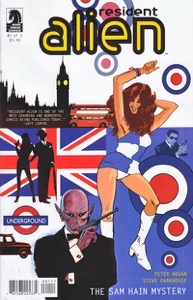
    Resident Alien The Sam Hain Mystery  1

    Harry the Resident Alien is back with a swinging adventure called The Sam Hain Mystery. Swinging in the sixties sense. And not really. The story’s again set in Harry’s small town, amid all the small town secrets.

    Writer Peter Hogan gives Harry a little mystery to solve, one he thinks he can wrap up on lunch–Resident Alien, for those (unfortunately) unaware, is often a genial mystery book–and it turns out to be a bigger mystery and one connected to some of Harry’s other developing interests.

    Since Resident Alien is on its third series, Hogan’s got to greet new and returning readers, probably more towards the latter. He does a good job with it; the interactions with the supporting cast are amusing enough to interest new readers while still reminding returning ones why they enjoy the comic.

    And Steve Parkhouse’s art is fantastic from page one. Some great stuff.

  • [Stop Button Lists] Siskel’s Ten Best of 1980

    The Ten Best Films of 1980, Gene Siskel

    source: The Chicago Tribune

    1. Raging Bull (1980, Martin Scorsese)
    2. Ordinary People (1980, Robert Redford)
    3. Coal Miner’s Daughter (1980, Michael Apted)
    4. The Tree of Wooden Clogs (1978, Ermanno Olmi)
    5. Kagemusha (1980, Kurosawa Akira)
    6. Being There (1980, Michael Apted)
    7. The Black Stallion (1979, Carroll Ballard)
    8. The Blues Brothers (1980, John Landis)
    9. The Great Santini (1979, Lewis John Carlino)
    10. The Stunt Man (1980, Richard Rush)
  • Resident Alien: The Sam Hain Mystery #1Harry the Resident Alien is back with a swinging adventure called The Sam Hain Mystery. Swinging in the sixties sense. And not really. The story’s again set in Harry’s small town, amid all the small town secrets.

    Writer Peter Hogan gives Harry a little mystery to solve, one he thinks he can wrap up on lunch–Resident Alien, for those (unfortunately) unaware, is often a genial mystery book–and it turns out to be a bigger mystery and one connected to some of Harry’s other developing interests.

    Since Resident Alien is on its third series, Hogan’s got to greet new and returning readers, probably more towards the latter. He does a good job with it; the interactions with the supporting cast are amusing enough to interest new readers while still reminding returning ones why they enjoy the comic.

    And Steve Parkhouse’s art is fantastic from page one. Some great stuff.

    CREDITS

    Writer, Peter Hogan; artist, Steve Parkhouse; editors, Roxy Polk and Philip R. Simon; publisher, Dark Horse Comics.

  • The ‘High Sign’ (1921, Edward F. Cline and Buster Keaton)

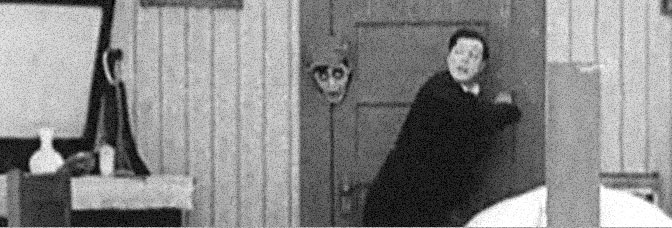
    The ‘High Sign’ starts innocuously enough. Leading man Buster Keaton is out of work and answers a want ad to be a clerk at a shooting range. Maybe the tone of the short can be determined from Keaton stealing a cop’s gun to practice, because things don’t stay innocuous for long.

    In addition to the range–which affords directors Keaton and Cline two different sequences (one with Keaton acting, one with Keaton reacting)–there’s eventually an elaborate home invasion sequence, with Keaton fighting off the bad guys to protect Bartine Burkett and her father.

    Of course, the bad guys hired Keaton to assassinate the father. It’s a lot of brisk storytelling.

    There are a handful of lovely cinematic flourishes, but mostly it’s just a good slapstick outing for Keaton. He’s got a wonderful nemesis in the giant Ingram B. Pickett.

    Small or (relatively) large, all Keaton and Cline’s gags work.

    3/3Highly Recommended

    CREDITS

    Written and directed by Edward F. Cline and Buster Keaton; director of photography, Elgin Lesley.

    Starring Buster Keaton (Our Hero), Bartine Burkett (Miss Nickelnurser) and Ingram B. Pickett (Tiny Tim).


    RELATED

  • Ghosted 20 (May 2015)

    Ghosted #20Ghosted ends. Rather abruptly. While Williamson does discuss ending the series in the back matter–and he pretty much brings back every slightly sympathetic character for a farewell of sorts–the pacing doesn’t feel right. Even if he meant to work towards a reveal and then go another route… it’s not a successful destination.

    Some of the problem is Goran Sudzuka trying a different style for his brief return to the comic. And then Laci and Williamson pretending they’re doing a desperately romantic Vertigo comic from the nineties. The tone is just off.

    Still, even if it’s not a compelling read, the final issue of Ghosted is a pleasing one. Williamson doesn’t take enough time with the characters but he gives them all fine farewells. The ties back to the series’s first arc just show how constrained Williamson envisioned the comic, which is too bad.

    Ghosted finishes acceptably, nothing more.

    CREDITS

    Writer, Joshua Williamson; artists, Goran Sudžuka and Vladimir Krstic Laci; colorist, Miroslav Mrva; letterer, Rus Wooten; editors, Michael Williamson and Sean Mackiewicz; publisher, Image Comics.

  • The Fade Out 6 (May 2015)

    The Fade Out #6It’s a good issue of Fade Out but something feels off. Like Brubaker is backing off a bit in the narration–he’s set up the story, he’s telling the reader a whole lot about Gil and Charlie and how they feel and so on. There’s still a great story for Charlie and Maya.

    It’s also where Brubaker embraces the regular reader. The previous issue had some big events and he doesn’t recap them here. If you aren’t on board with the series, you don’t get any more help.

    Brubaker moves things along in a big way with Gil’s storyline getting clearer–Charlie’s is still a muddle, the noir screenwriter fumbling his way through a noir while Gil’s being the actual hero. Brubaker introduces a Little Rascals stand-in troupe for some plot fodder; it’s what feels off. It’s too much of an Ellroy homage.

    Nice art from Philips as always.

    CREDITS

    To Set the World on Fire; writer, Ed Brubaker; artist, Sean Phillips; colorist, Elizabeth Breitweiser; publisher, Image Comics.

  • Drunken Angel (1948, Kurosawa Akira)

    Drunken Angel never hides its sentimentality. The film’s protagonist, an alcoholic doctor working in a slum (Shimura Takashi in a glorious performance), is well aware of his sentimentality. He resents it–Shimura has these great yelling and throwing scenes–but it’s what keeps him going. It also allows director Kurosawa to have intensely sentimental sequences without affecting the tone of the film–sometimes it’s in Hayasaka Fumio’s score, sometimes it’s just how Kurosawa and Kôno Akikazu cut a sequence.

    The film’s story has Shimura getting a new patient–Mifune Toshirô’s erratic (similarly hard-drinking) Yakuza neighborhood boss. The two fight, often physically, but form a bond–Mifune’s all subtlety, Shimura’s all noise. When their volumes reverse is when Kurosawa and co-writer Uekusa Keinosuke get in some fantastic character work. Of course, the actors are essential to it. Both of them become clearer and clearer as the film progresses. Even though Drunken Angel has an epical arc to it, it’s very much a character study.

    It’s also a setting study–Shimura’s practice is on the edge of a garbage swamp in the slum, Mifune’s favorite night club is just blocks away. In a relatively short run time (under 100 minutes), Kurosawa and Uekusa introduce a large supporting cast, establishing them usually in a few seconds, usually without much dialogue.

    As the epical arc goes along its track, the film moves over to Mifune, sort of reintroducing him (without Shimura’s judgment). It’s beautifully executed, as is everything else in the film.

    4/4★★★★

    CREDITS

    Directed by Kurosawa Akira; written by Uekusa Keinosuke and Kurosawa; director of photography, Itô Takeo; edited by Kôno Akikazu; music by Hayasaka Fumio; production designer, Matsuyama Takashi; produced by Motoki Sôjirô; released by Toho Company Ltd.

    Starring Shimura Takashi (Sanada), Mifune Toshirô (Matsunaga), Yamamoto Reizaburô (Okada), Kogure Michiyo (Nanae), Nakakita Chieko (Miyo), Shindô Eitarô (Takahama), Sengoku Noriko (Gin), Kasagi Shizuko (Singer), Shimizu Masao (Oyabun) and Kuga Yoshiko (Schoolgirl).


    RELATED

  • Satellite Sam 14 (May 2015)

    Satellite Sam #14And this issue is a perfect example of how you do a comic book. One thing Chaykin brings to Satellite Sam–even when he’s having an off issue, which he isn’t this issue–is a real understanding of how to make a comic book a comic book. You never read Sam and feel like Fraction’s itching for a movie option or whatnot. The way the story beats work, they only work in a comic.

    And there are a lot of big story beats this issue. Fraction deals with all of the major plot lines, along with a couple nods–sometimes with just those Italian language word balloons–to major subplots. These plot lines aren’t resolved (well, probably one of them), but they’re getting close. Fraction and Chaykin pack a lot into the issue and its story threads.

    Sam is going out on a rather high note, which is only appropriate.

    CREDITS

    Bad Actors; writer, Matt Fraction; artist, Howard Chaykin; letterer, Ken Bruzenak; editor, Thomas K.; publisher, Image Comics.

  • Poltergeist (2015, Gil Kenan)

    It’s hard to imagine Poltergeist being any better. Even if director Kenan was any good, there’d still be David Lindsay-Abaire’s atrocious screenplay, and even if both those elements were any good, there’d still be the acting. And even if the acting was better–and a better script would probably help on that front–there’d just the photography and editing and music.

    Poltergeist is so broken, there’s just no point in fixing it.

    There’s no point in talking about Kenan at length. He’s bad with actors, he can’t make scary scenes, he can’t compose a shot. Without a major gimmick, there’s no point for a Poltergeist remake and Kenan’s got nothing. Unless the producers thought the problem with the original was it was too good so they figured out a way to make it bad (Lindsay-Abaire’s script plays like a truncated version of the original).

    Are any of the actors good? No. Jane Adams is odd comic relief; in some ways, Jared Harris is the best as the celebrity ghost hunter just because he’s not so obviously phoning it in. Though it’s possible the reason Sam Rockwell and Rosemarie DeWitt’s performances are so mediocre is because they could never figure out what Kenan was doing with the camera.

    The film makes Rockwell and DeWitt’s son, Kyle Catlett, the ostensible protagonist. Except the film doesn’t seem to understand how protagonists work. Because it’s so inept.

    Poltergeist is too incompetent a film to be a cynical remake. It’s actually rather pitiable.

  • The Auteur: Sister Bambi (2015) #1

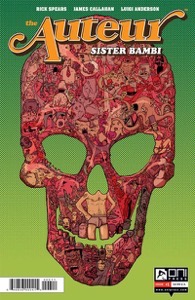
    The Auteur Sister Bambi  1

    The Auteur is back and it’s a little different. The jokes are broader, it’s less actually offensive and more obviously offensive. Writer Rick Spears knows he’s got an audience now and he’s got some idea of what they want. Movie jokes. Lots of movie jokes. Like a Dracula’s Dog joke.

    There’s still a lot of energy to the comic, regardless of how the dialogue gags work–James Callahan is a little light on details but there’s plenty of action.

    The protagonist, whose name I’ve sort of forgotten (not sort of, entirely), doesn’t get identified in the issue by name. Spears is definitely writing for the returning reader.

    There’s nothing exactly wrong with Sister Bambi, it’s just a lot more conventional. And not even in the conventions The Auteur made for itself last time. It’s hard to get excited about it; inventive, moderately effective movie jokes can only go so far.

  • The Auteur: Sister Bambi #1The Auteur is back and it’s a little different. The jokes are broader, it’s less actually offensive and more obviously offensive. Writer Rick Spears knows he’s got an audience now and he’s got some idea of what they want. Movie jokes. Lots of movie jokes. Like a Dracula’s Dog joke.

    There’s still a lot of energy to the comic, regardless of how the dialogue gags work–James Callahan is a little light on details but there’s plenty of action.

    The protagonist, whose name I’ve sort of forgotten (not sort of, entirely), doesn’t get identified in the issue by name. Spears is definitely writing for the returning reader.

    There’s nothing exactly wrong with Sister Bambi, it’s just a lot more conventional. And not even in the conventions The Auteur made for itself last time. It’s hard to get excited about it; inventive, moderately effective movie jokes can only go so far.

    CREDITS

    Independent Financing; writer and letterer, Rick Spears; artist, James Callahan; colorist, Luigi Anderson; editor, Charlie Chu; publisher, Oni Press.

  • Into the Grizzly Maze (2014, David Hackl)

    Should Into the Grizzly Maze be any good? It’s the story of two bickering brothers who have to hunt a giant killer bear. In Alaska. With the deaf wife of one brother–the cop–and the ex-girlfriend of the other brother. And the other brother is an ex-con. Their father’s former bear hunting protege also figures into the mix.

    It sounds like a really lame soap opera, not a movie about a giant monster bear. And when you consider the actors–Thomas Jane as the cop, James Marsden as the ex-con, Piper Perabo as the deaf wife, Billy Bob Thornton as the protege (and, yes, TV supporting player Michaela McManus as the ex-girlfriend). These actors used to be movie stars. If they’re going to be in a movie about a killer grizzly bear, shouldn’t it be somehow awesome?

    Yes, it should. But director Hackl’s atrocious. He can’t make Maze scary, can’t do the gore–and he wastes a few really good gore possibilities because the whole thing has awful CG in awful day for night digital shooting. Occasionally, it seems like James Liston’s photography is good, but then it’s obvious he just knows how to give that impression. It’s still better than anything Hackl does.

    The whole reason Perabo is deaf is so she can be hunted and the audience can know what’s coming (and maybe to pay her less) and Hackl can’t even sell that moment.

    Bad acting. Bad movie. Except Scott Glenn, of course.

    0/4ⓏⒺⓇⓄ

    CREDITS

    Directed by David Hackl; screenplay by Guy Moshe and J.R. Reher, based on a story by Reher; director of photography, James Liston; edited by Andrew Coutts, Michael N. Knue and Sara Mineo; music by Marcus Trumpp; production designer, Tink; produced by Paul Schiff, Tai Duncan and Hadeel Reda; released by Vertical Entertainment.

    Starring James Marsden (Rowan), Thomas Jane (Beckett), Piper Perabo (Michelle), Billy Bob Thornton (Douglass), Scott Glenn (Sully), Michaela McManus (Kaley), Kelly Curran (Amber) and Adam Beach (Johnny Cadillac).

  • We Can Never Go Home 1 (February 2015)

    We Can Never Go Home #1We Can Never Go Home Again is strange. Not so much in its content–small town teenage mutant girl hides her mutant powers, falls in with a boy with a secret (it’s a mix of countless young adult novels and the first X-Men movie)–but in how writers Matthew Rosenberg and Patrick Kindlon pace out the issue. They open with the boy with the secret, then switch focus between him and the girl, only neither one’s really the protagonist. Each seems to have some kind of secret the writers are keeping from the reader.

    It feels manufactured, but the dialogue–most of the issue is dialogue–is so strong, it doesn’t matter. It’s a fun read, with “so close to prime time it’s a shock when it isn’t” art from Josh Hood, even if it’s too fast.

    Hopefully it’ll go someplace more interesting than where it’s starting out from.

    CREDITS

    What We Do Is Secret; writers, Patrick Kindlon and Matthew Rosenberg; artist, Josh Hood; letterer, Jim Campbell; publisher, Black Mask Studios.

  • The Palm Beach Story (1942, Preston Sturges)

    The Palm Beach Story is a narrative. Director Sturges opens with a rapidly cut prologue showing stars Claudette Colbert and Joel McCrea getting married, where he inserts clues for what will eventually be the film’s utterly pointless deus ex machina. Sure, Palm Beach runs less than ninety minutes so it’s possible the viewer be sitting around focusing on the prologue’s unanswered questions, but unlikely. Sturges is betting a lot on no one paying too much attention.

    The film’s first act has Colbert paying off she and McCrea’s debt, so she then leaves him. She’d been waiting to do it until they were even with the grocer. Besides an awkward scene where she and McCrea get drunk, there’s almost no character development between them. It’s not just with one another–since the second act requires them both to be dishonest, there’s rarely any sincere scenes between their characters and anyone else in the film.

    One has to wonder if Sturges intended the deus ex machina to have more importance, since it deals entirely with Colbert and McCrea and he’s spent most of Palm Beach concentrating on the people they meet. Rudy Vallee and Mary Astor eventually show up to provide romantic interests for the married leads, which ought to be funnier but Sturges spends more time with jokes at Sig Arno’s expense.

    Astor is fantastic, Vallee is fine, Colbert is too mercenary and McCrea looks lost.

    Sturges never finds the right tone for the film. It’s off from that first scene.

  • Mayday 1 (April 2015)

    Mayday #1Mayday tells the story of a coked out Hollywood director who stumbles across a couple of bad Tarantino knock-off hit men and starts an adventure.

    There’s also a Benicio Del Toro (called Benicio Del Cocaine) character who’s given up Hollywood to start a cult and kill people. It’s not clear how it’s all connected, but it’s undoubtedly connected.

    I suppose Mayday writer Curt Pires gets some credit for doing a comic with absolutely no chance of getting optioned by Hollywood (one hopes Lindsay Lohan or Del Toro sues him for defamation of character) but there’s nothing to the story. The protagonist is obnoxious, the supporting cast is obnoxious. Towards the end of the issue, Pires cheaply inserts a second lead. She doesn’t have enough presence to be obnoxious.

    Chris Peterson’s art is okay enough, but he doesn’t do anything special. Mayday is a whole bag of not special actually.

    CREDITS

    Degradation Nation; writer, Curt Pires; artist, Chris Peterson; colorist, Pete Toms; letterer, Colin Bell; publisher, Black Mask Studios.

  • Rebels 2 (May 2015)

    Rebels #2Do you know why superheroes wear flashy outfits? So you can tell them apart in otherwise confusing action sequences. Rebels has no superheroes, just the heroic men of the pre-Revolutionary War militias fighting against the British. Wood picks an interesting topic–much like WWII, it’d be hard to find an anti-Revolutionary War sentiment in readers.

    But Wood doesn’t have any of the minutiae down. I’m not getting a history lesson with each issue, I’m getting a soap opera. It’s not even an interesting soap opera. Guy is determined and dense and disregards his wife’s feelings.

    And Wood’s lack of thoughtfulness–the wife asking what time it is when they don’t have a clock–is kind of the problem with the whole thing. To mix film metaphor, it’s The Patriot, but pretending to be Dances With Wolves.

    But, if it weren’t for the weak ending, it’d be fine enough.

    CREDITS

    A Well-Regulated Militia, Part Two; writer, Brian Wood; artist, Andrea Mutti; colorist, Jordie Bellaire; letterer, Jared K. Fletcher; editors, Spencer Cushing and Sierra Hahn; publisher, Dark Horse Comics.

  • Catwoman B&W
  • Video | Catwoman B&W
  • Stop Button Favorites – 1×4 – Batman Returns

    WHERE TO LISTEN

    Apple Podcasts
    Breaker
    Google Podcasts
    Overcast
    Pocket Casts
    Radio Public
    Spotify
    RSS
  • Dekalog (1989) s01e06 – Six

    Six is a mess and it shouldn’t be, because at the center of it director Kieslowski has this phenomenal performance from Grazyna Szapolowska. He opens with her (doing some hippy thing where she “blesses” her food), then moves the story to her stalker, played by Olaf Lubaszenko.

    Now, what eventually happens is Janet Leigh comes on to Norman Bates and he tries to kill himself and she realizes her wanton slutty modern woman ways have taken away her chance for godly happiness.

    Along the way, there’s some truly amazing acting from Szapolowska and all these missed opportunities in Krzysztof Piesiewicz and Kieslowski’s script. Half the film goes to Lubaszenko peeping on her (it’d have been more effective, after all the melodramatics, if it had just been this odd stalking movie), then everything else is rushed. Including, unfortunately, when Szapolowska starts stalking him back.

    Szapolowska’s performance deserved a far better script.

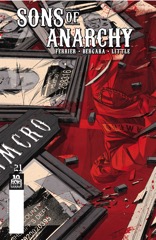
  • Sons of Anarchy #21It’s a better issue but still not a distinguished one. Ferrier treats the characters a little like cattle. He has them stand around, he has them go crazy, but he never gives the impression they’re anything but what he needs them to be for the story.

    The issue ends in about the same place as it begins, which is odd. Even though there are exciting moments throughout the issue, by looping around, Ferrier just makes the reader wonder why the issue was necessary. And the reader should never be left wondering why something is necessary.

    Bergara’s art is improving. It’s still too exaggerated and cartoony at times, but it’s definitely improving. In many ways, especially with the flat ending, it’s more successful this time out than the writing.

    Sons is better this issue than last, but the series is still in trouble. Ferrier just doesn’t have a feel for it.

    CREDITS

    Writer, Ryan Ferrier; artist, Matías Bergara; colorist, Paul Little; letterer, Ed Dukeshire; editors, Mary Gumport and Dafna Pleban; publisher, Boom! Studios.

  • Rocket Girl 6 (May 2015)

    Rocket Girl #6Something’s not quite right about Rocket Girl this issue and it took me a while to figure it out. Montclare’s starting a new arc, but he hasn’t given Dayoung anything to do as Rocket Girl. She’s got flashbacks to adventure, but in the present, the problem is that she’s not the teenager her new caretakers are expecting.

    Big surprise. She’s from the future. And after opening the issue with Dayoung extremely focused and strong, Montcare ends it treating her like a child. It raises a question about the series and how it will go on–is the reader supposed to spend time wondering about whether or not Dayoung’s capable of non-teenager thinking.

    Because, if so, the comic doesn’t read as well. It reads as trite YA stuff, not rollocking, witty adventure.

    Also odd? Reeder doesn’t get anything interesting to draw. Maybe some of the future stuff. But not much.

    CREDITS

    Split Second; writer, Brandon Montclare; artist, colorist and letterer, Amy Reeder; publisher, Image Comics.

  • A Day at the Races (1937, Sam Wood)

    Until the halfway point or so, A Day at the Races moves quite well. Sure, it gets off to a slow start–introducing Chico as sidekick to Maureen O’Sullivan and setting up her problems (her sanitarium is going out of business), which isn’t funny stuff. I think Allan Jones even shows up as her nightclub singing beau before the other Marx Brothers make an appearance. But once they do, Races gets in gear.

    There are a series of excellent sequences, all utilizing the Marx Brothers. Whether it’s Harpo doing physical comedy, Groucho and Chico doing a banter bit–with Harpo joining them in another one a few minutes later–Races uses them to wonderful effect. Director Wood even gets in a fine instrument playing number for Harpo and Chico.

    And the supporting cast–O’Sullivan, Margaret Dumont, Leonard Ceeley, Douglass Dumbrille–is strong. Jones is an exception; his performance is broad, but he’s likable enough.

    Until the second half, when the film should be giving him more to do acting-wise and doesn’t, instead giving him a long musical number. That long musical number, which leads to Harpo recruiting the nearby poor black workers into the number, kills Races’s pace. The previous musical interlude, with a lengthy (and gorgeous) ballet sequence, is about all it could handle. Maybe because there was great Marx Brothers comedy immediately following.

    After the second musical sequence? Uninspired situation comedy. Races manages a satisfactory recovery in the finish, but it can’t make up the time.

    3/4★★★

    CREDITS

    Directed by Sam Wood; screenplay by Robert Pirosh, George Seaton and George Oppenheimer, based on a story by Pirosh and Seaton; director of photography, Joseph Ruttenberg; edited by Frank E. Hull; music by Franz Waxman; released by Metro-Goldwyn-Mayer.

    Starring Groucho Marx (Dr. Hackenbush), Chico Marx (Tony), Harpo Marx (Stuffy), Allan Jones (Gil), Maureen O’Sullivan (Judy), Margaret Dumont (Mrs. Upjohn), Leonard Ceeley (Whitmore), Douglass Dumbrille (Morgan), Esther Muir (‘Flo’), Robert Middlemass (Sheriff), Vivien Fay (Dancer), Ivie Anderson (Vocalist) and Sig Ruman (Dr. Steinberg).


    RELATED

  • Descender 3 (May 2015)

    Descender #3I want to be able to keep reading Descender, but I’m getting close to my limit. It’s just A.I. with some flourishes on it. It’s like someone tried to make a comic book sequel to A.I., only instead of taking its visual template, Nguyen is grabbing from Alien and Outland and other seventies to early eighties sci-fi.

    This issue has robot Tim dying and going to robot purgatory, where all the souls of the robots from the alien invasion are living. Okay, maybe more A.I. mixed with one of the Ender’s Game sequels, suffice to say, Lemire doesn’t have anything original in this series. And maybe he’s not supposed to, maybe he’s just supposed to sell the option to Hollywood and the comic’s going to sell on Nguyen’s art.

    After all, Lemire’s just unoriginal, it’s not bad.

    But I don’t know if Nyugen’s art alone is worth the time.

    CREDITS

    Tin Stars, Part Three; writer, Jeff Lemire; artist, Dustin Nguyen; letterer, Steve Wands; publisher, Image Comics.

  • Mad Max: Fury Road (2015, George Miller)

    Mad Max: Fury Road opens with a voiceover from “star” Tom Hardy (who’s billed before Charlize Theron, but below her; very Towering Inferno) explaining how he’s Mad Max and he’s crazy haunted with all the people he never saved. In many ways, it’s Hardy’s biggest moment in the film and he’s not even on screen for it. It’s an exposition barrage and a needless one; Hardy and his sanity are never important to the film. The sanity stuff is just annoying. One has to wonder how the film’d play without him, because Miller has it structured to do so.

    Theron’s the protagonist in the film, helping bad guy Hugh Keays-Byrne’s pregnant young wives–he’s a post-apocalyptic warlord, no other character work is necessary in Fury Road–escape to Dry Land. Sorry, the Green Place. Miller’s also making Fury Road in the post-apocalyptic genre he created, just thirty years after people have been playing in the sandbox. There apparently are no new stories.

    Instead, there’s action, lots and lots of action. Usually with vehicles. The impressive stunt work never gets the focus. Since there’s no real connection with the characters; Miller doesn’t have a story, he has excuses for certain action sequences. John Seale shoots them all right (the hopefully intentional Sorcerer homage is cute), but editors Margaret Sixel and Jason Ballantine don’t have any rhythm.

    Theron’s really good, even with nothing to do.

    Road’s got its moments, but Miller’s never invested in the characters and it shows.

    1.5/4★½

    CREDITS

    Directed by George Miller; written by Miller, Brendan McCarthy and Nico Lathouris; director of photography, John Seale; edited by Margaret Sixel and Jason Ballantine; music by Junkie XL; production designer, Colin Gibson; produced by Miller, Doug Mitchell and P.J. Voeten; released by Warner Bros.

    Starring Tom Hardy (Max Rockatansky), Charlize Theron (Imperator Furiosa), Nicholas Hoult (Nux), Hugh Keays-Byrne (Immortan Joe), Josh Helman (Silt), Nathan Jones (Rictus Erectus), Zoë Kravitz (Toastthe Knowing), Rosie Huntington-Whiteley (The Splendid Angharad), Riley Keough (Capable), Abbey Lee (The Dag), Courtney Eaton (Cheedo the Fragile), Megan Gale (The Valkyrie) and Melissa Jaffer (Keeper of the Seeds).


    RELATED

  • Minimum Wage: So Many Bad Decisions (2015) #1

    Minimum Wage So Many Bad Decisions  1

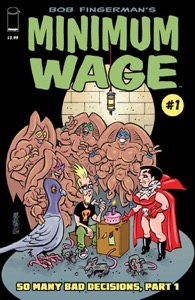
    Bob Fingerman and his alter ego, Rob Hoffman, return in Minimum Wage: So Many Bad Decisions and it’s a wonderful return.
    Fingerman throws Rob through some more hoops as things look up, down, and all around with his new girlfriend, but more importantly, it’s Rob’s birthday. No one remembers except his mother, of course. And even though Rob is getting a revised supporting cast–Fingerman forces a mentor on him–the issue feels very much Rob’s. Fingerman does a great job with the characters this issue, whether it’s the girlfriend, the mother, Rob’s friend who has a whole speech about crapping, but Rob gets the best moments. Fingerman takes the time for him.

    As usual, the art’s great. There’s a Richard Corben reference in the dialogue, which seems so appropriate given Fingerman looks like Corben through a Disney-grinder, and some great shading for tone.

    Great stuff. Glad it’s back.

  • Minimum Wage: So Many Bad Decisions #1Bob Fingerman and his alter ego, Rob Hoffman, return in Minimum Wage: So Many Bad Decisions and it’s a wonderful return.

    Fingerman throws Rob through some more hoops as things look up, down, and all around with his new girlfriend, but more importantly, it’s Rob’s birthday. No one remembers except his mother, of course. And even though Rob is getting a revised supporting cast–Fingerman forces a mentor on him–the issue feels very much Rob’s. Fingerman does a great job with the characters this issue, whether it’s the girlfriend, the mother, Rob’s friend who has a whole speech about crapping, but Rob gets the best moments. Fingerman takes the time for him.

    As usual, the art’s great. There’s a Richard Corben reference in the dialogue, which seems so appropriate given Fingerman looks like Corben through a Disney-grinder, and some great shading for tone.

    Great stuff. Glad it’s back.

    CREDITS

    Writer and artist, Bob Fingerman; publisher, Image Comics.

  • Nailbiter (2014) #12

    Nailbiter  12

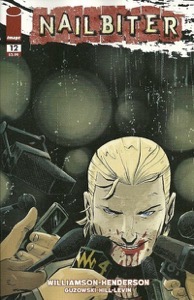
    It’s a fine issue of Nailbiter, though I’m not sure about Adam Markiewicz’s art. It’s not fluid enough–it’s in the same general style as Henderson, but it’s more static and somewhat bloated. Like Far Side bloated.

    Nailbiter is such a strange comic because of how Williamson paces it out. Someday he’s going to write some great television shows, I just hope it gets to be a series he creates; because Nailbiter’s problem is not enough space for all the subplots. There’s just not time in a twenty-four page story.

    Based on the “Three’s Company” reference in this issue–a perfectly beautiful one, as the titular Nailbiter becomes Chrissy to the lady sheriff (“She’s the Sheriff!”) and the rogue FBI agent–maybe it’d be a great thirty-minute drama.

    It’s not a great comic, but it’s a good one. Henderson just can’t make it belong in the medium.

  • Citizen Kane (1941, Orson Welles)

    In Citizen Kane, director Welles ties everything together–not just the story (he does wrap the narrative visually), but also how the filmmaking relates to the film’s content. Kane’s story can’t be told any other way. That precision–whether it’s in the summary sequences or in how scenes cut together–is absolutely necessary to not just keep the viewer engaged, but to keep them over-engaged. Even with the conclusion, where Welles reveals the film’s “solution” (quote unquote); it doesn’t resolve that mystery in a timely fashion–Welles drags it out to get the viewer thinking, questioning. Welles puts together this perfect film and then asks the viewer to wonder whether or not it was all worth it. Not just his making it, but the viewer’s watching it.

    The little moments in the film–Welles gets in these subtle things with melodramatic fireworks going off in the background, whether its Dorothy Comingore’s humanity or Everett Sloane’s wistfulness or “protagonist” William Alland’s frustration–remind the viewer the story’s still about people. And why shouldn’t it be? Most scenes in Kane feature two to three working characters. Sometimes Welles has people in the background, sometimes he doesn’t. The little moments in big scenes–like one between Joseph Cotten and Sloane during a party–are often more devastating than the little scenes.

    Welles unforgivingly asks a lot of the viewer. He opens the film with a complex fading sequence to bring the viewer into the world of Kane, then abruptly pulls the film out of itself, into a newsreel. And for almost twenty minutes, Welles barely gives himself any screen time. It’s always such a big deal that first time Welles lets Kane have an audible line in the newsreel.

    All that control isn’t to prime the viewer, isn’t to get him or her desperately wondering about Rosebud, all that control is because the film needs it. Kane spans forty-some years in under two hours. Far under two hours if you don’t count the newsreel “first act.” When Welles establishes his character as an older man, an atypical protagonist–Kane’s infinitely sympathetic while never likable, though Welles knows his charm goes a long way in lightening a heavy scene–he does so without hostility. Nowhere in Kane does Welles play for the audience, but he also doesn’t artificially distance them. The opening does, quite literally, guide the viewer into the film.

    Kane is an unsentimental film about a sentimental subject and Welles does wonders with that disconnect.

    Comingore probably gives the film’s best performance. Welles is amazing and mesmerizing, but so much of the second half has to do with how he plays off her, she’s essential. Of course, there aren’t any merely good performances–even Erskine Sanford, in the closest thing to a comedy relief role, is great. Ruth Warrick, Ray Collins, Paul Stewart, George Coulouris–all fantastic.

    And Joseph Cotten as the film’s “good guy?” He’s marvelous.

    Impeccable Gregg Toland photography, great Bernard Herrmann music.

    500 words aren’t enough.


  • Nailbiter #12It’s a fine issue of Nailbiter, though I’m not sure about Adam Markiewicz’s art. It’s not fluid enough–it’s in the same general style as Henderson, but it’s more static and somewhat bloated. Like Far Side bloated.

    Nailbiter is such a strange comic because of how Williamson paces it out. Someday he’s going to write some great television shows, I just hope it gets to be a series he creates; because Nailbiter’s problem is not enough space for all the subplots. There’s just not time in a twenty-four page story.

    Based on the “Three’s Company” reference in this issue–a perfectly beautiful one, as the titular Nailbiter becomes Chrissy to the lady sheriff (“She’s the Sheriff!”) and the rogue FBI agent–maybe it’d be a great thirty-minute drama.

    It’s not a great comic, but it’s a good one. Henderson just can’t make it belong in the medium.

    CREDITS

    Writer, Joshua Williamson; artists, Mike Henderson and Adam Markiewicz; colorist, Adam Guzowski; letterer, John J. Hill; editor, Rob Levin; publisher, Image Comics.