Mockingbird: My Feminist Agenda (2016)

Mockingbird my feminist

Mockingbird: My Feminist Agenda, the trade, contains five issues. Mockingbird: My Feminist Agenda, the storyline, is three issues. The last two issues are filler because the series got cancelled because comic book readers are awful. Before those last two issues is an afterword on the series from writer Chelsea Cain. Why would anyone want to read filler after finding out this wonderful comic is now gone. Especially since it’s nothing like Cain and artist Kate Niemczyk’s Mockingbird.

So what is Bobbi doing in My Feminist Agenda? Playing some Dungeons & Dragons, doing some light cosplay, taking a cruise, fretting over ex-husband Hawkeye’s murder trial. Oh, and she’s embroiled in a noirish mystery where she’s the detective and the beefcake spy partner Lance Hunter is Ursula Andrews. It’s awesome.

As usual, Cain paces it all out beautifully. The first issue isn’t just Bobbi getting on the boat, but it’s also the entirety of her purpose for getting on the boat. A mysterious Brony has information to help Clint Barton. There’s lots of intrigue, lots of humor, but also quite a bit of melancholy. Times are weighing heavy on Bobbi, regardless of her ludicrous setting or that Lance Hunter is onboard not as a super-spy, but because he’s at a Corgi convention. Not the toy cars, the adorable dogs.

That first issue gets a lot done, especially for readers coming in without any idea what’s going on with Hawkeye in the greater Marvel Universe. The absurd situation–Hawkeye kills the Hulk–gets positively melancholic by the end of the second issue. The rest of the second issue is a fairly serious, albeit with humorous asides, procedural. Bobbi is investigating a crime with onboard the ship of the cosplay damned. Oh, and there’s a Bermuda Triangle connection. Mostly for fun, though occasionally to let Cain get away with some stuff. Mockingbird is exceptionally precise. Niemczyk is carefully presenting all this information, which includes her own guest appearance as a convention goer and possible suspect.

Cain doesn’t draw any attention to it, it’s just fun detail. Turns out My Feminist Agenda is going to get a little heavier in the final issue of the story arc than Cain forecasted. It also stays fun, because the whole point of Mockingbird is Bobbi Morse’s awesome. Cain and Niemczyk are constantly making absurdities work out. No spoilers, but the tone changes from page to page in the last issue, with Bobbi juggling a lot while still fulfilling her duties as cruise ship detective. Mockingbird presents this fantastic protagonist, who’s sympathetic and relatable, but who’s also smarter than the reader and the story itself. Cain writes My Feminist Agenda, at least as far as how it works as a mystery, with Bobbi as a somewhat unreliable narrator. Some things the reader should be paying more attention about. Other things Cain’s keeping facedown to play later.

And it all wraps up beautifully. Equal parts sweet, spicy, and surreal. Then comes Cain’s afterword–her farewell to Mockingbird and she and Niemczyk’s Bobbi Morse. So thank goodness for the trades, because Cain and Niemczyk’s Mockingbird is one of those cancelled too soon superhero books to be mentioned in hushed reverence.
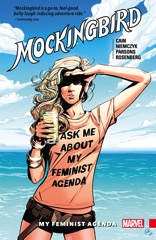
Mockingbird: My Feminist Agenda (2016)

Mockingbirdv2Mockingbird: My Feminist Agenda, the trade, contains five issues. Mockingbird: My Feminist Agenda, the storyline, is three issues. The last two issues are filler because the series got cancelled because comic book readers are awful. Before those last two issues is an afterword on the series from writer Chelsea Cain. Why would anyone want to read filler after finding out this wonderful comic is now gone. Especially since it’s nothing like Cain and artist Kate Niemczyk’s Mockingbird.

So what is Bobbi doing in My Feminist Agenda? Playing some Dungeons & Dragons, doing some light cosplay, taking a cruise, fretting over ex-husband Hawkeye’s murder trial. Oh, and she’s embroiled in a noirish mystery where she’s the detective and the beefcake spy partner Lance Hunter is Ursula Andrews. It’s awesome.

As usual, Cain paces it all out beautifully. The first issue isn’t just Bobbi getting on the boat, but it’s also the entirety of her purpose for getting on the boat. A mysterious Brony has information to help Clint Barton. There’s lots of intrigue, lots of humor, but also quite a bit of melancholy. Times are weighing heavy on Bobbi, regardless of her ludicrous setting or that Lance Hunter is onboard not as a super-spy, but because he’s at a Corgi convention. Not the toy cars, the adorable dogs.

Bobbi starts her getaway trip with Hawkeye on her mind. Or Lance just looks like a brunette Clint.
That first issue gets a lot done, especially for readers coming in without any idea what’s going on with Hawkeye in the greater Marvel Universe. The absurd situation–Hawkeye kills the Hulk–gets positively melancholic by the end of the second issue. The rest of the second issue is a fairly serious, albeit with humorous asides, procedural. Bobbi is investigating a crime with onboard the ship of the cosplay damned. Oh, and there’s a Bermuda Triangle connection. Mostly for fun, though occasionally to let Cain get away with some stuff. Mockingbird is exceptionally precise. Niemczyk is carefully presenting all this information, which includes her own guest appearance as a convention goer and possible suspect.

Cain doesn’t draw any attention to it, it’s just fun detail. Turns out My Feminist Agenda is going to get a little heavier in the final issue of the story arc than Cain forecasted. It also stays fun, because the whole point of Mockingbird is Bobbi Morse’s awesome. Cain and Niemczyk are constantly making absurdities work out. No spoilers, but the tone changes from page to page in the last issue, with Bobbi juggling a lot while still fulfilling her duties as cruise ship detective. Mockingbird presents this fantastic protagonist, who’s sympathetic and relatable, but who’s also smarter than the reader and the story itself. Cain writes My Feminist Agenda, at least as far as how it works as a mystery, with Bobbi as a somewhat unreliable narrator. Some things the reader should be paying more attention about. Other things Cain’s keeping facedown to play later.

Mockingbird and the New Avengers. And corgi-enthusiast Lance Hunter.
And it all wraps up beautifully. Equal parts sweet, spicy, and surreal. Then comes Cain’s afterword–her farewell to Mockingbird and she and Niemczyk’s Bobbi Morse. So thank goodness for the trades, because Cain and Niemczyk’s Mockingbird is one of those cancelled too soon superhero books to be mentioned in hushed reverence.

CREDITS

Writer, Chelsea Cain; penciller, Kate Niemczyk; inker, Sean P. Parsons; colorist, Rachelle Rosenberg; letterer, Joe Caramagna; editors, Christinia Harrington and Katie Kubert; publisher, Marvel Comics.

Cinema Purgatorio 9 (March 2017)

Cinema Purgatorio #9If Cinema Purgatorio were “shown” in a marathon, I think we’ve hit the point where even Alan Moore’s asleep. Garth Ennis too. But a couple of the backup guys are doing better. Sort of.

Anyway.

Purgatorio is about Thelma Todd’s death. Sadly Moore’s script for it is really boring. It’s like something didn’t work out. He thought it’d be more interesting but, instead, he’s just got occasional Batman visual cues because Todd’s lover made a movie called The Bat, which supposedly inspired Bob Kane (and, you know, Bill Finger) but whatever. So? I don’t think anyone ever doubted Kevin O’Neill could draw a giant bat.

It’s kind of fine, but in an unambitious sort of way. Moore might have peaked on Purgatorio.

So too might have Ennis. He’s got a lot of content for Code Pru but nothing he’s fixated on. It’s zombies. And not even Crossed, so it’s not even cute. Ew. Crossed and cute. But he’s just churning it out. I think there’s even a reference to the Code Pru “pilot” where she was a witch, which I don’t think he’s done before. Caceres’s art is fine. It’s not on him.

Now, I make that complaint and it usually means Ennis is going to do something really cool next issue. Fingers crossed.

More Perfect Union. Brooks doesn’t have his history text piece anymore, which is great, but his exposition is getting more verbose. Are they connected? I don’t care. It just means it’s a lot more maybe made up, maybe just for Civil War enthusiasts’ information. It’s noise. Really nice art from Andrade. He’s got good detail. It’s sort of impersonal, but the strip is also a parade of boring visual concepts.

And then Modded, which I hate having to enjoy, is once again pretty fun. Gillen’s writing characters. They’re obnoxious and thin, but with the personality from Lopez’s art, it doesn’t matter. There’s still way too much lingo and it feels like a dated post-apocalypse, so I don’t love it or anything, but I almost look forward to it. I don’t mind it, which is something; I used to loathe Modded.

And The Vast is The Vast. Great art from Andrade, little kaiju, big kaiju. Again, not personality but this time because it’s so poorly paced. Gage has somehow set up this comic one wants to like, but just can’t because it’s humorless. There’s nothing fun about it. Gage seems miserable and bored.

Cinema Purgatorio is getting to be a chore; I liked the book before Moore showed he could do awesome and amazing comics with it. I also miss liking Pru. She was really cool there for a while.

CREDITS

Cinema Purgatorio, Revelations of the Bat; writer, Alan Moore; artist, Kevin O’Neill. Code Pru, Night Without Dawn, Day Without End; writer, Garth Ennis; artist, Raulo Caceres. A More Perfect Union; writer, Max Brooks; artist, Gabriel Andrade. Modded; writer, Kieron Gillen; artist, Nahuel Lopez. The Vast; writer, Christos Gage; artist, Andrade. Letterer, Kurt Hathaway; publisher, Avatar Press.

Motor Crush (2016) #4

Motor crush  4

You know what happens to Motor Crush when Babs Tarr doesn’t get a lot to draw? It plods. This issue plods almost the entire way though, with Domino confronting her dad about her past and her dad storming off. She then pushes away the ex-girlfriend before robbing a rival gang of their speed drug. There’s a chase scene, but it’s complicated by Domino ripping off the drugs. The weak characterizations and scenes–and lack of Tarr dynamism–make this one a snoozer.

Motor Crush 4 (March 2017)

Motor Crush #4You know what happens to Motor Crush when Babs Tarr doesn’t get a lot to draw? It plods. This issue plods almost the entire way though, with Domino confronting her dad about her past and her dad storming off. She then pushes away the ex-girlfriend before robbing a rival gang of their speed drug. There’s a chase scene, but it’s complicated by Domino ripping off the drugs. The weak characterizations and scenes–and lack of Tarr dynamism–make this one a snoozer.

CREDITS

Writers, Brenden Fletcher and Cameron Stewart; artist, Babs Tarr; colorist, Heather Danforth; letterer, Aditya Bidikar; editor, Jeanine Schaefer; publisher, Image Comics.

Cinema Purgatorio 8 (February 2017)

Cinema Purgatorio #8It’s an okay issue, which–for Cinema Purgatorio–usually means there’s something lacking.

First, Alan Moore and Kevin O’Neill’s feature is the history of Felix the Cat “creator” Pat Sullivan, who was a scumbag both professionally and personally. O’Neill does a fine job on the art, but Moore’s script feels like he’s just hitting various details.

Garth Ennis has a similar problem with Code Pru. There’s a long setup involving ghosts for a full page visual gag payoff. Fine art from Raulo Caceres; there’s just no depth.

Gabriel Andrade takes over the art on More Perfect Union. He does all right, though he’s a little too fixated on human character design and not enough on giant ant action. Though the Max Brooks script doesn’t really offer any good giant ant action, just boring giant ant action.

And Modded is a lot less annoying than usual, maybe because Kieron Gillen’s script goes for brevity. Nahuel Lopez’s art is awesome.

Finally, The Vast. Boring, poorly paced, but with excellent art from Andrade. Very different from his Union art; he puts time into Vast. The other was a rush. The Christos Gage script is all right, I suppose, just disposable.

When Cinema Purgatorio doesn’t have a great Moore and O’Neill feature, the whole issue feels a little too rote.

CREDITS

Cinema Purgatorio, And the Blackness Moved; writer, Alan Moore; artist, Kevin O’Neill. Code Pru, Somethin’ Weird, an’ It Don’t Look Good; writer, Garth Ennis; artist, Raulo Caceres. A More Perfect Union; writer, Max Brooks; artist, Gabriel Andrade. Modded; writer, Kieron Gillen; artist, Nahuel Lopez. The Vast; writer, Christos Gage; artist, Andrade. Letterer, Kurt Hathaway; publisher, Avatar Press.

Motor Crush (2016) #3

Motor crush  3

Motor Crush is starting to lose me a little. Fletcher and Stewart aren’t doing a lot with the characters, instead focusing on the melodrama. It’s early, so if they do rebound with some character development and not just cliffhanger mysteries, the book can easily recover. Tarr’s art is strong, with some ambitious composition layouts too.

Motor Crush 3 (February 2017)

Motor Crush #3Motor Crush is starting to lose me a little. Fletcher and Stewart aren’t doing a lot with the characters, instead focusing on the melodrama. It’s early, so if they do rebound with some character development and not just cliffhanger mysteries, the book can easily recover. Tarr’s art is strong, with some ambitious composition layouts too.

CREDITS

Writers, Brenden Fletcher and Cameron Stewart; artist, Babs Tarr; colorist, Heather Danforth; letterer, Aditya Bidikar; editor, Jeanine Schaefer; publisher, Image Comics.

Motor Crush (2016) #2

Motor crush  2

This issue’s not as good as the first. It’s still good, with some great art from Tarr, but Fletcher and Stewart try a little too hard with all the mystery. There’s protagonist Domino’s hidden parentage, there’s her story with her ex-girlfriend (who returns this issue). The chase scenes in particular make up for any bumps, but it’s still unwieldy.

Motor Crush 2 (January 2017)

Motor Crush #2This issue’s not as good as the first. It’s still good, with some great art from Tarr, but Fletcher and Cameron try a little too hard with all the mystery. There’s protagonist Domino’s hidden parentage, there’s her story with her ex-girlfriend (who returns this issue). The chase scenes in particular make up for any bumps, but it’s still unwieldy.

CREDITS

Writers, Brenden Fletcher and Cameron Stewart; artist, Babs Tarr; letterer, Aditya Bidikar; editor, Jeanine Schaefer; publisher, Image Comics.