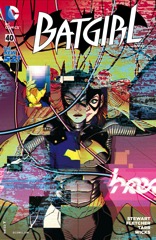
 This issue of Batgirl is a little weird. Stewart and Fletcher sort of do an adaptation of… Captain America 2. Satellite going to shoot people from space because they’re bad or might someday be bad. Big plot point in that movie. In the previews, I believe. Just a few years ago.
Yet, here it is in Batgirl. Not the most original suspense plot.
The rest of the comic–except the way Stewart and Fletcher refer back to Killing Joke–is pretty good. Stewart and Tarr’s art has a lot of energy, with Tarr’s details giving the comic a distinct style of its own, not quite Stewart, not quite not.
The epilogue sort of reestablishes Batgirl again, which is way too many times, but it’s a reasonable setup for whatever comes next. Barbara’s still not a character, Dinah’s still not a character, but the writers are getting there. Just too gradually.
CREDITS
Ghost in the Cowl; writers, Cameron Stewart and Brenden Fletcher; pencillers, Stewart and Babs Tarr; inker, Tarr; colorist, Maris Wicks; letterer, Jared K. Fletcher; editors, Dave Wielgosz and Chris Conroy; publisher, DC Comics.


 You know what happens to Motor Crush when Babs Tarr doesn’t get a lot to draw? It plods. This issue plods almost the entire way though, with Domino confronting her dad about her past and her dad storming off. She then pushes away the ex-girlfriend before robbing a rival gang of their speed drug. There’s a chase scene, but it’s complicated by Domino ripping off the drugs. The weak characterizations and scenes–and lack of Tarr dynamism–make this one a snoozer.

 Motor Crush is starting to lose me a little. Fletcher and Stewart aren’t doing a lot with the characters, instead focusing on the melodrama. It’s early, so if they do rebound with some character development and not just cliffhanger mysteries, the book can easily recover. Tarr’s art is strong, with some ambitious composition layouts too.


 Well. Motor Crush is absolutely awesome. It’s got a phenomenal pace, lots of action–Babs Tarr’s art is fantastic–and just the right amount of drama. Cameron Stewart and Brenden Fletcher actually do a whole three act story this issue, all while doing a first issue. It’s very cool, with a great cliffhanger. And the lead just gets more appealing the more time you spend with her.
 There’s a shocking amount of this comic book I don’t care about in the least. I’ve been tiring of Stewart and Fletcher’s somewhat incompetent Barbara, but at least they acknowledge her here. Sure, they make too many leaps of logic to get there, but they finally get to something.
 Something happens this issue of Batgirl. The gimmick starts to get a little old. Barbara using Batgirl to be popular on social media, Barbara going after a reality TV bad boy, Barbara dating a cop who thinks Batgirl is a menace. All of a sudden–and having Dinah point out all Barbara’s inconsistent behaviors doesn’t help–all of a sudden, Stewart and Fletcher seem like they’ve gone too far.