 Well, isn’t Batgirl and the Birds of Prey a bit of a surprise? It’s a Rebirth tie-in so there’s a lot of exposition setting up post-Crisis, post-New 52 Batgirl and Black Canary (and Huntress), but writers Julie Benson and Shawna Benson pace it pretty well. The Barbara Gordon narration is strong. There’s some awkward points–mostly in how it addresses the Killing Joke and the writers kind of swerve, which is okay because this comic is going for fun. It’s got this dark, noirish art from Claire Roe, but it’s a fun book.
I do wish it were twice as long. Black Canary doesn’t show up until the second half or so, doesn’t get her own origin recap, which makes it seem a little unbalanced (especially since Birds of Prey was Canary’s book originally). But she and Babs are great together. Their bickering is fun to see with Batgirl fighting alongside Canary.
And this Canary is still the punk rock New 52 brawler Black Canary, which is still kind of funny to me because it’s too much. They went too far with it, but they’re committed.
Huntress isn’t impressive so far. Huntress hasn’t been impressive since Earth–2, so there’s not much to be said about it. She’s kind of like “Ultimate” Huntress, but the writers do get her setup done fairly well. They’re quick about it. Maybe too quick because then the comic’s over in a few more pages and I really wanted more story. I’m excited to read more of this comic.
CREDITS
Rebirth; writers, Julie Benson and Shawna Benson; artist, Claire Roe; colorist, Allen Passalaqua; letterer, Steve Wands; editors, Dave Wielgosz and Chris Conroy; publisher, DC Comics.
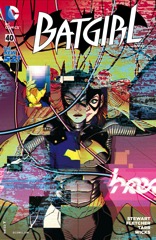 This issue of Batgirl is a little weird. Stewart and Fletcher sort of do an adaptation of… Captain America 2. Satellite going to shoot people from space because they’re bad or might someday be bad. Big plot point in that movie. In the previews, I believe. Just a few years ago.
 There’s a shocking amount of this comic book I don’t care about in the least. I’ve been tiring of Stewart and Fletcher’s somewhat incompetent Barbara, but at least they acknowledge her here. Sure, they make too many leaps of logic to get there, but they finally get to something.
 Something happens this issue of Batgirl. The gimmick starts to get a little old. Barbara using Batgirl to be popular on social media, Barbara going after a reality TV bad boy, Barbara dating a cop who thinks Batgirl is a menace. All of a sudden–and having Dinah point out all Barbara’s inconsistent behaviors doesn’t help–all of a sudden, Stewart and Fletcher seem like they’ve gone too far.
 There’s a somewhat pointless plot twist at the end of this issue. It’s sensational, when the writers haven’t actually set up a point for it. They aren’t asking profound questions or making profound statements, they’re actually just making fun of their villain.
 It’s another solid issue, with Babs stumbling onto a crime on campus. Stewart and Fletcher also introduce a few more supporting cast members–the issue ends with a sitcom-like tag with all of them, sans Dinah, who’s clearly a guest star. It gives Batgirl a nice feel, though the more impressive stuff comes just before.
 It's the all-new Batgirl, which is mostly just a “Veronica Mars” in college where Babs solves hip crimes–the supervillain this issue is hacking phones and putting the embarrassing private information online. Why? Because he's a bad guy. And he's got a cybernetic brain and can hold his own with Batgirl in a fight.
 This issue has a neat thread running through its three feature-length stories. The Huntress (from Earth-Two) comes to Earth-One for a visit. In the Batman story, she meets him and Robin. Then she teams up with Batgirl and Batwoman. For the finale, her going home sets off the events for Man-Bat and the Demon’s story.
