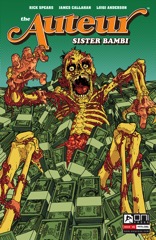
 I don’t know. I’m not sure what other response one should have to Sister Bambi’s conclusion, just because—well, first off, it has almost nothing to do with this series and instead serves to close off the entire Auteur franchise (unfortunately)—but because the comic is so strange.
Spears splits the (double-sized) issue between a script for what seems more like the final issue of Sister Bambi and regular comic story. The regular comic story has Rex battling it out with what seems to be his creator (only Spears only writes the book, so maybe it’s supposed to be Callahan). Is it a reflection on the state of the creator and the creation? Of the artist’s place in the twenty-first century? Or is it just Spears and Callahan being gross?
The comic works, to some degree, on all three levels, but never all the way. Even though Callahan puts a lot of work into the art, the story isn’t particularly engaging. Especially not when juxtaposed against Spears’s other script, which one can easily imagine visualized and it would be rather funny.
So, in the end, Sister Bambi’s conclusion seems to be a mercy killing, which is odd, because if readers made it through ten issues… they might want something better for Rex and company.
Spears and Callahan achieve irreverent and absurd; hopefully they weren’t going profound and sublime. Either way, it’s one heck of a way to end a comic.
CREDITS
None of Us Get Out of Here Alive; writer and letterer, Rick Spears; artist, James Callahan; colorist, Luigi Anderson; editor, Charlie Chu; publisher, Oni Press.
 I enjoyed this issue of Sister Bambi. The soft cliffhanger, especially considering the comic opens with a comedic bookend, is annoying but in a pointless kind of way. Spears is still chasing something with the series, even though once you bring in zombie triceratops, you’ve sort of given up.
 Well.
Well. Spears seems a lot more concerned with making this issue fun than anything else. The film crew gets to a jungle island and runs afoul of a giant gorilla, which the immortal serial killer brings to a graphic finish. It gives Callahan something to do because most of the rest of the issue is talking heads. Even when it’s the lead–whose name I still don’t remember–meeting with a dream plane script doctor, it’s talking heads.
 The Auteur is back and it’s a little different. The jokes are broader, it’s less actually offensive and more obviously offensive. Writer Rick Spears knows he’s got an audience now and he’s got some idea of what they want. Movie jokes. Lots of movie jokes. Like a Dracula’s Dog joke.
 I don’t know why Spears can get away with the end of The Auteur. I don’t want to think about it too hard either, just because the last issue of this arc (or the series, it’s unclear) is so entertaining and sincerely presented.
 What do you do when your last issue goes off the rails? Well, if you're Rick Spears and you're writing The Auteur you do something really odd.
 What just happened here? It’s like Spears put together two weak ideas–the very Hollywood one of how does his lunatic producer deal with an actress who won’t take off her top and then what happens if the producer’s serial killer sidekick actually kills someone. The result is a pointless, personality-free issue of The Auteur.
 I'm hesitant, but I'm pretty sure The Auteur is reprehensible. Gloriously so, of course, but just completely reprehensible. Spears sends his Hollywood producer to court to defend a serial killer–so the serial killer can consult on a horror movie, natch–and comes up with this great argument about how a serial killer represents a natural predator in the human ecosystem.
 After finishing the first issue, I haven’t got a clue where writer Rick Spears is going to take The Auteur, which is a good thing. It’s an absurdly violent story set in Hollywood, full of awful studio heads, drugged up producers, obnoxious directors and gurus doling out snake venom as cure-alls.