Ace in the Hole (1951, Billy Wilder)

Ace in the Hole moves while the script–from director Wilder, Lesser Samuels and Walter Newman–never races. In fact, it’s deliberate and methodical, maybe even redundant at times (especially in the first act). The redundant moments aren’t actually a problem since Kirk Douglas is in almost every scene of the film and, even when he doesn’t have the best scene, his performance is fantastic.

Douglas plays disgraced newspaperman trying to make it in a world of journalism students and publishers who believe in ethics and so on. Douglas believes in selling the most newspapers and getting paid for it. Most of the first act has Douglas spreading the gospel, which makes for great scenes.

The story then has Douglas happening across a tragic situation and exploiting it. All he has to do is convince a handful of people to do the wrong thing. And here’s where Hole’s eventual problems start showing up. Douglas has this perverted relationship with Jan Sterling; she’s married to Richard Benedict, who’s stuck in a hole and Douglas is turning it into a big story. Wilder and the other writers never really explore Douglas’s motivations (alcohol provides a fast answer) in that situation. Instead, Douglas gets a more traditional, epical arc. An overcooked one.

But that overcooked character arc is in a gorgeously made film. Wilder has excellent composition, whether for dialogue scenes or the big vista shots of New Mexico.

Douglas and Wilder, somewhat separately, make Hole worthwhile. It’s just got its problems.

Acme Novelty Library (1993) #1

Acme1

Wow, what an exceptionally depressing piece of work.

Ware has little Jimmy Corrigan stories and bigger ones. The bigger ones tend to be more affecting. There’s a Big Tex story in here too and it’s the closest thing to played for laughs Acme Novelty Library gets.

Having heard about it for years, but not read it, I did not know what to expect. I certainly wasn’t reading for this depressing story about a kid and his mother—abandoned by the father—who then grows up to be a recluse. What’s so affecting is the breaks Ware takes in Jimmy’s timeline.

At some point, he’s with a woman. We don’t get to see any of it. Then there’s the longer story where he grows up, losing his childhood and not even realizing it.

Ware’s artwork is precious, but he also retains a deep dreariness.

It’s great; it’s just a complete downer.

Dark Horse Presents 67 (November 1992)

dhp67.jpg
The issue opens with an idiotic story about an annoying character called Zoo-Lou. Hedden and McWeeney usually do great work. The art here’s excellent, but the writing is an absolute nightmare. Dark Horse really loves poking fun at themselves… and usually it comes out awful, like Zoo-Lou.

An Accidental Death comes to its conclusion here. No one does this kind of angst and suffering like Brubaker. Everything he does these days is a waste compared to what he could be doing. Brilliant work from Shanower too.

Duffy and Sakamoto have an awful story called Nestrobber. It’s just atrocious.

The Predator story is weird–it’s based on an Andrew Vachss story. Not bad, just too soon to tell.

Campbell’s got a funny Alec, then Russell closes with an Oscar Wilde adaptation. It’s a brilliant piece of work, but it really needs color to make the fairy tale element work.

CREDITS

Zoo-Lou vs. Editor; story, art and lettering by Rich Heddon and Tom McWeeney. An Accidental Death, Part Three; story by Ed Brubaker; art and lettering by Eric Shanower. Nestrobber, Money for Nothing; story by Jo Duffy; art and lettering by Maya Sakamoto. Predator, Race War, Part One; story by Andrew Vachss; adapted by Randy Stradley; pencils by Jordan Raskin; inks by John Beatty; lettering by Clem Robins. Alec, A Pub Far Away; pencils, inks and lettering by Eddie Campbell. The Selfish Giant; story by Oscar Wilde; adaptation, art and lettering by P. Craig Russell. Edited by Randy Stradley.

Dark Horse Presents 66 (September 1992)

dhp66.jpg
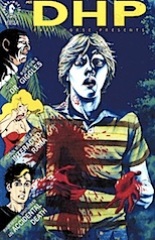
Obviously, the major attraction is the second chapter of An Accidental Death. The pace changes throughout; it opens with the body being hidden, then Brubaker moves to summary, then to scene again. The final scene–the discovery–comes after the two boys (the protagonist and the murderer) start to discover where they really live. Reality, in more ways than one, rushes in on them. But Brubaker’s writing is nuanced, never obvious. It’s just lovely.

Then Dr. Giggles, hopefully, finishes up. I don’t think I’ve mentioned how inept Coto is at plotting this narrative. The plot developments get stupider and stupider. At least it’s over.

The Concrete story is a little overwritten… lots of narration, but it’s amusing and Chadwick and Hotchkiss do a great job with the art.

The issue ends with two one page Alec comics from Campbell. Both are quiet, wonderful and somewhat profound. It’s such good work.

CREDITS

Concrete, Byrdland’s Secret; story and art by Paul Chadwick; lettering by Bill Spicer. Dr. Giggles, Part Three; story by Manny Coto; art by Alan J. Burrows; lettering by Willie Schubert. An Accidental Death, Part Two; story by Ed Brubaker; art and lettering by Eric Shanower. Alec, Genetic Defects and Overheard While I Was Supposed to be Working; story, art and lettering by Eddie Campbell. Edited by Randy Stradley.

Dark Horse Presents 65 (August 1992)

dhp65.jpg
An Accidental Death opens this issue. It’s been a while since I’ve read it. The most immediate thing is Shanower’s art. It’s finished and precise; I’m sure Dark Horse Presents has had artwork as good, I just can’t think of any example. But then there’s Brubaker’s writing–and the way he presents the moral ambiguity of being a teenager. He’s able to make the naive behavior create sympathy… then the danger arises. It’s great work.

The Dr. Giggles story has awful writing from Coto. He didn’t get any better between issues. Burrows has some really gross visuals here and they work. It’s just sad Dark Horse used Presents to hawk their crappy movie tie-in. Unfortunately, it’s not even the worst thing they published to this point.

Hedden and McSweeney contribute a story without dialogue or narration. The reader gets to cut and paste. The art’s fantastic, but it’s pointless.

CREDITS

An Accidental Death, Part One; story by Ed Brubaker; art and lettering by Eric Shanower. Dr. Giggles, Part Two; story by Manny Coto; art by Alan J. Burrows; lettering by Bill Spicer. Interact-O-Rama; pencils by Rich Hedden; inks by Tom McWeeney. Edited by Randy Stradley.