 Once again, Glass gets a whole lot done in one issue.
He opens with the captives, who have their own flashback–which relates to the story of Karic and Pilot (sort of). The captives get some closure, then it’s off to resolve the cliffhanger with Pilot under attack from a fellow Templar.
Here’s where the issue gets confusing. While Karic stands in for the reader when discovering things, there’s so much new information–new information he can’t understand–Glass often leaves the reader spinning around to try to make sense of things. Karic doesn’t spin because he’s just a kid, which actually makes the reader spin more as Karic’s somewhat to read.
But then Glass even has time to go back to the captives and introduce the capital city and its political intrigue into the issue. He even textures it with regular folk.
Finally, the doozy cliffhanger wallops both Karic and the reader.
A
CREDITS
The Prophecy, Part Five: Truth Behind the Lies; writers, Michael Avon Oeming and Bryan J.L. Glass; artist, Oeming; colorist, Wil Quintana; letterer, James H. Glass; editors, Judy Glass and Will Swyer; publisher, Image Comics.
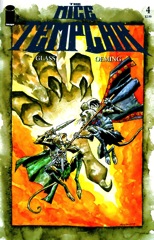 Trippy might be the best word for this issue. There’s a lengthy hallucination, mystical sequence as the finale, but Glass is constantly spinning the reader around before it. Actually, having a dream sequence is the most straightforward thing he does this issue. Everything before is much less so.
 This issue is a little busy. First, Glass showcases a rat battalion as they return home. They’re hunting. Nasty guys, these rats. It turns out some of the cast from the first issue has survived and are now prisoners of the rats, so Glass turns the focus to them for a while.
 There’s a lot of information in this issue. There’s a recap of the last issue and there’s a big history lesson of the Mice Templar world. That history lesson is rather confusing. Glass brings in a lot of names and ideas–the Oeming art is really good for these sequences. But it’s still a long history lesson.
 The Mice Templar is a heavy book. This first issue is double-sized, which is both good and bad. It’s good because Michael Avon Oeming and Bryan J.L. Glass are able to get the whole story done, but it’s bad because it’s too much at once. Glass has time to introduce the cast–maybe not make them all familiar to the reader, just because there are so many–and make the reader enjoying spending time with the cast.