
 It’s a short but not sweet zero issue for the second Mice Templar series, which picks up almost immediately where the first series ended.
Writer Bryan J.L. Glass has two stories going–one has the fallout from the actions of the good priest (not exactly priest, more like elder–but still called a priest) and then one with Karic, the series’s protagonist, on the run with his new protector, Cassius.
Glass doesn’t have a lot of room to do anything and he doesn’t try. He lets new artist Victor Santos show his chops in both talking mouse heads and then an action sequence too. It’s almost more interesting as a transitory piece than anything else. There’s nothing necessary in the issue, but it’s impossible to discount it too.
The look into the activities of the elders is reason enough not to disregard it. It’s more unexpectedly deep than the stuff with Karic.
B
CREDITS
The Sacrifice; writers, Michael Avon Oeming and Bryan J.L. Glass; artist, Victor Santos; colorist, Veronica Gandini; letterer, James H. Glass; editor, Judy Glass; publisher, Image Comics.

 I don't know where to start. I'm not sure about the epilogue. It's a very cute and nice epilogue, but Glass has just got done dragging the reader through a very rough opening action sequence and then an extremely taut issue. With Furious, Glass has always made sure to keep the series's reality very dangerous. So anything can happen.
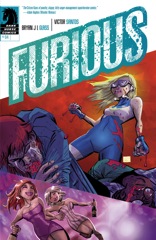 Glass brings in something I don’t think I realized the comic was missing–the Jim Gordon character. Some kind of person for Furious to have a conversation with about things, even if it’s brief.
 Glass doesn’t let up this issue. He makes things so intense, the previous issue’s cliffhanger is forgotten until this issue’s cliffhanger, which is similarly themed. The one problematic thing about Furious is how much Glass is hinging on the resolution to the Cadence Lark question.
 What a very strange comic book. It’s got a lot of humor; Glass writes some really funny details and rejoinders. Funny, funny guy. It’s got a lot of pop culture commentary. Glass makes some perfectly good observations about how celebrities get treated. It’s thought out too. He backs it up with good flashbacks. It’s got the Santos artwork. There are some problems I’ll mention later, but otherwise, very solid artwork. Santos handles motion beautifully and there’s a lot of motion in Furious.
 I obviously haven’t been getting enough Darwyn Cooke and Cameron Stewart lately because they were the first styles I thought of seeing Furious. It’s not like Victor Santos is particularly similar to either style–his figures are sharper against the backgrounds–but the tone is the same. It looks fun, but it’s serious.