Manifest Destiny 19 (May 2016)

Manifest destiny #19It’s good to have Manifest Destiny back, even if it’s a bit of a messy issue.

Two things are immediately different this issue–a story arc subtitle (Sasquatch) and a flashback to a previously troubled expedition into the wilds of North America. Dingess and Roberts do some solid juxtaposing between expeditions, but it’s strange to come back to the book and for Lewis and Clark to have so little to do.

Let’s not even get into Sacagawea’s utter lack of anything to do, once again. And the other female character has disappeared, because with the story arc subtitle, Dingess is all about setting up the eventual Sasquatch. Just like he once set up Sacagawea. It’d be hilarious if the Sasquatch has almost nothing to do.

Roberts, inked by Tony Akins and Stefano Gaudiano, does have some excellent visuals and the book’s pace is fine. It’s just a bit messy. Not opening with the regular cast might work fine in the eventual trade, but in a single issue, it doesn’t work. I even spent the first half of the comic wondering if Lewis and Clark had died off page since the last story arc, which doesn’t seem historically possible but there’s not a timeline to explain the comic opens in a flashback.

Maybe I just don’t care about Manifest Destiny doing a Sasquatch story line. Dingess does have a way of accelerating to a good place. Hopefully this arc is just warming up.

CREDITS

Sasquatch, Part One; writer, Chris Dingess; penciller, Matthew Roberts; inkers, Tony Akins and Stefano Gaudiano; colorist, Owen Gieni; letterer, Pat Brosseau; editors, Arielle Basich and Sean Mankiewicz; publisher, Image Comics.

Manifest Destiny (2013) #18

Manifest Destiny  18

Dingess takes Manifest Destiny somewhere new and unpleasant. Even though he’s dealt with the unpleasantness of the characters before, this issue–the last in the second “volume” of Destiny–forces the reader’s complicity in that unpleasantness. It’s well-done and should’ve been predictable (Roberts butchers the final page with an exclamation point) but isn’t really. The beginning of the issue’s distractingly strong.

One almost forgotten element of Destiny has been the imaginative wildlife Lewis and Clark find on their voyage. This issue reimagines the traditional vampire as some kind of decapitating, head-stealing flying monster. It’s a neat concept, not too gory in Roberts’s art but still striking. And it makes for a great action sequence.

The subsequent scenes in Destiny remind of Return of the Jedi as Lewis and Clark and company return to the bird people village; it’s why Dingess is able to get away with a big twist. He’s letting the reader enjoy the comic. It starts with a great action sequence, why not celebrate. It’s a trick and a good one.

But Dingess has raised a lot of questions in the comic (just not in this issue) and he doesn’t get any of them answered. They’re starting to get annoying. Otherwise though, it’s just about the best issue of Manifest Destiny yet.

Manifest Destiny 18 (October 2015)

Manifest Destiny #18Dingess takes Manifest Destiny somewhere new and unpleasant. Even though he’s dealt with the unpleasantness of the characters before, this issue–the last in the second “volume” of Destiny–forces the reader’s complicity in that unpleasantness. It’s well-done and should’ve been predictable (Roberts butchers the final page with an exclamation point) but isn’t really. The beginning of the issue’s distractingly strong.

One almost forgotten element of Destiny has been the imaginative wildlife Lewis and Clark find on their voyage. This issue reimagines the traditional vampire as some kind of decapitating, head-stealing flying monster. It’s a neat concept, not too gory in Roberts’s art but still striking. And it makes for a great action sequence.

The subsequent scenes in Destiny remind of Return of the Jedi as Lewis and Clark and company return to the bird people village; it’s why Dingess is able to get away with a big twist. He’s letting the reader enjoy the comic. It starts with a great action sequence, why not celebrate. It’s a trick and a good one.

But Dingess has raised a lot of questions in the comic (just not in this issue) and he doesn’t get any of them answered. They’re starting to get annoying. Otherwise though, it’s just about the best issue of Manifest Destiny yet.

CREDITS

Writer, Chris Dingess; penciller, Matthew Roberts; inkers, Stefano Gaudiano and Tony Akins; colorist, Owen Gieni; letterer, Pat Brosseau; editors, Arielle Basich and Sean Mackiewicz; publisher, Image Comics.

Manifest Destiny (2013) #17

Manifest Destiny  17

It’s almost as though Dingess is refusing to do a full story in the issue. The Sacagawea subplot, which takes up a scene–with flashback–is more complete than the main plot of the issue, with the landing party waiting to see if the blue bird person and one of the humans can make beat the monster. It’s a talking heads book, just with everyone talking about what the reader gets to see for him or herself when Dingess takes the action to the bird person and the human.

Manifest Destiny is not a story with a strong supporting cast. Dingess rarely deals with the supporting cast, which is enormous. And they aren’t particularly distinctive. Even though Roberts goes out of his way to make some visually distinctive… there are like five or six memorable people here, no more. So a talking heads book with random people talking.

The hard cliffhanger will undoubtedly get resolved quickly next issue and that issue will then have its own weak, hard cliffhanger. Dingess doesn’t let the reader enjoy the book, which is unfortunate. He’s too manipulative when he doesn’t need to be. It almost feels desperate that this point.

Manifest Destiny 17 (September 2015)

Manifest Destiny #17It’s almost as though Dingess is refusing to do a full story in the issue. The Sacagawea subplot, which takes up a scene–with flashback–is more complete than the main plot of the issue, with the landing party waiting to see if the blue bird person and one of the humans can make beat the monster. It’s a talking heads book, just with everyone talking about what the reader gets to see for him or herself when Dingess takes the action to the bird person and the human.
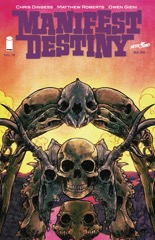
Manifest Destiny is not a story with a strong supporting cast. Dingess rarely deals with the supporting cast, which is enormous. And they aren’t particularly distinctive. Even though Roberts goes out of his way to make some visually distinctive… there are like five or six memorable people here, no more. So a talking heads book with random people talking.

The hard cliffhanger will undoubtedly get resolved quickly next issue and that issue will then have its own weak, hard cliffhanger. Dingess doesn’t let the reader enjoy the book, which is unfortunate. He’s too manipulative when he doesn’t need to be. It almost feels desperate that this point.

CREDITS

Writer, Chris Dingess; penciller, Matthew Roberts; inkers, Stefano Gaudiano and Tony Akins; colorist, Owen Gieni; letterer, Pat Brosseau; editor, Sean Mackiewicz; publisher, Image Comics.

Manifest Destiny (2013) #16

Manifest Destiny  16

Talk about not much of an issue… Dingess’s pacing never impresses on Manifest Destiny but I think he might have set a new record for himself.

The comic has five or six scenes–plus a flashback–and reads in just a few minutes. The most interesting part has to be the Sacagawea sequence, which has the flashback to her youth when she starts the warrior’s path (to fend off the white man), and just shows how wasted she’s been in the comic. It’s like Dingess has been saving her for something awesome from the second issue but it’s gotten to the point there’s no way there can be enough pay off.

Speaking of pay off, during the rest of the issue–which involves the blue bird people–Dingess hints the monsters might have come from another world to ours. Kind of boring, actually. The Americas being a mythic place of violent megafauna? Interesting. The Americas being invaded by monsters from another dimension? Cop out.

As always, it’s an amusing enough read and the art is spot on. Something about the content makes me not want to give up on Manifest Destiny having real potential but every issue convinces me I need to adjust my expectations.

Manifest Destiny 16 (August 2016)

Manifest Destiny #16Talk about not much of an issue… Dingess’s pacing never impresses on Manifest Destiny but I think he might have set a new record for himself.

The comic has five or six scenes–plus a flashback–and reads in just a few minutes. The most interesting part has to be the Sacagawea sequence, which has the flashback to her youth when she starts the warrior’s path (to fend off the white man), and just shows how wasted she’s been in the comic. It’s like Dingess has been saving her for something awesome from the second issue but it’s gotten to the point there’s no way there can be enough pay off.

Speaking of pay off, during the rest of the issue–which involves the blue bird people–Dingess hints the monsters might have come from another world to ours. Kind of boring, actually. The Americas being a mythic place of violent megafauna? Interesting. The Americas being invaded by monsters from another dimension? Cop out.

As always, it’s an amusing enough read and the art is spot on. Something about the content makes me not want to give up on Manifest Destiny having real potential but every issue convinces me I need to adjust my expectations.

CREDITS

Writer, Chris Dingess; penciller, Matthew Roberts; inkers, Stefano Gaudiano and Tony Akins; colorist, Owen Gieni; letterer, Pat Brosseau; editor, Sean Mackiewicz; publisher, Image Comics.

Dark Horse Presents (1986) #56

Dhp56

This oversized issue opens and closes with an Aliens two-parter. Loose art from Guinan and Akins doesn’t help Arcudi’s script. It’s absolutely incomprehensible if you don’t read the Aliens series.

Byrne finally produces a Next Men I’m not interested in. It’s two government guys revealing all. The art’s really, really mediocre. It’s like even Byrne doesn’t have any interest in this part of the story, which really makes one wonder why he’s bothering tell it.

Duffy and Geary both have nice stories. Duffy (with Chacon art) has an amusing fantasy story, Fancies about a tavern fight, while Geary does the history of Eldgytha. She was British royalty who had a lot of husbands. It’s fantastically concise and engaging work from Geary.

Sin City is crap, but not as mean-spirited as Earth Boys.

Arcudi and Eaglesham’s The Creep is good. It’s maybe the best thing I’ve read from Arcudi.

Dark Horse Presents 56 (November 1991)

35867.jpg
This oversized issue opens and closes with an Aliens two-parter. Loose art from Guinan and Akins doesn’t help Arcudi’s script. It’s absolutely incomprehensible if you don’t read the Aliens series.

Byrne finally produces a Next Men I’m not interested in. It’s two government guys revealing all. The art’s really, really mediocre. It’s like even Byrne doesn’t have any interest in this part of the story, which really makes one wonder why he’s bothering tell it.

Duffy and Geary both have nice stories. Duffy (with Chacon art) has an amusing fantasy story, Fancies about a tavern fight, while Geary does the history of Eldgytha. She was British royalty who had a lot of husbands. It’s fantastically concise and engaging work from Geary.

Sin City is crap, but not as mean-spirited as Earth Boys.

Arcudi and Eaglesham’s The Creep is good. It’s maybe the best thing I’ve read from Arcudi.

CREDITS

Aliens, The Alien; story by John Arcudi; pencils by Tony Akins; layouts and inks by Paul Guinan; lettering by Willie Schubert. The Next Men, Prelude; story, art and lettering by John Byrne. Fancies; story by Jo Duffy; art by Joven Chacon; lettering by Gaspar Saladino. The True Chronicle of Eldgytha; story, art and lettering by Rick Geary. Sin City, Episode Seven; story, art and lettering by Frank Miller. The Creep; story by John Arcudi; art by Dale Eaglesham; lettering by Pat Brosseau. Earth Boys, The Trouble with Kiib’Bllz; story by Cliff Biggers and Brett Brooks; art by Dave Johnson; lettering by Pat Brosseau. Edited by Randy Stradley.