Swamp Thing 120 (June 1992)

16090Bad news, good news. Eaton’s the regular penciller. In addition to Tefé’s undocumented nanny, Lady Jane, not having a nose, none of the other female characters seem to have much of one either. Certainly not enough to make their faces three dimensional.

Good news is Collins can write, which I already knew, but she choses to do so here. She tells Lady Jane’s origin story and she does it a lot better than the rest of the issue. It’s an unhappy story of early industrial age England, told from a woman’s perspective; it’s excellent.

The stuff with Alec being unsympathetic to Abby? Not excellent. Collins skips establishing Alec approving of Lady Jane as a nanny so his position on the matter makes no sense.

It’s only a few pages in the issue, but enough to show–juxtaposed against the Lady Jane origin–where Collins’s storytelling interests lie.

It’s mostly great.

CREDITS

Lady Jane; writer, Nancy A. Collins; penciller, Scot Eaton; inker, Kim DeMulder; colorist, Tatjana Wood; letterer, John Costanza; editor, Stuart Moore; publisher, DC Comics.

Swamp Thing (1985) #119

Swamp Thing  119

For the entire issue–which is incredibly fast paced as Alec and Abby try to find a kidnapped Tefé–Scot Eaton’s pencils are fine. There aren’t any amazing panels, but it all flows rather nicely. Until the final reveal, where Eaton goes entirely flat. It’s a full page too. It ends the issue poorly.

Otherwise, the issue’s pretty. Alec acting as a tracking dog for the cops is unlikely; I don’t believe he can’t sense Tefé’s location–can’t he talk to the trees or grass around her–but it’s dramatically successful. Collins hasn’t found a good balance for his power.

She also has a lot of exposition, which is again about the purple vengeance monster. It’s nothing she didn’t cover in the previous issue and now it’s just text to slow the reader. It doesn’t offer anything.

Collins tries to do too much this issue. She should’ve taken her time.

Swamp Thing 119 (May 1992)

16089For the entire issue–which is incredibly fast paced as Alec and Abby try to find a kidnapped Tefé–Scot Eaton’s pencils are fine. There aren’t any amazing panels, but it all flows rather nicely. Until the final reveal, where Eaton goes entirely flat. It’s a full page too. It ends the issue poorly.

Otherwise, the issue’s pretty. Alec acting as a tracking dog for the cops is unlikely; I don’t believe he can’t sense Tefé’s location–can’t he talk to the trees or grass around her–but it’s dramatically successful. Collins hasn’t found a good balance for his power.

She also has a lot of exposition, which is again about the purple vengeance monster. It’s nothing she didn’t cover in the previous issue and now it’s just text to slow the reader. It doesn’t offer anything.

Collins tries to do too much this issue. She should’ve taken her time.

CREDITS

The Bad Man; writer, Nancy A. Collins; penciller, Scot Eaton; inker, Kim DeMulder; colorist, Tatjana Wood; letterer, John Costanza; editor, Stuart Moore; publisher, DC Comics.
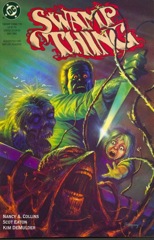
Swamp Thing 118 (April 1992)

16088A couple big things happen this issue. First is Collins’s handling of the Parliament of Trees. They haven’t been in the book since she came on and she handles them much differently than her predecessor. There’s practically a line of dialogue about it, about how things are going to be different from now on.

And much better. They’re not warriors or superheroes, but trees.

Then there’s the cat. Tefé kills her pet cat, which has always stuck with me. It kicks off a big arc–as I remember–but it’s a powerful scene. Collins hasn’t gotten into the big stuff with Swamp Thing yet; she’s kept Alec’s stories small. This one implies rather big things as Alec’s not able to rear Teré.

The purple revenge bog monster appears too, with Collins finally wrapping up that story arc (her first). Besides the monster’s (unnecessary) origin retelling, the issue is rather excellent.

CREDITS

A Child’s Garden; writer, Nancy A. Collins; penciller, Scot Eaton; inker, Kim DeMulder; colorist, Tatjana Wood; letterer, John Costanza; editor, Stuart Moore; publisher, DC Comics.

Swamp Thing 117 (March 1992)

16087It’s a strange issue and should be a better one. Alec, Abby, Chester and their friends go to New Orleans for Mardi Gras. Alec acting like a regular guy plays really well and the issue seems fun. Jan Duursema’s pencils are straightforward, handling the realistic, fantastical nature of the parades and costumes.

Then Alec goes off on his own little side story and all of a sudden it’s page after page of art. No story content, just panels of his journey through Mardi Gras. It’s pointless and lengthy, especially after Collins finishes the subplot.

Poor Abby doesn’t get a subplot except to look for Alec, which seems unfair. The group getting back together at the end is nice, but it doesn’t make up for the wasted time.

Collins introduces a great concept–Alec being able to pretend he’s a guy in a costume–but fails to do anything with it.

CREDITS

The Lord of Misrule; writer, Nancy A. Collins; penciller, Jan Duursema; inker, Kim DeMulder; colorist, Tatjana Wood; letterer, John Costanza; editor, Stuart Moore; publisher, DC Comics.

Swamp Thing 115 (January 1992)

16085This story eventually has a very familiar feel… ghosts in the swamp fighting. It’s unclear if Collins meant to pay homage to Wein and Wrightson. One hopes, because otherwise it just seems like a repeat episode.

There’s a really cute short at the end about the Cajun Santa, which cements the domestic feeling Collins has given Abby and Alec. It has some very nice art from Mandrake and DeMulder; their art on the main story’s good too, but it’s a lot more precious on the Santa story.

Collins brings in Constantine for an extended stretch this issue and gives he and Alec a long scene of squabbling. It’s amusing (if too domestic–Swamp Thing is practically a sitcom now) and contributes to the concern for kidnapped Abby and Tefé.

Once again, unfortunately, Collins relies on Alec’s limited omnipotence. He doesn’t know the obvious, just the essential for a neat finish.

CREDITS

Rum, Necromancy, & the Lash. Papa Noel. Writer, Nancy A. Collins; penciller, Tom Mandrake; inker, Kim DeMulder; colorist, Tatjana Wood; letterer, John Costanza; editor, Stuart Moore; publisher, DC Comics.

Swamp Thing 114 (December 1991)

16084Nice art from Tom Mandrake and Kim DeMulder on a weird issue. Collins introduces a bunch of demonic pirates–there are ties to Cthulhu-like gods, something not in the previous DC versions of Hell as far as I remember–who go after Swamp Thing and family.

Except they have no real reason to go after Abby and Tefé except a coincidence–one of Alec’s romantic gestures backfires–and Constantine shows up.

For a while, it seems like Collins is going to pace it more gradually. The pirates wreck havoc while Alec and Constantine catch up. It’s been a while since he’s been around and a lot has happened to both. But, no, not a talking heads book. It turns into an action comic.

Mandrake and DeMulder doing an action comic with ghost pirates is definitely cool; it’s stylish and fantastic. But cool’s not enough to disguise Collins’s pacing problems.

CREDITS

Pirate’s Alley; writer, Nancy A. Collins; penciller, Tom Mandrake; inker, Kim DeMulder; colorist, Tatjana Wood; letterer, John Costanza; editor, Stuart Moore; publisher, DC Comics.

Swamp Thing 113 (November 1991)

16083Collins goes for humor again. Not a little humor either, but full pun humor. It’s like “I Love Lucy” all of a sudden. Except bad people still get killed.

It’s a very strange mix of things. Collins is concentrating on making the characters fun to read–Abby and Chester trying to escape the press hounding them, Alec giving a press conference, Tefé being cute. It’s weird.

Meanwhile, besides the purple bayou monster, there’s not much going on. And the bayou monster’s only after bad people anyway so it’s not a threat. Collins foreshadows a neo-Nazi Republican gubernatorial candidate is plotting against Alec… but come on. He’s not a particularly threatening villain.

Yeates and Hendrix continue to be an awkward pairing on the art. It’s sort of bland.

Except Alec, he’s very detailed. Lots of moss.

It’s fun and well-produced, but some seriousness would be nice. It’s too lighthearted.

CREDITS

Fear and Loathing on the Bayou Trail; writer, Nancy A. Collins; penciller, Tom Yeates; inker, Shepherd Hendrix; colorist, Tatjana Wood; letterer, Albert DeGuzman; editor, Stuart Moore; publisher, DC Comics.

Swamp Thing 112 (October 1991)

16082Shepherd Hendrix is a very stranger inker (or finisher) for Tom Yeates’s pencils (or layouts). The art’s not bad at all, but Hendrix removes most of Yeates’s personality from the pencils. It’s an awkward amalgamation.

Collins continues her uptick, with Chester going through an emotional crisis and Alec (unknowingly) getting drawn into the Louisiana governor’s race. Collins’s approach to Louisiana’s peculiar. She seems to hate the people who live there. Lots of dumb white racist jokes. Not everyone’s a dumb white racist, but she gives a lot of attention to the ones who are such people.

Still, it shows she’s able to tell a joke even about something serious.

More uses of the word “elemental” in conversation–not to mention Chester referring to Alec as “Swampy”–continue to make Swamp Thing seem more domestic. Abby’s kitchen now even has a stove and refrigerator.

It’s good; Collins writes some great details.

CREDITS

All the Swamp King’s Men; writer, Nancy A. Collins; penciller, Tom Yeates; inker, Shepherd Hendrix; colorist, Tatjana Wood; letterer, Albert DeGuzman; editor, Stuart Moore; publisher, DC Comics.

Swamp Thing 111 (September 1991)

16081Collins shows off a lot this issue. She turns the comic into a domestic–it’s young parents Abby and Alec bantering about the baby. Unfortunately Collins dumbs down Abby–she’s just a mom now instead of a development of her previous self; still, Collins writes new Abby well.

But then the couple runs across a swamp ghost who tells them many scary, profound stories. Mandrake and DeMulder beautifully handle most of those stories. Shawn McManus does one of them, the big one. The McManus art isn’t his best and it lacks the activity of Mandrake and DeMulder.

Some of the page transitions are fantastic. An out of place panel showing a character having a realization about what someone else read in a previous panel. They’re intricate and seemingly natural to Collins’s pacing.

Swamp Thing has become exciting again. Collins, Mandrake and DeMulder have something going here. It’s quietly wonderful stuff.

CREDITS

Zydeco Ya-Ya; writer, Nancy A. Collins; pencillers, Tom Mandrake and Shawn McManus; inkers, Kim DeMulder and McManus; colorist, Tatjana Wood; letterer, John Costanza; editor, Stuart Moore; publisher, DC Comics.