Friday (2020) #1

Friday 2020

Friday is actually Friday #1. Or “Chapter One.” I went into it cold, only aware it was Ed Brubaker writing and Marcos Martin on art. I figured it was a done-in-one, but it’s actually the start of a new serial.

The titular Friday is one Friday Fitzhugh, who’s just come home from college to her New England town and found herself immediately in pursuit of some kid who’s run off with a sacred knife from an archeological dig.

The comic’s set in an indeterminate past, pre-cellphone, looks to be pre-laptop too. There’s not a lot of time to reflect on the seventies or eighties as quaint because it’s mostly action as Friday and her partner but he’s really the Batman to her Robin, Lancelot Jones, are in this pursuit. With the sheriff driving them. Sheriff answers to Lancelot.

There are lots of allusions to Friday and Lancelot’s “partnership” before college, though not as many as references to some cataclysmic rift in their relationship the night before she left for college. Did one of them get amorous and get shot down? Don’t know. Friday wants to talk about it, Lancelot instead ignores her and ditches her after picking her up—in the sheriff’s car—from her train to go on their mission.

There’s a lot of precedent for teen and tween boy detectives having tomboy female sidekicks (Encyclopedia Brown did, didn't he) and Brubaker seems to think there’s gristle in examining them after they’re able to buy cigarettes but….

Friday #1 ends with a postscript from Brubaker explaining its origins in the proto-YA novels of his childhood (mentioning Edward Gorey just makes you wonder how it’d read if Martin’s art were eerie in any way), which kind of constrains the whole thing and gives it some padding.

It may turn out to be worthwhile.

But a comic called Friday about a literal girl Friday (the reference just seems to target a forty-something, middle-class White male audience) and so far disinterested in examining its gender tropes by going all-on traditional? Eh.

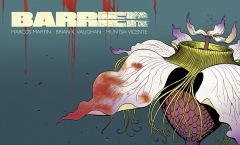
Barrier (2015) #5

B5

Barrier #5 finally translates Oscar’s dialogue. He and Liddy are both plugged into the aliens’ heads and, after Liddy’s flashback–revealing what had happened to her husband, though without dialogue–the aliens talk for a bit in Spanish then it’s Oscar’s flashback. With English dialogue.

Given how important not translating Oscar’s dialogue has been the entire series, it’s a little weird to see his tragedy unfold in English. Especially when it turns out Vaughan and Martin only hinted at the actual tragedy. Well, didn’t really hint. Lied. They lied about the tragedy. Unless you read the Spanish? It’s unclear.

There’s some good art. It’s not exactly good comic art. It’s good art though. I can’t even remember how the book read when the visual pacing was so good. None of its here, even though there’s a lot of art. There’s no opportunity for that kind of pacing anymore, not with the narrative.

Then comes the twist ending.

It’s an eye-roller. And makes the English translation even more of a cop-out.

Barrier #5 (July 2017 / May 2018)

Barrier #5Barrier #5 finally translates Oscar’s dialogue. He and Liddy are both plugged into the aliens’ heads and, after Liddy’s flashback–revealing what had happened to her husband, though without dialogue–the aliens talk for a bit in Spanish then it’s Oscar’s flashback. With English dialogue.

Given how important not translating Oscar’s dialogue has been the entire series, it’s a little weird to see his tragedy unfold in English. Especially when it turns out Vaughan and Martin only hinted at the actual tragedy. Well, didn’t really hint. Lied. They lied about the tragedy. Unless you read the Spanish? It’s unclear.

There’s some good art. It’s not exactly good comic art. It’s good art though. I can’t even remember how the book read when the visual pacing was so good. None of its here, even though there’s a lot of art. There’s no opportunity for that kind of pacing anymore, not with the narrative.

Then comes the twist ending.

It’s an eye-roller. And makes the English translation even more of a cop-out.

CREDITS

Writer, Brian K. Vaughan; artist, Marcos Martin; colorist, Muntsa Vicente; publisher, Panel Syndicate (2017) / Image Comics (2018).

Barrier (2015) #4

B4

They get to talk again. The aliens dump them in a different area of the ship where there are other aliens and those aliens are mean.

Barrier doesn’t refer to language barrier, does it?

The issue delves into Oscar’s back story, undoubtedly much more if you can read Spanish, but there’s still some discernible information if you don’t. His family’s in Los Angeles, so he’s going to Los Angeles. The people in his hometown make fun of him since he doesn’t speak any English.

Barrier indeed.

The Texas comes out in Liddy at just the right time–though she’s barefoot in this alien forest, I find it hard to believe the grass is all nice and soft and not tearing up her feet considering there are starfish monsters around.

It’s okay. It reads in about three minutes, which is fine when you’re a “pay what you want” e-comic and not a four dollar floppy.

Barrier (2015) #3

B3

The aliens speaking makes human ears bleed to the point of deafness. Blows the ear drums? So now Liddy and Oscar can’t talk to each other. They just have to communicate with body language and expression. Or Liddy just takes Oscar’s stuff because… she can?

There’s some “character development” like the revelation Liddy’s husband was (maybe) murdered. And we find out why Oscar wants his red notebook so bad. And the aliens don’t like fire. Maybe not personally, but their ship’s sprinkler system is all kinds of crazy.

So there’s no talking in the book, just visuals. There’s a little bit more of a visual tempo than last issue but nothing compared to the first. Martin’s alien ship designs aren’t very interesting. The ship’s empty. Martin does well with little details. The ship doesn’t have any.

Clearly the creators are invested–at least Martin anyway (he’s drawing a lot), it’s hard to imagine the script was longer than a couple pages unless Vaughan writes Moore style–but the result is fairly underwhelming. There have been far better “silent” comic books; it isn’t even ambitious.

Barrier (2015) #2

B2

So pretty much everything I liked in Barrier #1 is gone in Barrier #2. The issue opens at NORAD, with a couple officers talking in acronyms about how they’re not going to report a UFO even though they saw a UFO.

Close Encounters it ain’t.

Independence Day it ain’t even.

Vaughan thinks the acronym-heavy banter is enough to get through the scene. Can’t understand them, just like English readers can’t understand Oscar’s Spanish dialogue. The difference is Spanish is a real language and one assumes Vaughan is making up UFO acronym speak.

Then it’s back to the leads, who are now in space (or at least on an alien spaceship). They find each other, they fight, they bond, the aliens separate them. Yawn.

All of Martin’s visual pacing from the first issue is gone. There are War of the Worlds nods, Alien nods, probably other things, but it doesn’t make up for flow.

Oh, and it’s not Liddy’s daddy whose ranch she ranches, it’s her dead husband’s. Martin’s shockingly bad at drawing her face, by the way. He doesn’t have any depth to her features (most of the time). Same thing last issue but the visual pace made up for it.

No glorious visual pace here; nothing to make up for it.

Barrier #4 (March 2017 / May 2018)

Barrier #4They get to talk again. The aliens dump them in a different area of the ship where there are other aliens and those aliens are mean.

Barrier doesn’t refer to language barrier, does it?

The issue delves into Oscar’s back story, undoubtedly much more if you can read Spanish, but there’s still some discernible information if you don’t. His family’s in Los Angeles, so he’s going to Los Angeles. The people in his hometown make fun of him since he doesn’t speak any English.

Barrier indeed.

The Texas comes out in Liddy at just the right time–though she’s barefoot in this alien forest, I find it hard to believe the grass is all nice and soft and not tearing up her feet considering there are starfish monsters around.

It’s okay. It reads in about three minutes, which is fine when you’re a “pay what you want” e-comic and not a four dollar floppy.

CREDITS

Writer, Brian K. Vaughan; artist, Marcos Martin; colorist, Muntsa Vicente; publisher, Panel Syndicate (2016) / Image Comics (2018).

Barrier #3 (December 2016 / May 2018)

Barrier #3The aliens speaking makes human ears bleed to the point of deafness. Blows the ear drums? So now Liddy and Oscar can’t talk to each other. They just have to communicate with body language and expression. Or Liddy just takes Oscar’s stuff because… she can?

There’s some “character development” like the revelation Liddy’s husband was (maybe) murdered. And we find out why Oscar wants his red notebook so bad. And the aliens don’t like fire. Maybe not personally, but their ship’s sprinkler system is all kinds of crazy.

So there’s no talking in the book, just visuals. There’s a little bit more of a visual tempo than last issue but nothing compared to the first. Martin’s alien ship designs aren’t very interesting. The ship’s empty. Martin does well with little details. The ship doesn’t have any.

Clearly the creators are invested–at least Martin anyway (he’s drawing a lot), it’s hard to imagine the script was longer than a couple pages unless Vaughan writes Moore style–but the result is fairly underwhelming. There have been far better “silent” comic books; it isn’t even ambitious.

CREDITS

Writer, Brian K. Vaughan; artist, Marcos Martin; colorist, Muntsa Vicente; publisher, Panel Syndicate (2016) / Image Comics (2018).

Barrier #2 (September 2016 / May 2018)

Barrier #2So pretty much everything I liked in Barrier #1 is gone in Barrier #2. The issue opens at NORAD, with a couple officers talking in acronyms about how they’re not going to report a UFO even though they saw a UFO.

Close Encounters it ain’t.

Independence Day it ain’t even.

Vaughan thinks the acronym-heavy banter is enough to get through the scene. Can’t understand them, just like English readers can’t understand Oscar’s Spanish dialogue. The difference is Spanish is a real language and one assumes Vaughan is making up UFO acronym speak.

Then it’s back to the leads, who are now in space (or at least on an alien spaceship). They find each other, they fight, they bond, the aliens separate them. Yawn.

All of Martin’s visual pacing from the first issue is gone. There are War of the Worlds nods, Alien nods, probably other things, but it doesn’t make up for flow.

Oh, and it’s not Liddy’s daddy whose ranch she ranches, it’s her dead husband’s. Martin’s shockingly bad at drawing her face, by the way. He doesn’t have any depth to her features (most of the time). Same thing last issue but the visual pace made up for it.

No glorious visual pace here; nothing to make up for it.

CREDITS

Writer, Brian K. Vaughan; artist, Marcos Martin; colorist, Muntsa Vicente; publisher, Panel Syndicate (2016) / Image Comics (2018).

Barrier (2015) #1

B1

As a visual piece, Barrier #1 is all kinds of awesome. Marcos Martin’s pacing is sublime; the comic is “widescreen”–or landscape–with Martin sometimes using the whole page, sometimes filling it with as many panels as possible, sometimes splitting a single “shot” into panels. The visual reading experience is sublime.

The script? Eh.

Barrier is from late 2015. It’s creator-owned, originally digital. So far, politically-speaking, it dates poorly. Though, frankly, some of those questionable characterizations were always going to be questionable.

The first issue is an introduction to the main characters, Liddy and Oscar. Liddy is a Texan rancher, ranching her daddy’s place no doubt because tropes, and she’s having problems with a drug gang. She thinks. It’s unclear.

Oscar is from Honduras. He’s sneaking into the States, onto Liddy’s land eventually, and his entire story is in Spanish. No translation. Its success is–like the comic–a showcase for Martin’s art.

The stuff with Liddy getting drunk and maybe hiring an ex-military type to “deal with” her problem? Not so successful.

Of course, given how the issue ends, it’s entirely possible nothing this issue is going to matter.