 Hadrian’s Wall runs eight issues. Why did I think it was five issues? I might have even thought it was four at some point. Needless to say, there’s a lot more story coming in this issue. A lot more backstory too. The detective is in a prolonged state of withdrawal, which sort of changes the flashbacks–if they’re occurring to him as they occur to the reader–but not a lot. It’s a smooth issue. Gets the rebel pirates introduced, puts these characters in this place; it’s a positioning issue. Higgins and Siegel are rearranging the board. Good art from Reis as always, but there’s not a lot for him to do. The settings are visually boring, actually.
CREDITS
Writers, Kyle Higgins and Alec Siegel; artist, Rod Reis; letterer, Troy Peteri; editor, Matt Idelson; publisher, Image Comics.
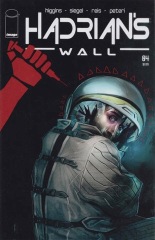 I have no idea what just happened. I mean, I do. Higgins and Siegel are straightforward writers, even when they’re doing flashbacks and big reveals in quick sequence. But it has a strange plot development for the first issue of the back three. And while there are flashbacks to Earth, all of a sudden Reis’s art feels more claustrophobic. As the stakes raise for the characters finally, it’s like the book’s visually closing in. It’s a good issue with some excellent work from Reis.

 Hadrian’s Wall just got somewhere very unexpected. It’s not clear if the writers are going to take the unexpected route or the familiar, but it’s an impressive narrative development. The issue’s methodical, which works, especially given the art. Reis has a great flow to the interrogation scenes.

 The issue’s a little drawn out as far as the script goes, but Reis’s art more than carries it along. And there’s some decent detective investigation exposition slash narration, with the detective recording his notes. But the soft cliffhanger’s weak. The writers take advantage of the medium.

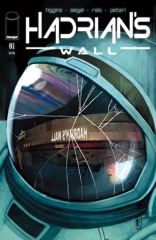 Hadrian’s Wall opens with a paragraph explaining the setting–it’s set in an alternate future because it has an alternate past (the U.S. and U.S.S.R. nuked each other in 1985 so the future’s different)–but then it’s just a traditional future cop sci-fi thing. And it’s pretty good at it too. Writers Kyle Higgins and Alec Siegel just have one major mystery for the cop to solve–who killed his ex-wife’s new husband? Who she initially had an affair with, who got him fired, who shot him four times.
 I guess C.O.W.L. is over. I really should be reading back matter, apparently, as I went through the issue with no idea it was wrapping up after just two arcs. Especially since the story’s weighted with an emphasis on the supporting cast and not the big plot. It seems like it’s a setup for whatever comes next.
 It’s an okay issue of C.O.W.L.. Higgins and Siegel are doing a bridging issue. Most of the issue is either one person being threatened or another person threatening and so on. There’s some nice art from Reis on it, but it all feels very by the numbers.