Nailbiter Returns (2020) #1

Nailbiter Returns 2020 1

I jumped shift halfway through the original Nailbiter series, so I think I missed the part about the serial killer antihero (the Nailbiter) having a daughter with the hero of the series. It’s been so long I can’t remember if the first series felt like a pitch for McFarlane Toys, but Nailbiter Returns feels it. Complete with play sets.

All of a sudden I’m reminded of that “Mentalist” quote, “If you don't get horny reading Fangoria, I'm Britney Spears.”

But Nailbiter Returns tries so hard not to just be an exploitation comic. And suffers for not just embracing it.

If it were just exploitation, writer Joshua Williamson could get away with the new lead—the Nailbiter’s teenage normal girl daughter—not being able to shut up about Argento movies and Goblin scores. After some serial killer torture violence—which is only disquieting because of how blandly the comic executes it—Williamson does some exposition to catch us up, but with a whole bunch of horror movie talk thrown in.

Scream has been old enough to drink for three years and we’re still at the Scream level of pop culture references.

Not to get into a whole thing about how pop culture references do and do not add to a narrative work but it’d almost be more interesting than talking about the comic.

Nailbiter Returns is almost middling. Williamson’s does a thorough job, albeit without any nuance. Mike Henderson’s art either feels rushed—lots of empty backgrounds, ill-defined character physiologies—or forced.

The double-sized first issue, which barely has any story and I think I’m remembering what helped me jump on the first series, doesn’t do anything to make me think jumping was the wrong choice.

Evolution (2017) #6

Evolution 6 18eea61b85

And after its best issue, Evolution returns to its regular level. A little rushed–or, more accurately, a little abrupt–and all setup for something coming in a future issue. Delayed realization.
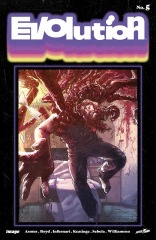
Once again, the art becomes the most important thing about the comic. Infurnari delivers, though it’s not a lot of interesting stuff. L.A. diners and New York hospitals are only so visually stimulating. The infected, evolved monsters are out of John Carpenter’s The Thing, which is fine–maybe they should’ve done a licensed title instead–but nothing new.

This issue has a big twist at the end involving the one doctor who knows what’s going on. He was previously the closest thing the comic had to a protagonist (unlike the other two plot lines, he gets two plots an issue–so maybe two writers too). It’s not a great twist. In fact, it’s one of those “do I still want to read this comic” twists.

Evolution #6 (April 2018)

Evolution #6And after its best issue, Evolution returns to its regular level. A little rushed–or, more accurately, a little abrupt–and all setup for something coming in a future issue. Delayed realization.

Once again, the art becomes the most important thing about the comic. Infurnari delivers, though it’s not a lot of interesting stuff. L.A. diners and New York hospitals are only so visually stimulating. The infected, evolved monsters are out of John Carpenter’s The Thing, which is fine–maybe they should’ve done a licensed title instead–but nothing new.

This issue has a big twist at the end involving the one doctor who knows what’s going on. He was previously the closest thing the comic had to a protagonist (unlike the other two plot lines, he gets two plots an issue–so maybe two writers too). It’s not a great twist. In fact, it’s one of those “do I still want to read this comic” twists.

CREDITS

Writers, James Asmus, Joseph Keatinge, Christopher Sebela, and Joshua Williamson; artist, Joe Infurnari; colorist, Jordan Boyd; letterer, Pat Brosseau; editors, Arielle Basich and Jon Moisan; publisher, Image Comics.

Evolution (2017) #5

Evolution 5 6d2f0c9234

Evolution just passed an interesting landmark—the comic is no longer reliant on the art. First and foremost, it’s been an interesting looking book—until now. This issue has the best writing so far in the comic, on each of the separate plot lines. The characters have finally been around long enough to be compelling.

Which means I hope the comic doesn’t get too ambitious with series length. After five issues, the gaggle of writers have got the book into a great spot. They’re not going to be able to keep it there forever.

It’s a fantastically plotted issue. The development work in each plot is outstanding, the art is good, the dialogue is fine. The series is paying off. Of course, it would’ve been nice if that success weren’t so surprising to me. The writers really pull off a good issue here.

Evolution #5 (March 2018)

Evolution #5Evolution just passed an interesting landmark—the comic is no longer reliant on the art. First and foremost, it’s been an interesting looking book—until now. This issue has the best writing so far in the comic, on each of the separate plot lines. The characters have finally been around long enough to be compelling.

Which means I hope the comic doesn’t get too ambitious with series length. After five issues, the gaggle of writers have got the book into a great spot. They’re not going to be able to keep it there forever.

It’s a fantastically plotted issue. The development work in each plot is outstanding, the art is good, the dialogue is fine. The series is paying off. Of course, it would’ve been nice if that success weren’t so surprising to me. The writers really pull off a good issue here.

CREDITS

Writers, James Asmus, Joseph Keatinge, Christopher Sebela, and Joshua Williamson; artist, Joe Infurnari; colorist, Jordan Boyd; letterer, Pat Brosseau; editors, Arielle Basich and Jon Moisan; publisher, Image Comics.

Deathbed (2018) #2

Db2

Deathbed still has pacing issues. Williamson does a lot better without exposition on the girl. The first issue pretended she was the protagonist. This issue reveals she’s the sidekick. She’s a good sidekick, but just the sidekick.

And it’s not even because the lead guy–Luna (the aged but still virile adventurer–seriously, how long has it been since Tom Strong established the old man adventurer in comics); anyway, its not because the lead guy gets more to do. He obviously does, because there’s a big fight at a funeral. Artist Rossmo’s comedy chops exceed his action. The action is good. A little busy but good. The comedy is great.

The comedy art will need to be great because Deathbed isn’t just about Luna and his biographer having adventures. It’s about Luna growing as a person. Williamson writes Luna the grower better than Luna the shower. Oh, sorry, I must still be thinking about how fixated Deathbed is at showing Luna nude. It might be funny if the biographer cared but she doesn’t. Instead it’s weird. Is it a machismo thing?

Anyway. Much improved second issue.

It does still read too fast.

Deathbed #2 (May 2018)

Deathbed #2Deathbed still has pacing issues. Williamson does a lot better without exposition on the girl. The first issue pretended she was the protagonist. This issue reveals she’s the sidekick. She’s a good sidekick, but just the sidekick.

And it’s not even because the lead guy–Luna (the aged but still virile adventurer–seriously, how long has it been since Tom Strong established the old man adventurer in comics); anyway, its not because the lead guy gets more to do. He obviously does, because there’s a big fight at a funeral. Artist Rossmo’s comedy chops exceed his action. The action is good. A little busy but good. The comedy is great.

The comedy art will need to be great because Deathbed isn’t just about Luna and his biographer having adventures. It’s about Luna growing as a person. Williamson writes Luna the grower better than Luna the shower. Oh, sorry, I must still be thinking about how fixated Deathbed is at showing Luna nude. It might be funny if the biographer cared but she doesn’t. Instead it’s weird. Is it a machismo thing?

Anyway. Much improved second issue.

It does still read too fast.

CREDITS

Writer, Joshua Williamson; artist, Riley Rossmo; colorist, Ivan Plascencia; letterer, Deron Bennett; editor, Amedeo Turturro; publisher, Vertigo.

Deathbed (2018) #1

Db1

I’ve been reading indie books so long I forgot what Vertigo pacing feels like. Besides the pacing, Deathbed actually doesn’t feel too much like a “Vertigo book.” Sure, the witty, buxom female protagonist feels like a Vertigo book–oh, no, am I going to regret saying it didn’t feel like a Vertigo book–but the subject of the book doesn’t feel like a Vertigo “hero.”

Deathbed is about a failing writer who agrees to ghostwrite the autobiography of some guy she’s never heard of. But he’s rich. And it turns out he’s a monster hunter. It’s never clear whether or not the protagonist–Val–is aware there are monsters. It’s a problem, but writer Joshua Williamson skips over it. He’s got the issue to finish.

It’s going to be six issues, which is probably fine. Nothing much happens here–not in terms of establishing the protagonist (though it’s entirely possible she’s not going to get any more character than she’s got at the end of issue one)–except there’s eventually mummies attacking a naked old (but astoundingly fit) guy and him killing them all.

It’s not a spoiler. It’s kind of the point of the book. He’s on his final quest–rid the world of bad guys until one of them kills him. Val, ghostwriter, will be there to watch.

Riley Rossmo’s art is all right, but the book’s so rushed there’s not a lot of time to appreciate it. There’s a strange reliance on double page spreads, which just hurry things along even more.

Deathbed needs to slow down.

Deathbed #1 (April 2018)

Deathbed #1I’ve been reading indie books so long I forgot what Vertigo pacing feels like. Besides the pacing, Deathbed actually doesn’t feel too much like a “Vertigo book.” Sure, the witty, buxom female protagonist feels like a Vertigo book–oh, no, am I going to regret saying it didn’t feel like a Vertigo book–but the subject of the book doesn’t feel like a Vertigo “hero.”

Deathbed is about a failing writer who agrees to ghostwrite the autobiography of some guy she’s never heard of. But he’s rich. And it turns out he’s a monster hunter. It’s never clear whether or not the protagonist–Val–is aware there are monsters. It’s a problem, but writer Joshua Williamson skips over it. He’s got the issue to finish.

It’s going to be six issues, which is probably fine. Nothing much happens here–not in terms of establishing the protagonist (though it’s entirely possible she’s not going to get any more character than she’s got at the end of issue one)–except there’s eventually mummies attacking a naked old (but astoundingly fit) guy and him killing them all.

It’s not a spoiler. It’s kind of the point of the book. He’s on his final quest–rid the world of bad guys until one of them kills him. Val, ghostwriter, will be there to watch.

Riley Rossmo’s art is all right, but the book’s so rushed there’s not a lot of time to appreciate it. There’s a strange reliance on double page spreads, which just hurry things along even more.

Deathbed needs to slow down.

CREDITS

Writer, Joshua Williamson; artist, Riley Rossmo; colorist, Ivan Plascencia; letterer, Deron Bennett; editor, Amedeo Turturro; publisher, Vertigo.

Evolution (2017) #4

Evolution 4 42711c6167

Evolution #4 shows off the possiblities of the format–multi-writer, one artist. Each writer has a subplot they do, while artist Infurnari gets to draw the gross.

People are evolving only into monsters and there’s some Cthulhu-ish undertones of course. Because there are always Cthulhu-ish undertones.

The comic opens with a talking heads scene between Claire, who’s the protagonist of one of the subplots (and writer’s contributions), and her mysterious benefactor. I think she just saw this guy kill a monster a couple issues ago. Now he’s doing a backstory exposition dump and giving her a check. Infurnari gets the mood just right. It’s creepy but maybe not dangerous. But maybe dangerous.

Then it’s off to Rome to check in on the nun-on-the-run. She’s just seen the Church cover up some of the monsters. Her story is the most sympathetic, if only because Claire (who’s in L.A.) doesn’t realize the danger around her. The nun gets it. She goes off to see a priest who’s left the church (maybe he’s left, it’s unclear). And then there’s her backstory exposition dump.

The only story with an exposition dump is the scientist. He’s already had his backstory reveal. Now he’s just ranting to himself about how he’s going to stop the evolution and the monsters. His subplot is Evolution’s weak link. It makes sense–in that disaster movie sort of way, you need someone to do exposition dumps as things happen–but he’s an unlikable character. You can be working to save the world and be unlikable, apparently.

Evolution’s gross–Infurnari does blood, guts, and tendons enthusiastically; he also does general creepiness well–but almost a pleasant reading experience. None of the writers try too hard. It’s a methodical, “anthology” horror comic. The writers embrace the constraints to decent result.