
This issue of Platoon is Ennis looking at the quiet time for Frank Castle and his unit. Most of the issue has to do with Frank trying to get better rifles for his men. There’s some stuff with the Viet Cong, there’s the framing sequences, but really, it’s just an issue about Frank trying to get better rifles for his men. It’s very, very strange.
The comic itself is phenomenal. Ennis’s dialogue, his narration, the plotting, it’s all great. Parlov’s art’s great, but playing more for… humor. There’s some absurdity of war stuff going on and Ennis tries to find the humanity in the characters’ reactions to it. He also nicely echoes sentiments from the past to the future with the modern day framing stuff. It feels very whole.
But it’s strange. It’s not really a bridging issue, not unless everything hinges on Frank going to the black market for better rifles. It seems like an aside. A texture issue in a limited series. Does Ennis have time to do it?
Of course he does. Because it’s Ennis and Punisher. He never lets Frank down.
 This issue of Platoon is Ennis looking at the quiet time for Frank Castle and his unit. Most of the issue has to do with Frank trying to get better rifles for his men. There’s some stuff with the Viet Cong, there’s the framing sequences, but really, it’s just an issue about Frank trying to get better rifles for his men. It’s very, very strange.
 I think three times this issue there are full page panels with the credit “Ennis/Parlov.” I’m not sure if they’ve got their first names on it. They’re heavy panels. Ennis is doing a Vietnam story. He’s got the vets, he’s got the author, he’s got Frank. The vets get most of the time, whether telling the author their story or just in flashback. The author opens it, introduces some details and some unexpected reality (a former Viet Cong officer being a happy old man visiting the U.S. frequently).
 Punisher: The Platoon is Garth Ennis doing a Vietnam war comic with Frank Castle. Young Frank Castle. Green Frank Castle. An author has tracked down Castle’s first platoon to interview them for a book; the author is never seen. Is it Ennis? Peter Parker? Maybe we’ll find out by issue six.
 You know, I hate Mark Millar. I hate how he was able to goof around with Starlight–not just drag out the series, but be really late on the last issue–and how he’s still able to deliver exactly what he needs to deliver on this finale.
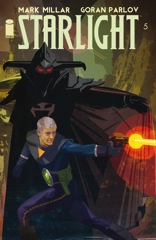 I didn’t realize Starlight was a limited series. I guess it makes sense, given the creative team, but Millar sure didn’t pace it well for a finite run. Subplots would have been cool. I just thought he was padding it out.
 I don't know if Starlight is exactly deceptive, but Millar does make you forget he's up to his old content tricks. There's just enough humor, character revelations (I was going to say development, but not really) and nods to the Flash Gordon roots of the project to move things along. Not to mention the Parlov art. There's some phenomenal Parlov art this issue.
 For the third issue of Starlight, things are coming together. Well, not so much things, but Millar’s writing. He’s pacing out the narrative a lot better. There are probably six or seven scenes this issue and they’re mostly good scenes. The cliffhanger is a little abrupt and he spends too much time with the lame villain, but the stuff with Duke is all pretty great.