 Well, Dusk’s personal story arc for this series sure doesn’t go anywhere expected. Maybe it’s because McGregor didn’t set him up for enough development or maybe it’s because almost a fourth of the double-sized issue is wasted on a poorly paced resolution to last issue’s cliffhanger.
The issue has good art, even during that lengthy opening, but it’s just a bunch of action scenes strung together. The final one, involving Dusk playing Indiana Jones doesn’t even feel like the same comic. McGregor’s rushing to get in all his period detail and not worried enough about the story itself.
There are no supporting characters in this final issue. No one who’s appeared before makes any impression, not on the plot, not on the protagonist. If it weren’t for McGregor’s competence and the still good art from Colan, things would have been a lot worse.
It’s a shame Dusk’s finale disappoints.
B-
CREDITS
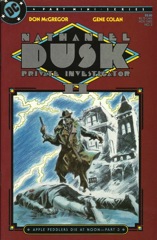
Apple Peddlers Die at Noon, Part Four; writer and editor, Don McGregor; artist, Gene Colan; colorist, Tom Zuiko; letterer, John Costanza; publisher, DC Comics.
 McGregor gets to a lot of revelations this issue. Well, more like two. But they’re big ones. One involves the case, one involves Dusk’s involvement with his dead girlfriend’s kids. The case one is particularly interesting because McGregor does it without much emotion. McGregor isn’t unenthusiastic, he’s just measured–both for the comic (it’s not the big reveal) and for the character. This type of thing isn’t something to get Dusk emotional. He’s disconnected from it.
 The second issue has a lot of action. The issues are double-sized and McGregor plots them quite well. There are three, maybe four, big action sequences in this one, along with a bunch of scenes involving the case itself, but there’s still time for the character work. McGregor always makes sure to work some of it into the investigation-related scenes too.
 For Nathaniel Dusk II, Gene Colan’s pencils go without inks. However, they go with Tom Ziuko’s colors. Ziuko’s a familiar name as a colorist but I was still a little surprised with his work here. He takes Colan’s pencils and turns them into a painted comic. The colors are muted, but still lush. There are some fabulous skies in this one and Colan probably only contributed the cloud outlines.
 Dusk is a good comic and all and McGregor does good with it and all but I’m shocked he could pull this issue off.
 How do you have a private eye comic without a mystery? This issue of Dusk is the perfect example of such a thing. Now, Chandler didn’t always have the most intricately laid mysteries–the investigation mattered. And McGregor has gotten to that point in this mystery. The investigation is the thing. Only, it’s not particularly compelling.
 It’s a fast issue, which is strange given there’s so much exposition. McGregor really gets into the private eye running monologue thing. It could go either way–and he does get long-winded during the action sequences (Colan’s pencils can handle them on their own)–but it works out by the end. McGregor writes Dusk really, really well and gives him a number of things to deal with.
 There are no inks on Gene Colan’s pencils in Nathaniel Dusk. It’s pencils and color. To. Ziuko uses really bright colors too, often it’ll just be a single color across objects. Colan’s not too concerned about universal detail.