
Dingess takes Manifest Destiny somewhere new and unpleasant. Even though he’s dealt with the unpleasantness of the characters before, this issue–the last in the second “volume” of Destiny–forces the reader’s complicity in that unpleasantness. It’s well-done and should’ve been predictable (Roberts butchers the final page with an exclamation point) but isn’t really. The beginning of the issue’s distractingly strong.
One almost forgotten element of Destiny has been the imaginative wildlife Lewis and Clark find on their voyage. This issue reimagines the traditional vampire as some kind of decapitating, head-stealing flying monster. It’s a neat concept, not too gory in Roberts’s art but still striking. And it makes for a great action sequence.
The subsequent scenes in Destiny remind of Return of the Jedi as Lewis and Clark and company return to the bird people village; it’s why Dingess is able to get away with a big twist. He’s letting the reader enjoy the comic. It starts with a great action sequence, why not celebrate. It’s a trick and a good one.
But Dingess has raised a lot of questions in the comic (just not in this issue) and he doesn’t get any of them answered. They’re starting to get annoying. Otherwise though, it’s just about the best issue of Manifest Destiny yet.
 Dingess takes Manifest Destiny somewhere new and unpleasant. Even though he’s dealt with the unpleasantness of the characters before, this issue–the last in the second “volume” of Destiny–forces the reader’s complicity in that unpleasantness. It’s well-done and should’ve been predictable (Roberts butchers the final page with an exclamation point) but isn’t really. The beginning of the issue’s distractingly strong.
 It’s almost as though Dingess is refusing to do a full story in the issue. The Sacagawea subplot, which takes up a scene–with flashback–is more complete than the main plot of the issue, with the landing party waiting to see if the blue bird person and one of the humans can make beat the monster. It’s a talking heads book, just with everyone talking about what the reader gets to see for him or herself when Dingess takes the action to the bird person and the human.
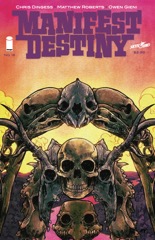 Talk about not much of an issue… Dingess’s pacing never impresses on Manifest Destiny but I think he might have set a new record for himself.
 I figured out what’s wrong with Dingess’s writing. He can’t do the scenes. It’s like he’s got an amazing outline–he can do the plot, he can do the dialogue, he can even do the narration (most of it)–but he can’t do actual scenes. Or maybe it’s a strange disconnect between how Dingess writes and how Roberts composes the scenes.
 It’s another too fast issue of Manifest Destiny. Or maybe it’s just how Dingess uses the cliffhanger. He’s actually doing character development, both in scene and through the journal narration device, but it doesn’t get to go anywhere because the last few pages are all setting up the cliffhanger.