
Famously (or infamously), the Batman Incorporated: Leviathan Strikes special burned off the remaining Inc. issues from before the “New 52.” It’s less a cohesive big issue than just two issues packaged as one, which isn’t necessarily a bad thing.
Actually, the big reveal in the second story–Leviathan’s identity–isn’t a bad reveal. Morrison even jokes at the obviousness of it all; he just did a good job distracting with all his busy work. He keeps up that busy work for the second story and, though Burnham’s art is excellent, the payoff’s lackluster.
The first story, with Cameron Stewart art, which involves Stephanie Brown going undercover at a girl’s school of assassins is a lot of fun. Stewart’s art is slick and Morrison’s script is fun. He writes Stephanie better than anyone else in Inc., except maybe Selina.
Instead of writing the best story, Morrison’s too concentrated on seeming smart.
CREDITS
Chapter 1: The School of Night; writer, Grant Morrison; artist, Cameron Stewart. Chapter 2: Leviathan Strikes!; writer, Morrison; artist, Chris Burnham. Colorist, Nathan Fairbairn; letterer, Sal Cipriano; editors, Katie Kubert, Rickey Purdin and Mike Marts; publisher, DC Comics.


 Well. Motor Crush is absolutely awesome. It’s got a phenomenal pace, lots of action–Babs Tarr’s art is fantastic–and just the right amount of drama. Cameron Stewart and Brenden Fletcher actually do a whole three act story this issue, all while doing a first issue. It’s very cool, with a great cliffhanger. And the lead just gets more appealing the more time you spend with her.
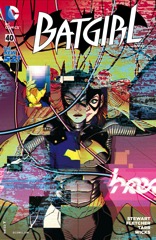 This issue of Batgirl is a little weird. Stewart and Fletcher sort of do an adaptation of… Captain America 2. Satellite going to shoot people from space because they’re bad or might someday be bad. Big plot point in that movie. In the previews, I believe. Just a few years ago.
 There’s a shocking amount of this comic book I don’t care about in the least. I’ve been tiring of Stewart and Fletcher’s somewhat incompetent Barbara, but at least they acknowledge her here. Sure, they make too many leaps of logic to get there, but they finally get to something.
 Something happens this issue of Batgirl. The gimmick starts to get a little old. Barbara using Batgirl to be popular on social media, Barbara going after a reality TV bad boy, Barbara dating a cop who thinks Batgirl is a menace. All of a sudden–and having Dinah point out all Barbara’s inconsistent behaviors doesn’t help–all of a sudden, Stewart and Fletcher seem like they’ve gone too far.
 There’s a somewhat pointless plot twist at the end of this issue. It’s sensational, when the writers haven’t actually set up a point for it. They aren’t asking profound questions or making profound statements, they’re actually just making fun of their villain.
 It’s another solid issue, with Babs stumbling onto a crime on campus. Stewart and Fletcher also introduce a few more supporting cast members–the issue ends with a sitcom-like tag with all of them, sans Dinah, who’s clearly a guest star. It gives Batgirl a nice feel, though the more impressive stuff comes just before.
 It's the all-new Batgirl, which is mostly just a “Veronica Mars” in college where Babs solves hip crimes–the supervillain this issue is hacking phones and putting the embarrassing private information online. Why? Because he's a bad guy. And he's got a cybernetic brain and can hold his own with Batgirl in a fight.