
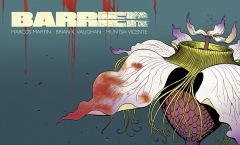
Barrier #5 finally translates Oscar’s dialogue. He and Liddy are both plugged into the aliens’ heads and, after Liddy’s flashback–revealing what had happened to her husband, though without dialogue–the aliens talk for a bit in Spanish then it’s Oscar’s flashback. With English dialogue.
Given how important not translating Oscar’s dialogue has been the entire series, it’s a little weird to see his tragedy unfold in English. Especially when it turns out Vaughan and Martin only hinted at the actual tragedy. Well, didn’t really hint. Lied. They lied about the tragedy. Unless you read the Spanish? It’s unclear.
There’s some good art. It’s not exactly good comic art. It’s good art though. I can’t even remember how the book read when the visual pacing was so good. None of its here, even though there’s a lot of art. There’s no opportunity for that kind of pacing anymore, not with the narrative.
Then comes the twist ending.
It’s an eye-roller. And makes the English translation even more of a cop-out.
 Barrier #5 finally translates Oscar’s dialogue. He and Liddy are both plugged into the aliens’ heads and, after Liddy’s flashback–revealing what had happened to her husband, though without dialogue–the aliens talk for a bit in Spanish then it’s Oscar’s flashback. With English dialogue.


 They get to talk again. The aliens dump them in a different area of the ship where there are other aliens and those aliens are mean.
 The aliens speaking makes human ears bleed to the point of deafness. Blows the ear drums? So now Liddy and Oscar can’t talk to each other. They just have to communicate with body language and expression. Or Liddy just takes Oscar’s stuff because… she can?
 So pretty much everything I liked in Barrier #1 is gone in Barrier #2. The issue opens at NORAD, with a couple officers talking in acronyms about how they’re not going to report a UFO even though they saw a UFO.
 As a visual piece, Barrier #1 is all kinds of awesome. Marcos Martin’s pacing is sublime; the comic is “widescreen”–or landscape–with Martin sometimes using the whole page, sometimes filling it with as many panels as possible, sometimes splitting a single “shot” into panels. The visual reading experience is sublime.