A collection of film responses discussing the FRIDAY THE 13TH movies, starting with the 1980 original directed by Sean S. Cunningham and ending with the 2009 remake directed by Marcus Nispel. Includes all the original series, JASON X, and VS. JASON.
-

-
I wasn’t planning on launching Selected Declarations until 2022 (I’ve even got a topic ready), but since I’ve been inbox-bombing Stop Button subscribers with archival posts all night, I thought I’d explain in a “preview.
While I don’t have any significant plans for the blog in 2022, I did have a bunch of cleaning up to do after a misguided return to self-hosting a couple years ago. And then combining Stop Button and Comics Fondle. So there’s housekeeping from that one too. One of the things I wanted to get done was setting up better hosting for podcasts, which I did. Unfortunately, I didn’t think it through and removed all the original posts from when the episodes went live. If I’d kept them, I could’ve just edited those posts and not created a bunch of “new” posts, which WordPress.com then sent to subscribers.
My bad. I’m not going to do more than five a day now I’ve got the formatting finalized. Rough estimate, it’ll be a month of the extra (old) posts. I’d love to figure a way around it, but it’s also a bit of work to get each post done with the new Gutenberg blogging system, so I don’t really want to do more than five a day. I can make templates for embedding the podcast episodes no problem. The header art is another story; I’ve decided to give everything its own header image. Not a problem for the Best of An Alan Smithee Podcast because Matt did a bunch of nice new headers back when we posted that project; probably not a problem for Podcast 60 because they cover single subjects (i.e., episodes), but it’s a pain for the old Comics Fondle episodes. We never thought of doing individual episode art. I’ve found an all-right template. Nothing earth-shattering, but visually distinct. Actually, I’m going to work on it a little more.
Otherwise, 2022 blogging plans are getting through some catalog films and a read-through of more Love and Rockets. Through volume two. I’ve got a nice schedule worked out for both, which should also allow for a return to prose reading. I’ve had Little Women sitting waiting for a read (to be fair, the still exceptionally difficult to talk about even in internal monologue book project derailed that read), but 2022’s got a couple memoirs dropping I’ve been wanting for years—Jamilah Lemieux and Raquel Willis’s—so time to get back to reading.
Reading without thinking about writing. What a concept.
Selected Declarations will be at least weekly posts. The name is a Harry Mathews nod, though I never grokked him as much as I thought I would. There’s also a wink-wink constraint; if someone guesses the what and why, there’s a No Prize with your name on it.
Anyway.
Buckle up; we’re in for another unimaginably stupid year.
-

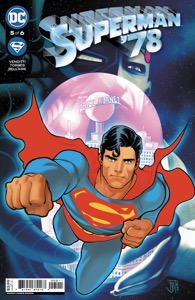
It’s the Superman ’78 version of an action issue, which means a terribly written scene for Marlon Brando and Susannah York saying goodbye to adult Christopher Reeve this time, some boring Superman vs. Brainiac robots action, and Metropolis-in-danger montage shots. The montage shots have bad dialogue when they have it, but also a cameo from “Barney Miller” Hal Linden and possibly Gus Gorman (Richard Pryor from Superman III).
The cameos don’t save it. Or help it. Because Superman ’78 is fairly intolerably bad again. I feel like I got more bullish on it for an issue, but the comic’s back to the Robert Venditti-penned pits again. The conversation Jor-El and Kara have when sending Superman back out into the world to save Metropolis from Brainiac is the worst dialogue of the series so far and probably the worst dialogue in a comic I’ve read in quite a while. Brando Jor-El flexes about the derring-do of the men of the House of El, and it’s beyond insipid. Though it’s kind of funny to imagine Brando filming it and asking for another fifty thousand dollars per word as he read the dialogue for the first time.
Or just up and quit. Because it’s real bad. I thought Superman ’78 had bad writing when Venditti was aping dialogue from the movies themselves, but when he’s got to write for Marlon Brando… Venditti bellyflops hard enough you can hear it across the twenty-eight known galaxies. People pay money for this comic book; they should get dialogue a seventies toy commercial wouldn't refuse.
And Wilfredo Torres’s art has lost the charm too. Maybe because the Superman action is so bad, maybe because the talking heads scene is so bad (like, Jor-El and Kara talk about sending their baby away again, maybe try to duplicate The Movie scene beats), but it’s not cute or charming anymore. Also, because Superman’s kind of barely in it. Torres loses track of Superman in the cliffhanger lead-up. On and on.
The opening with a rando walking his dog is better than anything else in the movie, and it’s basically a Red Skies Crisis riff. Hopefully, a Red Skies Crisis riff. Who cares. There’s one more to go. It’s almost over.
What should’ve been a slam dunk on Torres’s art alone is proving Superman IV is an accomplishment, all things considered.
-
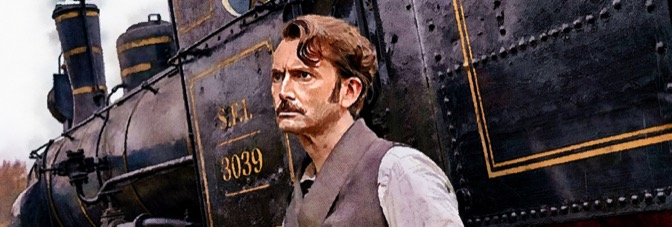
Last episode, it seemed very much like David Tennant, despite being top-billed, was just going to be “Around the World in 80 Days” ’s monied catalyst. He can afford this great adventure, but it’s going to be Ibrahim Koma and Leonie Benesch’s story. Koma’s a working-class (Black) Frenchman on the run from at least responsibility and maybe some other things; Benesch’s a woman in the Victorian world, where no one thinks she can do anything. Together, they’re going to help foppish, incapable Tennant accomplish his task while talking crap about him behind his back. Including Benesch going all-in on the era’s toxic masculinity, at least when it comes to Tennant. He’s a fraud, they’re sure, and Benesch has hung her ambitions on him.
Only in this episode it turns out Tennant’s very much going to be the lead. And the show’s going to directly interrogate the toxic expectations.
Tennant, Koma, and Benesch start the episode by crash landing their hot air balloon and catching an Italian train, where Tennant runs afoul of a self-made industrialist, Giovanni Scifoni. Scifoni doesn’t like British blue bloods, and he doesn’t like his son, Cristian De Vergori, bonding with Tennant. So a lot of the episode is just Scifoni browbeating Tennant into feeling like this “Around the World” adventure will inevitably fail. Koma and Benesch agree—amongst themselves—with Benesch embracing that toxic masculinity dismissal of Tennant. It makes Benesch unlikable, which the episode evens out with all the workers on the train hating her because she talks and she’s a woman. She’s hanging out with Koma, who’s hanging out with the train drivers and conductors, who like her when she’s decorative and not at all when she speaks. Well, except maybe conductor Simone Coppo, who ends up being compassionate. Mostly because Coppo’s really good.
After the initial dustups with Sciofoni, Tennant spends the episode pensive, making brusque observations about himself—while avoiding giving Benesch the background into his personal history she desires—and it’s all about the performance. Tennant’s captivating in his brooding silence. It’s an exceptional performance given the constraints of the project—it’s a TV adaptation of a Victorian novel, after all, and Tennant brings a whole new layer to it.
Of course, there are some other layers, thanks to Koma not really fitting in with the Italian working class. He’ll eventually win them over (and then reject their friendship thanks to his self-loathing). “Around the World” has layer upon layer, the eventual Tennant arc coming as a surprise, with the narrative distance gracefully shifting a quarter of the way into the episode. Again, Steve Barron’s direction is excellent.
Also, the technology aspect. There isn’t much in the way of expository dumps about how new technologies are changing lives. Instead, the show just shows the characters experiencing it and its newness. It’s very cool.
Of the main stars, Benesch gets the least material. First, she’s decorative to Tennant’s initial plotline—she’s allowed to socialize with the first-class passengers while Koma’s off with the workers. Then she’s support to Koma’s character development. Finally, both she and Koma are support to Tennant’s arc, as an unexpected crisis allows him to excel. There’s some foreshadowing with the crisis, just not with it being Tennant who’ll get to do anything with it.
Lots of good acting in the supporting cast, particularly Sciofoni. De Vergori’s a reasonably likable kid, but it’s because he’s sympathetic, not because he’s good. Instead, because Sciofoni’s an exceptional asshole of a dad.
At the end of the last episode, I was impressed with “Around the World in 80 Days”’s presentation of the time period and thoughtfulness in its characterizations, but at the end of this episode… the show’s going even more places. Particularly with Tennant. It’s probably too early to say, but this performance might be the best one of his I’ve ever seen. There’s something singular about it, which is even more impressive considering he’s doing it in an adaptation of a 150-year-old novel. Albeit an excellent adaptation.
The show’s gearing up to be something special.
-
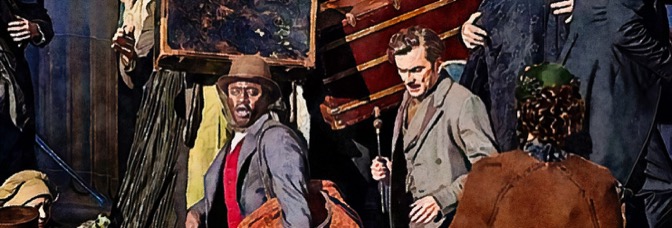
“Around the World in 80 Days” immediately showcases why adapting Victorian novels is a good idea right now. You can do whiz-bang CGI effects for them, but you can also make a white guy the hero and then have marginalized people in the supporting roles and get away with it. The white man was the inarguable king of the Western World. In “World” ’s case, the white guy is David Tennant, and the marginalized folks are Black guy Ibrahim Koma and white woman Leonie Benesch. However, no one really craps on Koma for being Black since he’s also French, and Frenchmen are much more shitting-on-worthy (according to “World”). Meanwhile, Benesch is busting ass to establish herself as a journalist, and her own father (Jason Watkins) is erasing her, giving her a male pseudonym.
Meanwhile, Tennant’s generally incapable and only survives thanks to Koma. And mercenary nuns.
The episode opens with Tennant receiving a postcard with a single word—“Coward”—with no postmark. We’ll find out he’s got a series of these postcards, though it’s unclear if they all have “Coward” written on them, and his fellow rich men think he’s, well, a coward. Koma is a waiter at Tennant’s club, which is why he’s in the story, and then Benesch’s there because dad Watkins is one of Tennant’s fellows at said club. The other important guy at the club is Peter Sullivan, who spends his time trying to humiliate Tennant whenever possible.
Benesch is upset with Watkins because he took her name off an article about how it’s now possible—thanks to technology—to circumnavigate the globe in eighty days. Tennant reads that article and, full of piss and vinegar from the postcard, declares he will attempt such a journey. Sullivan mocks him and publicly bets against him, setting Tennant up for failure. Thanks to some poor personal choices, Koma finds himself in need of a new position and becomes Tennant’s valet—unaware they’ll be traveling the globe—because Tennant’s existing butler, Richard Wilson, is old and useless.
Once Benesch finds out Tennant’s going to attempt the trip, she tells dad Watkins she’s tagging along, and he better not give her a dude’s name in her column recounting the adventure.
All this setup is rapid, and the real action of the episode happens once they get to Paris. The French people getting screwed over by their government. Koma’s been out of the country for some personal reasons—on the run from responsibility—so when they get there, and the police have closed the train station, stalling their trip on the first day, no one’s happy. Tennant’s incapable of fending for himself, Benesch doesn’t realize it’s actually dangerous, and Koma’s just trying to survive seeing revolutionary brother Loic Djani again.
Tennant spends much of the episode passive, only getting his steam going when he realizes Benesch is in danger and he can’t get friend Watkins’s daughter killed. Koma hasn’t been honest with Tennant about his history (or his present situation), so Tennant’s mostly unaware of that angle. But Benesch gets the whole story, which creates an interesting relationship between her and Koma.
It’s all solidly acted—Koma’s the best here, getting to be flashy and proactive while Tennant and Benesch are reactive—with superb production values and surprisingly strong direction from Steve Barron. I’m saying “surprisingly strong” because I only know Barron from Teenage Mutant Ninja Turtles, which I don’t remember being well-directed at all. Quite the opposite. But “Around the World in 80 Days” is well-directed, combining a nice sense of humor with harsh reality. I’m not sure what I was expecting—I haven’t read the Jules Verne novel, and if I’ve ever seen another adaptation, it’s been literal decades—but this one is a somber look at classism, sexism, and politics in the late nineteenth century.
The show’s off to a great start.
-

A critical episode guide discussing the all five of the Marvel Cinematic Universe Phase Four shows streaming in 2021 on Disney+. Responses covers WANDAVISION (9 episodes), THE FALCON AND THE WINTER SOLDIER (6 episodes), LOKI (6 episodes), WHAT IF...? (9 episodes), and HAWKEYE (6 episodes). -

I understand there are reasons for The Matrix Revolutions. If that one rumor is true, it’s basically Keanu Reeves didn’t want to do sequels forever, and the Wachowskis wanted to do a long-running franchise. Old Internet gossip (oddly more reliably than some later Internet gossip, but still… Internet gossip). And then the costume changes… the Columbine shooting didn’t help with trench coats as a fashion statement. Oh, and then instead of the movies being all about freeing people trapped in their Matrix lives—so if you’re a cop, you’re working for the machine, and the good guys will have to take you out—that action kills a real person. Who, if they were a good person who took the red pill, wouldn’t be a cop. But it’s a person. It’s after 9/11. Cheering killing mindless human-faced zombies… not so easy.
So you make them all programs like TRON. Only they’re sometimes super horny and sweaty.
I get it.
Also, Gloria Foster dying and having to be replaced between the last movie and this movie, even though Revolutions takes place immediately following the last one, Reloaded. I grok it.
It’s also still godawful movie-making.
What happens to Larry Fishburne in the franchise where he was a very big deal in the first movie? He’s barely in it. Demoted to hanging out with the cast introduced in the last movie and having nothing to do with the main plotline he’s around. Though it’s not much better for “lead” Reeves and romantic interest but also action sidekick Carrie-Anne Moss. They’re nowhere near the film’s biggest action set piece. Fishburne doesn’t get to participate in the action (because he’s not a CGI flying, techno-Lovecraftian flying thing, or a machine-gunning version of the Aliens power loader) in the big set-piece. Still, he’s at least ostensibly vital to it.
He’s not because the script instead wants to be about how Harry Lennix is a joyless hard-ass who doesn’t think Reeves will turn out to be Matrix Jesus and save the day. Fishburne’s most significant scene in the movie is his debriefing. The human survivor council has some questions. This time there’s a Black lady (Francine Bell) who gets not just a close-up but also to talk. There are also the pointless old white people—bad seventies sci-fi guy Anthony Zerbe and “why didn’t you stunt cast this part” Robyn Nevin—plus Black man Cornel West doing a cameo. The movie’s just Fishburne getting less and less to do.
Well, except maybe Moss. Moss, who started the franchise with less screen time than the boys but still just as important (and then more important for some other reasons), basically gets put into a freezer. She’s the damsel in distress. Even though she’s the one who hijacks the initial plot.
The movie opens with Reeves still in a coma since Reloaded ended three minutes before and a new captain (David Leonard) leading the B plot. Leonard should have been in Reloaded and may have been in Reloaded, but I’m not checking. I don’t remember him from it, so he mustn’t have had more than two lines because, at three lines, you realize how bad his performance will be. And it just gets worse and worse.
Ditto Ian Bliss, who appeared last time as a counter-revolutionary and potential traitor to the humans. He’s got the film’s most important scene… maybe second important, but it depends. Most important or second most important. And he sucks. He’s comically bad. He’s supposed to be mimicking one of the other actors in the movie, and it’s painfully obvious he’s doing it, but none of the characters notice, so they’re all taken by surprise later on. It makes all the good guys seem like they’re not actually attentive enough to pull off saving the world.
Anyway.
Reeves is in his coma, but not really; he’s in the Matrix, where he learns the programs can love, which changes everything. If they can love, they’re people too. It’s an interesting idea—the value of life extending to artificial life—and probably the only one in the entire movie? Matrix Revolutions doesn’t even try with the philosophical nonsense of the last one. Instead, there’s a bang bang, boom boom solution to things in this one.
Moss and Fishburne have to go save Reeves, returning to visit last movie’s bad guy, Lambert Wilson. The previous film started with the machines due at humanity’s last refuge in thirty-six hours to wipe them out. This movie begins with those same machines due in twelve hours. So when Wilson says, “Didn’t think I’d be a returning villain so soon?” to our heroes… it’s been like three hours since they’ve seen each other. And Wilson’s got an entirely new gang of sidekicks, who are going to do a big fight scene, and then Moss and Fishburne will have to work for him and on and on and on. Until Moss cuts the bullshit and the cliffhanger resolve is all over.
Then it’s just setting up Moss and Reeves to go to the never-before mentioned Machine City, where all the programs live, presumably, under the watchful eye of the MCP—because he’s going to convince them he’s their savior too. Fishburne, Pinkett Smith, Leonard, and still charmlessly in the movie Harold Perrineau are going to the human city to try to stop the first wave of the invasion. They’ve got the only weapon left on the planet to do it. We didn’t see the destruction of the others; Revolutions covers it in a poorly acted exposition dump. Because it’s a bad movie.
The big set-piece is the humans trying to fend off the invading metal octopus monsters while Pinkett Smith tries to make the Kessel Run less than twelve parsecs. There’s a really shitty subtext about it because Lennix, Pinkett Smith’s boyfriend, doesn’t just not think she can do it, he didn’t listen to her when she undoubtedly told him about the times she did it. I get the Fishburne, Lennix, and Pinkett Smith love triangle thing doesn’t really work out because Lennix is risibly bad, and Fishburne and Pinkett Smith repulse each other like magnets in the chemistry department… but why not fix it? Maybe there was a deadline. It’s always good to kill your darlings with a rushed finale; everyone says so.
Again, anyway.
The big battle scene is terrible. This time out, Bill Pope’s photography is slightly better than the second movie, but it’s still unbelievable he’s had other jobs, including doing the excellently photographed original. It’s a mawkish scene, all about macho battlefield stuff while playing with bad eighties toys done in not terrible CGI. Not good CGI, not well-lighted CGI, but not terrible CGI. Not well-directed future war action either. But. The CGI exhibits competence at some base levels. It’s long, it’s boring, and there’s this weird subplot with Nona Gaye and her female sidekick, who very much don’t have macho war movie bonding going on. The movie intentionally gives it to The Not-Feral Kid (Clayton Watson) to do a lousy job with it while Gaye gets action but squat as far as character. Gaye’s bad, but Watson’s much, much worse. It’s just another crappy part of the movie.
Speaking of Not-Feral Kids… there’s a genuinely awful cameo from Bruce Spence. It seems like a Road Warrior reference, making it the only time the Wachowskis fully extend the homage, but Spence is so terrible they really shouldn’t have done it. Revolutions is even worse than the last one. It’s an achievement in missing the target time after time.
And, so, finally, let’s talk Hugo Weaving. The first movie’s break-out performance. The first sequel’s pointless addition amid pointless additions. He’s now the anti-Reeves, wanting to take over the Matrix for himself by turning everyone in the Matrix—presumably humans (we never see it because dead civilians after all) and programs alike. Reeves will have to do a flying kung fu battle with him to save the world.
The flying kung fu battle’s better than you’d expect, given the rest of the movie, but Weaving’s performance isn’t just easily the worst in the film; it’s cartoonish in a way it’s unbelievable Weaving wasn’t trying to make it bad. Like he was out to sabotage the movie. It’s unspeakably bad. And utterly pointless.
The nicest thing to say about the Matrix Revolutions is Reeves, Moss, and Fishburne never embarrass themselves. Reeves and Moss get some saccharine sludge for material, and Fishburne’s got to act opposite Lennix and Leonard, but they make it through professionally. Ditto Mary Alice (replacing Foster), Lambert, Bernard White as a very special program, Gina Torres, and Collin Chou (maybe). Everyone else is bad and worse. And there’s no end to the worse.
Rupert Reid’s particularly annoying as Lennix’s sidekick, not just because he should’ve been there last time, but also because he manages to be even less charismatic than Lennix. You don’t want a performance less charismatic than Lennix’s. It’s a dangerous place.
Bad music from Don Davis.
Not bad editing from Zach Staenberg; he’s doing the best he can with insipid material.
In addition to being an insipid mishmash of action and sci-fi movie nods, kiddie pool depth philosophy, and bad acting, Revolutions is also a really boring version of that movie. Revolutions is bad, disappointing, and bored with itself.
The only bigger “Why?” than “Why watch Matrix Revolutions” is, “Why make Matrix Revolutions.”
At least be honest and call it The Matrix Contractual Obligations.
-

I’m trying to think of something nice to say about The Matrix Reloaded. None of the returning good guys give bad performances? None of the leading returning good guys? Like, Gloria Foster’s back and, while she doesn’t give a bad performance, it’s an utterly charmless one heavily leveraging her charm in the last movie. But she’s gone from Black grandmother saving the future to… something else. The something else is a third act reveal without Foster’s participation, but the one scene she does get definitely changes the trajectory the first movie promised.
Reloaded takes place approximately six months after the first Matrix. In that amount of time, Keanu Reeves and Laurence Fishburne have changed their outfits—Fishburne’s got a different leather jacket while Reeves goes with a cloth cassock. Carrie-Anne Moss still does the whole shiny leather thing. It might make for a great scene if they had any personality or character relationships. But there’s not a lot of character in Reloaded for the trio.
Other than Reeves and Moss being lovey-dovey and trying to find make-out time when they’re not busy saving the world. Or when people in the real world are begging Reeves to save their relatives from the Matrix. Or when they’re bringing alms to Reeves. Plus, Reeves is having dreams about Moss dying, which is how the movie starts—a lengthy action sequence with Moss falling to her death before Reeves wakes up scared and sad. He has other ominous dreams, which seem to be really happening, but he never acknowledges his prescience. Even when he and Foster talk around it.
All Fishburne gets in the character development arena is… ex-girlfriend Jada Pinkett Smith’s new boyfriend, Harry Lennox, is willing to destroy the future of humanity because he doesn’t like how Pinkett Smith used to like Fishburne. Pinkett Smith’s terrible, but Lennox is a whole other level of bad. He’d be comically bad if he weren’t actually ruining the scenes. Pinkett Smith doesn’t get enough to do to ruin them. Lennox does get enough and does ruin them.
Though the Wachowskis’ bewildering, seemingly ready for pan-and-scan composition doesn’t help. Maybe they were just bored with the political goings-on too. Lennox is the human resistance army commander and doesn’t think Reeves is the Matrix messiah, though it’s never clear why except to make Lennox more of a dick. The human settlement stuff is weird in a bad way. The only time the Wachowskis show any interest in it is when there’s a sex scene for Reeves and Moss (who apparently can’t do it on their ship because Fishburne and new crew member Harold Perrineau are around) intercut with a very sweaty dance party. Hundreds of scantily clad humans bumping and grinding. Only not the politicians who run the future settlement. Thankfully. Not sure I wanted to see Anthony Zerbe getting down with his shirt off, dripping in sweat from the subterranean heat.
Zerbe’s the council member who isn’t sure Reeves is magic but will risk it. There are some weird optics in having old white guy Zerbe bossing around all the Black people who do the work in the future city. The optics worsen when old white lady Robyn Nevin shows up and does the same thing. Because even though the council itself is diverse, it’s only those two people talking. Well, them and Cornel West, who’s a Black man, but he just parrots Niven and Zerbe. The entire subplot with the survivor city is terrible, even though it’s the de facto A plot since they’ve got thirty-six hours before the machines kill them all. Lennox wants all the ships protecting the city, but Fishburne and Reeves want to go up and into the Matrix. Specifically to see Foster, who drops some big truth bombs on Reeves, which he apparently never tells Fishburne about.
Do Reeves and Fishburne actually have any scenes together? Do they have any conversations before the epilogue? They’re around each other, they have an action scene or two in each other’s company, but they don’t have a character relationship. No time for that sort of thing in Reloaded.
The film’s a series of pseudo-intellectual monologues, seemingly divorced from the first film’s mythology—Matrix Reloaded owes more to TRON in that department than it does to its predecessor—and tedious, pointless action sequences.
Hugo Weaver comes back as a rogue agent—meaning the Matrix is after him too—who can self-replicate, so Reeves has to fight dozens of Weavers at a time for absolutely no narrative reason. The scenes just slow down the plot and create bad set pieces (Reloaded feels like three different sequel ideas glued together).
But those Weaver sequences manage to be more consequential than the eventual main plot for Reeves, which has him confronting one peculiar computer program after another. Including Lambert Wilson, who decided to affect a horny Frenchman for his Matrix avatar, much to wife Monica Bellucci’s displeasure. But Bellucci’s also got her issues.
Wilson’s got a gang of cyberpunk thugs who will fight Reeves and company. They’re not worth talking about, even though the Wachowskis try to make them more interesting by implying they started out as vampires and werewolves or some nonsense. It’s just terrible. Most of them are gone after the first too-long fight, with only Neil and Adrian Rayment sticking around for two set-pieces. I don’t want to get into the Rayments, who are terrible actors in terrible roles, but one could spend a lot of time on all the things bad about them. Maybe not even starting with them being white men with dreadlocks, but definitely getting to it.
So much lousy acting, whether Lennox, Pinkett Smith, Zerbe, Ian Bliss, the Rayments, Perrineau (who’s profoundly lacking in charisma just like his predecessor, Marcus Chong, in the last movie), Nona Gaye as Perrineau’s pointlessly overbearing wife, Collin Chou as Foster’s bodyguard (a computer program who needs to fight a man to see if they can be pals or some nonsense). Helmut Bakaitis has a singularly important part and is godawful.
It’s a terrible sequel, a terrible movie.
Even the returning crew from last time—cinematographer Bill Pope, composer Don Davis—who did excellent work there do bad work here. Pope can’t light for all the green-screened composite shots, and Davis’s score is bad.
Last thing—the CGI models for Reeves. He’s got some Superman-esque flying going on, and whenever he does it, there’s some terrible CGI head on the model.
Nothing the Wachowskis do in Reloaded works, but none of it seems like they care if it works either. It’s the pits.
-
The Matrix starts kicking ass in the second half. The first act clunks along, introducing both Keanu Reeves’s plot and then the Carrie-Anne Moss and Laurence Fishburne one. The second act makes a lot of promises and stumbles delivering on them. There’s this big fight scene between Reeves and Fishburne, and instead of accelerating the film’s momentum, it intentionally stalls it out again.
The film opens with Moss on the run from the cops and the Men in Black—a phenomenal Hugo Weaving and the lackluster Paul Goddard and Robert Taylor. She’s a cyberpunk hacker who can leap (between) medium-sized buildings in a single bound. Right after Moss’s fantastical introduction, Matrix switches into mundane with Reeves’s white-collar computer programmer. After he gets a prescient message on his computer screen, Reeves goes out clubbing and meets Moss, only to wake up late the following day. At work, he gets a special delivery—a cell phone. It rings, Fishburne calling to warn him Weaver is after him.
Now, if Reeves listens to Fishburne in this scene, the movie will get to the second act faster, so of course, he doesn’t and instead gets arrested. It’s okay, as it allows for the first great scene from Weaver in the film. But then immediately following, Moss comes along (with friends who aren’t going to matter other than looking cool) to rescue Reeves. Not from Weaver, but from reality. Or what he thinks is reality.
Because the actual reality is humanity is being used as batteries for the machines who have taken over the planet. Moss, Fishburne, and the aforementioned indistinct but cool pals (save Joe Pantoliano, who’s intentionally not cool but also very distinct) are freedom fighters who live in the real world—one suffering an endless nuclear winter thanks to the war of the machines—and try to fight the computers, with the fake reality (The Matrix) their battlefield.
And Fishburne’s absolutely positive Reeves is their John Connor. Just no one else is sure. Especially not Reeves, who isn’t thrilled to find out his entire life’s not just a lie but also fake. Even if it does mean he can learn kung fu as fast as it can be uploaded onto his brain via Sony MiniDisc.
The biggest problem with the first half of The Matrix is the sluggish plotting, which keeps Moss in the background so she can save a surprise for later, as well as the tell then show then tell some more style of storytelling. But also the lack of character development for the indistinct but cool pals. The only ones who get anything to do are Pantoliano, who’s disgruntled, and then tech guy Marcus Chong. Chong can’t go into the Matrix because he’s a regular human born out in the post-apocalyptic real world, so instead, he operates the computers to send the other people back in. Chong’s bad. He’s not the worst performance—I mean, he’s close, but he’s much better than Goddard and Tylor—but he’s got terrible timing and bad writing. He’s a charisma vacuum in a part utterly dependent on it.
Once Reeves heads back into the Matrix as one of Fishburne’s team, and they stop promising to do something great and start doing some great things, the film takes off. Starting with Reeves going to visit Gloria Foster. Foster’s the fortune-teller who’s going to suss out whether or not Fishburne found the right guy to save the world.
While The Matrix’s most outstanding achievement is probably its technicals, there’s also something really cool in how the people saving the future are Black (Fishburne and Foster). It just feels right. And special. The film even seems aware of it, with Fishburne alluding towards it during a fistfight with Smith.
The film’s second half is a continual action sequence, primarily set in the Matrix where Reeves, Moss, and Fishburne can do kung fu and shoot guns. The gun stuff gets a little tiresome, but it’s more technically impressive than the kung fu. The best action involves a helicopter rescue sequence; directors Wachowski do their best work on that one, with some excellent editing from Zach Staenberg. The lengthy kung fu fights are all slowed down for emphasis, which makes them less visually impressive, but does allow time to focus on the characters’ experience of the fights, whether it’s Reeves starting to think he actually might be the white savior Fishburne’s looking for, or Weaver coming to a similar conclusion. Good for Reeves, bad for Weaver.
Weaver’s best scene in the movie isn’t opposite Reeves, but Fishburne. Reeves is just Weaver’s fisticuffs nemesis, while Fishburne’s the one he can talk to about two levels of artificial life.
Great music from Don Davis, great photography from Bill Pope. The Wachowskis’ direction of actors isn’t always the best—especially in the first half—but their approach pays off for the actors it needs to pay off for (i.e., Moss). Oddly, they direct Reeves better outside the Matrix scenes than inside, which is an anomaly. Though Reeves probably plays worse inside the Matrix than out because of that super-clunky first act and then the tedious hero’s journey in the second.
Fishburne’s great, Weaver’s great, Pantoliano’s great. Foster. Foster’s really great. If it weren’t for Weaver’s scenes getting better (until they don’t), Foster would be the best performance with just her one scene. But it’s Weaver.
Moss and Reeves are excellent together, which is the point, even if it takes a while. And relies on third act reveals to inform previous scenes.
Reeves is a good lead. He’s best reacting to other people, just so long as they’re strong enough to hold the scenes.
The Wachowskis’ script has some problems, and they can’t always make the obviousness work—then other times sail through it—but the pacing is fantastic. The direction’s usually exceptional.
There are a handful of movie homages. Star Wars and Terminator are the most obvious, plus whatever the wire fu pictures they’re referencing, and there’s eventually a nice Western nod.
Matrix is good. and they can’t always make the obviousness work—then other times sail through it—but the pacing is fantastic. The direction’s usually exceptional.
There are a handful of movie homages. Star Wars and Terminator are the most obvious, plus whatever the wire fu pictures they’re referencing, and there’s eventually a nice Western nod.
Matrix is good.
-

After three episodes away, Rhys Thomas is back directing this episode of “Hawkeye” for the grand finale, and… well, I wish they’d let Bert & Bertie do it. Thomas’s fight scenes aren’t any better than the previous directors’ fight scenes, and he doesn’t have the same light touch with the characters. It’s fine. It’s a successful conclusion to the series, but it’s checking boxes successfully, not ambitious and then succeeding in realizing those ambitions. Because there’s just too much to be done.
Last episode, we discovered not only is Vera Farmiga a villain, but she’s also a villain whose been working with big reveal Vincent D’Onofrio. D’Onofrio’s from Netflix’s “Marvel’s Daredevil” and his appearance last episode is the first confirmation those Netflix shows are in some kind of continuity, even if it’s just cast continuity (in the week in between that episode and this one, D’Onofrio’s “Daredevil” costar, Charlie Cox, reprised the role in Spider-Man 3). But this episode isn’t D’Onofrio just doing a stunt cameo; he’s got a whole arc. No post-Blip recap at the beginning, which seems like a miss given both Alaqua Cox and Florence Pugh got them, but the episode’s so way too full already.
Despite hiring Julia Louis-Dreyfus (who doesn’t appear) to assassinate Jeremy Renner because he’s too good an influence on daughter Hailee Steinfeld, Farmiga’s done with the international crime syndicate lifestyle, and she’s quitting whether D’Onofrio likes it or not.
D’Onofrio doesn’t like it, and he tells Fra Fee to kill Farmiga. Meanwhile, Cox has realized D’Onofrio had her father killed, and she’s trying to get away from him. Alaqua Cox, not Charlie Cox. Charlie Cox isn’t in this episode.
Just realized how confusing writing these posts will be if Alaqua Cox’s “Echo” spin-off involves Daredevil Charlie Cox.
Renner and Steinfeld figure out D’Onofrio’s going after Farmiga—but don’t ever imagine he’d have a Fee snipe her, which seems like an oversight—so if they’re going to save her, they’ll have to do it at a ritzy Christmas Eve party at Rockefeller Center. The Christmas tree and the ice skating will both be things; I’m pretty sure they were spots on Renner’s tourist list when he was showing his kids New York City at Christmas in the first episode, but everyone seems to have forgotten. I’m blaming director Thomas. It’s probably not his fault, but I’m blaming Thomas for not making sure the echoes—no pun—reverberated.
The episode’s going to be a series of middling fight scenes with good banter, starting with Steinfeld and Pugh (Pugh’s the assassin Louis-Dreyfus hired to kill Renner in the post-credits scene in Black Widow). It’s an under-choreographed but energetic fight, with Steinfeld and Pugh’s delightful chemistry driving the whole thing.
Oh, wait—also important, Renner tells Steinfeld she’s his partner earlier, and it’s a whole touching bonding moment even though the episode never gives it enough time.
Pugh’s eager to kill Renner because she’s convinced Renner killed Scarlett Johansson in Avengers 4. But she’s still just in it for the job, which is another miss.
After their (relative to the rest in the episode) excellent fight scene, Renner’s going to fight Fee, Cox is going to fight Fee, Renner and Steinfeld are going to fight the Tracksuit Mafia, Steinfeld’s going to fight D’Onofrio, and Renner and Pugh will have their showdown.
The Renner and Steinfeld team-up fight scene is the best of those sequences, then probably the Cox and Fee one because there’s some gravitas to it. The fight between Renner and Pugh can’t possibly deliver all it needs to deliver; there’s just not enough time for the character development (Pugh’s Renner’s best friend’s kid sister, and it ought to be about their shared loss, but it’s not). It doesn’t flop, which is about the best it can ever hope for.
Similarly, Steinfeld’s fighting D’Onofrio—who apparently got his hands on some super-soldier serum between “Daredevil: Season Three” and “Hawkeye,” which is fine and could’ve easily been explained—is just to keep D’Onofrio from killing Farmiga. Except Farmiga and Steinfeld’s mother and daughter arc completely fizzles.
Though nothing would’ve made me happy with it other than Steinfeld telling Farmiga it’s not “Mare of Easttown,” so she’s not covering for her being a murderer and what not.
The episode’s most successful for Steinfeld, Renner, and Cox, with Tony Dalton getting an honorable mention. He’s got a very fun little arc. And there’s some nice stuff with the larpers, just not enough. Farmiga, Fee, D’Onofrio? Eh. It’s all fine and with more time would’ve been better, but they don’t get more time. Pugh’s good but too much a guest star. It’s almost like they could’ve used another episode.
And then the final “twist” for Renner and wife Linda Cardellini… it’s a little forced and a little slight. Another episode would’ve helped it too.
But as far as ushering Kate Bishop into the MCU and setting up a good dynamic for Steinfeld and Renner? “Hawkeye” succeeds. Though Bert & Bertie probably would’ve directed the packed script better.
There’s a hilarious joke at the MCU franchise’s expense for the post-credits scene. It’s good, and it’s nice they can laugh at themselves, but seriously, we just got done with Kate Bishop’s first adventure—the critical question is, when will she be back? And do they understand they need to bring Pugh along with Steinfeld for it?
As for Renner… if he could do this MCU dad bit so well, why didn’t they have him doing it from the start instead of being the franchise’s most useless major participant? The way they’re able to juxtapose the friendship between Renner and Steinfeld with the never explored one between Renner and ScarJo is some deft work too.
“Hawkeye”’s not a home run, but it’s decidedly a win.
-

A critical episode guide discussing the all eight second season episodes of the Netflix streaming show, The Witcher, based on the novels by Andrzej Sapkowski. The show tells the story of monster hunter Geralt of Rivia (Henry Cavill), who struggles to find a place in a world where people are often more wicked than beasts. The show also stars Freya Allan, Eamon Farren, Anya Chalotra, Joey Batey, MyAnna Buring, Royce Pierreson, Mimi Ndiweni, Mecia Simson, Anna Shaffer, Mahesh Jadu, and Kim Bodnia. -
It’s the worst-case scenario for our heroes, with Henry Cavill racing to the Witcher Winter Wonderland where he’s sure an eternal evil spirit is after Freya Allan. Anya Chalotra is tagging along with Cavill, desperate to convince him she’s not just really sorry she was going to give Allan to that same evil spirit; she’s also now convinced her purpose in life is to help Allan. Live vicariously through Allan’s magic; it’s okay for Chalotra not to have magic of her own, she says. Cavill isn’t listening; if all the people last episode telling him to give Chalotra a chance got through to him, the current crisis has him pushing it away.
We know things are bad at the Witcher Winter Wonderland because Allan is dreaming she’s back in her old castle, back with old friend and protector Adam Levy (a first season favorite). And not just Levy, but Jodhi May’s actually back as well. The way they shoot the back of her head, it actually makes me wonder if she was the back of the head cameo a few episodes ago too. Everything’s just right in Allan’s memories, better than it ever could’ve actually been….
Which is good because, in reality, the evil spirit has possessed Allan, and she’s walking around the Witcher keep slicing every Witcher throat she can find. Good thing Cavill gets there in time to stop her from doing in Kim Bodnia; if she’d done Bodnia too, the very nice father and son arc for he and Cavill wouldn’t get its conclusion. Instead, it does; these two warriors are eventually able to bear their emotions to one another. It’s a great moment and possibly Cavill’s most successful of the season. “Witcher” is Cavill doing likable soulful brute amid better performances that caricature plays off.
Cavill and Bodnia and the rest of the Witchers have to fight Allan, who’s not done killing Witchers; she just wanted to take a break to make everyone sad about the situation. The evil spirit gets more powerful the more tragedy in the world—so when elf queen Mecia Simson abandons Mimi Ndiweni to go north and kill a bunch of human babies, it makes things worse for Cavill and Bodnia. Especially since Cavill’s trying to save Allan and just get rid of the evil spirit. Bodnia’s on the fence.
Chalotra and Joey Batey team up to do science stuff—a potion to separate the evil spirit—which is good because Cavill’s plan is to convince Allan to break through and regain control. Except Allan’s not just in her best memories, she’s in her best dreams—this world she’s found herself in doesn’t just have May and Levy alive; Allan’s also reunited with her parents. It’s everything she ever could’ve hoped for.
There’s a lot of political intrigue going on elsewhere—Eamon Farren convinces Ndiweni he’s a really smart co-conspirator, and they should lie about getting Simson and the elves on the warpath. There’s some more with plotter Graham McTavish, but surprisingly nothing about hundreds of babies incinerating or whatever. Given the epilogues have a whole new setting and job description for MyAnna Buring, it wouldn’t be surprising to discover some of the political machinations got cut.
We also get an idea of what Royce Pierreson will be doing next season, a surprise reveal for Farren and Ndiweni’s arc, and a continued delay on evil fire mage Chris Fulton’s employer. Guess the show only wants to have one unknown but known big twist villain at a time.
But at a certain point in the A-plot—which has Cavill and friends fighting some very nasty dinosaurs (you can tell they’re dinosaurs because of the feathers) before a convenient and well-executed resolution—it’s all just about the promise of season three. The episode checks in with the main cast to go over their responsibilities for next season. They could’ve had Batey make some quip about being ready for the next season and got away with it; the A-plot is so successful for Cavill, Allan, and Chalotra. While Chalotra and Cavill did action together last season, it was never epic. They’ve been building towards Cavill and Allan as a team this season, but always with a missing ingredient. Chalotra. Because they really are doing the surrogate family thing, and they’re leaning in on it.
There are some terrible CGI skies. “Witcher” has real problems with CGI skies.
But, otherwise, they’re set.
The wait between first and second season was fine because the first season was just entertaining and often problematic. However, this finale makes it clear the show knows what it’s doing, and it’s just getting bigger from here on out.
So it’s going to be a long wait for season three. Thank goodness they’re already renewed. Cavill does a fine job “leading” the show while Allan and Chalotra’s performances are getting better as their characters develop. Like, I said, they’re set.
-

Lots gets done this episode. An almost unimaginable amount, given all the characters in play.
The episode begins with Henry Cavill apologizing to Adjoa Andoh for fighting in the temple (no fighting in the temple is one of the rules), but it’s not his fault; it’s bad guy Chris Fulton’s fault. Andoh forgives Cavill and suggests maybe he ought to pay that forgiving forward to Anya Chalotra. Cavill’s pretty sure Chalotra has kidnapped Freya Allan; he just doesn’t know why. So at this point, he does not know it was Allan who magicked open a portal and got them out of there.
Meanwhile, Chalotra and Allan escaped Fulton to find themselves in a less dangerous but still upsetting setting. Fulton tracked down some of Allan’s friends from the first season and killed them, horrifying Allan. Chalotra–indeed acting with malicious intent–lies to Allan about Fulton capturing Cavill in the temple fight, and now they’re going to have to go rescue him. From the city where the bad guys have been giving the elves refuge and where Allan ran from last season, and where she unintentionally unleashed a bunch of monsters when she escaped Eamon Farren. This episode’s going to be a backtrack for Allan’s arc and then a catch-up one for Cavill. Separately. I can’t remember if callback events happen in the previous season finale. It just feels late to return to them, like the last six episodes have just been transitory.
Back at the mage base, we find out MyAnna Buring is making the beast with two backs with Mahesh Jadu, who has assumed control of the Mage Brotherhood since we last saw him. Or I completely missed a scene explaining it. But Jadu’s the boss, Buring’s his lady friend, and Anna Shaffer has come back in a panic after discovering Allan’s a warrior princess with elven blood.
Then the action cuts to Mimi Ndiweni and her troubles hanging on to power. Farren and the human generals in the South are sick of the elves not wanting to fight and are convinced there’s a spy somewhere. So they’re indiscriminately killing elves. It had seemed like there might be some complicated morality at play with the South kingdom like they were trying to help the elves against the racist Northern rulers. But the Southern people are just as bad.
So there’s Chalotra and Allan, Buring and Shaffer, Ndiweni and Farren. And then Cavill and Joey Batey. There’s a great scene where Cavill busts Batey out of jail, lots of action, lots of solid jokes about that action.
Cavill and Batey have some catch-up before Cavill figures out Chalotra’s in league with the Baba Yaga (Ania Marson). Only they need fresh horses, and they happen upon some more season one returnees to get them.
There’s character development for pretty much everyone, usually an equal share—though Batey’s mostly just for laughs and then Buring co-opts Shaffer’s. The character arcs for Allan and Chalotra are the best, especially as Chalotra proves the most successful person yet at teaching Allan how to use her magicks.
The hard cliffhanger has Marson making at least one big move while someone else crosses a point of no return in Ndiweni’s arc too. Monumental ramifications. It’s an excellent episode for Ndiweni in particular. She and Buring have an interesting “even mages are misogynists” juxtaposing.
It’s real good. Very impressive they were able to do so much in the penultimate episode of an eight-episode season. Like, it hasn’t been lackadaisical by any means, but they did take their time a lot in the first half and made then maintained a busy, brisk pace for the rest.
-

This episode opens with a profound downer. Henry Cavill and Freya Allan have left the Witcher Winter Wonderland and run into the new flying monster from last episode. Turns out the new monsters are all trying to get to Allan for some reason. There’s the most significant casualty of the season so far and possibly the series.
Cavill and Allan also have some excellent moments; she’s pissed at him for not letting her take the Witcher juice, and he’s trying to make her understand why. Unfortunately, the monster interferes, but the brief character development sets the board for later in the episode.
It’s good they left the Witcher base because the fire mage (Chris Fulton) can teleport there looking for Allan. Anna Shaffer and Kim Bodnia, who have been confabbing about Allan’s mysterious and major powers, survive Fulton’s attack but not without serious injury. It’s also a little weird the rest of the Witchers in the fort don’t hear the ruckus. It must really suck when you’ve got a monster in your village, and you get any Witcher except Cavill or Bodnia. The rest are severely wanting.
The B plot is going to be Mimi Ndiweni’s continued problems controlling the shitty generals—who want Eamon Farren to put her in her place for helping the elves—and the elves, led by Mecia Simson, are more interested in making sure Simson’s pregnancy goes well than playing soldier for Farren and friends.
It’s unclear what Cavill and Allan will get up to in the temple, other than a lot of exposition and backstory (Cavill was a science student as a teenage Witcher); the A-plot’s up in the air. But it’s got Cavill’s old teacher, Adjoa Andoh, who’s a delight, so it doesn’t really matter. She’s got some great scenes with Cavill and Allan. And then Allan makes an age-appropriate friend in student Joseph Payne.
Then Anya Chalotra turns up at the temple, and we get this lengthy reuniting plot for her and Cavill. Running under it is the audience knowing Chalotra’s in league with the witch out to harm Allan, and her affection for Cavill is an undeniable, magical urge, so there’s a lot of conflict going on. Conflict the audience is aware of but not privy to. “Witcher: Season Two” has had a particular plotting. The first two episodes were resolution and set up; the next two were more set up and reveals; now we’re into the home stretch, and the show’s still picking up speed.
The show finally establishes Cavill, Chalotra, and Allan as a trio, with Allan curious about their history; despite Cavill and Chalotra being the subject of the scene, it’s where the character development arc for Allan and Cavill returns. Very well-executed stuff.
There’s some more world-building with Royce Pierreson in a charming antiquarian bookshop where he and the shop owners (Simon Callow and Liz Carr) learn all about Allan’s secret origin. Turns out she’s the World Killer or whatever they call Wonder Woman in the first movie. But only in the wrong hands, she could also bring about good things. Allan, not Wonder Woman. Ships sailed on Wonder Woman.
It’s pure exposition, but Callow and Carr are fantastic, so it evens out.
There’s a questionable fight scene—if anyone’s been waiting for Cavill to do something for five episodes, I imagine it’s a bathing scene, not a slow-motion fight scene—but otherwise, the episode’s well-directed. And the cliffhanger’s a fantastic mix of ominous and thrilling.
-

I neglected to mention there’s a scene last episode with Joey Batey defending his popular song’s use of deceptive timeline chicanery (oh, if they’d called it Westworlding). It’s only important here because the first scene in the episode doesn’t resolve anything from last time; it instead introduces an evil mage, Chris Fulton. Fulton was imprisoned by Jodhi May, Freya Allan’s warrior queen grandma from last season, and since she’s dead, he’s going to get out. As long as he agrees to hunt down Allan.
It happens at some period before Anya Chalotra meets up with Batey again (from last episode) because we return to that scene and find out not everyone on the Continent thinks Batey’s good at the barding thing. It’s a nice funny in what’s going to be a wry episode; Haily Hall gets the script credit. There’s a lot of wry one-liners.
And pronounced grunting from Henry Cavill. “Witcher: Season Two” does really feel like the scripts know what works in the show and leverages accordingly.
So when Batey goes missing after helping Chalotra and her elf friends to safety, it’s going to turn out Fulton’s got him and is going to torture him for information. But, of course, Batey doesn’t really have any information because Cavill dumped him last season, and he’s no longer in the know. Chalotra’s big decision at the cliffhanger was either staying to help Batey or escaping (since she’s on the lamb). Turns out she stayed. Even though it takes about an entire scene to confirm it.
The episode pairs off characters—Chalotra and Batey, Cavill and Royce Pierreson, Allan and Anna Shaffer. Chalotra and Batey have to escape not just Fulton—who’s a fire mage, which complicates things—but also the local authorities. Cavill and Pierreson are investigating fallen monoliths and new monsters, discovering a bunch of world-building backstories. For example, everyone thought the planet resulted from three different worlds colliding; it turns out there might just be giant teleportation devices. Plus, Cavill and Pierreson get to talk about Chalotra—though Cavill doesn’t explain the reason Pierreson’s love will forever go unrequited is Cavill and Chalotra’s love spell—and so “Witcher” is not going to drag out Cavill knowing she’s alive until the season finale.
Another difference from first season.
Speaking of first season, Shaffer takes Allan on a magical flashback to her life pre- “Witcher” war and drama. Only there aren’t any big first-season cameos. Jodhi May’s supposed to be there but just from the back of the head. Otherwise, it’s all about Allan seeing her parents, Gaia Mondadori and Bart Edwards, again. They’re actually back from the first season (I had to check). And lots of scary magic, which breaks Shaffer’s spell and puts her in danger.
Given the only reason they’re doing the magical mystery flashback tour is because Allan wants Kim Bodnia to turn her into a Witcher so she can unlock hidden memories, and Shaffer wants to save Allan from being injected with a potentially fatal mutating agent.
The cliffhanger is Chalotra finding out what the Baba Yaga (Ania Marson) wants her to do in exchange for getting back her magic: hunt Allan too.
There’s also some check-in on the politics stuff with Mimi Ndiweni and Mecia Simson realizing it’s nice to have a partner in power right before Eamon Farren gets back from the enemy lands. Farren’s immediately a dick, and everything Ndiweni worked for is in danger.
Iffy opening with the threat of more Westworlding, and the character names are way too similar and way too indistinct, but a strong episode.
-
Spider-Man: No Way Home’s got a very appropriate title. There’s just no way to bring this one home, not for any of the things it tries to do. Though “tries” might be stretching it, No Way Home’s script feels like it’s four different ideas strung together with plot points dependent on the latest Academy Award-nominated or winning actor they managed to convince to come back for it.
But as Tom Holland’s Spider-Man seeming comes to its end—and, no spoilers (which I’m going to try hard to maintain), one way or another, something definitely ends here. No Way Home is a very particular collaboration between Disney and Sony; Disney owns Spider-Man: The Character and Sony owns Spider-Man: The Movie Rights. They weren’t even going to make this movie until Holland called the Disney head honcho and pleaded they go back to the table to make a deal. Disney was ready to leave it hanging on the previous entry’s cliffhanger.
So, while the producers are doing press rounds saying Holland’s not done… it’d be “okay” if he were done. No one in the MCU proper will be missing Spider-Man after No Way Home.
The film brings back major stars from all Sony’s previous Spider-Man franchises, though it never really gives them enough time. No Way Home’s set up to be Holland’s movie, but he loses it in the second half, and when it’s time to hand it back to him, they’ve broken it. They give him the pieces and send him on his way, the numerous epilogues just showcasing how noncommittal anyone wants to be about there ever being another Tom Holland Spider-Man movie again. It’s also a bummer for Zendaya and Jacob Batalan, who get to play sidekicks to a much fuller degree in this outing. No Way Home’s most consistently successful, non-gimmick moments are the ones playing off the trio. The movie does noticeably avoid giving Zendaya anything to do but play the damsel—and not just for Holland—while Batalan gets a potential spin-off setup.
To be clear, Batalan’s delightful, but some of that delightfulness is at Zendaya’s expense.
So the movie fails Holland and his Home trilogy sidekicks (it is nice to see Zendaya get to do more in this one, even if it’s just filler), it fails Holland as the MCU Spider-Man, but it also doesn’t really do anything for the returning Sony Spider-Man franchise participants either. I mean, it also really fails director Watts, who’s stuck directing actors in caricatures of former performances. Spider-Man: No Way Home is groundbreaking but only as a force of commercial will. There’s never been anything like it. And probably can’t be anything like it again; some of the actors look so miserable in this outing, it’s hard to imagine them returning.
It’s a movie without stakes for anyone involved, except potentially guest star Benedict Cumberbatch, who’s worried new boss Benedict Wong will find out how badly the guest star spot is going. All Holland wanted was for everyone to forget last movie’s big twist ending, and instead, he and Cumberbatch break the Spider-Verse. Sorry, multiverse. There’s no Spider-Verse crossover, which is the film’s most obvious miss. Well, the movie’s fourth story’s most obvious miss. There are obvious misses in the three stories preceding it, too, possibly four when you remember there’s not actually a supervillain team-up, just supervillain coincidences. Like it’s an old Godzilla movie, and all the kaiju show up somewhere because otherwise you don’t have a fight, and otherwise you don’t have a Godzilla movie.
Is a Spider-Man movie just a set piece with a bunch of swinging and thwapping action? No, but No Way Home would sure like to get away with one.
Most unfortunately, the film fails Holland as an actor. After single-handedly being the most important addition to the MCU since its inception, his (latest) potential finale turns all his character drama into a multiverse detail gimmick. It then drains any of the remaining resonance in the epilogues. No Way Home is just a graceful out for his Spider-career, which is easily the longest in the movies (six real appearances, one pseudo-cameo), and second only to Nicholas Hammond in live-action appearances. And Hammond was doing a TV show.
Holland’s emotional response to the events in the film—when they still matter to anyone—always get neatly wrapped into a Spider-Man lesson from previous participants from other franchises. The epilogues cheat Holland out of his character arc, just like the very tidy finale cheating all the guest stars out of their arcs. One of the significant developments in No Way Home is Marisa Tomei inspiring Holland not to give up even on the bad guys—especially the ones made bad by science mishaps—and it ends up being one of those stories to nowhere, taken off the stovetop for the next surprise guest star.
It’d be easy to blame the whole thing on screenwriters Chris McKenna and Erik Sommers, but it’s obviously not their fault—not to mention the movie shot during Rona, so there were more factors than the Brinks truck not being full enough. Instead, No Way Home is just a series of gimmicks competently realized with a $200 million price tag.
There are some good performances. Holland’s strong despite the material, ditto Zendaya. Cumberbatch is fun. Jon Favreau seems like he’s trapped in a contract. Marisa Tomei’s got shockingly little despite being in the movie a bunch; she does get one kind of funny flirting scene straight out of the comics. Sort of.
Some of the bad acting is just… the whole caricatures of previous performances thing. It’s like looping an entire performance and not just the dialogue. The standout amongst returning villains is easily Alfred Molina, who’s also in it the most and has the closest thing to a character arc.
And some of the previous performance caricatures work. Just not as much for the villains; it seems like if you’re a bad guy and you’re not bringing anything new, it’s a fail, but if you’re a good guy… it can work.
There are also just plain bad performances like Arian Moayed, the federal agent out for Holland’s hide. That story—the resolution to last movie’s cliffhanger—is all busywork, relying on real surprise (and welcome) cameos and then some decent jokes. There will be okay jokes later on, but they’re just funny and not actually good. Kind of like the movie itself: even when it’s not failing, it’s never truly succeeding.
No Way Home doesn’t quite prove truncated franchises are better than unimaginatively completed ones, but it comes real close.
-
Hotel Splendide is based on a novel by Marie Redonnet. She doesn’t get any credit in the film, director Gross instead taking the full writing credit. Guess the WGA is good, actually.
The film having a novel source explains a few things, principally why Hugh O’Conor is narrating the movie. O’Conor’s ostensibly an aquaphobic staying at the titular hotel, a sanitarium set up on a remote island. I say ostensibly aquaphobic because the film implies, time and again, O’Conor’s really there for something else, and everyone’s been lying to him about his fear of water. There’s even the implication the hotel staff intentionally gave him aquaphobia to take his mind off his real problem, which—based on O’Conor’s character otherwise being entirely devoted to peeping on sexual congresses and playing solitaire with nudie cards—seems to have been him being a sexually frustrated serial killer.
Doesn’t matter because O’Conor disappears in the second act when the film finally gets around to letting Daniel Craig have some agency, only to bring O’Conor back to screw up the finish.
And it’s impressive Splendide’s gotten to a point where O’Conor can drag it back down. The film rallies big time when it really shouldn’t be, including turning Stephen Tompkinson into a dangerous villain when he’s previously just been a simpering mama’s boy without a mama. The mother ran the hotel, dying a year before the present action kicked off. Toni Collette has returned from the outside world, having left five years before when the mother disapproved of her and Craig’s love affair.
Someone—not Craig, who starts the film enraged at Collette for abandoning him—wrote Collette to beckon her back. Her arrival will ruin Tompkinson’s control over the hotel, which is killing off its residents and not getting any new ones since no one who’s been off the island still thinks eating nothing but eel and seaweed stew to constipate yourself and require daily enemas is a good idea anymore. Or at least, one would hope. Splendide requires a bunch of suspension of disbelief, like how the family running the hotel—who’ve presumably never lived anywhere else—have such good vocabularies or how they get power (they get gas by converting residents’ shit into methane to fuel the hotel forever, with the furnace being an angry stand-in for the departed mom), or why they seem to have new clothes. Maybe the novel explains it. Or perhaps the novel’s good enough it doesn’t have to explain it. Or perhaps the novel just avoids it like the movie.
The film starts with director Gross overestimating how charming quirky can be, especially since the quirkiness is laden with ableism, misogyny, and… icky. O’Conor’s icky without being dangerous, while Tompkinson is odious and potentially dangerous (though when the dangerous comes out, Gross makes it ableist to further villainize him, which is a lot). But the person who has it worst—other than maybe actually physically abused kitchen staff Toby Jones—is the sister, Katrin Cartlidge.
Tompkinson manages the hotel, Craig runs the kitchen, Cartlidge handles the physical therapy whether she likes it or not, and retired since his widowing dad Peter Vaughan just hanging around. The film presents Vaughan as a sympathetic old dodderer, too weak to stand up to the dead wife, but then has all these terrible details about him as he perpetuates a bunch of abuse. Gross seems entirely unaware because it involves women, and they aren’t really characters in Hotel Splendide, like when top-billed Collette essentially becomes Craig’s accessory for the second act.
At times, both Collette and Craig are quite good. Unfortunately, usually not in their scenes together. If they aren’t bickering about Collette literally not wanting to be abused by Craig’s family, Collette’s just silent when Craig does things. The third act doesn’t completely whiff their relationship development, but it comes pretty close. Then the denouement makes them irrelevant. It’s very messy.
Besides Collette and Craig, there are good performances from Cartlidge, Joerg Stadler, and Helen McCrory. Everyone else is fine, save Tompkinson and O’Conor, who are both terrible, though it’s unclear how much is Tompkinson’s fault and not just Gross’s script or directing. O’Conor’s, unfortunately, a charisma vacuum, with or without Gross.
Technically, Splendide hasn’t got much going for it. Gross’s direction of actors is slightly better than his composition, which wouldn’t matter if it were better because Gyula Pados’s photography is terrible. Though not as bad as Michael Ellis’s editing or, especially, Mark Tschanz’s music. The film relies on Tschanz’s score more than anything else, and, even with O’Conor’s annoying narrator, better music probably would’ve saved the day.
For a while, it seems like Splendide will end up being a mildly compelling oddity for Collette, Craig, and Cartlidge. Sadly, it doesn’t. Though it doesn’t fail Collette or Craig anywhere near as much as Cartlidge. It fails her something fierce.
-

Lots goes on this episode, including the return of a season one regular, the return of a season one guest player, and a new political intrigue subplot. Still, nothing’s more important than the Kevin Doyle guest spot. It’s the episode of “The Witcher” with Mr. Molesley from “Downton.” Everything else is secondary.
The episode opens with Henry Cavill training Freya Allan in the mountains. They’re running along in helicopter shots, and I really wanted Cavill to yell out, “This is the Quickening!” But alas, no. Allan will have a good character development arc involving Cavill and Anna Shaffer. Shaffer’s at the Witcher Winter Wonderland because Cavill wants Allan to get training for her magic. Allan’s still slightly distrustful of Cavill as far as her powers go, and the episode does a fine job getting them communicating. In no small part, thanks to the Shaffer’s presence, it helps to have another woman in the Witcher Winter Wonderland, especially one who doesn’t put up with their shit.
Otherwise, it’s kind of a bridging episode. Maybe for everyone but Allan, actually.
Anya Chalotra is still teamed up with Dollar Store Kylo Ren (Eamon Farren), trying to escape the north. They’re going to go to the southern city Farren’s troops captured, which has become a refuge for the elves all the northern kingdoms are rounding up for slaughter; Doyle’s one of the elves. But, only less important because it’s Mr. Moseley, Joey Batey’s the coyote. Batey, still stinging from Cavill ditching him last season—when is unclear, their friendship being one of the confusing parts of the Westworlded narrative structure—is nonetheless still a good guy, and he’s going to help the elves.
Even if he’s got to work with pseudo-nemesis Chalotra. Their bickering might be the most fun “Watcher” has had in season two. Everything else is serious and sad. Batey and Chalotra being cattish is very welcome.
It seems like a done-in-one cameo for Batey until the third act makes it more consequential and potentially derails Chalotra’s arc. It’s very effective and balanced. The episode very nimbly trades Farren for Batey for Chalotra’s sidekick.
The political intrigue involves foppish king Ed Birch, his advisor Graham McTavish, and their pet David Bowie from Labyrinth owl. McTavish is trying to convince Birch to invade the city in the south and take it from Farren’s guys. But first, they’re going to need some intelligence, so they’re going to send Wilson Mbomio (Allan’s elf friend from season one) as a spy.
There’s also a contrived reason for Shaffer not to tell Cavill about Chalotra being alive, some more hints at Allan’s unique heritage and powers, including her blood probably being magic, and then a big team-up for Cavill for next episode.
The episode—“Mr. Moseley from Downton is on the Witcher”—gets a lot done, most of it successfully. Some very good acting from Allan, Chalotra, and Shaffer. And Batey’s return is well-executed.
-
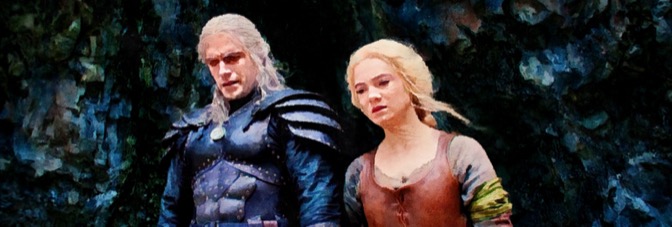
It’s old home week on “The Witcher,” with Anya Chalotra getting back to the Mage Fortress just as MyAnna Buring has finally come to terms with Chalotra’s presumed demise. We also find out when Buring tortured Eamon Farren in the season premiere, and they cut away… they cut away from Buring not finding anything out because Farren’s got a magic brainwashing shield. It’s a month later, with absolute dipshit Lars Mikkelsen suspicious because Chalotra’s been gone so long.
Mikkelsen’s a cartoonishly broad villain, which doesn’t play well off anyone else. I can’t remember if it worked better last season, but here he seems silly playing off very serious Buring, Chalotra, and Royce Pierreson. Pierreson’s back from last season, too—it seems like the reason no one was around the last time they were at Mage Fortress was budgetary, not because the characters had an excuse to be anywhere else.
Chalotra’s got some okay bonding scenes with Buring and Anna Shaffer, but she’s got a deep dark secret, which the show’s heavily implied for the audience, and Buring lays out in dialogue about halfway through. Chalotra’s going to have a strange plot arc this episode, getting involved with Buring and Mahesh Jadu’s political machinations. It’s a lousy arc for Buring, who gets progressively less sympathetic as it plays out.
At the Witcher Winter Wonderland, Henry Cavill and Kim Bodnia have been trying to figure out how a plant monster could breach the walls of their fortress. Though when they do establishing shots and show the broken down sections of the fortress, it doesn’t seem like they should be so surprised. It’s a decent investigation arc for Cavill and Bodnia, which also has them bonding over (surrogate) fatherhood.
But all Cavill’s focusing on helping Bodnia has meant he’s not paying attention to Freya Allan or her training. Or Witcher Paul Bullion deciding he’s going to bully Allan and see if he can get her to hurt herself out of trying to be a Witcher. It shouldn’t be hard since Cavill establishes he and the other boy Witchers are all fast-healing mutants, and Allan’s just a regular human who’ll die.
The show keeps at the training sequence long enough to make it an athletic achievement arc for Allan, right before she and Cavill go monster hunting, and she’s able to stay alive, no matter what occurs. The show also gets around to addressing Allan’s secret magical powers and Cavill knowing about them, which is nice they’re not dragging that bit out. It’s a nice sequence for Cavill and Allan, who haven’t done much bonding because they’re at Winter Wonderland.
There’s also some catchup with evil mage Mimi Ndiweni and elf mage Mecia Simson, who are teaming up to take on the good guys. The show seems to be laying the groundwork for the good guys actually being a bunch of racist shitheels, so… potential twist.
The Allan and Cavill material makes up for Chalotra finding herself in a wanting arc. Chalotra’s okay; it’s just the story. Some very good direction from Sarah O’Gorman throughout. It all works out thanks to Chalotra’s plot getting an actually surprising conclusion with a lot of character agency. Not Mikkelsen, who seems like he’s auditioning to play that villain in “The Smurfs,” but otherwise.
It’s a good episode.
-
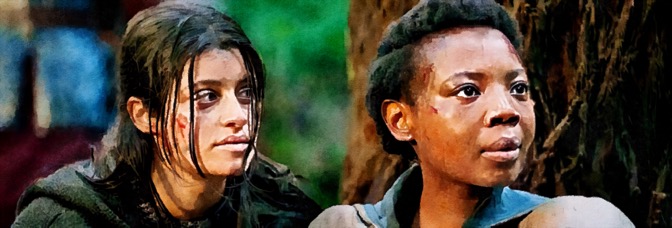
The episode opens with Anya Chalotra having a domestic bliss dream about Henry Cavill. Last season it seemed like “Witcher” was setting up Cavill, Chalotra, and Freya Allan as a surrogate family unit—seemed might be too strong a characterization, but there were definite tones. The dream sequence is very… lovey-dovey. Very unlike “The Witcher.” It goes to a nightmare, sure—a horrific one—but the sentimentality’s interesting.
Chalotra wakes up to discover she and her former classmate, now enemy Mimi Ndiweni are being held prisoner by elves. There’s a bit with the elves before elf magic boss lady Mecia Simson shows up. It turns out Simson, Chalotra, and Ndiweni are all having similar dreams, which will lead to a pretty good episode for them. Simson’s strong, and Ndiweni’s excellent. It’s the first time Ndiweni’s really gotten to do anything on her own—albeit while held prisoner by elves—but she’s real good.
Their plot will involve a Baba Yaga house and a “be careful what you wish for” deal with the proverbial devil. It’s good. And a lot more sympathetic than the A-plot with Cavill and Allan, who finally arrive at the Witcher Winter Wonderland. It’s a keep in the side of a mountain, where all the Witchers get together and get drunk and train and make potions.
Well, if Cavill had his way, they’d be doing those productive activities. But we find out immediately Cavill’s not a Buzz Killington because he’s a Witcher; he’s just a Buzz Killington. The other Witchers are all a barrel of laughs who really want to drink and carouse and make slightly creepy comments about Allan.
Except for Basil Eidenbenz, Cavill’s best friend, who’s just straight up intimidating to Allan.
Kim Bodnia’s the boss Witcher, who rescued all the mutant kids back when and trained them to be Witchers. Cavill clearly models himself off Bodnia, while everyone else is rambunctious.
The plot is ostensibly just Allan and Cavill’s first night in the keep, where Allan’s got to learn not to expect luxury even though she’s a princess (and even though she rarely had any in the first season), but then a monster makes an appearance.
The episode’s been awkwardly foreshadowing the monster the entire episode and how it’s going to appear and why, but it’s still an effective sequence. Cavill and Bodnia have to save the day while Allan’s got to maintain composure. Rather good effects for the show, which often has wanting composite shots. They can do plant monsters just fine, it turns out.
The episode feels very much like the setup for season two—without any apparent Westworldling—with Cavill and Allan figuring out what they’re going to be doing (training her to fight). Then Chalotra’s got her surprise arc of the season.
It’s an all right episode, though the majority of the other Witchers—those with lines, anyway—being a gaggle of jokey, drunken bros is surprising. It seemed like a solemn calling, but they’re just jackasses for the most part. The Chalotra and Ndiweni material is the best.
-

Despite “The Witcher” taking place in a world of magic and monsters, they don’t come up with a cool way to explain why Freya Allan’s all of a sudden got brown eyebrows this season. This episode picks up immediately after last season’s cliffhanger, with Henry Cavill and Allan finally united and trying to find Anya Chalotra. MyAnna Buring’s also trying to find Chalotra, who tapped into the fire magicks to defeat the bad guys last time, and everyone sort of thinks she spontaneously combusted from the effort.
So fire, lots of fire, potentially could’ve singed Allan’s eyebrows, made them visible. Instead of the transparent blonde they were the entire last season. Allan’s aged a little between season filming, no doubt, but with the different eyebrows—it takes a while to get used to her new look. Especially since the season one recap has a bunch of the transparent blonde eyebrows.
After finding out Chalotra’s presumed dead, a stoically mourning Cavill heads toward the Witcher winter palace, Allan in tow. It’s where Witchers go to chill and prepare for a summer of monster hunting. It’s unclear. Especially since the episode opens with a group of travelers stopping in a small village and being picked off by a flying monster. When Cavill and Allan show up in the town, it plays like it’s their destination. But apparently not. Luckily Cavill’s got a friend nearby, and so he takes Allan into a Beauty and the Beast adaptation.
Kristofer Hivju—Tormund from “Game of Thrones” but beastly most of the episode—looks like a warthog man but has a bunch of fun magic and is old friends with Cavill. He doesn’t know anything about the village being empty, also ignore he’s apparently got something living in his attic.
Meanwhile, Buring is back at the Mage Fortress trying to figure out how to get prisoner Eamon Farren to talk. Buring’s upset about Chalotra being dead and will make Farren pay. Except, of course, Chalotra’s not dead; she’s really being held prisoner by Farren’s mage pal, Mimi Ndiweni.
The main plot with Cavill and Allan getting more and more suspicious at Hivju’s, even though he seems trustworthy, is pretty good. It’s maybe not the best adventure for Allan and Cavill if you just binged the first season and were waiting for them to get together, but it’s a well-executed Beauty and the Beast riff. Agnes Born plays a mysterious woman Allan encounters—who knows Allan’s got magic too—and she’s good. It works out, mainly because it finds a good balance for Cavill and Allan.
It’s good because the other plots go nowhere. The Buring plot goes nowhere, while the Chalotra one at least gets to be the cliffhanger. Though they could’ve introduced her being alive and done the cliffhanger as the cliffhanger. The plot’s nothing in between, except a little banter between Chalotra and Ndiweni.
It also doesn’t help for the first half of the episode; I kept trying to see if they were Westworlding the timelines to gin up the narrative like they did last season. They aren’t, and they don’t draw attention to it, but it does imply this season of the “Witcher” will be less manipulative than the first.
-
Back in the early days of comics collections—and I'm talking mid-to-late eighties, pre-Dark Knight Returns, pre-Watchmen—there were occasionally collections on themes. Hitman: For Tomorrow feels very much like a collection of Hitman comics based on the theme. It's writer Garth Ennis leaning in on taking Tommy and friends out of their comfort zones but into ones potentially more familiar to the reader. Then Ennis forces the potentially unsuited zone into Hitman. Like the two-part opener with Tommy having to fight vampires, or later on, there's a 2000 AD homage with a dinosaur, then one of Ennis's first war stories. Ennis is getting a lot more ambitious, asking a lot more from penciler John McCrea and inker Garry Leach. Not just the dinosaur one, but also a four-part John Woo homage. Tommy's romantic problems with Tiegel and general interpersonal relationship problems with everyone else run underneath it all, breaking through to find Ennis waiting for them, ready to incorporate them into the greater narrative.
For Tomorrow collects fourteen issues. There's a two-parter, a four-parter, a done-in-one, then a three-parter, and finally another four-parters. It's a lot of comics, with the general theme being Tommy's recovery from the last collection. This one starts with Tommy having sequestered himself in his apartment to think about his horrific family backstory while he gets drunker and drunker. Natt the Hat comes to pull him out of it, leading to the two having a solemn talk about things. And Ennis, McCrea, and Leach explore the idea of a pitch-black Hitman; Tommy's tragic, and he's doing stoicism to avoid having to feel. Better to keep Tiegel away than share it with her, better to ignore his friends, better to avoid surrogate father Sean entirely rather than confront him about a lifetime's worth of lies.
Luckily, Tommy and friends live in Gotham City, which is going through the No Man's Land crossover, only for Hitman, Ennis does vampires. Vampires have decided Tommy's neighborhood, the Cauldron, is perfect for a vampire paradise, especially since it's full of despicable hitmen who'll no doubt supply the vampires with fresh food. Little do the vampires realize what's in store for them.
Though the entire thing hinges on the vampires not being willing to destroy a Catholic Church because it's shelter and Tommy and pals being thrilled to tear it down. It's really effective, but it also feels very much against the Irish Catholic grain Ennis has been incorporating into the comic from the start. It's a good two-parter; the vampires are appropriately evil and determined but also not as wise as Tommy when they need to be. And it does an excellent job getting Tommy through his personal darkness.
In the background of that two-parter, Sean—bartender to the hitmen and Tommy's surrogate dad—is feeling the strain on their relationship and finding a friend in hitman Ringo Lam.
Since Ennis introduced Ringo way back in Hitman, there's always been discussion of him and Tommy having a shootout to see who's the better gunsel. I'm misusing gunsel intentionally for effect. It's always unclear who's the better killer, and when Tommy bumps into Ringo and his girlfriend, it seems like they're going to find out. Over a woman. Because the girlfriend is Wendy, who dumped Tommy for being a hitman back in issue #6. And she's figured out what Ringo does for a living now too.
Ennis sets up the story with Ringo as the protagonist, quickly leaning into a John Woo homage. I can't figure out if Ringo is more a Chow Yun-fat type or a Tony Leung. Ringo soon finds himself in trouble for a hit he made, and Tommy's around, so the bad guys are after both of them now. And Wendy's in danger. So it's a Hong Kong action movie, albeit one with a superpowered villain (I feel like Ennis would've written a mean Wolverine if they could've gotten him to do it straight); it's a buddy movie, full of heart, full of character development. When Tommy and Ringo are captured, Ringo tells Tommy (and the reader) his life story. Whether Tommy wants to hear it or not.
It ends up being a very nice examination of male friendships and their shortcomings. Ennis writes the hell out of it, all without breaking the genre rules. Though it helps there's a lot of heart in John Woo's Hong Kong action epics. And McCrea and Leach ably handle all the action, which isn't the Hitman normal, if there is such a thing. The series's visual motifs have not been a John Woo movie until this point, and then there are four issues where they have to immediately adapt; McCrea and Leach handle the transition ably. I'm curious how much direction Ennis gave them in the script.
After that four-parter, Ennis takes an issue to get Tommy in trouble with Tiegel and find some resolution with Sean. There's some action and humor, but it's all pretty serious character development stuff. Ennis is very thoughtful with the Sean and Tommy stuff and not with the Tiegel stuff. It all builds to a punchline for Tiegel, but not… really? Ennis, McCrea, and Leach put Tiegel through the objectification ringer—physically and mentally—and then give her a comedy gag punchline. It's memorable for the punchline and the Sean stuff, but it's almost like Ennis needed two issues to get it done. Or maybe just not to have ginned up the Tiegel drama to get her and Tommy on the outs again.
Though there's no time for love in the next arc, which has Tommy and Natt accidentally going on a time-traveling safari to the Jurassic period, messing it up, and letting a bunch of hungry dinosaurs invade Gotham in the present. One of the dinosaurs, a Tyrannosaurus rex, gets close third-person narration (which is where it just feels the most like 2000 AD). Also, a great white hunter dipshit is trying to kill Tommy before the dinosaurs; the hunter led the time travel safari and is mad Tommy screwed it up.
It's a big action story with dinosaurs. It's great. Awesome art. There's not much more to say about it. They go back in time, get to see dinosaurs, bring them back to the future, dinosaurs start eating people. But it's still No Man's Land Gotham, so it's up to Tommy and friends to stop them. It's a bunch of fun without ever being silly. And it's able to get away with never being silly because Ennis, McCrea, and Leach lean into it so much. Until the run in this trade, Ennis was a lot less assured at incorporating the absurdities of a superhero universe into Hitman. He made fun of it, no less. But For Tomorrow's got vampires, unalluring mutants, and dinosaurs. There's lots of absurdity, only they've figured out how to embrace it.
Then it's time for the tour de force finale, which opens with Sean telling the boys at the bar a war story. Only it's from when he was a kid during World War II. There's more background to Sean before Gotham City and bartending (Ennis also doesn't get into the nun he's been carrying on with for decades) throughout the arc, but nothing's ever quite as effective as the first one. Maybe because Sean's a kid and more vulnerable, but also maybe because it's the earliest real Ennis war story I've seen. Or at least, remember seeing. Also, maybe just in the context of the collection—For Tomorrow is often very fantastical, and the finale's very, very grounded.
Sure, the story's about a mob princess wanting Tommy's head on a spike for her wedding present and a legendary hitman—for a while, I was thinking Christopher Walken, but then less him—is going to get it for her. This hitman, Benito Gallo, will stop at nothing, including targeting Tommy's friends. And thanks to Tommy's continued pursuit of Tiegel, she's in the mix too.
Aside from icky stuff with the mob princess and Benito, who's her uncle, the story's all about Tommy, Sean, Tiegel, and the rest bar cast. They're all still sensitive from recent losses and faced with an endless onslaught of bad guys. It becomes a siege situation, which Ennis used in the vampires story; only the mobsters are impervious to sunlight. Plus, Tommy's got everyone he can call in a jam in the jam with him.
It's kind of amazing how much traction Ennis got over Tommy stumbling into a mob meeting where he had to shoot his way out, forever pissing off the mob and leading to this eventual story arc. It's not really intricate plotting, just Ennis knowing how to match the series's momentum with significant events.
Then there's an epilogue issue—which I thought was the last issue because I knew Hitman was always a bubble book and figured they canceled it on them early, so they did a quick wrap-up, but no, there are another ten issues. So the epilogue issue is sort of a repudiation of that DC One Million crossover issue, like Ennis did it again but with a straight face and found the heart underneath it all.
It's a great arc. Excellent character work, possibly a little too much objectification of Tiegel as she reluctantly becomes a badass with the rest of the hitmen, expressive, moody art. The ending—pre-epilogue—has this beautiful, perfectly awful moment for Tommy thanks to his "powers." It'll be hard for the actual series finale to top this one.
But I'm confident Ennis, McCrea, and Leach will do it because they've figured out how to make great Hitman comics, and they're not slowing down.
-

Okay, now I’m “worried.” They’ve only got one episode left, they just introduced the big bad, and it’s a surprise reveal for… streaming media rights disputes geeks (like myself), but otherwise, it’s just a Marvel property. I’d seen the rumors, and then this episode, there are some big hints, but it turns out the villain is someone Jeremy Renner knows, and there’s a big back story he hasn’t been telling anyone about.
And it sets up Alaqua Cox’s “Echo” spin-off for next year or whatever, but it does absolutely nothing for “Hawkeye,” which isn’t great since “Hawkeye” just got a lot fuller this episode. With only one more to go.
The episode opens with Florence Pugh’s post-Black Widow catch-up. Kind of like how Cox got one, but with more jokes, the Blip, and less actual content. Because Pugh’s catch-up is set before Widow’s end titles scene, then when Pugh’s in the actual episode proper, it was obviously shot a lot later.
Pugh’s only in the episode proper to hang out with Hailee Steinfeld, which is simultaneously wonderful and promises of excellent New Avengers interactions. Still, it’s also kind of rushed and shoehorned. There’s only one episode left; any further bonding with Pugh and Steinfeld clearly isn’t happening on “Hawkeye.” But Pugh reveals who hired her to kill Renner—it’s not actually her life’s goal since she thinks he killed ScarJo in Endgame. She’s just in it for the money (in this case, funneled from this series’s surprise villain in the cast to the cameo villain to Julia Louis-Dreyfus’s character from “Falcon and the Winter Soldier”). It kind of ruins Pugh’s motivations, but hopefully, they’ll somehow get her set for her next appearance in the one hour they have left.
This episode’s only forty minutes (nothing pads end titles like CGI credits and dubbing credits), so unless the next one is seventy, there’s going to be something lost in the shuffle. And it seems very much like it’s going to be Renner and Steinfeld’s relationship. They start the episode broken up but get back together after Steinfeld’s run-in with Pugh and Renner donning his ninja assassin outfit to threaten Cox and give her some information for the next episode and her spin-off.
Linda Cardellini appears for a phone call, but it’s not about family stuff; it’s hinting at more reveals. Potentially very cool reveals, just ones the show doesn’t seem to have time to address appropriately. Not when they’re doing double major twists in the last few minutes.
Otherwise, of course, it’s a pretty great episode. The fight scene between Renner and Cox is wanting in terms of choreography, but directors Bert & Bertie are very enthusiastic about the setting. There’s this weird disconnect where they’re clearly trying with shooting the fight but not the fight itself.
Larper, firefighter, and fun sidekick Clayton English is back for a bit. Enough time to showcase how he should’ve been in the show more, or they really should’ve gone eight episodes. Vera Farmiga and Tony Dalton both have good scenes; Fra Fee’s got a good scene—it’s Cox’s best episode too. Lots of good acting. Even when it’s silly like Renner talking to ScarJo beyond the grave (I mean, she doesn’t respond), which Renner nails, but the show hasn’t established and should have.
Steinfeld’s able to keep up with Pugh, who realizes the potential for the Russian super-assassin in the world of Marvel Superheroes like none other.
Some wonderful Christmas music choices, funny moments with the Tracksuit Mafia, and so on… but there’s so much to resolve and still keep it Steinfeld and Renner’s show. They seem more concerned about setting up spin-offs than completing this story.
Fingers, toes, and nose crossed they do right by Kate Bishop.
-
Like most superhero origin stories, Spider-Man: Into the Spider-Verse suffers from some third-act problems. It doesn’t just have a lengthy final fight scene between new Spider-Man (voiced by Shameik Moore) and Kingpin (Liev Schreiber in maybe the film’s only pointless voice casting), it’s got some inherently reduced stakes being an animated movie with a PG rating (i.e., it’s doubtful Moore’s going to die), but also no particular animus between Moore and Schreiber. The film starts with Schreiber disposing of the original Spider-Man (Chris Pine) while Moore watches. Pine isn’t in it long enough to make an impact, but he also isn’t in it so much he’s clearly not making an impact like Schreiber. Pine’s Peter Parker Spider-Man, Moore’s Miles Morales Spider-Man.
But Moore’s just met Pine, and while they do have a quick banter about Pine training Moore, they don’t have a relationship. Not like Moore and pretty much every other character in the movie, including one who’s got a significant relationship with Schreiber and could have a major third act pay-off… but doesn’t because Schreiber’s unaware of it.
Unlike most superhero origin stories, Spider-Verse can pull out of the tailspin for a nice set of epilogues. It’s a montage setting up Moore as the new Spider-Man, which the movie’s been setting up since a few minutes in, so it saves the day.
Kingpin might just be a bad villain, outside Vincent D’Onofrio anyway. He’s also not the point of the story here. Sure, he’s trying to open a portal to other universes to get back his family, unintentionally ripping the fabric of the multiverse and letting various Spider-People in from alternate dimensions, only for Moore’s universe to reject their cells and slowly destroy them. So while Schreiber’s responsible for the stakes, he’s really got nothing to do with them.
Enough complaining, however, because Spider-Verse is otherwise a joyful, heartbreaking trip through the Spider-Man mythos. Yes, there’s Moore’s journey to taking up the mantle, but there’s also a bunch of other Spider-People who all inform the mythos one way or another. Principally, there’s Jake Johnson as a forty-something loser version of Spider-Man; he’s like the Pine variant gone wrong, which made me assume he did the voice for the first Peter Parker Spider-Man too. Pine’s seriously not in it enough for it to matter. Johnson reluctantly becomes Moore’s mentor and has the best character arc of the Spider-People.
Mainly because no one else has any stakes other than surviving the movie. Johnson’s learned to love the web again thanks to his adventures with Moore. Plus, Johnson’s from a universe where he’s lost people, and they’re still around in this one.
Then there’s Hailee Steinfeld’s Spider-Woman (or Spider-Gwen). She’s the “What If the Spider Bit Gwen Stacy and Not Peter Parker” issue. Steinfeld’s delightful, probably the second-best performance in the film—Moore’s far and away the best—she just doesn’t have any conflict. The film presents short origin stories for all the Spider-People, starting with Pine’s Spider-Man, and Steinfeld’s gives her some gravitas just nowhere to use it. She’s trapped in another universe, nothing else.
Ditto Nicolas Cage’s Spider-Man Noir, who’s a gag turned into an exemplary supporting cast member—he gets played for laughs the entire time—Kimiko Glenn’s Peni Parker (she’s from a manga future), and then John Mulaney’s Peter Porker, the Spectacular Spider-Ham. He’s from a cartoon universe. Except it’s an animated movie where the very fabric of reality is tearing so it’s frequently cartoony even when Mulaney’s not around. Glenn’s sympathetic, Mulaney’s fine, Cage’s fun. But the best of the Spider-Friends outside the central trio (who don’t get to be the central trio for long enough) is Lily Tomlin’s Aunt May. She’s the tech brains behind Spider-Man, and it’s a wonderful turn.
So all those Spider-People need to get home and stop Schreiber from destroying this universe while Moore’s also dealing with family issues. Dad Brian Tyree Henry is pressuring Moore to go to an elite private school, where Moore’s class and race set him apart from the rest of the students. He just wishes he could stay in Brooklyn and hang out with his uncle, played by Mahershala Ali. Mom Luna Lauren Velez is in the movie so little you’d think Christopher Nolan wrote it.
Henry makes it known right off he doesn’t like web-slinging vigilantes, making him the wrong person for Moore to consult about his new spider-powers. Worse, Ali’s got a complicated relationship with Spider-Man, too, cutting Moore off from his family.
The movie tries to play up the family angle at the end, but it doesn’t work. It’s another third act stumble to recover from, and it does.
Great direction and animation—it almost always emphasizes the emotionality of the situations the characters find themselves in, finding the sadness at the core of the Spider-Man character and relating it not just between inter-dimensional Spider-People, but also to the core of regular people. It’s an incredibly thoughtful, deliberate exploration of the character through variants of that character. Like, very cool work from writers Phil Lord and Rodney Rothman. They discover something exceptional in Spider-Verse.
The direction and animation are also crucial. Particularly for the pacing. Spider-Verse gets to speed up and slow down using devices not just from film and animation but also incorporating comic book techniques. The comic book style stuff works out great, which is another reason the busy, neat, action-packed, and dramatic finale still comes up short. It doesn’t fulfill the creative ambitions in the rest of the picture.
Excellent music from Daniel Pemberton and then the soundtrack selections as well. And not just because they use the St. Elmo’s Fire song for some reason; it’s kind of awesome when they do.
Spider-Verse is so one of a kind and wonderful, I’ve forgotten to mention Kathryn Hahn until this point. She’s the scientist who’s trying to unlock the multiverse and turns out to be more tied to the Spider-People than it first appears. She goes from being Schreiber’a seemingly unwitting flunky to being the best villain in the movie. It’s not a particularly high bar, of course, but there’s an excellent surprise runner-up to her before it’s all the way down the hill to Schreiber.
Tombstone shows up for a bit, which is cool, but he’s background more than an actual villain.
Spider-Verse is a fantastic motion picture. Moore, Stenfield, and—to a lesser extent—Johnson create some very special characters. Well, along with the animation team, who do phenomenal work on the performances. The voice acting’s great, but the animators make sure the visuals are equal in caliber. Maybe another reason Schreiber’s Kingpin is so wanting, they don’t give him anywhere near the expressiveness of the rest of the characters.
It’s great. Especially since they’re able to save the end… though the end credits tag is utterly skippable. It’s technically and culturally amusing but too slight after the main action.
-

A collection of film responses discussing the JAWS movies, starting with the 1975 original directed by Steven Spielberg and ending with the 1987 sequel, JAWS: THE REVENGE, directed by Joseph Sargent. Discusses all four entries in the franchise. -

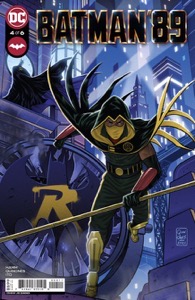
I’m verklempt. I wasn’t expecting to be verklempt. But writer Sam Hamm is going for it with Batman ‘89, with artist Joe Quinones going along with all of it—try to make a community march, but in Tim Burton’s Gotham City, you got it—and this issue might be where the elevation is permanent. Hamm’s taken this goofy, craven comic book tchotchke and made it special.
And not even because it made me verklempt. I got verklempt in the opening, which is about many Black Gothamites marching after Harvey Dent’s injury and resulting hospitalization. They’re marching in support of Harvey and his renewed mission for a more equitable Gotham City. Commissioner Gordon—mostly off-page—has guaranteed them the cops will be there to help, not hinder. All the church leaders are there; the news is there; it’d take a real asshole to screw it up.
That asshole is Lieutenant Harvey Bullock, who’s a racist piece of shit and is going to attack all the marchers and toss them in jail because it’ll teach them to behave. I’m still unsure who, if anyone, Quinones and Hamm have in mind for the Bullock “casting.”
But then Bullock’s attempts to sabotage the march go wrong when Robin shows up, distributing spray paint and smoke bombs and giving the marchers a chance. Now, since it’s a comic book set in a movie universe, the cops are only using rubber bullets—which are not non-lethal and quite dangerous—so there’s still little danger to the marchers. But thanks to Robin, there’s enough time for Gordon to show up for Pat Hingle’s one-panel cameo. I think it’s got to be a joke about how little Hingle’s in the movies.
Or maybe his estate’s litigious.
Anyway.
After that opening, it’s incredible Hamm’s going to try to flex some more, and flex he does. First, the Harvey in the hospital subplot, which involves Barbara Gordon. She’ll get her own subplot with Selina Kyle (who doesn’t look much like Michelle Pfeiffer, but it’s still cool to see professional, not boss-murdery Selina in action); they don’t quite pass Bechdel, but it’s more because the system’s patriarchal and sexist. Like, they actually don’t have anything else to talk about in their scene.
We get some insight into Harvey and Two-Face, who argue, which is interesting. There are also a bunch of Superman: The Movie homages with Harvey’s escape from the cops and eventual lair, which is neat. It’d have been really cute in a movie in 1995 or whatever.
But the other big swing and hit from Hamm is introducing (Not Tim) Drake Winston to Bruce Wayne. Drake’s pretty sure Wayne’s Batman, for a bunch of good reasons—including some funny ones—and he’s trying to suss out his suspicions. Meanwhile, thanks to Alfred, Bruce has just discovered his great grand-daddy put Drake’s great grand-daddy out of business on a shitty white man whim once upon a time. So there’s this uncomfortable depth to the relationship immediately, even before it turns into Michael Keaton—even a dramatic Michael Keaton—playing straight man in comedy scenes. But then it worked out perfectly.
There are only two more issues, and who knows how this book has sold but damn, I hope they get another one. I’m not familiar enough with this genre—which, for the longest time, was solely the purview of Stars Wars and Treks—Hamm and Quinones seem primed to fully legitimize it as an artistic endeavor.
-

A critical guide discussing the first four years of AGENTS OF ATLAS, a Marvel Comics series written by Jeff Parker, with art by Leonard Kirk, Carlo Pagulayan, Clayton Henry, Gabriel Hardman, and Many Others. Covers AGENTS OF ATLAS (2006 and 2009 series), X-MEN VERSUS AGENTS OF ATLAS, THE INCREDIBLE HERCULES backups, AVENGERS VS. ATLAS, and MARVEL BOY: THE URANIAN. The first lineup was composed of characters originally appearing in unrelated stories published in the 1950s by Marvel's predecessor company, Atlas Comics. The roster consists of Namora, Venus, Marvel Boy/the Uranian, the Gorilla-Man, M-11/the Human Robot, and Jimmy Woo. -

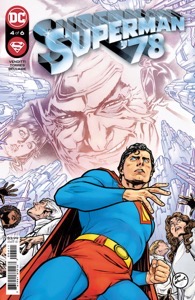
Well, it’s easily Robert Venditti’s best writing of the series so far. After an utterly pointless waste of a couple pages on Brainiac’s origin story, we get to Kal-El in the Bottle City of Kandor. Where, surprise, it’s not the adventures of Nightwing and Flamebird, but the continued adventures of Marlon Brando and Susannah York. Yes, Superman ’78 is what could’ve been if Brando had been as desperate in 1983 as he would be in the nineties or whatever.
Brando’s Jor-El is thrilled to have his son back because now he can make Kal-El become a politician and figure out all the problems of living in a finite bottle city. But, of course, Kal-El just wants to put on the tights and head back to Earth, not be a politician.
Luckily, Lex Luthor slipped an interstellar transmitter on him and can communicate, but that communication only pisses off Brainiac, who heads back to Earth. But what if Luthor’s gadget could somehow bring Kal-El back to regular size so he could defeat Brainiac and save Earth? Sure would be weird if his mom was like, nah, to hell with those humans.
Now, when I say it’s Venditti’s best writing, I mean it’s a terrible comic book adaptation of a not-bad movie. Like if they’d gotten Jeannot Szwarc to do Superman III and given him a bunch of money and a decent script. It’s the first and only time Christopher Reeve Superman has gotten to think about himself as anything but the last son of Krypton and whatnot.
So it’s an added bummer Wilfredo Torres can’t seem to figure out how to draw it. This comic is cursed. When Venditti’s writing to Torres’s strengths, all Venditti’s doing is regurgitating Superman: The Movie and The Sequels scenes. When Venditti actually finds a plot, Torres is lost trying to make his Reeve Superman “act.”
There’s some terrible stuff from Venditti, to be sure. Not just the Brainiac intro, but also Gene Hackman Lex Luthor, and Margot Kidder Lois Lane. Venditti writes them both particularly badly, especially when together. But at least Torres is on the ball drawing those scenes. The stuff “on Krypton”? Not so much. Though his Marlon Brando’s always on point. The less said about Susannah York Lara, the better.
There’s no way to save Superman ’78 but I really didn’t think Venditti had even the limited good ideas of this issue in him, so I guess it’s a plus. Like, it implied the possibility of a good movie for this series to be poorly adapting, which has never happened before.
Shame about the Torres art, though. Hopefully, it gets back on track.
-
A critical episode guide discussing the all fifteen first season episodes of the CW television show, Superman & Lois. The show stars Tyler Hoechlin, Elizabeth Tulloch, Jordan Elsass, Alex Garfin, Erik Valdez, Inde Navarrette, Emmanuelle Chriqui, Wolé Parks, and Adam Rayner. -

It’s a shorter episode, but a lot is going on. Especially since it’s often a bridging episode setting up the rest of the season, which is only two more episodes, which is frankly terrifying given all they’ve got to do.
But more on that bit later (I’ve been thinking “Hawkeye” ran eight, not six, so I wasn’t thinking about it while watching).
The episode opens with a quick resolve of Tony Dalton discovering Jeremy Renner snooping around his apartment and quickly gets into an awkward introduction scene for Renner and Hailee Steinfeld’s family. Complete with Vera Farmiga being very suspicious (after asking Renner to finish his case without Steinfeld’s help). Then Renner immediately finds out Dalton’s laundering money for the Tracksuit Mafia. So lots of potential drama.
For later. Because then there’s this lovely scene with Steinfeld getting to see what mom Farmiga sees in Dalton, and it’s this touching Christmas family scene.
That touching Christmas family scene gives way to Steinfeld crashing Renner’s night—spent sitting around by himself covered in ice packs. He has a family phone call—Linda Cardellini gets her cameo—but then he’s sad and solo. Until new best friend Steinfeld arrives and they have a fun night.
The show’s doing a fantastic job with their character relationship, mixing in Renner’s Black Widow-related regrets (though not missing the solo movie), and setting up an echo—no pun intended—for later in the episode. It’s a pronounced echo, but a very good one.
After some amusing scenes with Renner threatening bad guy Fra Fee and Steinfeld hanging out with the larpers from before (and introducing something for later), they’re back on assignment. There’s a Rolex MacGuffin from Avengers mansion—sorry, sorry, Avengers tower—which could give away the location of a hidden Avenger or something. It’s going to be one of the later reveals, which they only have two episodes for.
There are also two more reveals coming up for Renner because it turns out villain Alaqua Cox is stalking his family, and there’s a very special guest star hunting him down on the rooftops. On Steinfeld’s side, the hard truths about Farmiga and Dalton are coming up. I don’t think she’s got anything else outstanding.
So they’ve got four to six plot threads to resolve—let’s not forget Renner’s still got to make it home for Christmas—in two episodes. I really hope they pull it off.
Very nice work from Steinfeld and Renner this episode. Since Farmiga and Dalton are suspicious more than anything else, there’s only so much they can do. If it ends well, “Hawkeye”’s going to rewatch spectacularly. Especially as a Christmas-time binge watch. If they don’t at least make it a great Christmas story….
The big fight scene is the only thing wrong with the episode—outside it potentially setting up the series to stumble. It’s a complicated New York rooftop fight, full of laughs and action, and directors Bert & Bertie do a fine job shooting it… but they don’t care at all about the fight choreography. Yes, “Hawkeye”’s a show about archers and arrows, but if they’re going to do fisticuffs, make the fisticuffs interesting to look at. Unfortunately, it’s almost like they’re doing an anti-Netflix Marvel show with their aversion to good fight choreography.
I really hope they pull this one off. Steinfeld and Renner deserve it.
As do Kate Bishop fans.
 The Stop Button