A critical episode guide discussing the all fifteen fifth-season episodes of the CW Arrowverse show, Legends of Tomorrow. The show stars Caity Lotz, Tala Ashe, Jes Macallan, Olivia Swann, Amy Louise Pemberton, Nick Zano, Dominic Purcell, Matt Ryan, Adam Tsekhman, Shayan Sobhian, and Lisseth Chavez and is based on characters from DC Comics and Magazines.
-
-

Halloween 4: The Return of Michael Myers (1988) – 709 Meridian
With the end of season one (and Halloween) in sight, D and Andrew get back to the original timeline with 1988's RETURN OF MICHAEL MYERS, when the franchise still got recognizable character actors, Donald Pleasence did stunts (sort of), and the movies weren't stupefyingly bad.WHERE TO LISTEN

Apple Podcasts 
Spotify 
Stitcher 
RSS 
YouTube -

A critical episode guide discussing the all eight season one episodes of the Netflix streaming crime documentary, Tiger King: Murder, Mayhem and Madness. The series is about the life of former zookeeper and convicted felon Joe Exotic. The series focuses on the small but deeply interconnected society of big cat conservationists such as Carole Baskin, owner of Big Cat Rescue, and collectors such as Exotic, whom Baskin accuses of abusing and exploiting wild animals. -

Well. Here I thought this episode was the season finale. It’s not. It’s the end of “Resident Alien: Season Two: Part One.” Another eight episodes are coming later. Things make a little more sense (though they may have introduced more in this episode than they can resolve in another eight). The episode ends on a big cliffhanger, with all sorts of future connotations, after an episode where everything’s got different connotations for the future. Starting with the first scene, which introduces another alien species on Earth, seemingly protecting aliens from Linda Hamilton’s evil general.
Though maybe not, based on some of the later revelations in the episode.
Some developments are even more impressive with the episode not being the finale. They got a lot done in eight episodes, giving numerous cast members full arcs. Much of the episode involves Levi Fiehler and Meredith Garretson getting annoyed with one another at Alan Tudyk’s impromptu surprise birthday party. Tudyk and Sara Tomko are just back from a trip to New York, with an (unbeknownst to them) hatching alien egg in tow.
Garretson’s freaking out about a possible pregnancy, with Alice Wetterlund her only confidant. Unfortunately, Wetterlund’s keeping some secrets from Garretson about her and Fiehler. It’s a very complicated, very volatile situation, even without an alien baby due any minute. Plus, Gracelyn Awad Rinke has just discovered Judah Prehn probably got the town doctor kidnapped by Hamilton and wants to rush and tell Tomko. Only it’s not safe to go outside.
Deputy Elizabeth Bowen also gets an arc about her alien encounter memories, which she gets to share with her newly introduced (to the show) husband, Trevor Carroll. No doubt, it’s set up for a “Season Two: Part Two” subplot, but when you think it’s the finale, it just seems like some nice character development for Bowen. Sheriff Corey Reynolds gets something similar, finally working through his grieving over a dead partner. Though Reynolds is mostly around for the one-liners. He’s hilarious and seemingly the only guest who’s fully aware Fiehler’s got ulterior motives for throwing the bash, which doesn’t even end up being important because there’s so much other stuff.
And not just with Fiehler and Garretson.
It’s a very, very full episode—Tudyk’s got an entire alien baby care arc, and then Tomko has a small but significant one with daughter Kaylayla Raine.
Claudia Yarmy’s direction is solid; she gives the actors enough time and space, taking advantage of the background to keep other plots moving, and the jokes coming. Reynolds has a few times he’s just behind the main action telling jokes. I’m not sure the show’s ever brought the whole cast together before—there are ten adults plus two kids. And Diana Bang has a great, short bit as Rinke and Prehn’s babysitter.
Show creator Chris Sheridan gets the script credit. He does well with so much going on in a short present action (a few hours at most).
I had fully prepared myself for “Resident Alien” to lose its renewal chicken. The acting’s way too good in a way too peculiar show. But knowing it’s just on a mid-season hiatus? I can just appreciate its considerable successes (Tomko’s particularly great this episode) and eagerly await its return.
-
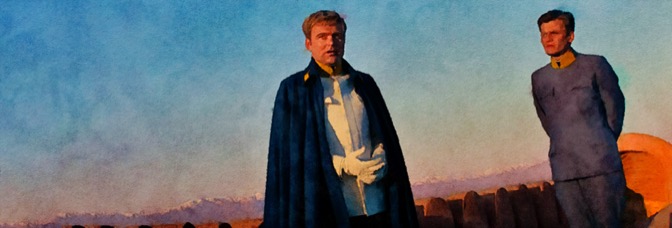
The Desert of the Tartars is a warless war epic. Set at a remote desert fort, a young officer (Jacques Perrin) discovers army life isn’t what he was expecting. The film opens with Perrin leaving home, ready for the great fortune awaiting him, only to learn he’s been assigned to the ass-end of nowhere. The fort, commanded by Vittorio Gassman, is between a vast desert, where once upon a time lived and warred the Tartars, and a foreign power to the north. There’s uneasy peace with the north, desert to the south, nothing for the men to do but wait and wonder if they’ll ever see battle.
With a couple exceptions, the film ignores the enlisted men. Principally there’s Francisco Rabal, who’s in Perrin’s platoon; Perrin turns to him for advice the first time he thinks he sees something in the desert. You’re never supposed to see anything in the desert, lest you act on it, and end up like the fort’s captain, Max von Sydow. Ten years before, von Sydow sounded the alarm and got everyone very worked up… only for there to be no invading army. So instead of becoming a war hero, von Sydow’s become another of the fort’s forgotten officers, waiting and hoping for eventual glory.
The film’s first half takes place over Perrin’s first four to six months at the fort. The first four are clearly delineated, as Perrin’s got to wait for general Philippe Noiret to arrive and sign his transfer orders. Perrin arranged with the fort’s major, Giuliano Gemma, for the fort doctor, Jean-Louis Trintignant, to give him a medical out. Perrin doesn’t understand why Gemma’s helping him—Perrin gives the assignment only a few days (at most) before trying to get out and doesn’t want to file for an official transfer because it’d look bad. It takes the film a while to observe Gemma’s behavior enough to explain his altruism in the matter—Gemma resents the upper-class officer core in the fort and doesn’t want to share the eventual glory.
Trintignant is willing to help Perrin but would never consider leaving himself. There’s an unspoken agreement between the officers to not abandon one another or the fort, especially not when one of them, Laurent Terzieff, is deathly ill. Turns out the fort has mold growing in its walls, and, if it gets you sick, you never get better. But Terzieff’s not willing to abandon his duty, being royalty and all, which confuses Gemma but not the rest of the officers.
So much of Tartars, at least in the first and second acts, is a society drama with dress uniforms, occasional military exercises, and foreboding dread. The other important officer is Helmut Griem. Griem, Terzieff, and Perrin all serve under von Sydow; there are some other lieutenants around, but the film never shows their commands, if they have any.
Fernando Rey plays the only officer to have seen any action; everyone needs to pitch in and help him since he’s got a broken back from the experience. He’s not eagerly anticipating an invasion or any glory.
The first six months of Perrin’s assignment will be more consequential than the rest of it, with the fort suffering enough tragedy to lose its stature. The failure and tragedy play out on all the officers, who find themselves looking out into the empty desert to stay occupied; they can look out and remember to dream of glorious battle instead of looking around at the various failures in leadership and camaraderie.
The second half of the film takes place over an indeterminate number of years, with Perrin aging along with his peers, unprepared for how the years of waiting will affect them all.
Director and co-screenwriter Zurlini sustains a languid, lyrical pacing for almost a full hour (Tartars runs two hours and twenty minutes, never feeling it). Much more happens in the first hour, but because there are more people around, Zurlini keeps and maintains the same narrative distance throughout, approximately eight feet away from Perrin at all times. It’s a character study, just one without much detail. The film doesn’t dwell too deep into the characters’ personal lives or thoughts—outside their formal or professional interactions, we don’t see anything of the character relationships. Perrin and Griem are good friends, for example, but outside how they exhibit that friendship on duty, we don’t see it. Other characters have similarly opaque relationships, with aristocratic pride and privacy enforcing the haziness. Tartars, especially in the first half, is a fascinating character drama.
The most pay-off the film ever allows is Gemma’s arc about not being high enough class to understand how the rest of the officers feel. Otherwise, the characters remain private and separated from one another. One subplot involves the fort’s enlisted men organizing and acting out, but Zurlini still keeps it at a distance. Duty requires the officers not to address it, but their subsequent inability to process it will congeal into very particular morale rot.
The second half of the film becomes far more concerned with the endless waiting, with Perrin unexpectedly having to endure more of the remote assignment and how his peers change. Perrin becomes disillusioned and more and more isolated, mentally and physically. By the end of the film, the fort’s officers more haunt it than serve it, the empty years of anticipation eating them away, nothing left but a someday glory.
Zurlini ends the film more empathetic than sympathetic with the characters. They’re all too far gone by the end, too broken to remember when they weren’t, the fort literally poisoning them.
Tartars is technically exceptional, with Zurlini, cinematographer Luciano Tovoli, editors Franco Arcalli and Raimondo Crociani, production designer Giancarlo Bartolini Salimbeni (who also worked on costumes), and other costume designer Sissi Parravicini all doing spectacular work. The costumes are essential in the first act, tracking Perrin’s acceptance into the fort’s “society.” Zurlini and Tovoli shoot a magnificent picture. And then there’s Ennis Morricone’s outstanding score. Morricone’s music needs to do a lot in the second half, and it’s always a success.
Most of the performances are excellent; the rest are just exceptionally good. Gassman, Gemma, and von Sydow are the standouts. And Rabal, who’s not around as much once Perrin gets in with the officers.
Desert of the Tartars is a superb film. It’s nimble with a lengthy runtime and a long present action, with Zurlini knowing just when to slow down and when to turn the haunting and the dread up to eleven.
It’s glorious.
This post is part of the Bustles and Bonnets: Costume Blogathon hosted by Gabriela of Pale Writer and Paul of Silver Screen Classics.

-
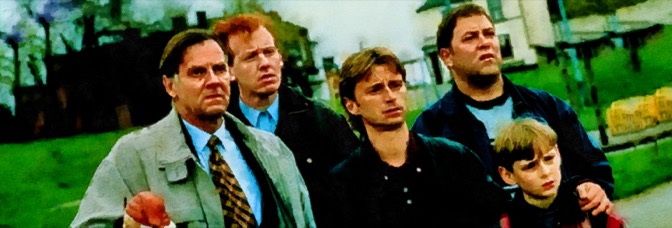
During The Full Monty’s opening titles, an old promotional film plays, establishing the setting. Sheffield during its glory days, when they produced the best steel in the world. Or at least could make a promotional film saying they did. In the present, the steel mills have closed—and been closed about six months—and the former employees are either on the dole or working lousy jobs. The first scene is former steelworkers Robert Carlyle and Mark Addy breaking into the mill to steal metal; divorced dad Carlyle brings along his son, Wim Snape, who’s more embarrassed than scared.
Carlyle and Addy share the film’s protagonist spot. Carlyle’s got the active plot: trying to put together a male strip routine and make some fast cash. Addy’s got the more passive: he’s worried he’s losing with Lesley Sharp and becomes fixated on being overweight once the strip routine talk starts.
They get the stripping idea when they find out how much the visiting Chippendales made. There are several problems, starting with them not knowing how to dance, not being able to afford a venue, not having enough dancers. But once they cajole former mill foreman Tom Wilkinson into helping them (he can dance and has basic organizational skills), things start coming together. Thanks to new friend Steve Huison—a former mill worker who ended up as security guard to the empty buildings—they’ve got a place to rehearse and a fourth dancer. They find a couple more reasonably quick—Paul Barber and Hugo Speer—and then they just need to learn how to dance.
Along the way, in addition to Addy’s self-fulfilling problems with Sharp, Carlyle butts heads with ex-wife Emily Woof over child support, and Wilkinson’s got a subplot about lying to wife Deirdre Costello. She thinks he’s still got a job (after six months). Presumably, she doesn’t think he still works at the closed mill, but it’s never explained. Monty doesn’t delve too much into its characters’ personal lives (other than Addy). Huison’s most significant scene is his introduction, while Barber and Speer get little moments but not much substance. It’s all ensemble for the supporting players.
And it works. Because no one gets too much time, everyone gets to have a reveal or two. Sometimes the reveals are just to keep the plot going, but there are character development ones too. Even without character development arcs, the actors do a great job implying.
Of the three leads—Carlyle, Addy, and Wilkinson—the best arc is Addy’s; it’s also the most consequential. The best-acted one is Wilkinson’s. Carlyle and Addy are both good, especially given how long it takes the film to get to Addy, but Wilkinson’s performance is transfixing from his first scene. The part could be a caricature. Instead, Wilkinson gives it immediate depth, which isn’t easy since he starts the movie as a comic foil for Carlyle and Addy’s buffoonery. The film uses the first act, “getting the team together,” arc to humanize Carlyle and Addy past initial sympathy. And that arc hinges on Wilkinson. Snape’s important as well—Snape’s kind of Carlyle’s conscience because tween boys are more emotionally aware than Monty’s adult men.
At the core of all the men’s problems—including supporting players like Barber and Speer—is their inability to express themselves to anyone. Not to each other, not to their partners, not to themselves. For Addy and Wilkinson, it might not be too late, whereas Carlyle’s already lost wife Woof to new dude Paul Butterworth, who’s a complete prick. But Carlyle might still have a shot at being a good dad to Snape.
Monty’s technically solid. Director Cattaneo balances the comedy and drama well; since the film is so terse, he can maintain a considerable narrative distance, so the situations never seem too dire. Or never seem too dire too long. They’re usually able to navigate hurdles in a couple scenes.
Lovely photography from John de Borman, whose lighting finds the warmth in the grimy, permanently overcast Sheffield. The scenery is drab; the characters’ experience of it is not.
Then Anne Dudley’s score brings a lot of personality to the film. It’s one of Monty’s essential elements; Dudley’s music, Addy, Carlyle, Wilkinson, Snape. It wouldn’t work without them. Plus Simon Beaufoy’s script. The script contrasts humor and tragedy, introducing the characters’ humanity in that mix, then the actors run with that sketch.
The film’s also got a great soundtrack—as the boys try to select their music—utilizing Donna Summer’s Hot Stuff to fantastic effect.
The Full Monty’s good stuff.
-
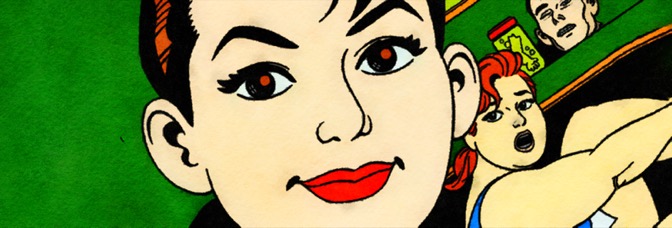

Once again, creator Jaime Hernandez surprises with Penny Century. This issue features the first appearance of Maggie’s husband, T.C. (short for Tony “Top Cat” Chase). However, that appearance comes with a big asterisk. The character doesn’t show up, just his face. Well, his head. See, the issue’s all a dream, and Maggie’s working out some stuff.
She’s conflicted about the divorce, her feelings for Hopey, and still recovering from her traumatic night of driving a few issues back. Even without a corporeal ghoul in her backseat, the experience was still harrowing enough to stick with her. Jaime’s got a few existing Penny threads running through the story—including ones it doesn’t make sense for Maggie to know to dream about—and this issue’s the first time Maggie’s had a story from her perspective since the lonely drive one.
It’s also the first time the reader gets to hear about Maggie’s marriage from her.
There aren’t many details on that front. Maggie thinks about how not many people knew about the marriage (Jaime doesn’t break the fourth wall with a wink, but it’s almost there) and remembers some scant details about her time with T.C., mostly in contrast with Hopey.
Maggie’s dream—and the issue—is about a race. She starts the race by dropping out and going for a walk instead. Her walk leads her to Izzy, dressed as a witch and plowing a yard, not in Hoppers; they have a brief reuniting moment (I don’t think they’ve had a scene together in Penny) before Izzy starts worrying about her next public speaking engagement and shrinks. When she’s worried, she shrinks (for Maggie). It’ll be relevant later since she previously grew for Penny and Hopey.
And not in their dreams. Penny’s wall between dreams and reality is tenuous.
The next stop is a cocktail party where the eclectic, obnoxious high-brow guests make fun of Maggie. Once she’s done with them, Jaime introduces the plot foil—someone’s following Maggie. In the distance, the person’s just a little stick figure, no details; up close, they will be wearing a black bodysuit, their face covered until the reveal.
Wait, there’s also a little imp who usually lives inside Maggie and causes all her mistakes, only in this dream it’s out in the world with her and can directly attack her. Can’t forget the little imp.
Who doesn’t not resemble Hopey.
Hopey and Penny eventually show up in the dream, along with Norma, a new character and mutual friend of the gang who Jaime introduced last issue at the very end.
That tenuous wall between dream and reality comes back into play with Penny talking to Maggie about her current adventures (on the moon, running away from settling her dead husband’s estate) and her previous ones, covered in the comic, but without Maggie around. So either someone told Maggie about them or Penny Century’s reality is both dream and not.
It’s a good, fun, thoughtful story, with Jaime and Maggie working out a bunch. The art’s fantastic; since she’s encountering new things every few panels, sometimes dream-like things, Jaime gets to do one excellent reaction shot after another. Jaime does eight panels a page for the entire story (minus the title splash), and Maggie’s got fantastic expressions in about six of them. There’s also a visual deep cut back to old Love and Rockets; one Beto also did more recently in New Love.
Then the color strip on the back cover has Maggie and Hopey—in L.A. but seemingly in their earlier, punkier days—seeing Mini Rivero on the street and Hopey explaining about her fifties local access show, which Jaime’s been using as a strip. It’s a neat little strip, also bringing in some proverbial Rockets.
So the story’s good—it’s a great dream story, but with the caveats as a dream, it can’t be as tangible—and the art’s fabulous. One more Penny Century to go. As usual, I can’t imagine where Jaime’s going with it, but I’m confident it’ll be good….
I’m going to miss this book.
-

So, Rob Hanning gets the script credit this episode; his name stood out but not because of his “Equalizer” work. He used to write on “Frasier.” He did another “Equalizer” too, the relatively good episode with Chris Noth saving his son; an inglorious distinction, to be sure. But Hanning’s name stood out.
And his episode is a mix of Midnight Run and Oliver Twist. Just a straight mix of the two. Not the Liza Lapira subplot—she tells best friend Christina Brucato how husband Adam Goldberg’s actually alive, and Lapira’s been lying to Brucato for years about it. The subplot’s not good. Brucato’s profoundly unlikable.
But Oliver Twist J.J. Wynder is good. He’s a teen car thief who works for Alphonso Walker Jr. And then the Charles Gordon analog, Josh Cooke, is mostly good. Cooke’s got a weird, rushed romance subplot with Walker’s abused girlfriend, Louisa Krause. It’s a strange addition to the episode, which must’ve been stretching to make its runtime.
Cooke’s Queen Latifah’s client this episode. He’s a mob accountant who got a conscience—which makes him analogous to Wynder, eventually—only Wynder stole his car, and the ledger they need is in the car. The feds won’t have anything to do with him without the paperwork; if they just followed him around, they could get the mobsters for multiple murder attempts.
So Latifah’s got to keep Cooke alive while getting involved with Wynder, Walker, and Krause. There are double-crosses, missed connections, and a lot of botany talk. Cooke’s a green thumb.
It’s mostly amusing because Latifah and Cooke are fun together. He’s in way over his head in every situation, usually comically or awkwardly. Then Latifah decides to help out Wynder, leading to odd couple interactions for him and Cooke.
Despite there being quite a bit of danger, given Walker, given the mobsters, it’s kind of a light episode. At least for Latifah. Lapira’s subplot is pointlessly intense. Even if Brucato didn’t know Goldberg was a CIA hacker or whatever, she must’ve known Lapira was a Special Forces sniper and would have some correspondingly intense adventures. Or not. The only thing we find out about Brucato and Lapira’s friendship is they’ve known each other forever, and they like doing shots.
The good subplot is Laya DeLeon Hayes and Lorraine Toussaint playing spades against Toussaint’s rivals. Toussaint’s regular partner calls out, and Hayes has to sit in, leading to an amusing subplot. Toussaint and Hayes’s performances are delightful, even though the subplot doesn’t get any real resolution.
The end’s a little tepid too. While the show never gives up on Latifah’s relationship with Wynter, Cooke suddenly becomes the hero in a romantic comedy thriller, not the guest star on an “Equalizer.” It’s also unclear how much a better performance in Krause’s part would help; in addition to Krause’s performance being lackluster, she and Cooke don’t have any chemistry. It doesn’t help she’s in an abusive relationship and he’s doing a nerdy white knight whing. But also… Krause isn’t good.
The episode starts better than it finishes and never fulfills most of its promise. Wynter would make a good regular or recurring sidekick for Latifah. Especially if he doesn’t bring annoying guest stars like Brucato along.
-

Either “Upload” decided to be just another 2022 show and play chicken with its renewal post-reduced Covid-19 lockdown season, or they ran out of time to shoot the whole season. As a result, this episode feels like a great mid-season breakpoint, not a season finale. It’s got three massive cliffhangers, one semi-resolution to an outstanding arc, one big whiff instead of a resolution, and one natural character development moment.
It’s a slightly longer episode than usual—closer to forty minutes than thirty—because there’s just so much to do, starting with Robbie Amell and Andy Allo coming up with a plan to foil the bad guys’ plan. That plan involves shifting the voting demographics in swing states, which is entirely shoehorned into the show; it’s a contrived crisis, starting last episode.
Anyway.
They need to get Amell’s retina scan to save the United States, basically. Except Amell’s dead and his avatar in the digital afterlife uses templates when you zoom into the eyes close enough. Though there’s a great scene with Allo gazing into Amell’s eyes, and who cares if the plot’s contrived.
Luckily, as the audience found out at the very end of the previous episode, Allegra Edwards has cloned Amell so she can reinsert his personality into the brain. Of course, Amell knows nothing about it, but Edwards is going to reward him with the information once he signs on the dotted line for having a creepy virtual baby with her.
Except, of course, the process for reinserting personalities into clones results in the subject’s head exploding. This subplot also seems a little rushed, like if they’d had a couple more episodes to the season, it wouldn’t feel so abrupt. They’ve been testing the procedure on pigeons, which leads to some funny (but, you know, not nice to pigeon) scenes.
But in addition to Edwards’s cooperation, they’re also going to need help from the Luds. Allo has to convince the Christian fundamentalist terrorist pastor Peter Bryant, and she’s not getting much help from now ex-boyfriend Paulo Costanzo. But she does get an unlikely supporter in fellow double agent Josh Banday, who thinks Allo’s really cool, actually.
There’s also some danger for Amell’s mom, Jessica Tuck, who’s going to have herself uploaded into the forthcoming freeware afterlife so she can hang out with him. Also, because she’s so poor, it makes more sense to stop existing. Amell doesn’t know anything about it, but it’s the first life-or-death stake in the episode. It’s not the last, which is kind of a big swing for a sitcom, only they did the same thing last season and then spent most of this one ignoring that shift.
The only people with regular arcs are Zainab Johnson and Kevin Bigley. Johnson’s boss, Andrea Rosen, wants to promote her one more time, which means bigger bucks and a much better living situation. It also means Johnson will have to commit to the very likely (but still nebulously) evil company.
And then Bigley’s just excited for Edwards to ruin things with Amell so they can bro out.
It’s a tense, dramatic, occasionally wonderful season finale. With three big cliffhangers and no resolutions if they don’t get a renewal.
There are some great scenes for Allo and Amell, some funny ones for Costanzo, and a lackluster finish for Edwards, who deserved more after the season she’s had.
Even with the limited opportunity for Allo and Amell charm this season, the actors still manage to deliver and up the charm. They’re delightful together. Also, “Upload”’s got a solid supporting cast who deserves to finish some character arcs.
I really hope Amazon renews it.
-
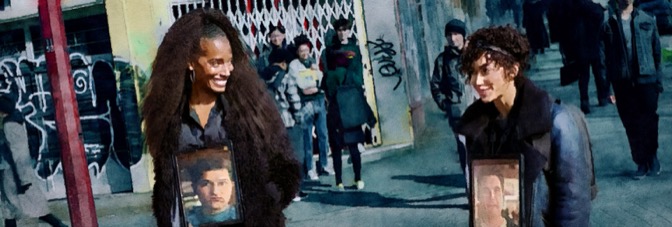
This episode very much does not feel like the penultimate episode of the season. Most of the episode is character development and relationship arcs, with Andy Allo and Zainab Johnson taking Robbie Amell and Kevin Bigley on a field trip to New York City. Despite it being the near future and there being human-to-AI conversion software—not to mention actual cloning—Allo and Johnson are still stuck with iPads hung around their necks with Amell and Bigley looking out.
The procedure makes little sense given the show’s technology—seriously, no one brings back Google Glass?—but it’s clearly just a way to keep Amell and Bigley present in scenes. It’s also nonsensical Allo—now a star bug hunter in the programming department—would be allowed to be Amell’s guide.
Those hurdles aside, it’s a pretty darn good episode. Allo and Johnson haven’t gotten to hang out much this season—most of their scenes are talking about boys no less—and their trip will bring some building issues to the fore. Johnson’s gotten multiple promotions and is shining in the company. She sees a future not requiring her to work two full-time jobs for a crappy studio apartment. Her experiences aren’t corresponding with Allo’s, who might not be a full-blown Lud revolutionary, but she and Amell are trying to rock the foundation of the digital afterlife thanks to the latest development in their murder investigation.
In the previous episode, Amell and Allo found out his odious rich guy neighbor (William B. Davis) had him killed for potentially witnessing something related to the freeware version of the digital afterlife. Suddenly, this freeware afterlife is opening in five days, meaning Amell and Allo have to rush to figure it out. Davis is downloading into a robot to go to a meeting in New York; Allo finds out, hence the field trip.
Meanwhile, Allegra Edwards has her post-virtual baby evaluation to see if she and Amell can have a “real” virtual baby, not the NPC version. But first, Edwards has to get through the evaluation with Josh Banday, Mackenzie Cardwell, and Owen Daniels. There are some great lines about Banday the incel. It’ll be another strangely touching arc for Edwards and entirely unreal AI guy Owen Daniels, one of the season’s most consistently successful subplots.
In the real world, Edwards also gets a visit from mom Teryl Rothery and brother Lucas Wyka, who are mean to her, but there’s a decent punchline to the whole season. Also, potentially some actual character development for Edwards. Though much like the iPad technology in the A-plot, Edwards needing to be evaluated for a paid software add-on seems a little unlikely.
Then again, when Allo and Amell discover Davis’s evil plan… it’s entirely based on current-to-2021 events. Though I suppose if “Upload” were more thoughtful about its future, the show wouldn’t rely so wholly on Amell and Allo’s charm together.
Good acting from Allo, Edwards, and Johnson. All of Amell’s scenes (until the end) are basically video calls, so he doesn’t have much to do. Ditto Bigley, who’s entirely support, though he gets some funny stuff and a decent, sincere moment for once.
And then the cliffhanger reveal’s a genuine shocker.
-
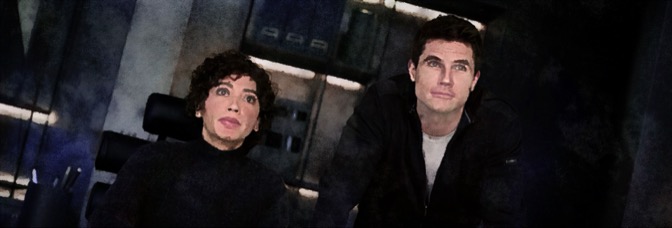
After last episode teasing the return of Nathan and Nora (Robbie Amell and Andy Allo, respectively) chemistry, this episode delivers. The episode also works to disentangle them from their ill-suited love interests, with Allo having a potentially relationship-ending argument with her boyfriend, Paulo Costanzo. Costanzo’s thrilled at the success of their cyber-terror attack on the digital afterlife, and Allo’s not sure about deleting sentient data.
During their argument—which has some more great material with Josh Banday’s sex robot crushing on Costanzo—they have no idea what else their attack has wrought; as a direct result of the hack, the U.S. government (off-screen) has changed the law to allow the digital afterlife company to read the thoughts of its customers. And to put them up online if they’re spicy enough.
Spicy enough meaning Kevin Bigley’s sex dreams about Zainab Johnson are going to make her a real-world celebrity whether she likes it or not. The company’s thrilled with these changes to privacy laws, including Andrea Rosen, which makes her a lot less likable. Her cyber-peeping on Bigley has been one of the show’s running gags, but now she gets to more forcibly intrude on him (when she screen caps his showers now, he hears the snapping sound). It’s gross and ghoulish. “Upload” sometimes doesn’t seem to realize how unlikable it makes its regulars.
Once Allo finds out about the mind-reading upgrade, she realizes the bad guys will soon be able to discover Amell got his memories back. It’s particularly problematic since he was murdered for corporate espionage reasons, so they’ve got to work together to stop the mind-reading software from going live. Along the way, they’re going to flirt, be adorable together, and uncover another clue in his murder.
Amell has time to hang out with Allo all episode because girlfriend Allegra Edwards is busy raising one of the virtual babies. She hasn’t told Amell she’s doing it, and Karens her way through the interview process with Rosen. Throughout the episode, the virtual baby ages, always with some variation of AI guy Owen Daniels’s face. It’s creepy but amusingly.
It’s kind of a busywork plot for Edwards, but it’s amusing and eventually somewhat touching. The subplot also allows Vic Michaelis to do something besides being drunk and horny; Michaelis is Edwards’s (dead) grandma, living in the virtual afterlife too, and they have a scene talking about parenting.
This episode’s the first time Amell’s gotten to really do any character development in season two, which is nice—it’s a tad late (there are only two episodes left after this one), but it works out. Amell’s got so much more potential, as a character, with Allo around; with Edwards, the joke is he’s suffering her obnoxious behavior (and profound deceit), and—despite last episode apparently introducing depth to Bigley—there’s no character development with him around either.
With Allo, however, Amell gets to do some development. And it makes all the difference.
-

It’s Family Day in the virtual afterlife, which means Robbie Amell’s mom, Jessica Tuck, and adorable niece, Chloe Coleman, get to visit. Of course, since Amell’s now got Allegra Edwards in the afterlife with him, it means uncomfortable interactions as Edwards tries to ingratiate herself to poors Tuck and Coleman. To minimal success, leading to Edwards’s surprisingly affecting subplot where the AI guy (Owen Daniels) offers her emotional support.
But having people visiting the virtual ghosts in the afterlife also presents “Lud” revolutionary Paulo Costanzo an opportunity for mischief he can’t pass up. Now’s the time to unleash a virus in the system. The plan’s contingent on Andy Allo being in the virtual afterlife, but when she got the new job last episode, Costanzo was dismissive about it. The show never made it clear if she didn’t get that one job, she’d still need to go back to her old job and be a mole. Though I guess Josh Banday could’ve done it.
Doesn’t matter.
What matters is Amell and Allo reunite, finally. It’s halfway through “Upload: Season Two,” which has either got the Covid-19 lockdown reduced episode order, or the first season’s ratings weren’t quite there, but Amell and Allo are back. He spots her fixing something from across the way and runs over, thinking it’s still Mackenzie Cardwell using Allo’s avatar, but no, Cardwell’s got her own and Allo’s back.
They have a very awkward interaction where Amell acknowledges Edwards is with him in the afterlife, and then Allo mentions she’s dating Costanzo. There’s nothing about Amell’s phone messages to Allo, which he was leaving her all throughout the first episode of this season, so one assumes she never retrieved her phone, which seems weird.
Again, doesn’t matter… even somewhat frosty and awkward to one another, Amell and Allo still have their wondrous chemistry, and all of a sudden, “Upload” just feels right again.
Other significant developments in this episode include Allo, Costanzo, and Banday infiltrating a clone factory—there’s a phenomenal punchline if one’s familiar enough with their terrible white YouTubers—and then the virtual afterlife company introducing virtual babies. Edwards wants a baby, Amell doesn’t, mom Tuck gets in the middle of it. At least until the terror attack.
There’s also a subplot for Zainab Johnson and Kevin Bigley. Bigley has invited his army bud Klarc Jerome Wilson to visit him, and Johnson plays tennis with them. Well, their version of tennis. It’s an entirely comedic subplot until the end when Johnson’s forced to look at Bigley from a different perspective. Similarly, Allo’s starting to realize she’s more uncomfortable with Costanzo and his tactics than she thought.
Good acting from Allo, Edwards, and Johnson. Allo and Edwards get more material, but Johnson’s got to make Bigley’s juvenile humor funny longer than the initial bit.
Also, there’s some amusing stuff with Costanzo and Banday.
It’s either the best episode of the season so far or just feels like it because Allo and Amell have real scenes together. Possibly it’s both.
-

It’s an excellent episode for Allegra Edwards. She gets to play out of character—in the real world, Edwards’s talking toilet has been chastising her for too much time in VR, so she’s going to take a break. To ensure Robbie Amell doesn’t ask any questions, Edwards hires a “job gerbil”—for an Amazon show, “Upload”’s real comfortable showing what a Bezos-led dystopia would look like. The job gerbil, a phenomenal Paloma Nuñez, has to pretend to be Edwards in the virtual afterlife.
Except Nuñez isn’t terrible, so Amell and buddy Kevin Bigley will think Edwards is just being awesome all of a sudden. The episode opens with them discovering they can siphon data off the rich guys and give it to the poor people on limited data plans. You pause until next month when you run out of data in the virtual afterlife. Amell’s got a code editor device (from last season) to do the hacking.
He and Bigley take it upon themselves to play, you guessed it, Robin Hood.
They have a great suspense comedy plot with Edwards. It’s casino night (or afternoon) in the afterlife, and they’re going to win big against the richies, thanks to a complicated cheating system. Suspense factors in once real-world boss Andrea Rosen catches the code hacker in use, so she and debugger Ryan Beil try to find the culprit.
Their investigation coincides with Andy Allo’s job interview with Beil; while she’s usually in customer service, the Luds want her to drop some physical items around the programming floor, so she’s got to do a job interview. She’s ostensibly unqualified, but the show established from the start she’s really good at the programming side when she gets to do it.
Since she can’t go back to her apartment, she’s rooming with fellow Lud and fellow virtual afterlife customer service rep Josh Banday. It ends up being an excuse to show off Banday’s profoundly gross and funny lifestyle and get some laughs.
Allo also reunites with Zainab Johnson and meets her not-exactly-replacement Mackenzie Cardwell. No reuniting for Allo and Amell just yet, though she does check in on him once she’s back.
Rosen gets a lot this episode; cop Hiro Kanagawa is investigating—which freaks out Rosen because she spies on Bigley in the shower and then Beil for an indeterminate reason—so Rosen enlists Johnson’s help hiding evidence. It all will tie together with Allo’s arc by the end.
It’s a good episode for Allo too. It’s a decent character development arc amid her saboteur stuff and then the silliness in the virtual world.
But Edwards gets the best material by far; just a splendid showcase.
-
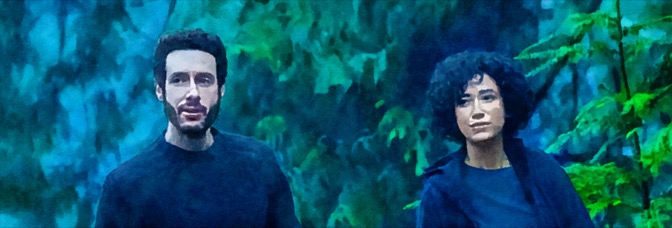
Both Robbie Amell and Andy Allo spend this episode getting used to their new normals (without each other), with Allo having a much better time of it. She gets to hang out with new beau Paulo Costanzo, which means a bunch of flirting, but also finding out some of the Luds anti-digital afterlife plans.
Amell’s just got to suffer through fiancée Allegra Edwards throwing a dinner party; the audience now knows Edwards is lying to him about being dead. She’s just in a VR suit in her bathtub 24/7. She invites the worst people she can find around the place, letting Amell invite his poor friend Phoebe Miu for some contrast. Kevin Bigley’s there too, but he’d either be an Amell invite or as Vic Michaelis’s plus one. Michaelis is Edwards’s grandma, who spends her digital afterlife drunk and knocking boots with Bigley.
Michaelis also gets a conversation with fellow rich guest William B. Davis (as a Koch brother analog) about how much fun it is to be racist and how women getting the vote caused the Great Depression. Davis has some unlikely, seemingly empathetic ideas about the poors receiving a digital afterlife, too, surprising Amell and horrifying Edwards. Bigley gets it in his head there’s something to Davis’s interest concerning the big conspiracy against Amell (Amell having programmed a free digital afterlife and apparently murdered for it), but Amell’s too busy with the dinner party. Specifically the help.
In addition to Allo’s adventures with the Luds, the episode’s also got Zainab Johnson and her new sidekick, Mackenzie Cardwell, trying to keep up with Edwards’s demands for the dinner party. Edwards is just too much of a Karen for the AI to keep up with her; there are some great scenes for Owen Daniels, who plays all the in-world AI characters. When Cardwell enters the digital afterlife, she uses Allo’s existing avatar, sending Amell into conniptions.
While there are some funny faux pas moments for Amell and Cardwell Allo, it’s also some jarringly unlikable Amell for a while. Once he gets the identities sorted out, he gets really short–a complete reverse from when he doesn’t know and is falling over himself to pay attention to Cardwell Allo in front of Edwards. Although Amell told Edwards he’d had a digital afterlife fling last episode, it’s unclear if she knows it’s Allo.
Anyway.
They use Amell’s brief foray into unlikable as a character development arc, as well as a way to further establish Cardwell. Johnson’s got a great line about Amell being a “human bowl of oatmeal” who drives the other girls wild.
Meanwhile, the real Allo ends the episode getting even more involved with the Luds, specifically their plans for hacking the digital afterlife and leveraging her experience (and job) to do it.
-

“Upload” starts its second season making some immediate changes from the previous season cliffhanger. One’s a reveal at the end of the episode and a good twist. The other’s Andy Allo’s not great real-life love interest Matt Ward getting axed in the first scene. They’re on the run in upstate New York, and Allo ditches him at a bed and breakfast to run off with dad Chris Williams to the off-griders.
With lead Robbie Amell still stuck in the reduced data area of the digital afterlife, Allo’s adventures with the “Luds” (as in Luddites) takes up the first half of the episode. Despite being a tech junkie in her regular life, Allo takes to the Lud colony, where she’s soon teaching the orientation classes and flirting with community leader Paulo Costanzo.
Besides growing their own vegetables and not having any wifi, the Luds also have a fundamentalist Christian terrorist thing going on under the leadership of pastor Peter Bryant. Allo and Costanzo bond over being charming, attractive, and not extreme like Bryant. And gardening.
Meanwhile, back at Allo’s job, her absence has coworker and bestie Zainab Johnson getting a lot more responsibility and a promotion. She and boss Andrea Rosen get to be better pals with Allo gone too; they’ve got to suffer a particularly obnoxious new upload (a dead person’s consciousness uploaded into a virtual afterlife paradise)—Amell’s fiancée Allegra Edwards.
Edwards waits a few weeks to wake Amell up from his data cap, wanting to make changes to his existing apartment. Amell’s immediately worried about Allo, who was almost killed in the previous season’s finale because she and Amell found out he’d been murdered (by Edwards’s dad), and runs off to check up on her.
Except she’s entirely off-line, so he can’t find any information or get in touch. All his calls go to voicemail, including the one where he finally tells her he loves her too.
There’s some bro buffoonery with Amell’s neighbor and dead bestie Kevin Bigley (who’s semi-dating, i.e., getting horizontal, with Edwards’s dead grandma, Vic Michaelis, which continues to be hilarious). And Mackenzie Cardwell joins the cast as the temp Johnson hires to cover for missing Allo.
There’s also cybercrimes detective Hiro Kanagawa, who seems like he’s going to have something to do with the season—the whole Amell hacking the real world to save Allo last season.
It’s an okay season starter; Allo’s extremely likable, Johnson’s excellent, and Bigley’s broadly funny. Edwards is very intense as the de facto villain. Amell’s kind of got nothing to do except cyberstalk, which is a bummer. Allo’s his only human connection on the show, and they’re not talking.
-
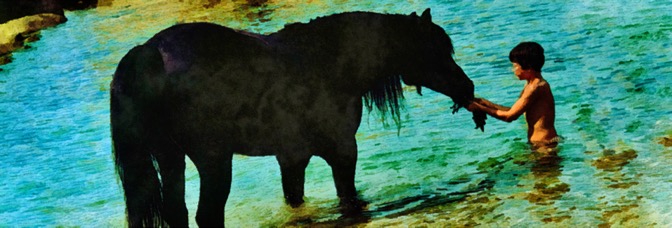
The Black Stallion is two separate, subsequent narratives. The filmmakers utilize two different but related styles for them. The first narrative, with 1940s tween Kelly Reno, shipwrecked on a desert island off the coast of North Africa with a wild Arabian stallion. The second is after Reno’s rescue when he and the stallion have to adjust to “real” life back home in the United States. That adjustment will lead to ex-jockey and current unsuccessful farmer Mickey Rooney taking an interest in Reno and the horse, who don’t do well in town.
The first narrative takes just under an hour, starting with Reno and dad Hoyt Aston on the ship, with a bored Reno discovering the horse onboard. There’s not a lot of dialogue, with director Ballard immediately establishing the film’s distinct narrative distance to protagonist Reno. The first part of Stallion’s more visual, the second part’s more audial, but Ballard and his crew maintain techniques throughout, including this deliberate angle on Reno. Ballard focuses on Reno’s experience of events but without showing his reaction to those events. Sometimes the film will catch Reno as he reacts; it just does so while the reaction’s already in progress. The film gives Reno his privacy.
The film’s got almost a half hour without any dialogue. Reno makes some noises at the horse in attempts to ingratiate himself—to limited success—but otherwise, most of the desert island sequence is no diegetic sound, just Carmine Coppola’s score. Coppola’s score is often ethereal, moving between styles, then focusing in for exact dramatic effect. The Black Stallion is a technically precise film. It’s exquisite too, but the precision is on a whole other level. Ballard, cinematographer Caleb Deschanel, editor Robert Dalva, and composer Coppola create these sublime sequences, each distinct but building off one another. The film tracks this relationship between Reno and the horse, their developing friendship and companionship, and gives them space to separately experience their desert island plight. The only word for it is divine.
And it takes Stallion until the film’s third act (and of the second narrative) to get back to that level. The second part is technically superb and quite charming (Rooney’s adorable, Teri Garr’s extremely sympathetic as Reno’s mom, and the period production design is excellent), but it’s not the first part. It’s not about Reno and the horse as pals anymore; it’s about Reno trying to figure out how to have an Arabian stallion somewhere in Rockwellian America. Rooney and the potential of racing glory give Reno some idea, though.
Since the film started on the ship, the film never establishes Reno before his exciting and tragic adventure. He’s always quiet and reflective, even on the boat, so one can assume he’s not less exuberant than before, but once he’s home, it’s still all about the horse. They’ve just lost the context for their friendship, with Rooney becoming—if not a surrogate dad—then at least a male role model for Reno. Rooney can understand some of Reno’s relationship with the horse. Despite the intense dangers the two experienced, Reno still has boyish dreams for him and his horse.
Good thing he lives in a place where male wish-fulfillment is a cornerstone of the culture because he’ll get his chance. Though the film will let Reno verbalize his dreams, the closest is when he breaks down and tells mom Garr about his experiences, which the film showed without sharing his internal experience. It did an excellent job of conveying that experience visually, but it’s not until much later Reno finally gets to talk about them.
The film’s terse with all its actors; Axton gets a great, staring straight in the camera (Reno’s perspective) monologue at the beginning, but he doesn’t talk much otherwise. It takes until the end of the second act for Reno to get his big moment. Garr gets hers in the same scene. Both Rooney and Clarence Muse have already had their big scenes, despite coming in after Garr. And big comes with an asterisk. They’re just longer passages of dialogue, maybe monologues. Ballard’s not interested in listening to people talk, instead showing how they act and interact.
The sound editing’s the thing in the second part. The sound of the horse running, hooves now on grass and pavement. Although there were lengthy horse-riding sequences in the first part, those sequences all had Coppola’s music accompanying them, not the actual sound. Ballard and the sound editors (Todd Boekelheide, Richard Burrow, Diana Pellegrini, and Stephen Stept) very deliberately refine the sound through the second part until the exceptional finale, when the sound becomes the most important technical. Albeit amid the exceptional other technicals. Stallion’s finale is gorgeous filmmaking. The photography, the editing, the directing, all stellar. And then the sound is even more impressive.
It’s transcendent, and when Stallion ties the epical (if stylishly lyrical) second part back to that lyrical, divine first part.
The film has several phenomenal sequences (in addition to the finale). Heck, the end credits are a remarkable flashback sequence. But most of the scenes on the island are fantastic, particularly the underwater dance and riding sequence. Reno chasing the horse through town is also great. But, again, nothing compares to the finale. Well, some of the island stuff, but it literally compares, not figuratively.
The Black Stallion is exquisite and masterful, occasionally divine. It’s a magnificent film.
-


2-1: Freaks and Geeks (1999), Part 1: Episodes 1-2 – Onesies
Emily and Andrew kick off Season Two with a look at FREAKS AND GEEKS, an NBC television series created by Paul Feig and executive-produced by Judd Apatow. Listen as they talk about Ben Foster in a problematic part, baby Martin Starr, argue over Joe Flaherty's Canadian heritage, and so on!WHERE TO LISTEN
Apple Podcasts Spotify Stitcher RSS YouTube -

A critical episode guide discussing the all eight season one episodes of the Disney Plus streaming show, The Mandalorian. Set in the Star Wars Universe after Return of the Jedi, the series stars Pedro Pascal, Carl Weathers, Werner Herzog, Omid Abtahi, Nick Nolte, Taika Waititi, Gina Carano, Giancarlo Esposito, and Emily Swallow. -
A critical episode guide discussing the all nine season two episodes of the Netflix streaming show, MINDHUNTER. The series stars Jonathan Groff, Holt McCallany, and Anna Torv, and it follows the founding of the Behavioral Science Unit in the Federal Bureau of Investigation (FBI) in the late 1970s and the beginning of criminal profiling. It is based on the 1995 true-crime book Mindhunter: Inside the FBI's Elite Serial Crime Unit written by John E. Douglas and Mark Olshaker. -
A critical episode guide discussing the all ten season one episodes of the Amazon Prime Video streaming show, Hunters. The series stars Al Pacino, Logan Lerman, Kate Mulvany, Tiffany Boone, Carol Kane, Saul Rubinek, Josh Radnor, Louis Ozawa Changchien, and Jerrika Hinton. -

Once again, I've failed to keep up with episodes per season on shows this year, and it turns out this episode is the penultimate one for "Resident Alien: Season Two," which makes a lot of sense. If the season were running ten episodes, it'd be a little strange to introduce so many new plot threads with three episodes to go.
Though maybe if it were running thirteen, there might be time. And with just one more, they can position the show for season three, something they really didn't get to do with season one's finale.
The episode concludes Alan Tudyk and Sara Tomko's trip to New York City (which looks more like Vancouver this episode than last time), with two big surprises. One came as even more of a surprise because I thought they were just adapting the comic arc, but they are not; they're upping the "Alien" ante. The other surprise is a phenomenal moment, with the show acknowledging it's hurrying some things and then taking the time to make things count.
After resolving Tudyk tripping on acid, Tudyk and Tomko's arc leads to some nice character bits in Central Park (or whatever it's called in Vancouver) and then is mostly action. They've got to find out what other alien's human companion Maxim Roy knows before woman-in-black Mandell Maughan kills them, plus there are some New York thugs following them, thinking Tudyk's still the human Tudyk. Lots of action.
Things back in small mountain town Colorado are slower but with similarly significant developments. Alice Wetterlund and Meredith Garretson have a girl jock character arc together; Wetterlund gets off her duff and gets back to the gym, where she runs into Garretson. Now, Garretson's unaware Wetterlund spent last episode on a bonding arc with Garretson's husband, Levi Fiehler. As Garretson muses about her marriage in this episode, Wetterlund's got some relevant information she can't share.
Luckily they can still bond over exercising.
Considering the other arc involves sheriff Corey Reynolds deciding he's made a mistake with a murder investigation and might be entirely up-ending the show (it includes him getting some detective novels, which are straight out of the comic), Wetterlund and Garretson's character arc is this episode's most ambitious, but also smallest swing; especially since Tomko doesn't end up with much to do. She's entirely support for Tudyk after a certain point.
She's got a couple terrific scenes. There's a lot of strong acting in this episode, especially Tudyk, whose absurd comedy moments are phenomenal, and Gary Farmer. Farmer gets a bonding scene with Reynolds where Farmer monologues a war story, and it's incredible. Oh, and then Diana Bang—the nurse at the town clinic who's been getting more and great material this season—has an awesome scene with Fiehler.
Good direction from Claudia Yarmy; she gives the actors time and room, never slowing down the action but never rushing anyone either.
Not knowing the season was almost over saved me worrying about it not being renewed (until now, anyway), but I really hope they get at least one more. With a bigger order too. Eight episodes—albeit an obviously Covid-19 lockdown limiting season—isn't enough, not with this cast.
-
Halloween (2018) – 709 Meridian
D and Andrew sit down and suffer through Halloween H40: Strode vs. Myers, discussing the South Carolina-looking suburban Illinois, Jamie Lee Curtis's hair (and her character versus H20), and Judy Greer's Karenness.WHERE TO LISTEN
Apple Podcasts Spotify Stitcher RSS YouTube -
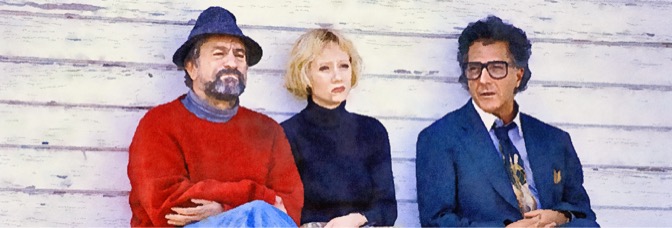
Wag the Dog is a relic from the unrevealed world. Though prescient enough to know sexual misconduct isn’t enough to derail a president from either U.S. political party. As an old—who saw it in the theater, probably opening day—it’s hard to imagine how it plays to someone who’s grown up with Republicans spewing lies and hatred and the Democrats spewing different lies and conditional hatred.
There are political parties in Dog, but the film never identifies allegiances. The one time “personal” politics comes up, it seems like the good guys are Republicans (Anne Heche attacks Dustin Hoffman’s liberalism). But she could just be a Democrat too.
Heche is a White House damage control staffer. The President has just been accused of sexual misconduct and brings in image expert Robert De Niro. Heche is his handler and sidekick. Hoffman is the Hollywood producer De Niro hires to create some war media for them to distract from the molester-in-chief.
Dog’s very cynical about the rape allegations. No one cares. Again, prescient but not about everything. It’s still a world without racism—it’s pre-9/11, so the islamophobia is generalized. In fact, the imaginary Muslim fundamentalist terrorists are white. So as a satire of political reality, Dog is profoundly naive.
Luckily, it’s rarely a political satire. Director Levinson and screenwriters Hilary Henkin and David Mamet avoid it as much as possible, putting the more satirical moments on television actually, which the main characters watch and ridicule.
It’s more often a Hollywood satire, with Hoffman always ready with a self-aggrandizing showbiz anecdote. But the film’s success comes from its position as a Hollywood fable. Hoffman is the populist producer—hair modeled on Robert Evans—who finally achieves important something thanks to De Niro. The stakes are higher, though Hoffman takes a while to understand the dangerous waters he’s found himself in. Just because De Niro’s working for the President doesn’t mean everyone in the federal government wants to go to such extremes to protect a sexual predator.
I mean, haha, right? How naive can you get?
The film runs a brisk ninety-seven minutes, with De Niro and Heche leading the film from location to location. Hoffman’s top-billed, the protagonist, but he’s the protagonist because of that arc, not because of his presence. Heche, then De Niro are the driving forces, making De Niro’s performance the most important in the film. He’s got to convey a lot with a very little; heck, he sleeps through the first big brainstorming session, where Hoffman assembles the hitmakers to figure out how to gin up a war with Albania.
Director Levinson’s got a phenomenal crew here. The most impressive technical is Rita Ryack’s costumes. Whether it’s Denis Leary’s outrageous outfits (he’s “Fad King,” who figures out all the licensed goods opportunities) or De Niro’s frumpy but still stylish attire, the costumes do a lot of establishing work in the film. There’s a lot of talking (usually Hoffman talking over people—oh, and Hoffman’s outfits are fantastic too), and there are a lot of characters coming and going; the costumes don’t just help establish, they further inform as scenes play out. Also, while obviously De Niro and Hoffman can act while looking like models in very different early eighties clothes catalogs, the performance Levinson gets out of Leary is incredible. His outfit’s too absurd to be believed (though it just looks like most nineties comic book “realistic” costumes).
Anyway.
Then there’s Stu Linder’s photography. Levinson occasionally does quick emphasis zooms, and the camera’s often mobile, not going for raw, jarring documentary, but closer to cinéma vérité than not. Except Linder shoots with these bright lights, shots’ subjects practically shining, overemphasized. Despite being ostentatious, it immediately becomes one of Dog’s hyper-realisms. Neither De Niro, Hoffman, nor Heche operate in the real world. De Niro can control the national narrative, Hoffman can produce fictional reality in real-time, and Heche thinks her party will take care of her. No one in Wag the Dog’s in touch with reality because it’s not about reality; it’s about an entertaining fantasy world of respectability. The joke in Wag the Dog is they’ve got to subvert accountability because the filmmakers are so naive they think accountability exists.
It also might be hard to grok Dog without at least a passing knowledge of Hollywood trivia, specifically twentieth-century blockbusters. Lots of Bible epic and Jaws references would date the picture if the politics didn’t make it a fantasy.
The casting’s impeccable throughout. Besides the lead trio, everyone else is in an extended cameo. The most important—and successful—is Woody Harrelson, an unlikely soldier who gets wrapped up in the scheme. But Willie Nelson’s got a fun part as Hoffman’s songwriter of choice. Another thing to note about Dog’s unreality—there’s little Black presence in American pop culture. Though it’s also an appropriately white cast for the profoundly callous plot.
Some of the other casts aren’t exactly cameo level, but the parts have limited presence and require the actors to do a lot in a little time. They just happen to be the female assistants to great (white) men. Suzie Plakson’s Hoffman’s assistant, Andrea Martin’s Leary’s. Plakson’s great. Martin’s good but with so much less. Plakson gets a pre-crisis scene to banter with Hoffman, which almost no one gets in the film. Similarly, White House press guy John Michael Higgins is one of those not quite cameos but would be with a different actor. He actually gets the least to do (literally parroting for the main trio), but it works with the constraints.
Kirsten Dunst has a good scene as a young actress. William H. Macy’s got an okay one as a CIA agent. He’s there to give De Niro someone good to act off, not to act himself.
While Hoffman’s the whole show—Levinson sparingly does close-ups of Hoffman, like we’ve got to wait to see him execute this divine performance—De Niro and Heche are excellent too. De Niro’s got his less is more thing going, which leaves Heche to draw him into scenes. She’s the breakout performance in the film; she stays salient amid Hoffman doing a victory marathon and De Niro oscillating from napping to cheering Hoffman on.
The film doesn’t have a lot of time for character development, but there’s a very nice, very tragic friendship for Hoffman and De Niro. They’re star-crossed alter egos.
Wag the Dog’s outstanding. It’d be much more dated if it weren’t for the incredible naïveté. Levinson, Hoffman, De Niro, Heche, Linder, Ryack all do spectacular work. And the Henkin and Mamet script’s fantastic.
-
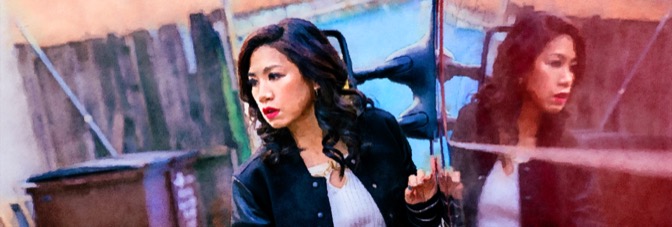
The Leonard Matlin capsule review of 1987’s other Mannequin movie, Lady Beware, describes Diane Lane’s lead performance in the film as “uneven, but her rage is convincing.” That phrase has stuck with me for decades now. This episode of “The Equalizer” feels similar. It’s about general hate crimes against Asian-Americans escalating to murder, though the NYPD doesn’t take them any more seriously once someone dies. It hits close to home for Asian-American Liza Lapira. The episode brings in a guest sidekick for Queen Latifah (and Lapira) with Perry Yung, a Chinese ex-cop whose investigating since the cops won’t.
There’s also some material for Yung and current cop Tory Kittles, who have a solemn discussion about their white police “brethren” actually giving a shit about them. It’s probably Yung’s best scene, which unfortunately isn’t saying a lot. His performance is uneven, but his rage is convincing. Ditto Lapira. Both of them make some really ill-advised, really unconvincing decisions to move the plot along. Maybe if Yung mentioned he was a fan of one old man Clint Eastwood movie in particular, since he borrows the plot twist for this episode. Just be obvious about it.
The scenes between Lapira and Yung ought to be great; they are not. Uneven performances, convincing rage.
The episode gets a lot of mileage from the shitty white supremacist villains being so awful—not to mention their victim, sweet old lady bakery owner Jo Yang, being such a sweet old lady. Despite initiating the case for Team Equalizer, Latifah keeps getting called away because of returning guest star Imani Lewis. Latifah is semi-mentoring Lewis, who’s currently fretting over doing a “Scared Straight” presentation to a high school class.
The Lewis stuff ought to be great, but it’s an even lesser subplot than the unlikely family one for Laya DeLeon Hayes and Lorraine Toussaint. Toussaint wants to make an old family recipe and teach Hayes—it’s one of those all-day cooking recipes, and Toussaint needs help, only Hayes wants to hang out with her friends, which seems very out of character for Hayes. She’s rarely callous, especially so obviously so. But Toussaint doesn’t want Latifah to interfere because Hayes should want to help, not be forced to help.
It’s a nothing-burger, busy-work plot, but somehow the episode still manages to prioritize it over Lewis’s return appearance.
The episode’s still reasonably effective—the bad guys are very bad guys, and the good guys are incredibly sympathetic, but it’s all pretty rote. The occasionally strong character moments (like Yung and Kittles) are too muffled. I’m actually surprised to see Zoe Robyn with the script credit since her name’s been on more thoughtful episodes.
But while the main plot is lackluster, Hayes and Toussaint’s subplot is downright disappointing. And Lewis seems like an afterthought instead of a guest star.
-
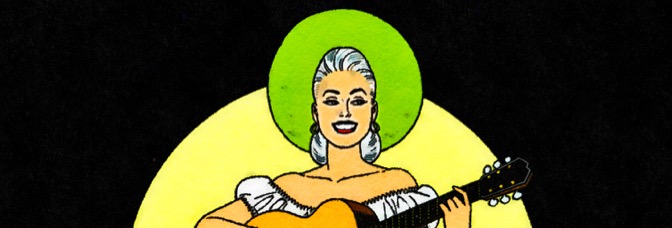

This issue’s distinctly creator Jaime Hernandez’s work, but some of the moves he makes remind entirely of brother Beto’s.
The first strip, for example, is a first-person one-pager about Ray getting in a social faux pas at a party. Jaime shows half of Ray’s face in a reflection; otherwise, it could easily be an autobiographical sketch, something Beto’s done in the past.
But the bigger Beto-esque surprise comes in the Locas feature, which Jaime splits into two parts. Most of the comic (except the Ray opener) is set soon after H.R. Costigan’s funeral. He died at the end of last issue, and this issue catches us up with everything since. Sort of.
The feature starts with Hopey waking up and volunteering at her local polling center. There’s a quick introduction to the other poll workers, and Hopey, wearing her sunglasses inside all day, contrasts them nicely. It’s slice of life stuff, right up until Maggie shows up to visit Hopey. Maggie mentions Hopey’s roommate—who called to her off-page at the story’s start, but who we’ve never met. Jaime will be introducing a lot of people we haven’t met, but the characters all know in this story….
Hopey tells Maggie all about Costigan’s strange funeral, where she was the only person from the comic. Neither widow Penny nor ex-wife Norma nor daughter Negra is at the funeral with Hopey.
The visit is tense—Hopey’s mad Maggie didn’t go with her to the funeral, but Penny hadn’t actually told Maggie about the funeral (or going with Hopey)—and Hopey goes back inside to listen to platitudes from the normies. She’s clearly in a very bad mood.
Jaime finishes the strip with a somewhat bewildering “Concluded in this issue” tag. Where he’s going to go with it is a big surprise.
But, first, he catches up with Norma and Negra. They’re on a road trip through the desert, staying at crappy motels, eating junk food, and actually bonding. It’s the first time Jaime’s really shown Norma as a loving mom; usually, she’s more concerned with her newly acquired wealth and wealthy friends, but here she and Negra are away from all that noise.
Except, of course, Norma has taken them on this impromptu road trip to keep the estate lawyers away from Negra. She’s H.R. Costigan’s daughter, after all, and her whole life is about to change.
The strip also establishes Negra never even met Costigan, which explains why he never mentioned her in Love and Rockets proper. I think.
Also—I forgot—we get some backstory on Costigan; Hopey and Maggie overhear the poll workers talking Costigan trivia, going back to World War II. It’s interesting as Costigan’s been a Love and Rockets character since the first issue, and Jaime’s taken years to reveal the backstory; heck, it took him years to reveal the horns weren’t demonic.
After the Norma and Negra strip, it’s back to Locas, starting with Maggie (and readers) finally getting to meet Guy Goforth, the big oaf who’s trying to romance Hopey. They all go for donuts on Hopey’s break, which leads to Maggie teasing Hopey about her suitor. And then Hopey loses it, unloading on Maggie.
During the barrage, we find out something about what happened a few issues ago with Maggie’s nightmare drive and her imagined (or not, still unclear) stalker, but also how she’s been ghosting Hopey since and Penny’s been their information go-between.
Penny’s always present in Penny Century while rarely being on-page.
Hopey’s day of work ends with a ride home from the poll supervisor (so she doesn’t need Maggie’s offered ride and proverbial olive branch) and the introduction of her roommate. Visually, no names. The roommate turns out to be a character from the comic’s opening strip, the Ray one-pager, so while Ray, Hopey, and Maggie are all in the same physical location, they keep missing each other.
Penny calls and dishes to Hopey about everything going on with Maggie, which includes shocking information for everyone—reader and Hopey alike—leading to an old-school bonding scene between the two of them. Except Jaime’s just revealed their entire relationship since Love and Rockets ended is different than what he’d been implying. It’s a stunner of a reveal, so big one of the supporting cast even comments on it.
It’s a turbulent strip—the second part is eight pages, and Jaime got like four major dramatic moments—and a really good one. Great art, especially on Hopey, who has lots of visual reactions to the events unfolding, often with the sunglasses obscuring her expressions.
Then we finally get a Penny appearance, which is an almost Watchmen, Doctor Manhattan on the moon riff. Or it might just be a Doctor Manhattan on the moon riff featuring a couple surprise costars for Penny. Great good girl art from Jaime.
The back cover color strip is a Lil’ Ray outing; nuclear bomb drills. It’s a fun, quick, but haunting strip.
It’s a humdinger of an issue, with a humdinger of a reveal. Penny Century’s been unexpected as far as content to this point, but it’s never been so wildly unpredictable. If it were any other comic, it might be cause for apprehension, but with Jaime, it’s cause for (perhaps cautious) enthusiasm.
-

I’ve overextended myself on reading and writing projects this year. It was inevitable. The first change was to adjust my movie watchlist for 2022. It doesn’t account for screeners or blogathons, which are not scheduled (albeit with deadlines and embargoes), and are more fun. Even when an ancient watch list item is good, the run-up to watching it is still rote.
I’m also adjusting the Love and Rockets read-through. Instead of two issues a week, it’s going to at least one issue a week. I read those issues three times each and like having dwell time in between.
My prose reading is also in danger, but it’s the thing I want to maintain most, so I’m doing something with it. But, unfortunately, my first idea, a dedicated read day, does not work.
Finally, Selected Declarations is getting out on hiatus. At least the idea of doing it weekly. It’s too indeterminate a space; it’s too many words to free write without writing about free writing.
I have an idea for what I can do with it, but I’m also not particularly enthused with that idea, so it might not be a thing.
2022 was supposed to be freer headspace, but there’s just not enough room. 2022 is taking up too much on its own. I do love escaping into Love and Rockets though. I could probably get away with a double read on each issue, but I like doing the third just to enjoy.
One of the most influential classes I took at MFA school was Systems of Writing; at the time, it helped me balance writing constraints with generative word blathering. Since then, it’s helped me think about approaching various projects. They’re fun to figure out, but then in practice, it’s just going off a watch list I made in 2019 or earlier and checking items off. Even when something’s pretty good, I’m upset it’s not better, especially if it was something I hyped in my youth.
The podcasting is almost entirely fun. Like, “Free Spirit” was a chore, and I pulled a muscle on the exercise bike watching it, but I’d have been biking anyway. Otherwise, those projects are just fun. Selected Declarations isn’t fun, especially since I keep forgetting it. Unlike finding my keys, there’s no endorphin rush after I post it either. I just wonder how I’ll get another one done in a week.
I’m also getting closer to finishing my offline project—turning the guest room slash computer room into a home office, storage, and cat recreation room. It’s been a slog, but it’s also nice not feeling crowded.
Of course, the home office refresh was waiting on Apple to ship Universal Control, so it had better work when it arrives next week.
And so ends this eleven-week attempt at a “lifestyle” post… maybe next time, it’ll run twelve.
-

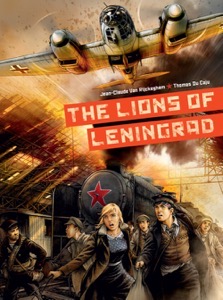
The Lions of Leningrad is European without being Russian, albeit then translated (from French) into English. But it’s a Russian tragedy, complete with a love quadrangle, flashbacks, gulags, and revenge.
The comic opens in Leningrad, 1962. The police arrest an indigent who’s broken into a concert hall. Only the arresting officer is a nitwit who just wants to torture an indigent; good thing a female officer is doing the questioning back at the station. The female officer, whose name is entirely unimportant, is writer Jean-Claude van Rijckeghem’s first entirely wanting female character. Lions doesn’t do a Madonna or whore thing; it does a Madonna, whore, or witch thing. Whores and witches are different. It’s incredibly annoying because the Madonna is kind of the protagonist. Even though she’s not the indigent recalling the flashback to the female officer, the Madonna’s the only character artist Thomas du Caju can reliably render. He gets the boys mixed up, which isn’t great in a comic with a dozen or so male characters throughout.
The flashback takes the comic back to 1941, when the indigent is a teen, playing Revolution with his friends. There’s the one girl, the Madonna, Anka, and the three boys, Maxim, Pyotr, and Grigory. All three boys are in love with Anka, who’s not interested. As the war comes to Leningrad and their lives go into disarray, the boys don’t stop pursuing her, making things more difficult at home. Her father didn’t raise no sluts, so he beats her whenever one of her male friends is nice to her. Then tells her to play some Mozart because music knows no nationality; who cares if the Germans just killed your friends. What about Stalin, after all.
Anka spends the entire comic suffering for the boys—which will also be a thing in the 1962 bookends—and gets nothing for it. Despite her character showing the most agency as far as Homefront derring-do, it’s only to set up her next interaction with one of the boys.
Maxim is the party secretary’s son, Pyotr’s the son of intellectuals (you know the kind), and Grigory’s the one with a single parent, his mom. The party killed Dad for complaining about his deathtrap airplane, and, as the story starts, Mom’s gotten lonely, and Maxim’s dad, philanderer or not, is a fetching distraction.
After the initial attack, where the teens get their Lions name—they survive a German attack and manage to escape back to Leningrad in a stolen jeep—the comic’s going to be about the long winter of 1941, with lots of starvation, desperation, murder, and betrayal. If the boys aren’t trying to screw each other over, their parents are trying to screw them over by proxy.
For the most part, Anka and Grigory remain the most sympathetic, though Grigory’s arc is mostly just thinking his mom’s a slut and mooning over dead dad. And even though he’s always trying to pressure Anka into sex, Maxim’s not as craven as his party member father.
Writer van Rijckeghem will occasionally try to texture the story—there’s a footnote explaining the historical accuracy of a Santa Claus analog—but he’s mostly contemptuous of his characters. There’s whataboutism with the Nazi’s attack (Stalin’s bad too, you know), and the boys aren’t so much friends as all hounding Anka and being collaborators in that effort. Everyone thinks Grigory’s dad’s a traitor, everyone thinks Pyotr’s parents are traitors, everyone thinks Maxim’s dad’s a party stooge—the only one no one comments on is Anka’s controlling, abusive dad.
There’s a running “Stalin banned x” gag, which is the closest the book ever comes to having successful comic relief. Unfortunately, Van Rijckeghem ruins it by making it into a pressuring Anka moment, but for a while, it’s all right. And it leans into the hustling nature of the characters’ lives in Soviet Russia in wartime. Everyone’s trying to survive, one way or another. Some folks just spend most of their time soapboxing about others… Anka does not.
She’s the female savior, just like the female officer in the bookends; she’ll make everything all right for the boys. Nothing else matters. The comic even ends on that note, which is a particular flex given the third act. Van Rijckeghem blunders a doppelgänger arc something fierce.
Speaking of blunders, de Caju’s got some awful moments. He’s got dead characters coming back to life—after not clearly dying—and then his action sequences can be nonsensical. More frustratingly, he’s got some good panels, where he’s clearly worked on the characters and their expressions, but they’re few and far between. Everything else is rushed, with faces sometimes looking copied and pasted.
Then all the shading is in the digital coloring, and there’s no real inking.
The cityscapes are all pretty solid, though.
Lions of Leningrad has its compelling, devastating moments—there are cannibal gangs during the long winter, for instance—but it’s never edifying as historical fiction. Van Rijckeghem’s just not a good enough writer to trust the historicity. He’s also got a substantial unaddressed plot hole, and everyone just has to go with it for the story to work. Then the trite bookends don’t pay off, except to reinforce the female savior stuff.
Someone’s got to save the boys, after all. They sure can’t be expected to do it themselves.
-

Monster from Green Hell is impressively boring. Despite running a theoretically spry seventy minutes, the film Hell’s a slog from minute five.
The film opens with unlikely scientist Jim Davis and sidekick Robert Griffin sending rockets into space to test cosmic rays on animals. Their launch site? A very recognizable, very wanting composite still of Monument Valley. One of their test rockets goes off course and crashes in Central Africa. Despite Davis thinking they should worry about that sort of thing, no one cares; not Griffin, not the government, just blandly heroic Davis.
Now, if Hell weren’t just endless long shots of people walking, and the script was talkier, it might achieve some camp value thanks to Davis. He’s profoundly miscast but entirely straight-faced about it. Griffin at least seems like he could be a scientist sidekick. Davis deserves at least a prize for delivering some of the science exposition; incredibly, he’s able to clomp through it, always with his Midwest cowboy drawl.
Unfortunately, Hell isn’t about the talking; it’s about the walking.
The on-location Africa footage is recycled from 1939’s Stanley and Livingstone, which dramatizes events from 1871. In other words, Hell isn’t just colonial; it’s disturbingly colonial. For example, when Davis and Griffin are trekking across Africa, Arab guide Eduardo Ciannelli carries a whip to keep the porters in line. It’s a lot. Especially since the movie’s already established its token credited Black guy, Joel Fluellen, and he’s more modernly presented.
The movie’s first half is Davis and Griffin’s trip across Africa to Fluellen’s village. The audience already knows they’ve run into a monster from the rocket crash; it hangs out in Green Hell and is stampeding the animals, causing turmoil all over the continent. The new apex predator has arrived, and it’s a giant wasp. Or at least it’s head and pincers because they couldn’t afford much more. They certainly couldn’t afford for it to fly.
The special effects on the giant wasp are not great. They’re gross, which helps in effectiveness, I suppose, but Monster’s wasp is a lousy giant fifties sci-fi monster, as it turns out. Primarily because of budget, partially because of writing, nothing is interesting about it. Could a good director have made it work? Probably. Director Crane has a grand total of one decent shot in the entire picture.
Also in Fluellen’s village are Christian missionary doctor Vladimir Sokoloff and his daughter, Barbara Turner. Turner looks miserable the entire time like she agreed to do the movie but didn’t think it’d ever get made. Sokoloff’s terrible and not in a fun way. When they’re around, Monster slogs even more than usual.
The only thing the film’s got going for it is Ray Flin’s surprisingly good black and white photography. In addition, there’s some stop motion animation, which is more creative than the composites the film usually uses for the menacing Monster. But it’s not, you know, good stop motion.
Monster from Green Hell is a bewildering, boring B. However, it’s strange enough you can imagine the behind-the-scenes story is a far better one than the finished product.
-
4: Free Spirit (1989), Part 4: Episodes 10-11, 13-14 [CORRECTED AUDIO] – Onesies
We had an audio hiccup but that's fixed here. Sorry about that early listeners! In spite of mostly disappointing or dreadful guest stars, majorly creepy plot points, and bad sitcom fatigue, Emily and Andrew successfully complete their watchthrough of 1989's FREE SPIRIT, the story of a witch (Corinne Bohrer) and her unlikable human charges. They also announce next season's show, which hopefully will not involve Dave Coulier or mullets.WHERE TO LISTEN
Apple Podcasts Spotify Stitcher RSS YouTube -
A critical episode guide discussing the all six series five episodes of the British ITV detective drama, Grantchester. The series stars Robson Green, Tom Brittney, Al Weaver, Kacey Ainsworth, Oliver Dimsdale, Nick Brimble, and Lauren Carse. The series is based on The Grantchester Mysteries, collections of short stories written by James Runcie.
 The Stop Button