• Carnival of Souls (1962, Herk Harvey)

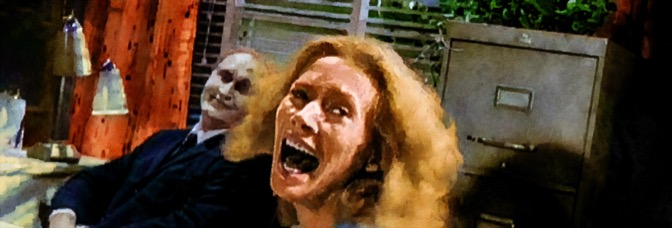
    Carnival of Souls is another film in the “way too literal ending” genre. After seventy-five minutes (of seventy-eight) recounting its protagonist’s bewildering, terrifying experiences, the finish is a big wink and shrug. Though there’s a seemingly unintentional casting gaffe to tie the disparate narratives together. Unfortunately, that low-budget coincidence doesn’t add anything to the ending.

    The film opens with lead Candace Hilligoss surviving a terrible car accident. She and her gal pals are drag racing some boys, and their car goes off a bridge; Hilligoss is the sole survivor. The opening titles are moody, beautiful lighted shots of the river, so when Hilligoss emerges, it’s in a familiar location. It sets a higher expectation than the film will achieve with recurring locations.

    Hilligoss can’t remember what happened in the car—the boys have already lied to the cops about what happened, so they luck out, but it goes unexplored anyway. After a very brief recovery, Hilligoss is ready to move on to her new job at a church in Utah; she’s a professional organist, which means there’s going to be so much organ music in the movie. At the beginning, especially during the titles, it seems like Gene Moore’s music will be an asset. However, once it’s clear it’s just organ music—probably the same organ music, it’s all indistinguishable, even when the music becomes a plot point—and it’s very tiresome.

    In Utah, Hilligoss hallucinates some scary ghouls around her car as she passes a closed carnival pavilion in the distance. The pavilion’s Souls’s best and worst; when Hilligoss eventually tours it, the experience is perfectly dreamy (Maurice Prather’s black and white photography is remarkable for such a low-budget effort and superb in general). But when she frequently daydreams about it, those sequences don’t have any of the dreaminess. Bill de Jarnette and Dan Palmquist do the cutting, and they’re a little too blunt about it; they’ve got no rhythm. Though with Moore’s organ music going in the background, what could they really do?

    Hilligoss finds herself a room; Frances Feist’s her landlady, Sidney Berger’s the creepy sexual predator neighbor who judges Hilligoss for not being religious enough even though she works at a church. She wants to be paid for playing music in church—doesn’t it give her nightmares? Souls has a peculiar relationship with religion, especially since Hilligoss’s boss, Art Ellison, is a combination dipshit and asshole. At least he’s not a creep. Lots of the old dudes in Souls exude creep, including the local doctor (Stan Levitt), who determines Hilligoss is unfit to be in public without him evaluating her (even though he’s not qualified). Her old boss, organ manufacturer Tom McGinnis, was also a little too intrusive.

    All the men agree Hilligoss is a little too independent, a little too headstrong, and has too much agency, which are interesting complaints, though none of them matter in the end.

    As she tries to get acclimated to her new job and surroundings, Hilligoss starts seeing one of the ghouls from her trip around town. Director Harvey plays this lead ghoul, who’s definitely creepy, but technically much less threatening than, say, Berger. No one else can see Harvey, which confuses Hilligoss, but not as much when she has fits of insubstantiality when no one else can see or hear her, and she can’t hear them either.

    It’s basically a “Twilight Zone” stretched out, with less budget than the TV show and questionable performances. Hilligoss does about as well as can be expected in the lead with such thin motivation and characterization. As needed, she looks terrified, though sometimes it’s unclear why she’s not terrified by what she’s experiencing (and vice versa). Berger’s amateurish but such a creep it ends up helping. Doctor Levitt and (apparently not Mormon in Utah) preacher Ellison are just bad. Though Souls has terrible ADR from the start, the looped deliveries aren’t just poorly acted but often clearly do not match the actors’ lips. So maybe it’s not all on them. Also, the script; Levitt and Ellison are the biggest patronizing assholes in a movie full of condescending assholes.

    As far as Harvey’s direction… he’s definitely got his moments. However, he can’t do a regular conversation scene, which hurts the film since it’s mostly conversation scenes. The eerie pavilion material is usually quite good, and he makes some other big swings, mainly in the first act. Once Hilligoss is settled in Utah, fending off Berger, running from ghoul Harvey, there’s basically none. Harvey instead relies on the editing, which doesn’t (no pun) cut it.

    Carnival of Souls isn’t terrible. It’s got a handful of moments; John Clifford’s script doesn’t do the film (or its actors) any favors, outside—albeit pointlessly—establishing Hilligoss as a singular (for the setting) protagonist. None of it adds up, not Hilligoss, not even the eerie pavilion, but at least the cinematography maintains throughout.

    Sadly, so does that organ music.

  • All Rise (2019) s03e03 – Give It Time

    This episode’s a downer. I kept waiting for it not to be a downer, only it keeps getting worse for pretty much everyone.

    But it’s also a very familiar kind of “All Rise” downer episode; it’s bittersweet and about how these people are just trying to do the good thing in impossible, structurally broken situations. Even though the episode’s very evenly distributed—there are two trials, Simone Missick and Ruthie Ann Miles’s corruption subplot, Wilson Bethel and Lindsey Gort babysitting, Bethel investigating Missick and Miles’s investigation, and Lindsay Mendez getting closer to a full arc for the first time this season. Though Miles and Missick are still having problems with a stenography replacement, so it does always seem ready for Mendez to give up the victims’ rights advocate position.

    Lucy Luna gets the script credit; she’s written numerous episodes and is a story editor. Again, it feels like “All Rise.”

    Jessica Camacho’s got the roughest professional arc this episode—Missick and Miles’s ends up being a lot more personal than either were expecting—while J. Alex Brinson’s trial is the lightest. Bethel and Gort’s babysitting alternates between being cute and tense; things go wrong, and Bethel and Christian Keyes (Missick’s newly recast husband) trying to figure things out behind the scenes to help Missick and Miles complicate matters.

    Also, Missick and Keyes get their best episode together so far; they’re doing date night without the baby, only it gets complicated.

    Kearran Giovanni is back guest-starring to make “All Rise” again feel like it’s from the “Closer” and “Major Crimes” production company (it’s not). She’s Camacho’s opposing counsel in a case about a young, single mother, Tina Ivlev, accused of assaulting a landlady. Camacho’s trying to make sure Ivlev doesn’t lose her kids, but it turns out Ivlev isn’t reliable. The show skirts around Ivlev’s guilt or culpability; she can’t get it together, she’s overwhelmed, and it’s affecting many things. It’s again a good arc for Camacho, though her resolution needed to be a little longer.

    “All Rise” does seem to be closing off some subplots—there are more than a few outstanding—and hopefully, it’ll lead to the show getting more focused.

    Lots of good performances this episode, particularly Bethel, Missick, Camacho, and Brinson. Keyes is getting comfortable in the part, and then it’s one of those good Gort episodes. It’s problematic that good is because she’s playing off Bethel and not doing court.

    But still. Everyone’s appropriately earnest this episode, and it pays off.

    Director Lionel Coleman does a good job keeping the episode moving… with the caveat, the episode did need to be longer. Forty minutes and thirty seconds or whatever doesn’t cut it.

  • The Orville (2017) s03e04 – Gently Falling Rain

    Gently Falling Rain came out on June 23, 2022. One of its briefest plot points would play differently if it had come out on June 24, 2022. The episode compares and contrasts future cultures; there’s the Union (the Federation), inclusive, diverse, progressive, and there is the Krill. They’re a combination of Romulan and Klingon, but they’re also religious fanatics who are xenophobic fascist capitalists. Abortion comes up eventually. The scene goes hard and then harder. It’s a very brief scene—and doesn’t come back later when it seems like it might—but it’s rough. I’ve been wondering how media will adjust, and Gently Falling Rain is a jarring reminder from the immediate but significantly different past; life’s constantly getting worse, just maybe not for as many people.

    The episode plays like Seth MacFarlane’s Star Trek: Nemesis, sadly without any dune buggies, though there is a big future car chase. Only MacFarlane didn’t direct and doesn’t have any script credit. So instead, it’s Brannon Braga’s Star Trek: Nemesis, with co-writing credit to André Bormanis, with Jon Cassar directing. The Krill and Union are going to sign a peace treaty, which gets the brass—recurring guest stars Victor Garber, Ted Danson, and Kelly Hu—very excited. Garber’s going with the president (Bruce Boxleitner in full makeup) to the Krill home world to sign the treaty.

    Only we’ve already seen the Krill home world, where populist upstart Michaela McManus is campaigning for the chancellorship on the peace treaty being weak and un-American. Oh, I mean, un-Krill.

    Sure I do.

    McManus is also a returning guest star; long time ago on “The Orville,” she had genetic surgery to appear human and seduce Orville captain MacFarlane in order to ruin him as payback for destroying a Krill vessel. She’s been back a few times since, with the two having an adversarial relationship with some underlying… romance might be too far, but something. This episode explores why McManus might feel a connection, also clueing MacFarlane in. I have questions about the timeline; the episode seems to have questions about the timeline; they do not get addressed, instead focusing on the character relationship and specifically how it plays out for MacFarlane.

    MacFarlane’s a Captain Kirk in a Captain Picard episode of “Next Generation.” It’s a good episode for him, but it doesn’t give him anything particularly challenging to do, so he never gets to achieve (or fail). It’s intentionally constructed to get around MacFarlane maybe not having the most depth as an actor, no matter how hard he tries (though they’ve never tried bringing in a director who isn’t doing “Orville” style).

    Anyway.

    MacFarlane goes down to the planet with the away team; things go sideways; he tries to reason with the Krill. Meanwhile, up on the Orville, Adrianne Palicki is ready to nuke them from orbit if anything happens to the away team.

    The finale’s not good. There’s a good car chase through the alien city, but everything preceding it is blasé. They go for a cheap resolution, entirely shifting the dramatic weight from the show to MacFarlane but then away from him again. But then the wrap-up scene’s really good.

    It’s the best “Orville,” not “New Horizons,” episode of the season. It feels very much like regular “Orville,” in good ways.

    McManus is a great recurring villain for the show, but since this episode’s four of ten, it seems unlikely she’ll have time to come back.

    There’s some good comedy early in the episode, but the show seems to resent including it, just using it to give Anne Winters another chance to be an asshole. She gets some more later on, but her character’s been entirely one-note since the season premiere. To the point I was wondering if she was going to get Yar’d this episode.

    But, otherwise, smooth sailing.

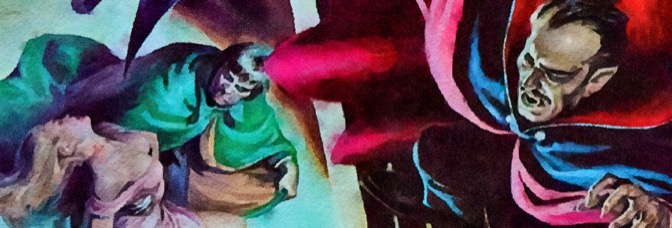
  • Dracula Lives (1973) #4

    Dl4

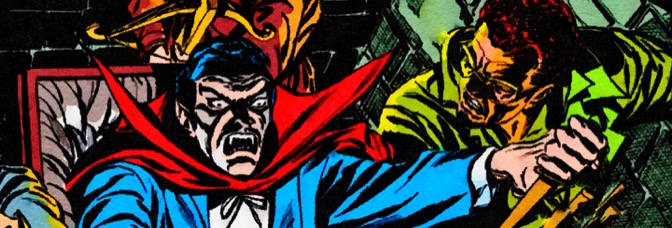
    I’m getting to be such a Mike Ploog snob. Seeing him ink his own pencils, then seeing others ink his pencils… the latter always seems to come with qualifications, asterisks, and compromises. Ploog pencils this issue’s first story, written by Marv Wolfman, with Ernie Chan inking him. Chan keeps much of the detail, even much of the personality, but not the energy.

    The story’s about one Louis Belski, Dracula actor. I thought Wolfman was doing a riff on Bela Lugosi: switching the initials, portraying the actor in his has-been days, ready for Ed Wood to show up with an offer, but apparently not. Belski’s instead just a hack who never achieved the greatness of Lugosi, John Carradine, or Christopher Lee—according to Dracula himself, who’s come to Hollywood to stop Belski from continuing his career.

    His career’s incredibly long; Belski started at the studio when it was constructed in 1927. It’s the early seventies; the actor’s apparently in his early to mid-sixties, which kind of explains why he’s not doing well in the part. He’s also a raging drunk who starts pretending he’s really Dracula after shooting’s stopped, attacking those who wrong him, and trying to seduce an ingénue. So the actual Count doesn’t just have to contend with an obnoxious actor; he’s also got to intercede in that actor’s drunken, murderous rampage.

    It’s a jam-packed story, with Wolfman sort of overwriting it but never thinking about it—Belski’s age, for instance, but then also the idea Dracula got his stake pulled in Tomb and went out to revival theaters to catch up on how he’d been portrayed in popular media. Also, Belski’s a lousy lead to follow around. It’s like a horror comic where you’re waiting for the villain’s comeuppance, but the collateral damage on the comeuppance is almost too much.

    While not bad, it’s definitely disappointing. Especially for the only Ploog in Dracula Lives so far.

    Then there are some text pieces; lots of text pieces this issue. And the movie stills with new text are back, though not as jokey as they’ve been before. Now they’re just interstitials. The first two text pieces are a book review about the real Dracula from Chris Claremont. The book’s called In Search of Dracula (and appears to still be in print if one’s interested), but the review’s way too overwrought with Claremont trying to be personable, then the typesetting on movie stills makes it hard to read.

    Then Dwight R. Decker contributes a one-page joke vacation text about real Romania? It’s too bad the filler’s not better in Lives. Especially since they appear to be upping the text and lowering the reprint count. There are only two reprint stories.

    The first is about a village where everyone thinks this lovely lady is a vampire seducing the local boys, then killing them. The truth’s more complicated and not particularly rewarding, but Joe Maneely’s art’s really good, and it’s only six pages.

    The following story is another original (thank goodness they’re still doing three an issue). Gardner Fox writes, Dick Ayers does the art. It’s Dracula versus Countess Elizabeth Báthory. She’s the one who bathed in human blood to stay young. Dracula doesn’t like her getting in on his business, especially when she’s a poser. It’s a tedious twelve pages, partially because the idea’s one-note, but also because Fox’s script isn’t great, and then the Ayers art is a considerable downgrade from the rest in the issue. Not just the new features either, the reprints as well.

    Then comes a couple more text pieces. One’s a jokey biography of Marv Wolfman, and the other’s a review of Horror of Dracula by Gerry Boudreau. It’s more a combination of behind-the-scenes and scene-by-scene recap with some scant critical commentary. They threaten more reviews at the end.

    The second reprint is a short one, art by Tony Mortellaro, and it seems like they should’ve run it in the first issue because it’s so well-suited for Lives. A German villager only wants his daughter to marry royalty, so he kills off her poor suitors, sometimes letting vampires feed on them for cover. Despite his daughter wanting to choose her own destiny, he decides for her and makes an exceptionally bad selection.

    The final story is the third original, written by Gerry Conway (easily his best Dracula in Lives or Tomb and some of his best writing from this era), with art by Vicente Alcazar. Alcazar has maybe two less than perfect panels, but otherwise, the art’s consistently breathtaking.

    It’s another of the Dracula origin stories, with the former Impaler retaking his castle from the invading Turks. He’s got to deal with the newly installed regional commander but also the neighborhood Catholic priest who’s got a fairly big secret. Then, of course, there’s still the castle, which the Turks have occupied, and the local girls they’ve enslaved.

    The feature’s a page shorter than the issue’s other two—eleven pages instead of twelve—, and it’s a bummer they didn’t give Conway and Alcazar more pages because it’s outstanding. Conway’s characterization of Dracula as vampire king is rather thoughtful, and—given the particulars—Drac gets to be an unproblematic protagonist. Everyone else is doing far worse things than just retaking from occupiers.

    Alcazar gets a variety of action to visualize, with Dracula fighting soldiers but also finding himself in his first vampire transformation duel. It’s great.

    I had been thinking I’d jump off Dracula Lives after a while, so long as Tomb doesn’t keep citing it; I don’t think I can give it up. Not just for the art either; the Conway writing on the last story is fantastic. Plus, the fifties reprints are surprisingly good. I’d always assumed fifties horror comics would be rote and stale, but nope. They’re succinct enough their initial impulse carries through.

    The text material, obviously, is take or leave. Meaning leave.

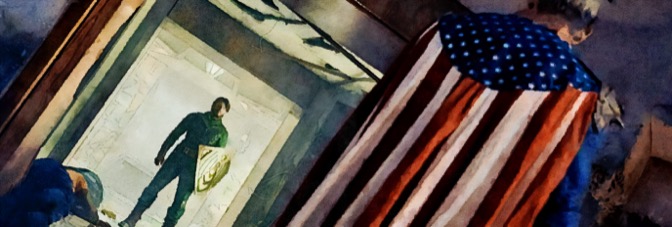
  • The Boys (2019) s03e06 – Herogasm

    Herogasm might be the best “Boys” episode. I can’t remember the previous seasons well enough, but it’s an exceptional hour of television with a phenomenal script (credit to Jessica Chou). It’s Chou’s first credit on the series, which makes the episode even more impressive as the episode concludes some long outstanding story arcs. It also gives many cast members big monologue scenes, including revealing a momentous new narrative device for Antony Starr.

    Superb monologue-y, spotlighted performances from (in no particular order): Starr, Erin Moriarty, Laz Alonso (probably his best work on the show), Jessie T. Usher (his best work on the show), Colby Minifie (her best work on the show), Claudia Doumit, and Jack Quaid. Karl Urban gets a phenomenal scene, but it’s not monologuing about his soul; it’s doing a super-powered fight. It’s awesome.

    Also awesome is Jensen Ackles, who hasn’t gotten a lot of lines before but gets to do his “Ultimate Captain America” in the sensitive modern era culture shock, and it’s excellent. The episode’s not about Urban, Quaid, and Ackles very often, but when it focuses on them, it does a great job exploring the character dynamics of this troubled trio. First, Ackles isn’t just a fascist murderer, he’s one who can’t control it, and then Urban and Quaid are addicted to the temporary superpower drug.

    The episode opens with Chace Crawford and Starr discovering Ackles is back from the dead, which causes Starr’s most loyal teammate Black Noir (Nathan Mitchell) to run out because Mitchell knows Ackles is out to get him. But Ackles is going after c-lister twin superheroes Jack Doolan and Kristin Booth first; they’ve retired from the hero game and just get stoned and screw around. The “Herogasm” of the title is an annual superhero orgy (for the c-listers), and multiple people end up there trying to intercept Ackles. Crawford’s going at Starr’s behest, Moriarty and Alonso have teamed up since Urban and Quaid abandoned them, Usher is there trying to find racist Nick Wechsler, and, obviously, Quaid, Urban, and Ackles are also headed there. The orgy’s extreme, gross, and sometimes funny, while acknowledging there’s a lot of not funny about it, and eventually there’s a lot of tragedy. The episode does a fantastic job using it as a framing device.

    The one set of cast members not at the orgy is Karen Fukuhara and Tomer Capone; Capone’s ex-boss Katia Winter has kidnapped Capone for not doing her bidding, and Fukuhara doesn’t have her superpowers to save him anymore. There’s a funny recurring bit about Capone being sad he didn’t get to see Herogasm, which also ties into Urban and Alonso’s professional and personal estrangement.

    Pretty much every scene is a highlight in one way or another, with Capone and Fukuhara getting some really nice moments. It’s a momentous episode, and it’s a significant success for the series, Chou, and director Nelson Cragg.

    I sometimes forget “The Boys” isn’t just good for a comic book adaptation but really good; then Herogasm comes along to remind it’s exceptionally good.

  • Superboy and the Legion of Super-Heroes (1977) #246

    Slsh246

    It’s half an excellent issue. The first story is a big success, an And Then There Were None type mystery set at a research hospital on Mercury. It’s the done-in-one feature. The second story’s a little shorter, but with the cliffhanger. Unfortunately, it’s also kind of bad. The writing’s not terrible, but the art falls apart during the big fight scene, and the story can’t recover. The pacing’s all off.

    What’s strange is both stories have half the same art team; Joe Staton pencils the feature, and he pencils the backup. Only on the feature, he’s got Dick Giordano inking, which makes the art look nearer Gil Kane or Carmine Infantino than anything else, and quite good. The expressions on Phantom Girl are terrible, but otherwise, the art’s aces. On the backup, Murphy Anderson inks Staton. While Anderson’s inks aren’t Giordano’s by any stretch, they’re better than last time. But once the action starts, Staton’s layouts start crapping out, and Anderson’s inks aren’t any help. It’s fascinating to see the two examples of different inkers consecutively, but it would’ve been much better if Giordano had inked both stories.

    Paul Levitz gets a credit on both: the feature’s plot and the backup’s script. Len Wein scripts the feature. It’s a good mystery with a solid sense of humor. It opens with a mini-mystery—the Legion lost track of Karate Kid after the previous issue’s big battle, and it turns out he’s in the medical lab on Mercury. Except people only go there when they’ve got a terminal disease. It’s unclear why the lab is on Mercury—the doctors are insect people who aren’t native to the planet—so maybe part of the research involves saunas.

    After the heroes discover what Karate Kid’s actually doing there, one of the doctors asks if they can investigate missing persons. Insects, actually. It becomes an engaging mix of mystery and action, with the solution not entirely unexpected but well-told. Wein’s got great pacing and does an excellent job with the investigating without feeding the reader red herring. There are actual good clues throughout.

    It’s an impressive story; as I was reading it, I kept hoping it’d somehow go on for the whole issue, even though a cover blurb promised the backup. So I hoped they’d have Giordano inking on it too.

    Nope.

    The second story is about how Legion villains The Fatal Five accidentally reformed and started shepherding a developing planet. Naturally, they want to join the Federation or the Union or whatever it’s called. Except no one trusts them because they call themselves the Fatal Five, so the Legion has to go investigate this new planet.

    Superboy leads the team.

    Levitz also structures it as something of a mystery, but not as well as Levitz does in the feature; the two stories contrast on multiple levels.

    There’s an okay reveal (kind of out of “Star Trek”) and then a big action scene. The action’s not good. It’s also a dramatically inert action sequence and probably reductive (we won’t find out until next issue).

    So half a good comic. But, wow, what a good first half.

  • Tomb of Dracula (1972) #14

    Tod14

    There are two ways to read this comic. I mean, there are many other ways, but in terms of the vampire hunters—either writer Marv Wolfman and editor Roy Thomas are missing some obvious plot points, or the vampire hunters are just a little dopey. The "little dopey" fits more.

    Like, when they've killed Dracula and check for a pulse—they're not establishing themselves as very knowledgable. So after the brainwashed villagers take Dracula's corpse and go for a walk, and the fearless vampire hunters do not follow the otherwise harmless brainwashed villagers… it makes sense. They're bad at their job.

    Especially since the villagers are too brainwashed to remove the knife from Dracula's heart, so his body decomposes and without a brain to mind control them, they drop the coffin and run off. Somehow Dracula thought to program them to get his corpse into his coffin, but not to remove any impalements.

    Days pass, during which time the vampire hunters sit around playing board games, and then Frank comes in with a handbill announcing a church tent revival centered around resurrecting… you guessed it, Dracula! See, a preacher suffering a mental breakdown found Drac's discarded coffin and decided he was a gift from God.

    The vampire hunters assume the preacher is ignorant of what he will unleash if he pulls the knife, and even Dracula will be confused about the motives. It turns out the preacher is not delusional about what he's found. The plan is to resurrect and kill Dracula repeatedly for the delight of good Christians.

    I mean, it tracks, right? Like. It's inhumane and evil, and it tracks.

    There's also some subplot about a Doctor Sun who's interested in vampires, enough to kill for one from the morgue. No explanation why the vampire's… dead. It doesn't have a stake through its heart, right? But, whatever. The comic promises it'll be more important later.

    The art's awesome this issue—Gene Colan and Tom Palmer working in glorious synchronicity–and it makes up for the rocky storyline. And Dracula seems somewhat tragic at the end when he's at the mercy of the murderous preacher. Though the scene where none of the vampire hunters want to decapitate Dracula and instead try to pass the buck to someone else should've been played as comedy.

    Oh, right: Taj survived his unsurvivable fall into the rapids. Frank Drake’s condescending but not racist when they find Taj, apparently entirely uninjured.

    It's incredible how much genuinely great comic art can compensate for.

  • Ms. Marvel (2022) s01e03 – Destined

    This episode feels oddly short like they knew they needed to keep the big action finale, so they cut material from before it. It’s a good episode—much better than I’d have been expecting had I known A.C. Bradley’s name was on the writing credits (she wrote a lot of “What If,” which is a very poorly written show). But it’s uneven. The episode gets away with it thanks to director Meera Menon, who got a fabulous grounding for the big action sequence.

    But does everything need to do a Jurassic Park raptors-in-the-kitchen reference now?

    Anyway. The too-short episode.

    The episode opens with a flashback to 1940s India and the discovery of the bangle bracelet, along with a Captain Mar-Vell nod (I figured the blue arm was a nod, I didn’t realize to who, thanks IMDb trivia). It’s an Indiana Jones-ish archeology scene with a diverse, affable cast. First, it made me worried they were going to tie in “Moon Knight,” then I realized no one was thinking hard enough on “Moon Knight” for them to do it.

    In addition to the Norse Gods and the Egyptian Gods being real, we’ll find out some supernatural creatures from Muslim mythology are real too. In the comics, Ms. Marvel is an Inhuman. In the MCU, “Inhumans” was a major flop and the last gasp of the pre-Disney+ TV unit. It seemed unlikely the origin would carry; the replacement is solid. Though, again, the MCU’s going to run out of gods to literalize at some point.

    Cute and apparently very good guy Rish Shah’s mom, Nimra Bucha, knows all about lead Iman Vellani’s origin. Including Vellani’s great-grandmother, played by Mehwish Hayat in the flashback. Vellani’s only got so much time to process her secret origin before Bucha asks her to magic her and her friends into their home dimension. Did they know Peter Parker was Spider-Man from somewhere across the Spider-Verse and got dumped in the Tri-State Region? Probably not. Wouldn’t be terrible, though.

    Okay, so. Vellani’s best (non-Muslim) friend Matt Lintz is jealous of Shah and worried about Vellani after her first public night out as a superhero, but still very interested in the origin and the don’t-call-them-Eternals Vellani’s pals with now.

    He’s going to start researching Islamic mythology and running experiments on Vellani’s power vectors or something, but he also—apropos of maybe a cut scene—makes her a Robin mask. It’s a good scene when Vellani gets the mask because she’s about to talk about superheroing with her understanding mosque sheikh Laith Nakli, but it makes as much sense in the moment as Lintz getting her a sandwich.

    They never talk about the mask for the rest of the episode. It’s like something got shuffled and never fixed. Because Lintz and Vellani have big scenes together. Lintz tells her he’s going away to Cal-Tech, he tells her helping Bucha will destroy the fabric of the space-time continuum, but he doesn’t tell her how or why on the mask.

    Of course, Vellani’s also very busy getting ready for brother Saagar Shaikh’s wedding, which will be the backdrop for the main plot. Important subplots include Vellani’s best friend Yasmeen Fletcher winning her mosque council campaign and dealing with racist federal agent Alysia Reiner. That plot at least lasts a few scenes; there’s another subplot about ace YouTube video producer Vellani going viral with her first night out fiascos. It goes nowhere.

    It’s seriously like they had an episode, cut half of it, and tacked it on to another episode. Destined’s only got about forty minutes of actual content. So it’s short by all metrics.

    So, the wedding preparation, then the wedding. There’s a big action sequence at the wedding, with the don’t-call-them-The Old Guard attacking Vellani, which has significant repercussions for Lintz and Fletcher as well. Not to mention Shaikh and Travina Springer’s wedding getting interrupted.

    It’s a great tone shift. Like, the wedding preparation stuff is strong. Good material for Vellani, Fletcher, and mom Zenobia Shroff. It fudges the first act being truncated. And the wedding, with some great dance sequences and very nice, light, lovable family drama, comes out of that preparation run-up.

    But the public attack and superhero fight in the reception hall? It’s a sharp turn. And very well-executed.

    The resolution’s a little less complicated than it ought to be but still good—the show knows to just focus on Vellani, and it’ll get through—with an intriguing, albeit seat-of-its-pants cliffhanger.

    This episode should’ve been the longest, not the shortest.

  • Detective Comics (1937) #469

    D469

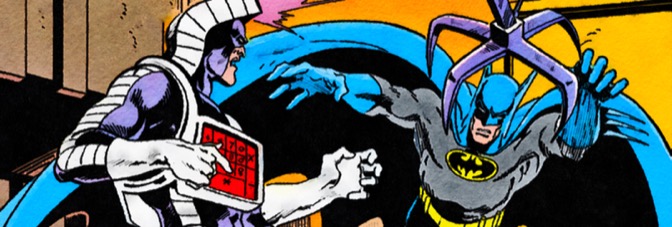
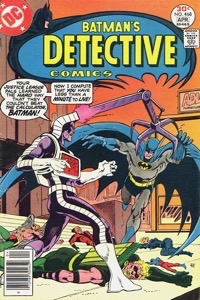
    Why does Steve Englehart’s writing sound like he’s doing a spec script for “Batman: The TV Show” cliffhanger narration? I can’t decide if it’d be better if he’s serious and thinks it’s good writing to treat your readers as infantile or if he’s doing it because he’s being condescending to the material. Either way… lousy start.

    Especially since I only started reading this era of Detective for an Englehart run.

    Yikes.

    From the first page, it’s a lot. There’s the narration, but there’s also Englehart doing a flashback on the second page to right before the first page. Alfred passed out when bringing Batman his morning snack. It appears sensational at first, then, you know, medically concerning. Maybe Alfred hit his head.

    Batman can’t get an ambulance because there’s an epidemic all of a sudden. People collapsing all over Gotham, so he rushes Alfred to the hospital as Bruce Wayne because Bruce Wayne “pays his way.” But, again, is Englehart being silly, or did he just finish reading some Atlas Shrugged for inspiration?

    A new villain is poisoning the city—Mr. Phosphorous—no, wait, Dr. Phosphorous—and he’s not going to stop. So Batman goes home (his Bruce Wayne caring for Alfred thing does not warrant a scene of concerned Bruce, it’s nonce) and investigates what poisoned Alfred. It takes Batman longer than it should. Like, it’s one of those Bob Rozakis “you-solve-its” only Batman had to cheat on the last page and turn the comic upside down.

    He’s able to go confront Doctor Phosphorous, who’s got a hilarious way of poisoning the people, and they have a big fight. Only Doctor Phosphorus is really hot, and it hurts to fight him, which leads to Batman wrapping his non-heat or flame-resistant gloves in his cape. The cape is heat and flame-resistant. It’s a poorly designed outfit or something, doesn’t matter. Neither does Batman’s next way to compensate.

    The scene ends with Doctor Phosphorous running off while Batman whines at him to stay and fight; Doctor Phosphorous says you have to come back next issue, silly, it’s a two-parter.

    The backup is Doctor Phosphorous’s origin, which unexpectedly ties into the main story. Phosphorous knows the city council guy who’s giving Gordon shit about Batman being a deputized vigilante—a different city council guy than a few issues ago; apparently, each Detective writer has to introduce their own similarly smarmy white guy whine. The city council’s corrupt and caused Doctor Phosphorous to become Doctor Phosphorus (sort of, he’s the one who thought he’d inspect a nuclear power plant on his own). So to pay him back for ruining his life, the city council has to set up Batman.

    It’s a complicated, petty politics story arc, with narration written for a very bored narrator to read. At times it feels like Englehart must’ve tested the lines aloud and liked the terrible way they sound.

    Big sigh.

    Al Milgrom inks Walt Simonson pencils. It doesn’t go well for Batman or the people, but Doctor Phosphorous is all right. The art stylizes the people strangely—some guy’s got Norman Osborn hair—and Batman’s awkwardly bulky. Phosphorous is a glowing skeleton. They do best with him.

    It’s a bad comic. Like, even for this era of Detective… it’s a bad comic. What have I gotten myself into?

  • A Walk Through Hell (2018) #7

    Wth7

    When I started this profoundly underwhelming Walk Through Hell, I observed sometimes writer Garth Ennis makes a radical save after some lackluster first issues.

    He doesn’t make any such save in Hell, but he does turn out to have a vaguely interesting twist, which comes way too late in the comic. We’re just over halfway through, and he’s introducing end of issue one material. He’s revealing the genre of horror, which first seems like he’s doing some Old Gods of Cthulhu business, but then quickly veers back into Preacher or Wormwood territory.

    It’s too late, but it’s better than I was expecting.

    He also focuses a lot on the FBI boss, Driscoll, as she enters the warehouse and starts to see its horrors. She’s a better protagonist than anyone else in the comic and a better subject for Ennis’s narration. But, of course, she’s not trying to hide anything like Shaw, or basically comic relief promoted to a more important role like MacGregor.

    There’s a lengthy talk about the 2016 election while Shaw and MacGregor are on stakeout, with Ennis presenting more depth than before. It’s not particularly deep, though—identity politics are bad because white supremacists don’t worry about their identity politics—and it’s got a terrible “punchline,” possibly the worst in the series so far.

    Given the potentially sensational nature of the big reveal, I’m surprised they didn’t open with it. Instead, they went with tedious police procedural with dramatically suffocating flashbacks. Then again, Ennis’s editor apparently thinks corpses grow hair, so why expect a better creative decision.

    There are two cliffhangers—one with Shaw, MacGregor, and the Patton Oswalt version of Seven’s John Doe (just with Christian blood magic thrown in), then one with Driscoll. Presumably, next issue will engage with one resolution and bore with another, which is one more engaging plot than usual for this Walk.

    Goran Sudžuka also appears to be sticking with the finer lines in his art, which continues to disappoint. Panels often threaten to have personality, then just don't.

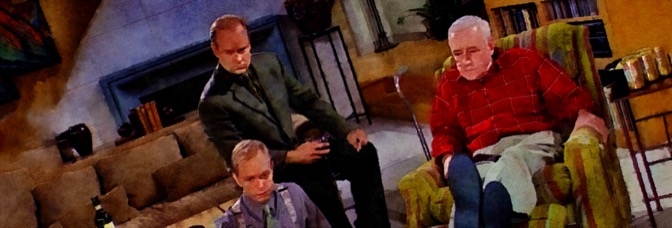
  • Frasier (1993) s07e07 – A Tsar Is Born

    This episode’s a great example of how a long-running show (probably specifically sitcom) can benefit from that longevity. There are new things in the culture relevant to the show, which it can now comment on. In this case, “Antiques Roadshow,” or whatever they call it on Tsar. “Roadshow” started in 1997, “Frasier” started in 1993. This 1999 episode offers a wonderful integration.

    Both Kelsey Grammer and David Hyde Pierce are big fans of the program, making an evening out of watching an episode. They’ve got Grammer’s apartment to themselves because dad John Mahoney’s going out for a boozer. Only then Mahoney’s pal cancels, and the boys think they’re out of luck; Mahoney promises they can have the TV after his program’s finished.

    Of course, his program is “Antiques Roadshow” too. For the first time in seasons upon seasons of episodes, Grammer, Hyde Pierce, and Mahoney find something they all enjoy. They even come up with a drinking game for whenever someone says “veneer.” It’s a fantastic bonding sequence, in some ways more touching than when they have their occasional heartfelt moments in episodes because it gets to be comedic. And let them all play to their characters’ eccentricities without anyone being the butt of a joke.

    At the end of “Roadshow,” they find out the show’s coming to town, so they’re going to go and bring some of Mahoney’s family relics. It kicks off a hilarious plot about the Romanov dynasty, scullery maids, and Winnebagos. I’m not sure if A Tsar Is Born is an exemplar “Frasier” going back to the start of the series, but it’s definitely a mid-run exemplar. The episode goes all out, too, with a scene set at the touring “Roadshow,” where Grammer and Hyde Pierce can be appropriately snobby.

    The script’s credited to Charlie Hauck, whose name seemed familiar but not from this show (Tsar is his first of two “Frasier” episodes). It’s a really good script. Especially since it gives Peri Gilpin and Jane Leeves a little more to do than usual.

    Still lovelorn, Gilpin checks out a laptop from the station to get on the World Wide Web. Presumably firing up Netscape Navigator, she’s met a nice guy online, and Grammer tries to convince Gilpin she’s being catfished. The subplot only gets a couple scenes, but there’s a nice moment for Gilpin and Mahoney, who haven’t gotten to hang out lately. Then the punchline is absolutely hilarious and provides an excellent showcase for Gilpin.

    Leeves gets showcased, too… though dressed as a go-go dancer. She and (off-screen) fiancé Saul Rubinek have different ideas of appropriate wedding attire, but Hyde Pierce gets some great reactions to Leeves in scanty sixties wedding dress. She also gets to make some good rejoinders to Grammer during his peak snobbery. It’s also nice to see Hyde Pierce have some—albeit highly inappropriate—passion. It’s been a while.

    Good direction from Pamela Fryman, great resolution for the A-plot–A Tsar is Born is an excellent sitcom episode.

  • Werewolf by Night (1972) #10

    Wbn10

    I know people buy Marvel superhero comics in Marvel comics. Still, when a kid’s floppies get knocked from his hands during Sarnak the evil sound engineer’s attack on Century City, and the kid wishes Spider-Man or Thor were here… it feels like he’s talking about his comic book heroes. Otherwise, wouldn’t someone just be whining about how L.A. doesn’t have any good superheroes?

    It’s a pretty good issue. Tom Sutton’s art is slightly better this time. Last time he made an excellent first impression, this time, he opens with some of his weakest stuff—not sure what’s going on with Lissa Russell’s head, but it looks painful—and then mostly improves. The Century City attack sequence is goofy—pissed off Jack escapes, Sarnak unleashes his army of mind-controlled sewer men on the citizenry. It doesn’t really play into the main plot, but I guess writer Gerry Conway thought any set piece would do.

    While that attack’s happening, Lissa’s presumably passed out in her sewer pit jail, while Jack goes to Venice Beach to get help from Buck, who doesn’t wonder why Jack’s shirtless and smelly. Weird norm.

    At the same time, copper Lou Hackett wants to question Phillip Russell, but the bad guys from the Committee show up and—literally—karate chop Russell into submission before kidnapping him. Lots going on at once, but none of it for this issue. We met the Committee earlier during Sarnak’s origin flashback; he was once a great sound engineer, but he started bootlegging records. Apparently, the label guys burned him alive for it. But he still knows his stuff, so he can create a mind-control device and do the Committee’s bidding.

    Their bidding in this case? Capture Jack and Lissa; the Committee knows Jack’s a werewolf and suspects Lissa will be one too. They want to control the werewolf siblings, and Sarnak’s just the man to do it, right after he organizes a brainwashed sewer army.

    It’s all extremely contrived, but it also makes the story much stranger than it would be without such a silly series of events.

    The finale’s good—Sutton obviously enjoys doing the werewolf scenes—and it’s nice to see Jack and Lissa on the same page about his lycanthropy. Even if she only plays damsel in distress when she was actually the Committee’s primary target.

    The Larry Talbots… I have it, my father had it, my sister has it.

    Conway and Sutton pull it off, rescuing the two-parter.

  • Persona (1966, Ingmar Bergman)

    Persona begins with a series of unrelated, sometimes startling, sometimes disturbing images. It’s leader on the film reel, and it establishes the film’s narrative distance. We’re not just removed from the action; the action’s on display at multiple levels, including one involving a young boy, played by Jörgen Lindström, who provides bookends for the film.

    He’s star Liv Ullmann’s son, but he’s never identified as such. Instead, he’s just the one with the most vested interest at the level.

    Ullmann plays a famous theater and film actor who, all of a sudden, stops talking one night during a performance. It only lasts a minute, but the next day, she’s not talking at all, and she isn’t moving around either. She’s stopped expressing herself in any way, which lands her in the hospital, where she gets a full-time nurse to look after her. Bibi Andersson plays the nurse.

    According to the doctor (a fantastic Margaretha Krook), Ullmann has nothing physically or mentally (though, sixties mentally) wrong. Andersson is patient and kind, trying to bond with Ullmann, who does react at times—like when Andersson starts reading her a letter from her husband—but there’s not much change.

    The audience knows Ullmann is moving and reactive; we watch her watch Vietnam War news coverage in the middle of the night, recoiling in horror at the reality she finds herself in. The war footage calls back to the opening imagery; Ullmann’s experiencing and shutting herself away from the miserable world around her.

    With no change as far as the medical staff can see, Krook decides it’d be best for Ullmann and Andersson to head out to her vacation house. Krook thinks she knows what’s going on with Ullmann; she’s just let the disconnect between apathy and empathy break her, and now she’s working through it, researching like an actor. The scene—Krook’s final one in the film and absolutely phenomenal—sets up two recurring themes. First, someone projecting their assumptions of Ullmann’s thoughts and feelings on a silent Ullmann. Second, the acting a part bit.

    With the minor exceptions of the opening leader montage, the finale, and an act break—with the film “burning” to remind us we’re not on holiday with Ullmann and Andersson, we’re watching them far removed–Persona has a relatively standard epical arc with Andersson as the protagonist.

    She gets this strange but not necessarily unpleasant assignment—Andersson goes into it assuming Ullmann wants to play a mind game with her companion, something Krook dissuades but informs Andersson later on—which turns into an extended holiday out at the beach. Andersson and Ullmann become pals, drinking wine, sunbathing, reading books, writing letters. It’s a holiday. Only Andersson does all the talking, though Ullmann does respond non-verbally to questions. So her condition’s changed a little, in relative line with Krook’s parting diagnosis.

    Things change for the pair when Andersson gets super drunk and shares a very personal memory with Ullmann. Andersson becomes convinced Ullmann speaks to her briefly, then comes to visit her in the middle of the night. The next day, Ullmann’s again not talking and denies either event. Must’ve been drunk dreams.

    When Andersson’s heading into town the next time for supplies, she takes the outgoing mail, including a letter from Ullmann to the doctor. Andersson can’t help but read the contents, which mainly concern her, with Ullmann making some very callous, mercenary observations. From then on, Andersson doesn’t think she can trust Ullmann but also finds herself becoming more and more wrapped in Ullmann’s “performance.” She just does it knowingly and often hatefully.

    The film doesn’t show Ullmann speaking to Andersson when Andersson thinks she is speaking to her. It doesn’t expressively determine whether the middle-of-the-night visit is actual or dream. But it clearly shows Ullmann hurrying to finish the letter and leaving it unsealed for Andersson to take. Persona’s got all sorts of mysteries to it, but Ullmann’s never not an enigma. We get the two private moments with her, the Vietnam footage, then her looking at a photo from World War II showing the Nazis terrorizing civilians. The horror of the world is very much on Ullmann’s mind. But is it on her mind for actor’s fodder, or what’s underneath it?

    Andersson becomes convinced Ullmann’s using her as an avatar: it’s not Andersson projecting on the unspeaking Ullmann; it’s Ullmann doing it the other way. Except, of course, it’d be a reflection of that projection, which leads to some fascinating scenes and performances. From the start—in no small part thanks to the opening sequence—Persona seems ready to submerge itself in the surreal, but Andersson and Ullmann’s performances are always firmly grounded. The confusion and hurt are always genuine.

    Director Bergman’s got some phenomenal sequences, both directing and in the script. The script’s deliberate in presenting the pair’s evolving relationship, which scenes it shows, which it skips. The direction’s all about the performances, down to a sequence where we literally get to see it from each character’s perspective.

    There are numerous second-half plot reveals—mostly about Ullmann’s husband, Gunnar Björnstrand, and son Lindström–and they’re perfect for deepening the existing character drama. At times, Persona is a character study; at times, it’s a psychological thriller; it’s always mesmerizing.

    Whether Andersson or Ullmann’s better is probably a matter of personal preference and, of course, what a viewer’s projecting on the character and its actor. It’s a perpetually fascinating film.

    Great black and white photography from Sven Nykvist, editing from Ulla Ryghe, music from Lars Johan Werle. Bibi Lindström’s production design is the third star after Ullmann and Andersson. Mago’s costumes are probably fourth.

    Persona is an exhilarating, singular experience.

  • Kill or Be Killed (2016) #13

    Kbk13

    This issue opens with more of writer Ed Brubaker’s “is it condescending or doesn’t he know how to do this” narration for protagonist Dylan. We’re almost caught up to the first issue’s framing device (the whole comic’s in past tense), but there’s one more story to tell first.

    And… there’s actually a story to tell?

    Brubaker’s been most successful with Kill or Be Killed when doing an issue unlike any others—introducing new characters (who don’t come back) or focusing on a supporting character (who’s never near as important again despite being the regular co-star). So this issue actually does all right just being a Kill or Be Killed. Dylan and Kira go out to his mom’s house to return her car, and he looks through Dad’s old art collection, and Mom tells him some family history he’d repressed or whatever.

    There’s actually… searching, earnest narration. There’s bad narration, there’s gatekeeping (better Google Tristan Shandy if you want to be in the real know), and the cliffhanger’s a mess, but when Dylan’s learned something about his Dad, it’s a good sequence. It’s a shock.

    And not a surprise Brubaker can’t maintain it. He didn’t start the issue so well; why finish it on a high point?

    It’s such a good plot point. One has to wonder why we’re getting it thirteen issues into the series. Dylan’s lack of a relationship with his father—who committed suicide when Dylan was ten—has always been on a far back burner. So far back, it didn’t seem relevant for issues, then Brubaker revealed the demon in Dad’s art, but now Dylan’s decided the demon haunted Dad too.

    Or something. The comic doesn’t seem to acknowledge Dylan not remembering his house growing up might also mean he doesn’t remember four specific paintings of his father’s he wasn’t supposed to be looking at anyway.

    His mom gets more page time than ever before, but still very little to do but drop a plot revelation on Dylan. There’s a weird standoffishness from Dylan towards her, which might be interesting if explored, but I’ve got no hopes or expectations for Kill or Be Killed. Brubaker’s highlights are way too inconsistent; this issue’s a perfect example. Usual blah, okay, surprisingly good, usual blah minus.

    Sean Phillips’s art is more of the rushed, not great variety. He doesn’t have the big head problem, but he still seems like he’s pasting features onto faces. Kira especially.

    So, problematic as ever, but also the most successful the concept’s ever been. Shame an editor didn’t tell Brubaker not to bury such a big lede thirteen issues in.

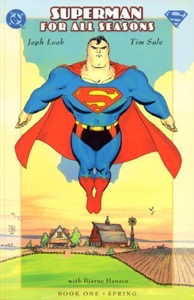
  • Superman for All Seasons (1998) #1

    Smas1

    The incredible thing about Superman For All Seasons is it never feels too precious. It ought to feel too precious as gentle, reserved giant Clark Kent ambles through his last spring in Smallville. Pa Kent narrates All Seasons, but Clark’s the protagonist. There’s a scene for Ma and Pa to talk about how Clark’s just getting so strong they don’t know what to do, but he can hear them, so it’s still his scene.

    The issue tracks Clark through his final significant changes—flying and invulnerability. The flying gets a big scene—Clark versus tornado—but the invulnerability starts with a haircut. The comic’s got a relaxed pace, with a two-page spread sometimes establishing a familiar scene or location. Downtown Smallville, as it were, or a Metropolis establishing shot. Tim Sale’s art often implores consideration, with Jeph Loeb pacing the writing to match.

    Pa Kent’s narration becomes a control of sorts.

    The issue ends with Clark in Metropolis, already established. The issue’s supposed to be “Spring,” which apparently means it starts in one spring and ends in another, years later. They skip over the college years if there are any; there’s discussion about Clark’s plans after high school, but once he’s able to fight tornados, the comic doesn’t include them anymore.

    The vast majority of the comic is solid, with the weakest scene probably being Clark trying to talk to the Smallville pastor about things. The pastor’s non-answer gets interrupted. Clark’s farewell flight with Lana Lang doesn’t have much in the way of story content, but Sale’s art is so good it doesn’t matter. Glorious night flight beats out intentionally indeterminate talking heads every time.

    Superman’s only big action sequence is a violence-free save; Metropolis is an impossible safety hazard, so he’s presumably always busy. Loeb and Sale know how to deliver their moments, but they’ve been saving up for that one. It’s magnificent.

    The “cliffhanger” introduces Lex Luthor—sporting his eighties Man of Steel red locks—but otherwise, the issue doesn’t do anything to forecast what’s coming next. Presumably, it’ll be well-paced and often lovely.

    All Seasons is off to an exceptional start.

    Oh, also—Bjarne Hansen’s colors. They’re enchanting. Again, kind of the point, but it’s also accomplishing its not inconsiderable ambitions.

    I mean, one issue in, anyway.

  • Frasier (1993) s07e06 – Rivals

    What’s most impressive about Rivals is how “Frasier” can keep doing these episodes. The title refers to brothers Kelsey Grammer and David Hyde Pierce, who this time think they’re both interested in the same woman, only they’re both interested in different women and are confused. They won’t just talk to each other about it—though Hyde Pierce’s situation is much different than Grammer’s—so they’re able to remain obtuse for long enough the episode can run its course.

    Jane Leeves’s only scenes involve her telling Grammer if he’d just talk to Hyde Pierce about it, they’d get it all sorted out, and Grammer waves her off. While it’s a waste of Leeves—the episode also wastes Peri Gilpin for the most part—it’s a very appropriate behavior from Grammer; seven seasons in, the show knows its characters and how to play them off each other, even if the sibling rivalry thing is one of the sitcom’s trope plots by now.

    Hyde Pierce is convinced Grammer’s got a crush on station owner’s daughter Katie Finneran, returning from earlier this season, while Grammer’s convinced Hyde Pierce likes Gigi Rice. Rice is Grammer’s new neighbor, who gets locked out of her apartment in just her towel, so John Mahoney takes her in. It gives Mahoney a chance to be a safe but gross old dude and allows him and Grammer to do a fun bit with Mahoney trying too hard to set Grammer up with her.

    Very experienced “Frasier” writer Christopher Lloyd’s got the script credit. It knows how to get the laughs; it just has to wiggle a lot to set them up after a while.

    Rice is one of Hyde Pierce’s patients, which they aren’t sharing with Grammer, so he’s convinced Hyde Pierce is after her. Grammer can’t stand Finneran, who acts differently around Hyde Pierce, so Hyde Pierce doesn’t believe Grammer’s denials. Rice gets the big introduction scene with Mahoney and Grammer, but Finneran’s basically just in the opening bit, so it’s uneven. Also, the show makes fun of Finneran a lot, so she can’t be too likable. And then Rice is the bigger guest star.

    They all end up at a charity ball together, leading to Grammer and Hyde Pierce scowling at each other across the dance floor to good effect. It’s a funny episode, ably directed by Katy Garretson. It’s a successful episode… it’s just… not very ambitious.

    The end credits sequence is Gilpin’s sad love life? It’s an out-of-nowhere tag since she had nothing going about it in the main episode; it’s just her character now, unlucky in love. Odd.

  • Evil (2019) s03e02 – The Demon of Memes

    Usually, when “Evil” veers too far into Catholic Church propaganda, Katja Herbers remarks about them all being a bunch of pedophiles or pedophile enablers. I can’t remember if she mentioned they killed hundreds of indigenous Canadians and buried them in holes.

    She’s not in the scenes she needs to be this episode to make such comments, so the episode—script credit to Davita Scarlett—does one big fake news related to the Church’s crimes and a second eyebrow-raiser. The first involves the episode’s “case.” Kids are spray painting a message on Catholic properties as part of an online prank; in reality, people are spray painting messages about the Church covering up the murders of hundreds of indigenous Canadian children.

    The eyebrow-raiser is Mike Colter’s subplot, which has him joining the Vatican secret service. Appropriately suspicious Brian d’Arcy James recruits him, with the mission involving one of the series’s outstanding but forgotten big arcs. Not the one directly affecting most of the cast (the demonic fertility agency), but rather a considerably less pressing one. Colter asks about the fertility agency, but the Vatican’s not interested. Live demon babies are a-okay.

    But obviously, the Vatican secret service is for laundering Nazi gold and shuffling rapists.

    Anyway.

    The rest of the episode checks most of the “Evil” boxes. The kids are slightly in danger: daughter Brooklyn Shuck knows a boy who’s doing the pranks; he’s got to do it. Otherwise, this demon the kids can see on Google Maps will kill him. Herbers and Aasif Mandvi investigate—Colter’s called away on secret business—and find a grad student (Jay Will) squatting. The episode flexes about unused living spaces and people experiencing homelessness, but it’ll demonize them by the end.

    Shuck accidentally sees the demon on Google Maps, so she’s worried she’ll be next. The show never explains how her friend, Uly Schlesinger, who’s locked himself in his room for days, counting down the clock on the curse, has apparently been doing the required tasks for the demon. Shuck starts the list: they all occur outside your room.

    That plot takes a backseat to Colter’s, which is fine; it’s not a very good mystery. And at least Colter’s plot is intriguing. Though Herbers and Mandvi do go visit returning guest star Brooke Bloom for a scene; it’s the first Herbers has seen Bloom since killing her serial killer husband, which Colter definitely knows about but thinks the visit is okay, and Mandvi suspects and maybe doesn’t think the visit is okay.

    Meanwhile, Christine Lahti, Michael Emerson, and Tim Matheson are conspiring against Herbers’s husband, Patrick Brammall. He wants to kick Lahti out of his house—which, unbeknownst to Brammall, would probably put his daughters very much in immediate danger from Emerson. It’s a weird subplot because Brammall’s such a jackass you’re rooting for the bad guys to get him off the show.

    It’s a very low okay episode. Herbers and Shuck don’t have enough chemistry in their mother and daughter scenes, the one jump scare’s super cheap, and the cliffhanger’s boring. But at least Colter gets something to do; hopefully, that emphasis will continue this season.

  • Abbott and Costello Meet Frankenstein (1948, Charles Barton)

    Abbott and Costello Meet Frankenstein makes a surprising number of Universal monster movie gaffes. Most obvious is director Barton’s fault—Dracula (a very fun Bela Lugosi) casts a reflection. After shooting the “vampire seduces lady” scene half in reflection, careful not to show Lugosi, the finish just has a visible Dracula in the mirror. So it goes from being a clever constraint to a bewildering fail.

    There’s also some questionable vampire logic—Lugosi’s victims crave blood but aren’t vampires—and then it’s a full moon at least five nights in a row, maybe six, so Lon Chaney Jr. has something to do in the movie.

    For the first and third acts, gaffes don’t really matter. Only in the plodding second; Meet Frankenstein is only eighty minutes and change. There shouldn’t be any plodding, but it indeed plods, mainly because Bud Abbott is convinced there aren’t monsters, and Lou Costello’s either making it up or too dumb to successfully process reality, and it’s a drag. Every gag ends the same way—Costello seeing monsters, Abbott just missing them. In the first act, when Costello’s got a lengthy bit with Lugosi coming out of a coffin next to him, it’s amusing.

    Approximately fourteen times later? Less amusing.

    It’s especially unfortunate since Abbott’s pretty good when he’s not playing dunce. He and Chaney have to team up to save the day, and it’s a missed opportunity for more. Especially for Chaney, who starts the movie with a bunch of potential but then they just keep doing the same thing for him over and over again.

    At least Lugosi gets some variety. He gets to terrorize Costello, pretend to be a mad scientist, seduce the ladies, and lead Glenn Strange’s Frankenstein Monster around. Lugosi’s got the best part by far.

    Strange has the worst. While Chaney’s Wolf Man makeup is pretty good, Strange’s makeup seems cheap and flimsy. When he moves too much, it looks like his hair’s going to fall off. But there are decent enough sight gags for Strange in the third act; it just takes until then for him to figure into the plot.

    Abbott and Costello are baggage handlers in sunny Florida, where local haunted house owner Frank Ferguson has just bought the original corpses of Dracula and the Frankenstein Monster from Europe. Ferguson’s an obnoxious blowhard, and the film’s best early joke has Costello treating him appropriately. Costello’s better in the workaday scenes than when he’s doing the horror dating comedy—see, new-to-the-area, glamourpuss Lenore Aubert has taken a liking to Costello (frustrating Abbott), but then Jane Randolph starts cozying up to him as well. The second act is basically Costello juggling unlikely girlfriends; Aubert’s a mad scientist after his brain and Randolph’s an insurance investigator trying to figure out if the boys stole the infamous corpses.

    Then throw in Charles Bradstreet as Aubert’s assistant, who doesn’t know anything about his boss’s nefarious plans, but Randolph needs to be able to smile at a cute guy occasionally instead of Costello.

    The finale’s a madcap haunted castle romp with Abbott and Costello trying to escape but being foiled by monsters at every turn. Of course, Lugosi has the best material, including throwing potted plants at his adversaries. The movie does need to do something with all the monsters, which it resolves pretty well for half of them. The other half gets shrugged off, with the last one hurried so there can be the final, funny gag.

    All things considered, it’s far from a failure. It’d be nice if Abbott and Costello were strong together instead of apart, and Randolph seems like she’s going to have a good comic part then gets an immediate downgrade. It’s probably worst for Chaney, who always seems like he’ll get something, but then the full moon interrupts. Lugosi’s a delight.

    The special effects—outside Strange’s makeup—are decent. They use a cartoon bat for Dracula, but the transformation scenes aren’t bad, and there’s at least one really good composite shot. Unfortunately, the exteriors are all soundstages, and while Charles Van Enger’s photography does okay, they’re visibly sets. Any related problems seem to be more director Barton’s.

    Good music from Frank Skinner.

    Abbott and Costello Meet Frankenstein doesn’t set itself a very high bar, but it does clear it. Lugosi alone makes it worth it.

  • Dracula Lives (1973) #3

    Dl3

    There aren’t any pages of the Dracula movie stills with new dialogue. There are still some movie stills with accompanying text, but it’s not for laughs. It’s a welcome change to Dracula Lives, though the pages instead seem to be going to somewhat middling text material.

    But first, the comics.

    Writer Marv Wolfman contributes another part of Dracula’s Marvel origin. After becoming a vampire, killing his captors, and dropping his infant son off with some gypsies because a vampire can’t be a daddy, a flock of vampire bats descend on Dracula and again take him captive. He’s off to see Nimrod, Lord of the Vampires, only Dracula’s not going to bow to anyone, so he and Nimrod schedule a duel. Only then Nimrod’s lady tries to seduce Dracula, who isn’t into vampire ladies. Too cold.

    John Buscema pencils, Syd Shores inks. It’s probably the best art in the issue, with only one real competitor, but it’s somewhat uneven. Close-ups are great, medium and long shots are iffy on the faces. And then the final battle eventually runs out of steam and ends abruptly. Good writing from Wolfman, though, and lots of the art’s solid.

    The second story is one of the two fifties reprints in this issue. Larry Woromay does the art on the story, which recounts the tale of a man born disfigured who wants to become a vampire to make people pay for mistreating him. Only he can’t stand the thought of drinking blood. The end has a “twist,” but the story’s primarily successful for Woromy’s art. Lots of personality to it.

    Then comes the first text piece—Doug Moench writing about Bela Lugosi and the 1931 Dracula movie. It’s a thoughtful piece examining how the film’s aged. Probably a little long, but Moench’s got good observations.

    The following story is Dracula versus Solomon Kane, so Marvel did a multi-license crossover decades before the competition. Only not exactly because Dracula was never copyrighted in the United States, and the British one had run its course already.

    Solomon Kane’s trying to find a missing girl in Transylvania. First, he’s fighting bandits, then wolves, with Dracula showing up to save him at the last minute. Dracula doesn’t know anything about the girl, but wouldn’t Solomon like to spend the night at the castle.

    Roy Thomas writes, Alan Weiss pencils, and the “Crusty Bunkers” ink. They must sit at the same table with Many Hands. Supposedly Dick Giordano and Neal Adams did some of the inking. The art’s good but occasionally sparse. There’s great action, though, because obviously, Dracula didn’t offer Kane a place to crash not wanting to suck his blood.

    It’s a Solomon Kane story guest-starring Dracula; it’s okay.

    Next up is Chris Claremont’s text piece from the perspective of Van Helsing, set to pictures from the Hammer movies of Peter Cushing as Van Helsing. I get they needed to fill the pages, and the story’s better than the movie still rewrites, but it’s still a quick gimmick dragged out over six pages.

    The second reprint has Chuck Winter art and is a reasonably straightforward Macbeth adaptation until the last panel. Winter’s art is emotive but rushed, and the big reveal at the end isn’t an improvement on Shakespeare. Shocker. The adaptation also severely reduces Lady Macbeth’s part.

    The final story is from Gerry Conway and Alfonso Font. It continues last issue’s New Orleans adventure for Drac, this time getting him all the way to Paris. A mystery woman is out to kill him, there’s a gargoyle flying around the city, lots going on.

    Font’s art is design-oriented and fairly good, except Dracula looks a little silly. He’s very formally dressed and finely coiffed, but in a very distinct, very not Dracula Lives style. Font does a fantastic job with the Paris setting, just not the count. It might feature the best “bat” action, though it might also just be Paris.

    The Conway story is okay. But, unfortunately, it’s a little too busy for the story we end up getting.

    Dracula Lives doesn’t have any home run art outings this issue, which really hurts it. It’s a string of “not bad,” though at least the Wolfman one has some emotional weight. Then the text pieces seem like filler even when they’re okay.

  • Superboy and the Legion of Super-Heroes (1977) #245

    Slsh245

    Maybe I need to be more invested in the big villain reveal—it’s Mordru, who’s some kind of space wizard who the Legion always foils. He talks a lot and has no weaknesses other than being buried underground. Only four Legionnaires are left to take him on—Superboy, Karate Kid, Lightning Lad, and Saturn Girl. Last issue, I thought Saturn Girl was the science police officer who’d been trying to warn everyone; nope. That officer never comes back in the issue, so no one has to learn to listen to lady science cops.

    The four heroes have to figure out how to beat Mordru, who’s commanding an invading army of a million Khurds on Earth. Mordru’s mind control powers seem limitless, with a couple of pages dedicated to recapping how he was controlling x, y, and z in the last five or six issues of Superboy and the Legion. He’s just an infinitely powerful villain. There’s nothing else to him. His goal is just to destroy Earth for revenge against the Legion. It’s not particularly interesting.

    After their initial escape, Superboy gets temporarily brainwashed—that magic weakness—and there’s a fight scene with Karate Kid. It’s pretty silly. I don’t know if it’s because of Karate Kid’s giant lapels or the tropical island setting, but it’s not particularly exciting. Then the superheroes’ plan for taking on Mordru is also visually wanting. They’ve got to free the entire captive Legion… it might just be the mix of Staton and Anderson. Maybe the visuals would be better with different inking, but also maybe not.

    There’s not a lot of dramatic weight to the story. Of course, in the background, there’s still the intergalactic peace process or whatever, but it’s not part of the main story. It’s like writer Paul Levitz ran out of creative angles for the story and instead did a superhero team versus villain story.

    The epilogue’s got a significant potential development for the Legion going forward, but it’s mostly just an excuse for Staton and Anderson to draw the whole team together, which isn’t visually impressive. That exceptionally minor charm Staton’s art had in the previous issue must’ve been because of the Joe Giella inks. Does Anderson sap the energy, or is there just no energy to such a lackluster conclusion?

    It’s hard to go from future sci-fi superhero war comic to just a wizard.

    Though, again, maybe it’s different if you’re invested in Mordru. But Levitz doesn’t do anything to suggest one ought to be either.

    Eh.

  • The Brain from Planet Arous (1957, Nathan Juran)

    Given its micro-budget and absurdity, The Brain from Planet Arous is often surprisingly okay. Director Juran was so embarrassed he took his name off the final product (using his middle name, Hertz, as his surname on the credits), and the movie does get goofy, but its biggest problem isn’t the budget in the end.

    Instead, it’s how Arous treats leading lady and de facto protagonist Joyce Meadows. She’s second-billed, but lead John Agar has been possessed by an evil space brain. For the vast majority of the… seventy-minute runtime, it’s not Agar bent on world domination and assaulting Meadows; it’s this evil super brain. Literal super brain. There are two of them, one bad, one good, and they’re usually physically immaterial but visible, something Agar never figures out when trying to fight the bad one initially. Concerning since he’s a nuclear physicist.

    He and his sidekick, Robert Fuller, measure a way too much radiation out at “Mystery Mountain” (Ray Buffam’s script seems written for a “Scooby-Doo” in more ways than one) and go out to investigate. Before they go, they go over to Meadows’s house for some all-American grub. Hamburgers, French fries, and casual sexism. Though not as much as later when Meadows’s dad, Thomas Browne Henry, says he’s going to hide in his office, so he doesn’t have to help with the dishes and will only come out when she’s finished.

    Henry is terrible, which ends up helping the film a little. The only time the space brains appear in shots with the actors is when the brains are possessing someone. Otherwise, they never share shots, so there’s a lot of Agar dramatically flailing around the frame all by himself. There’s only so much he can do, right? Like, come on. It’s called The Brain from Planet Arous, after all.

    And when Agar’s possessed and planning world domination, he has moments of success. He’s able to get absurd enough to match the script. Rolling around by himself, there’s nothing to be done with it.

    He also gets metallic mutant eyes, which are clearly painful to wear, and Agar’s wincing pain makes for a more effective moment.

    After the opening, when Agar and Fuller go out and find the alien, most of the movie is set either in Agar’s lab or Meadows’s house. Specifically, her backyard because it seems like the lab is in a different part of that same house. The first scene makes it look like she’s coming in to get them for lunch, not getting in a car and driving over and bringing them back for lunch.

    Later, her dog will run between the houses regularly, but Agar always drives back and forth. It’s a little weird, but I guess even Arous knew the idea of scientists Agar and Fuller living with his girlfriend Meadows and her dad Henry was too silly.

    Meadows and Agar only get a couple scenes together before he becomes possessed by the evil brain, who taunts Agar about what they’re going to do to Meadows and how she brings out a certain malicious lust in the otherwise asexual brain. It’s a lot, and Meadows spends most of the movie terrified of Agar attacking her. She’s pretty damn good at it.

    Of course, after Agar gets back and assaults her, dad Henry tells her to get over it; Meadows doesn’t get any support until the good alien space brain shows up and confirms Agar’s now dangerous to Henry. It’s obvious what kind of world Meadows is living in.

    And, just when the film needs to acknowledge her ability to overcome that world’s hindrances… it makes a sexist joke about her. And she’s a silly, silly lady. It’s a mean ending for the character, a bad one for the film, a big diss to Meadows (who kept a straight face not just opposite translucent space brains but also Henry’s bad acting), and a crap end for the film overall.

    Instead of having a resolution, the movie literally just has someone gaslight Meadows and make her the butt of a joke.

    It’s a bummer since it didn’t have to end so badly. And it didn’t have anything to do with the budget, just bad writing. Arous just needed to take itself as seriously as its two leads did. Agar and, especially, Meadows get nothing for their efforts.

  • Tomb of Dracula (1972) #13

    Tod13

    It’s only taken a dozen issues, but Tomb of Dracula finally lets the vampire hunters get the upper hand. They get there the same way Dracula usually does—the writer surprising both the reader and the targets. The move isn’t quite a twist—it comes as a hard cliffhanger—and it’s nice to see writer Marv Wolfman mixing things up a bit. Not sure how many times he’ll be able to do it before it’s a trope, but this first time it works.

    The issue ends with a lengthy, exciting action sequence. The vampire hunters—recovered from Edith Harker’s death—have tracked Dracula to the little English town where he’s been hiding. He’s going into the battle with a handicap; it’s almost daylight, and he’s got tired brain. But he’s still got time to do away with those pesky vampire hunters.

    Gene Colan and Tom Palmer are on art, and it’s a lovely issue in that department. The art’s always good, starting with the vampire hunters bickering immediately after Edith’s death. Except when they show a shopkeep a sketch of Dracula, which alerts the Count and seemingly mind wipes the shopkeep. That sketch is a hoot. Colan and Palmer’s art is quite successful in its verisimilitude, bringing together all the comic’s disparate elements—modern London, Blaxploitation star Blade, Dracula himself—but that sketch is silly. The comic’s going into its most thrilling portion, but the most compelling question is who drew that picture and was it with crayon.

    It was probably Frank Drake, who starts the issue not consoling girlfriend Rachel Van Helsing about dead Edith, leaving it for Taj. Frank’s got to pontificate instead. Blade tells him to snap out of it, Frank yells at Blade, they calm down, then Quincy agrees with Blade. That pattern repeats itself a few more times in the issue. I get unexceptional white male leads, but events always showing they’re wrong, but they never learn from their mistakes is not good writing. It’s reality, but it’s not good writing.

    Anyway.

    We also get a flashback to Blade’s origin, though not the half-vampire stuff yet. Just his mom getting murdered while giving birth to him. The vampire they call is a doctor, which makes him the third vampire doctor in Tomb. At first, the most interesting part of the flashback is how they’re coding the mom giving birth in a brothel, but then it’s how could Blade possibly know most of the story since the only person in the room with the vampire is his dead mom. Exquisite art and all, but it goes on long enough for the incongruity to solidify.

    More interestingly, we get some insight into Dracula’s plan. He’s been biting people, not turning them into vampires, but instead into sleeper agents. His first victim is another woman he saves from a rapist. I’m not sure the last time we’ve seen Dracula kill a random woman in Tomb; he’s done it off-page, but we haven’t done the hunting in a while. So my idea for a Gene Colan art book of his panels of the bat swooping in on an unsuspecting British girl on the countryside won’t work out.

    The sleeper agent bit is cool, as is Dracula going to a boxing match and deciding sports are dumb, and so are the humans watching them. He says it more artfully. His hideout, however, is a little silly. It’s the village mortuary. Functional, sure, but weird Dracula’s going to screw up this small town’s only funeral service.

    Oh, speaking of weird. The timeline is a mess. The story opens at the end of last issue, then presumably jumps ahead to the next night. Dracula goes to the boxing match, then goes home. It takes him a long time to get home, and it’s almost dawn, but he sees a carnival in town. It’s only important because a cop working the carnival duty knows Quincy and calls in the vampire bat. The vampire bats are apparently ginormous, so they’re noticeable.

    The overnight carnival is just odd.

    But, odd aside, it’s a good issue. Dracula’s a personable villain protagonist, the art’s phenomenal, and the end action sequence is aces.

  • All Rise (2019) s03e02 – The Game

    I’m just going to assume the first OWN episode of “All Rise” was some kind of “new network” pilot. Because this episode’s not just a lot better, it doesn’t even feel like that episode. Maybe because there’s not constant, overblown music. But also… Wilson Bethel’s got a goatee in this episode, and Simone Missick’s hair’s different; it feels like the first real episode after a pilot. And it’s in better shape, thank goodness.

    The show’s leaning into humor and heart. The case is a severe one—star hockey player Zane Holtz and Instagram influencer Olivia Rose Keegan were having consensual rough sex, and then he assaulted her. There’s not a lot of opportunity for lightness, so the episode goes front-heavy with the humor beats. During the actual trial, the show relies on young assistant D.A. Ronak Gandhi for the relief. It’s not exactly comic relief, but Gandhi’s an affable character. He’s a millennial wunderkind ADA who thinks Bethel’s (professionally) incredible and surprised to discover the courtroom is one big friends group.

    Keegan’s good, Holtz’s scary, but there’s a disconnect when it comes to Lindsey Gort. She’s defending Holtz against fiancé Bethel, while Samantha Marie Ware is mortified at what defense attorneys do. Gort acts like it’s nothing, humanizing her through Bethel later on. But it’s impossible to blame her—it’s the script. Credited to Gina Gold and Aurorae Khoo, it directly raises questions from Ware to Gort, then ignores them all, but with Gort doing all the avoiding.

    It’s a strange oversight, especially when so much of the rest of the episode is about professional… well, development. J. Alex Brinson and Bethel talk professional talk, Brinson talks professional talk with Jessica Camacho (also romance subplot check-in but some professional talk), Missick gets to talk with other judge Patricia Rae; lots of shop talk for everyone. But Ware’s left hanging.

    Camacho’s whole plot line in this episode is professional too. She’s trying to get her holistic law practice going. It’s a fairly good setup for a season arc for her. More immediately, Missick’s got a professional subplot of her own with her assistant, Ruthie Ann Miles, throwing a wrench in their friendship. So it’s a whole bunch of professional storylines.

    But not Gort. It keeps the character one note. Defining her through Bethel’s even worse.

    It’s mostly a good episode. Bethel shares space with Gandhi well—he’s very complementary to the guest star—but he doesn’t get anything much of his own. Missick’s got some decent moments, but the Miles subplot feels (not otherwise unsuccessfully) shoehorned in. Camacho’s got the best arc.

    Lindsay Mendez also has some good moments; she’s Keegan’s victim’s rights advocate.

    It’s a little breezy at times, but the show at least feels like “All Rise” again and not some weird restaged version with the same cast.

  • Detective Comics (1937) #468

    Dc468

    At least the art’s better. I can’t imagine how this issue would read without it. Marshall Rogers is still way too design-focused, with most of the action taking place against blank backgrounds, but when there is scenery, it’s excellent. And Terry Austin’s thin, dark inks are perfect, particularly on the Batman pages.

    But the writing’s even worse than I was expecting, and I wasn’t expecting much.

    This issue concludes writer Bob Rozakis’s Calculator story, which had been running in Detective backups for the last five issues. The Calculator does some crimes, gets arrested by a superhero, hits a button on his chest keyboard, then escapes from prison immediately after. Neither the backups nor the feature explain the Calculator’s powers, but his computer can apparently create physical matter as well as do omniscient computer stuff.

    In other words, silly seventies computer shit.

    The issue begins with Batman fighting Calculator, beating him, but Calculator confidently going to jail. See, once he hits the magic button, his computer figures out how to forever beat the superhero he’s been fighting. Computers, am I right?

    He escapes from jail, and Batman goes to consult all the Justice League members who’ve been fighting him in the backups. They have a big team fight, with some competent but not engaging art; only Calculator still wins. Of course, since it’s a Rozakis comic, he’s going to tease the reader with the solution, but it’s such a silly solution it’s hard to believe Rozakis was talking about it. Until Batman explains, yes, indeed, the ridiculous solution was the inspired gimmick the whole time.

    There’s a subplot about Morgan Edge wanting Bruce’s vote for something and Bruce blowing him off. It’s a strangely grown-up plot for a comic otherwise written for eight-year-olds, though all the senseless computer jargon wouldn’t work for an eight-year-old either.

    Doesn’t matter. This inane story arc is finally over, and Rogers and Austin are on a quality uptick. Despite exclusively swinging around during the day, their Batman is pretty darn good.

    The finale’s punchline is particularly godawful but not a surprise. Rozakis’s script’s terrible.

  • Luba (1998) #10

    L10

    @#$%& Beto!

    I very deliberately emotionally steeled myself for Luba #10. Creator Beto Hernandez ended the last issue on such a one-two punch of cliffhangers (no pun), I knew I needed to be ready. Lots of stories were about to come to a head, lots of emotions.

    And they do. Lots of stories do come to a head—Beto’s finishing business he started back in Love and Rockets, including Luba and Ofelia’s origin story arc, Poison River—and there are lots of emotions. But Beto’s got some surprises up his sleeve, and he saves the big one for halfway through the issue, at which point there’s so much emotional relief he’s got time to prime up for another one-two punch on the finale. And this time, there’s no “Continued…,” but a “The End.”

    Much of the comic is about Luba, though often through her daughters’ perspective. She starts the issue visiting Pipo in the hospital—someone mugging Pipo and brutally beating her is one of the previous issue’s cliffhanger punches—and witnessing the peculiarities of Pipo’s storyline in the comic. For example, Luba’s sister Fritz arrives to console Pipo, who she’s dating, while Pipo’s son, Sergio, who used to date Fritz before Pipo seduced her away, stands in the back sullenly. Outside, Gato—Pipo’s ex-husband, now married to Luba’s daughter—waits for Sergio so they can go get shitfaced together. Pipo’s assault has given them a shared purpose, which we’ll discover later; it’ll be the largest non-Luba-related subplot.
    The most significant unrelated subplot—early in the issue before Beto gives away the “twist”—is Venus and Hector going for a walk through a scary forest where there’s a stone marked Frankenstein. It’s a gentle aside with a bit of a bite thanks to Hector having an “ah-ha” moment (eureka, not Take on Me), lots of mood, and lots of personality. Luba’s trying to calm down a still hysterical Venus during the opening hospital visit—Venus’s crying started at the end of last issue when everyone found out about the cliffhangers—and it’s a good bit of character work while laying groundwork for later. Though it’s groundwork on groundwork, it turns out. Beto does a whole bunch in the last two pages of the issue.

    Meanwhile, Luba’s feeling abandoned. Daughter Doralis is going to do televised charity work around the world, sister Fritz is going off to Hawaii with her (beard?) husband-to-be, not to mention Ofelia’s no longer going to be around to help. That particular absence convinces Luba’s estranged daughter Maricela to visit—not to make reconnect (Luba’s still super shitty about her gay kids being gay)—but to offer to take care of her youngest siblings. Something Luba’s husband, Khamo, doesn’t think is a bad idea. Without Ofelia around to even slightly referee, Luba’s arguments with Khamo get even more heated.

    It’s a hell of an issue for Luba. Especially how much it takes place in her background reactions. She’s rarely the focus of talking heads panels; it’s her kids, her sisters, her friends, but so much plays out for her and from her.

    And, obviously, Beto’s handling of the Ofelia stuff is extraordinary.

    Luba started a tightly connected anthology, then became a loosely connected multi-chapter narrative, and Beto brings it all together for a complete piece in the end. He forecast the approach last issue when the separately titled strips all wove together, but this issue’s one of his greats.

    There’s so much tragedy in the resolution but also so much hope. It’s a magnificent conclusion.

    @#$%& Beto!

  • The Boys (2019) s03e05 – The Last Time to Look on This World of Lies

    Silly me, when I wondered how things could get worse for everyone on “The Boys,” I didn’t realize it was going to be everyone everyone, including Antony Starr’s psychotic Superman analog. He’s just become to de facto CEO of the superhero pharmaceuticals company (sycophant Colby Minifie gets the title), and he doesn’t, you know, know anything about big business. Starr’s way out of his depth and obviously can’t admit it, which he plays beautifully. He’s actually not in the episode very much, just for some bad-to-worse scenes throughout, but it’s still an excellent episode for him.

    The episode opens with a reprieve (or cop-out) for previously mortally wounded Karen Fukuhara. She’s okay now. Like, she’s in the hospital—which raises questions about how they took a superpowered individual to the ER—but she’s okay. She and Tomer Capone get to spend one great day together with him taking care of her. Of course, he’s neglected to tell her his former boss, Katia Winter, blames him for their Russian mission going wrong last episode and is demanding he kill people for her again, but he’s trying to center Fukuhara’s recovery. It’s a lovely arc for Fukuhara and Capone, and of course, their respite will not last.

    Laz Alonso starts the episode mad at Karl Urban for superhero serum juicing, but once Jensen Ackles’s reawakened from a Russian lab Captain America gets to New York and starts blowing up city blocks… Alonso decides to put aside his anger. Erin Moriarty’s also recovering from last episode’s tragic twists, but she’s present enough to suggest they deal with Ackles, who everyone thinks is just a super-villain.

    Starr’s too busy watching the stock price, though.

    It’s a very packed episode. First, there’s relationship stuff for Moriarty and Jack Quaid, again showing why she’s one of the show’s greatest assets, then there’s Urban and Dominique McElligott bonding over the shared trauma of existence in “The Boys” universe. McElligott is another of the show’s best performances. Urban gets the heaviest lifting in their scenes, leaving her the comic relief, which is actually nice since the rest of the time, she just lives in terror of Starr.

    Jessie T. Usher then finally gets his arc involving racist superhero Nick Wechsler, which manages to go incredibly wrong even after it’s already going incredibly wrong. “The Boys” isn’t wasting any time getting everyone to the bottom of the well. Except for Chace Crawford, who’s only got one scene, where wife Katy Breier is effectively puppeteering him to success. I was expecting more with them, but the episode leaves a lot of seemingly open threads unfinished. It’s got a particularly frustrating cliffhanger.

    One big highlight—not sure executive producer Seth Rogen’s cameo is a highlight; it’s funny, it’s not a highlight–but one unquestionable series highlight is Paul Reiser. He plays “The Legend,” who was sort of Stan Lee in the comics, but in the show, he’s a Robert Evans-type. Reiser’s awesome; no notes.

    He helps the Boys find Ackles, who’s on a revenge mission.

    Ellie Monahan gets the script credit; very good script. And Nelson Cragg’s direction is outstanding.

    It’s a great episode. It’ll marathon superbly. But having to wait a week for any resolution to the… four or five hard cliffhangers? Annoying.

  • The Orville (2017) s03e03 – Mortality Paradox

    Well, here’s where it turns out “Orville: Season Three: New Horizons” is not making Penny Johnson Jerald the de facto series protagonist. Instead, Jerald’s in a scene or three but entirely superfluous to the main plot. Though the main plot is also entirely superfluous, so she didn’t miss much.

    I wonder if this episode would play better if you’re unfamiliar with its sub-genre of “Star Trek” episode. It’s modeled after an original series episode, with the flare (and budget) of later series and the inevitable punchline out of “Next Generation.” Though there’s one more sci-fi franchise reference—non-“Trek,” non-Wars—and it’s arguably the cutest. Though they miss a golden opportunity for a “Simpsons” dig.

    Anyway.

    The episode begins with Jessica Szohr returning from leave, which will be important later. Doing routine long-range scans, the ship discovers a settlement where there shouldn’t be a settlement. Some barren rock in the ass-end of space. The Orville goes to investigate, the ship’s sensors reading signals while the visuals don’t match. Captain Seth MacFarlane, first officer Adrianne Palicki, helmsman Scott Grimes, security officer Szohr, and second officer Peter Macon head down to investigate.

    Instead of a bustling civilization, they find a Class M planet with endless tree coverage, which is just as inappropriate on this particular planet. Walking through the forest, they find themselves at a twenty-first-century high school.

    The planet will continue to change locations, making one appropriate for each of the crew members to have a close call with impending doom. Though it seems like Grimes gets the brunt of it. Everyone else has relatively quick brushes, while Grimes gets a double in the first setting, then has to do all the work in the second.

    The episode’s also got more “we moved to Hulu late” commercial breaks than any of the previous entries and doesn’t fit the “mini-movie” or extended episode vibe of the two previous episodes this season. It’s stretched to fit its hour, not scrunched. Given the eventual reveals—which both drain the dramatic heft of the proceedings—it’s doubly pointless filler material.

    There’s some good acting, at least. Grimes gets the most to do in a while, ditto Macon. MacFarlane gets a Jim Kirk moment, which is fun, though otherwise, he and Palicki are in the background.

    Jon Cassar’s direction is good enough. He’s not great at segueing between physical locations; it often feels like the crew’s going through a funhouse, but with poorly executed transitions. The reveal suggests the transitions should be better. Or at least different.

    And then I was going to compliment how much John Debney’s score sounded like a John Williams riff, but Joel McNeely actually did the music, and Williams riffs are his whole thing, so no wonder. Music’s solid.

    The problem’s the plot and the eventual reveals. If there’s a way to do this episode well, the script (credited to Cherry Chevapravatdumrong) didn’t crack it. The reveal also requires a lot of familiarity with previous “Orville” episodes, which seems like a flex for a show advertised as “New Horizons.”

    But it feels most like a script intended for an ongoing broadcast television series, not one in its final (for now) season on a streaming service.

  • A Walk Through Hell (2018) #6

    Wth6

    Either writer Garth Ennis or editor Mike Marts doesn’t know corpses don’t grow hair.

    At least Ennis ought to know corpses don’t grow hair.

    Google’s free, people. I’ll bet it’s even on Bing.

    The issue opens with McGregor noticing he’s got facial hair, which would’ve taken a few weeks to grow, meaning they’re still alive somehow. Only Shaw hasn’t had her period, so time’s not passing; corpses just grow hair. I suppose they could be going for Shaw being wrong, not knowing some very basic “old wives’ tale” human anatomy stuff you’d hope an FBI agent would know. But McGregor doesn’t know anything about it either.

    Anyway, it’s not really their issue; it’s their boss’s issue. Their boss, Driscoll, gets to the warehouse two hours after they went in. Still no sign; the cops aren’t willing to go in. So she goes in on her own and starts having a weird text exchange with one of the other FBI agents. It’s middling at best and nowhere near creepy enough to maintain its own subplot. Especially since it’s not part of the cliffhanger.

    The cliffhanger ties into a story Driscoll tells McGregor and Shaw about a Nazi she once knew, who told her an anecdote about Notre Dame during World War II. The scene–Driscoll framing the story for McGregor and Shaw, the Nazi in the flashback–is one of the better ones in the series. It’s simple and peculiar but sincerely presented. Here’s this information, it’ll be relevant, who knows how.

    The rest of the issue’s bridging. Shaw and McGregor, mildly angry bantering, walking through the Hell warehouse towards a light. It’s tedious.

    Gorman Sudžuka’s still got his thin lines, which aren’t as noticeable this issue. They don’t slow the comic down like before; they’re the new, unfortunate normal. But he does an all-right job overall.

    The cliffhanger suggests something’s finally going to start happening, but six issues is a way too long lead-up.

  • Werewolf by Night (1972) #9

    Wbn9

    For a while, I thought artist Tom Sutton would be Werewolf by Night’s return to art form. Or at least getting closer to it than it’s been since they started putting consecutively worse inkers on Mike Ploog, then lost Ploog altogether. Sutton’s probably the most successful since then, but he’s not good.

    The first sequence has Wolfman Jack running through rainy Los Angeles while some scary-looking guy in a scarecrow outfit chases him in the sewer, eventually attacking. The werewolf holds his own until a supersonic dog whistle paralyzes him, letting the scarecrow guy escape, with the werewolf passing out in public. Jack wakes up in the morning in the LAPD drunk tank, with detective Lou Hackett waiting to question him.

    There was also a Len and Glynis Wein cameo, which is cute, but probably shouldn’t be one of Sutton’s most successful “people” panels. Because while Sutton’s better than most at the werewolf and his sewer-dwelling, scary-looking foe… the people are the pits. And they get worse as the story progresses. Then it turns out the sewer-dwelling grotesques are just ugly people who were experiencing homelessness and then hypnotized by some guy with a pied piper pipe… it’s rather dehumanizing and icky.

    Pied piper guy is named Sarnak. He works for the Committee. And he wants to brainwash the werewolf into helping them attack Century City, but it’s all actually a ruse to kidnap Lissa Russell (in addition to Jack, in werewolf form). Sarnak sent his bad guys to get Jack from step-dad Phillip’s place, where Lissa was asleep—before the full moon rose, they go to bed early in the Russell household—and the bad guys didn’t go to get her.

    There’s a line in Jack’s narration about Lissa’s presence being inexplicable, but go with it, so there may be no explanation next issue in the resolve.

    The rainy street scene’s really good. The bad guys fighting the werewolf in the Russell house is good. The rest is pretty blah.

    We do get Hackett trying to strong-arm Russell into giving him some answers about the werewolf, but Hackett calls Phillip, who shows up and takes Jack home. Not sure why they didn’t keep questioning him. But then Jack and Phillip get to argue for the first time in almost ten issues (I don’t know if they’ve had a scene together in Werewolf by Night proper). And Jack and Lissa get to briefly talk about the werewolf curse.

    She’s seemingly unworried about coming down with it herself.

    Gerry Conway’s script is okay. The people talking stuff might work if Sutton didn’t draw the people poorly.

    It’s good they’re finally getting to the Russell family drama stuff, but it’s been about a year since the series started putting it off. So hopefully, they’ve got something good planned for next issue’s resolution. But I’m also not holding my breath.

  • Kill or Be Killed (2016) #12

    Kbk12

    So.

    I'm not sure how seriously one can take this issue with even the briefest historical context. There's a lengthy section of Dylan's narration where he talks about how he's not just some alpha who protected his woman from the wolves. Given Kira's Harry Potter costume, if it were written these days, it would feel like writer Ed Brubaker wanted to in-virtue signal.

    But then there's the The Edge thing. The Edge is an Alec Baldwin and Anthony Hopkins action movie from the nineties, written by David Mamet. It apparently greatly inspired Dylan. He talks about it at length, with Brubaker again unable to make the narration not sound condescending or acknowledge his readers might have seen The Edge. It's… amateurish writing at best. If you told me Brubaker was putting his name on someone else's script at this point, I'd believe it. It's embarrassing for an experienced writer who was never so desperate with "pop" culture references before.

    The A plot is Dylan deciding he's going to take out the Russian mob "family." I mean, I'm not an organized crime expert—though Dylan researched them, so he ought to be at least informed, but he's not either. Okay, a quick Google says "family" is not the term, so Brubaker couldn't be bothered to Google, which also explains a lot.

    Anyway.

    He's going to take them out so he and Kira can be together safely. They go to a Halloween party together and have a great time and pointless filler conversations. But, of course, he's too busy thinking about how he's Tarzan and she's Jane, so he's not listening to her either. The emphasis is on the "going to" take them out. This issue's just bridging.

    The art's fine? No significant oversized head issues from Sean Phillips here, which is something of an achievement since it's usually in scenes with Kira and Dylan. The Dylan-in-disguise scenes are a little silly, but why wouldn't they be?

    There's also a weird copaganda bent to the story: vigilante Dylan just sees himself doing the job the police can't. Kill or Be Killed was never particularly forward-thinking, but if Brubaker makes a swing, it turns out to be a big miss.

    Or maybe I'm just misremembering, and The Edge isn't laughably bad.

    Whatever.