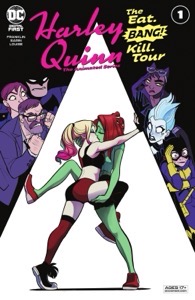
• Harley Quinn: The Animated Series: The Eat. Bang! Kill. Tour (2021) #2

    H2

    It’s a much quicker read than I’d like, which is the nature of a licensed title. Even a circularly licensed one like Harley Quinn: The Animated Series. It’s following the source media’s plotting. The issue amounts to about a seven-minute segment of TV; between commercial breaks. Harley and Ivy get to Selina’s, with Gordon in hot pursuit, and unintentionally wreak havoc.

    They’re stopping by Selina’s to drop off Harley’s hyenas; Harley hasn’t asked Selina for that favor yet, which kicks off a brief discussion of Harley’s impulsiveness and lack of respect for boundaries. It seems to be weighing on Ivy enough she remarks on it, but there’s no real character development on it, though Ivy does get the most narration. Writer Tee Franklin uses most of the narration asides as punchlines—for Gordon, Batman—but Ivy gets more. She’s still the series’s de facto protagonist, with Harley, the agent of chaos, moving her along this journey.

    There’s some really fun stuff and some really funny stuff. Franklin and artist Max Sarin have excellent comic timing. Sarin’s action timing could use some work, however. There’s a big action sequence to finish the issue, and it’s either rushed or confusing.

    Franklin’s also making Gordon so dangerous—getting his men killed and civilians injured—it’s stifling his comic potential. However, Batman’s still good for a smile or two, especially when Selina’s giving him shit.

    Eat. Bang! Kill. is still entertaining, but this issue feels like filler. There’s no reason to stop at Selina’s other than to do a Selina cameo, which doesn’t seem to add anything to the series. Worse, it delays the road trip starting, so the book hasn’t been able to work up any momentum. Hopefully, the road’s smoother next issue.

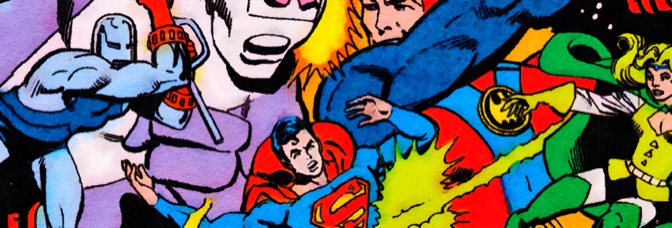
  • Superboy and the Legion of Super-Heroes (1977) #248

    Slsh248

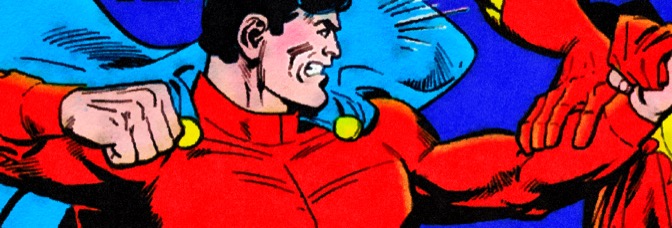
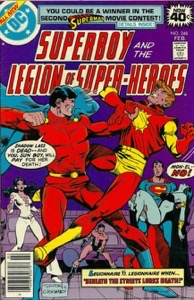
    So while this issue has Mon-El going around declaring Shadow Lass is “his woman” and people better recognize, cultural mores of the late seventies didn’t allow writer Gerry Conway to point out the Legion is fighting a shit monster.

    The Legion is helping with post-Earthwar rebuilding, and something strange is going on down in the sewers. So they investigate and, immediately after making fun of regular people for getting scared of nothing, a giant Lovecraftian shit monster emerges and attacks.

    Joe Staton and Dave Hunt do the art this issue. There’s bad, and there’s worse. Mon-El yelling at everyone to save Shadow Lass is the worse; the action is the bad. But the initial action sequence itself isn’t too bad. Conway knows how to juggle the multiple perspectives, and he still gets to use thought balloons, and the tentacles of a shit monster are terrifying, no matter who’s drawing them.

    Once the first fight’s over, and Shadow Lass needs medical attention, the comic downshifts. There’s building tension with the shit monster working its way through the city’s plumbing as the Legionnaires go about their days. Superboy’s working out to take his mind off things, Brainiac 5’s being a weirder asshole than usual, and Lightning Lad is making Saturn Girl dinner for the first time. Who knows how those scenes would play with better art. It’s not impossible for Staton pencils to have some charm, but not with Hunt inks. Not here, anyway.

    There’s a two-pronged cliffhanger. The shit monster can attack multiple places at once, so it’s after the Legion and their financial benefactor, R.J. Brande. Brande’s just discovered he’s bankrupt, which no doubt will kick off a new plot line.

    Despite being a bad-looking comic, it’s fine? The lousy art’s limiting the book’s exposure (and potential), but there are definitely worse badly drawn comics. Conway seems less interested in Legionnaires’ bickering than other scenes, which is a problem since Superboy and the Legion is usually about churlish genetically engineered white men bickering.

    Also, shit monsters are terrifying. Especially with tentacles. Drip drip.

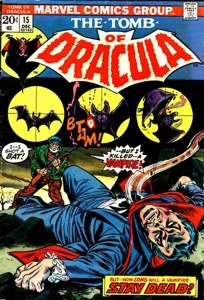
  • Tomb of Dracula (1972) #16

    Tod16

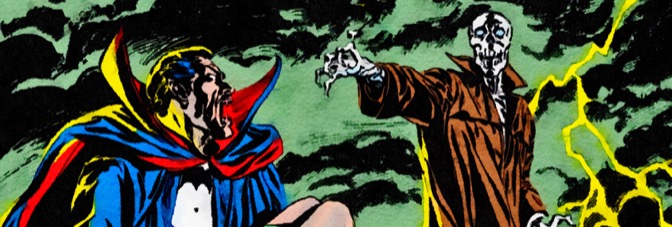
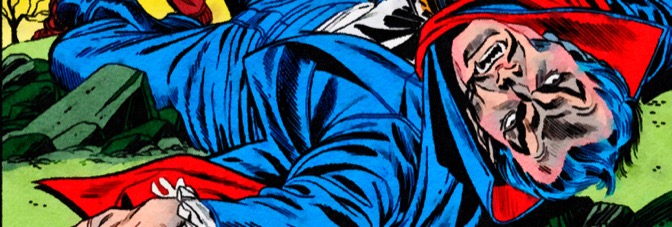
    It’s a horror mystery starring Dracula. Some skeleton is coming to life and terrorizing people, only he’s after specific people, not just everyone. Based on writer Marv Wolfman’s descriptions, it’s more a zombie than a skeleton, but there’s still such a thing as the Comics Code, so it’s a skeleton in the art. The text adds the gore.

    The issue opens with the skeleton murdering someone, then running away, so it starts with the mystery, including bringing in Scotland Yard inspector Chelm for the case. Chelm’s been in the comic before, maybe a dozen issues ago; he was support for the vampire hunter plots. So now he gets to do his own investigating one—including solving the case, which Dracula can’t do on his own.

    Dracula will get involved because the skeleton steals some of Drac’s snacks—disposing of a couple graverobbers who Dracula had been watching with dinner time intent. Because Dracula’s a macho asshole, the next time he comes across the skeleton, he wants to fight. Only the skeleton’s not likely anything else Dracula’s fought.

    There are some late contrivances—Dracula just happens to recognize a name relevant to the story, this person just happened to want to be a Dracula groupie (but presumably remain human)—and then the mystery solution is too rushed. But it’s a good, different kind of Tomb of Dracula story. Wolfman provides an elaborate setting for artists Gene Colan and Tom Palmer to play in. The skeleton is terrifying. It’s absent personality in its face—the unmoving skull—so Colan uses movement to create presence. It’s great work and helps get the comic through the rockier conclusion. Not really rocky, just not as smooth as some of the earlier scenes.

    The story seems to be a done-in-one unless something happens to Dracula immediately following the finish; he doesn’t worry about daylight any time in the issue, so it’s presumably imminent. Otherwise, there’s no character or plot development. Maybe Dracula and Chelm being chill—because Chelm calls Harker, who desperately wants to tag along, but Chelm doesn’t bring him in. Oh, and then we check in with the mysterious Doctor Sun to kick the can down the road a bit more.

    It’s a standard horror story, but it’s just a little different thanks to Dracula’s involvement. Really good, except for the last couple of pages, but they’re forgivable, especially after the gorgeous art.

  • Five Nights in Maine (2015, Maris Curran)

    So, it turns out sometimes you do actually need a story. No matter the locations, no matter the photography, the music, the actors, the editing, even the directing, sometimes you can’t get away with eighty minutes without some kind of narrative.

    Five Nights in Maine is the story of newly widowed David Oyelowo. He becomes severely melancholic after his wife, Hani Furstenberg, dies in a car accident. Unfortunately, writer and director Curran putting Furstenberg in at the beginning ends up being utterly pointless, especially given the later flashbacks and reveals. The first sign the script’s not there.

    Her estranged and dying mother, Dianne Wiest, calls and leaves an ominous voice mail telling Oyelowo to come to visit her in Maine; no need to call ahead. He lives in Atlanta. It’s a twenty-one-hour drive, and there’s no driving montage footage at night, so presumably, he stops somewhere at least once; we don’t see it because, despite being an ostensible character study of Oyelowo, Curran’s got no idea what’s going on with the guy.

    The film sets up a bunch of pieces—Oyelowo’s been pressuring Furstenberg to get pregnant, Wiest didn’t like Oyelowo because he’s Black, her lily-white neighbors are at the least weird to him, something happened on Furstenberg’s last visit to Wiest, Oyelowo’s driving around with Furstenberg’s ashes. Now, if Curran set up that chess board and then inspected it, Five Nights wouldn’t have an epical arc, but it would have a purpose. Instead, Curran just sets things up and moves past them. Only two of the aforementioned items matter, and only during the end-of-second-act blow-out. It’s a shockingly thin film.

    Curran’s able to imply a lot more depth thanks to Oyelowo. However, he works his ass for nothing. The camera spends most of the film inspecting him, and he’s always doing something relevant, but it adds up to nothing. Not even for his performance—when Oyelowo’s at the big payoff, Curran goes to long shot. It’s a not surprising miss. Because Curran wastes Wiest, there’s nothing she can do to disappoint.

    Oyelowo spends, presumably, Five Nights staying with Wiest. The first four nights, she’s barely around. They probably have dinner together, but the only first and last times are important. We don’t even find out home healthcare worker Rosie Perez doesn’t spend the night until the third night. Maybe fourth night. The film doesn’t count them; it’s not worth the effort for the audience either.

    Wiest goes from rude to mean to rude to meaner. She has a couple moments of levity, which the film doesn’t know what to do with; like, they seem accidentally okay, with Wiest getting to do some character development. There’s minimal character or character development in the film. Curran can’t be bothered.

    Curran does appreciate her actors, however. She holds her shots forever, letting Oyelowo and Wiest act, react, emote, pout, all sorts of things. Sweat—Oyelowo has a very dangerous jog. Smoke. He starts smoking a lot the last night to gin up conflict. As the film winds down, Curran does what she can to jumpstart the act change, and it’s all desperate and all weird. The last night is entirely different from the other nights, but it’s supposedly all routine.

    Though Wiest does have cancer, and she’s not getting better, and she’s maybe having mental health things going on. She doesn’t have a doctor in the movie, and Perez’s medical duties are opaque. Perez is there to talk to Oyelowo and make Wiest dinner.

    However, since she doesn’t have a genuine part, Perez’s performance can’t come up short. She’s fine. It’s an extended cameo. Fine. Bill Raymond’s good in a scene, and Teyonah Parris’s good in a couple scenes. It’s unclear if Furstenberg’s any good—Curran’s unreliable when presenting her.

    Good photography from Sofian El Fani, great editing from Ron Dulin. The Maine locations are lovely. The music appears not to be original; it’s solid. Manipulative but well-selected; Chris Robertson supervised. Unfortunately, the original song at the end, which uses lines of dialogue from the film as lyrics, is not good.

    Five Nights in Paris seemed like an easy proposition, and Curran’s a fine technical director, but she did not have the story. At all. It’s a waste of everyone’s time: Oyelowo’s, Wiest’s, the audience’s, Curran’s.

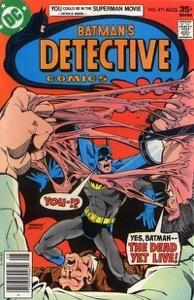
  • Detective Comics (1937) #471

    Dc471

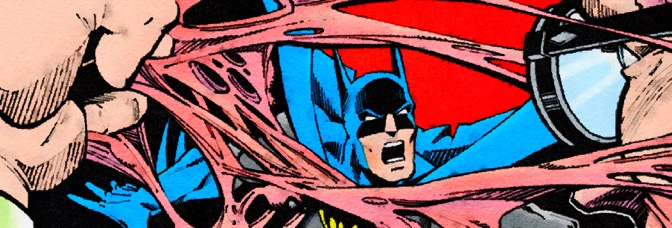
    So, I figured out where Steve Englehart and Marshall Rogers’s Detective Comics belongs. As a comic strip in late seventies Playboy. Seriously. Rogers’s art is detailed but plain, intricately designed but not artsy. Englehart’s exposition is childish—“comic book-ish”—and treats Batman as a fascist action figure, but it’s incredibly consistent. Lots! Of! Declarative! Statements!

    Plus, this incredibly banal writing—dialogue too, the dialogue’s just! As! Declarative!—is just the style; the content’s adult. Political corruption and sexual innuendo for Bruce Wayne and Silver St. Cloud. It’s a lousy cologne commercial.

    And a well-illustrated one. Rogers visualizes the heck out of Englehart’s script with a phenomenal combination of detail and personality. It’s excellent comic booking.

    But I don’t like it. I always considered myself a big Englehart and Rogers Batman fan; since the early 1990s, since The Greatest Batman Stories Ever Told. But I’m not digging it. Yet. I might dig it. But it’s too didactic, too pragmatic, too effective. To be that asshole, there’s no slippage.

    I get it too. Englehart’s done a couple issues of Detective already, and they look terrible when they don’t have an incredibly tight artist on them. It’s infinitely impressive how successfully Rogers is illustrating. But the story’s camp. The art’s not camp—and the art before on Englehart’s issues wasn’t camp—but Englehart’s script is camp. Maybe it’s intentionally camp; I hope it’s intentionally camp. It might not intentionally be camp.

    Doesn’t matter. It plays like camp, and it clashes with the art; only the art is able to successfully package it. It’s a hell of a comic.

    It’s just not a very good story. Lots of moody art—not a lot of moody Batman yet, mostly Bruce Wayne—but Rogers’s just doing setup. Bruce checks into a ritzy hospital for his radiation burns while the corrupt politicians conspire against Batman. It turns out the hospital is fake, set up to kidnap rich people.

    Bruce Wayne might be locked in his room, but Batman can get to the bottom of it, leading up to a big reveal cliffhanger. Right after introducing the deep-cut villain return.

    Wait, someone makes fun of how Batman and the villain talk to each other. Englehart knows what’s up. Still not a good story. But, damn, does Rogers tell it well.

    And great inks from Terry Austin, obviously.

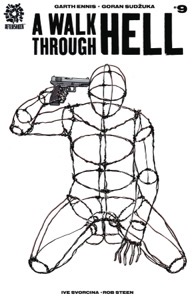
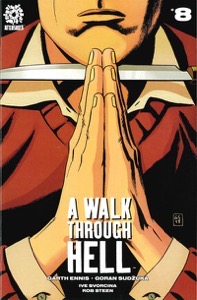
  • A Walk Through Hell (2018) #9

    Wth9

    Umm.

    I feel bad for writer Garth Ennis. I feel bad he did this issue. There are desperate ways to stretch out a series, to pad an issue, to make the right count for a trade. But somehow, Ennis surpasses all of them with this unconditional waste of time issue.

    I feel bad for Goran Sudžuka having to draw it. Either this issue will mean a little something for Director Driscoll’s character development, or it’ll mean nothing for her character development. She’s the best character Ennis has created for the series, but it’s not a high bar to clear.

    This issue’s a flashback to Driscoll getting the dirt on the bad guy from extra-curricular sources. It’s less information than we got about the bad guy during his “confession” last issue, and having Driscoll be able to verify those statements will either matter or it won’t. Probably won’t.

    So why do an issue all about it? To get to twelve for the series.

    Doing redundant issues in a limited series is bad enough, but to do them one after the other is beneath Ennis. Or ought to be.

    Despite all those complaints, Sudžuka’s art is better than it has been for ages. Maybe locking him in a dark warehouse or an interrogation room isn’t the best use of his talents. He and Ennis could do a killer “lady FBI boss and the shitty sexists she works with” procedural.

    It’s such a waste of an issue; however, it helps the series somewhat. Ennis basically axed an issue, making the already tedious series one issue shorter, albeit one you still bought, still read, but can just chalk up to being suckered by comic credits.

    Only three to go.

  • Evil (2019) s03e04 – The Demon of the Road

    “Evil”’s original conceit was a supernatural procedural. Hot priest-to-be Mike Colter, hot-but-appropriately-aged psychiatrist Katja Herbers, and funny and cute tech guy Aasif Mandvi investigate cases and prove they’re either not supernatural, or their solution gets left up in the air, but the danger abates.

    It’s changed over the seasons, though this episode leans in heavy on the religious people—both Churchy and Demonic—are just more susceptible to hallucination, whether through brain chemistry or mental health conditions. Not important. Yet. Maybe next episode.

    Anyway.

    The show’s always maintained the procedural element—they’re demon-busters on a mission from God (well, the Christian god, well, the Catholic god)–but often mysteries get solved off-screen or not at all or don’t even turn out to be mysteries. Sometimes the approach makes “Evil” better; sometimes, it makes it worse. This episode is straight procedural and for the better. The demon-busters get a case, they investigate, they solve.

    It ties into the overarching “cannibal demon cults” plot line, with some biggish reveals; it’s subplots for Herbers’s family, Andrea Martin’s got a big subplot where Michael Emerson’s successfully relying on the Catholic Church’s misogyny to force her to retire. But it’s a mystery episode, first and foremost.

    And it’s a good, creepy, fun mystery.

    Trucker KeiLyn Durrel Jones has a strange experience driving one night and blacks out. When he gets home, he starts sleepwalking and getting scary to his wife, Jennean Farmer. She goes to Colter, who agrees to investigate the case (it’s unclear why his boss didn’t want to take it).

    So Colter, Herbers, and Mandvi road trip to upstate New York and have a creepy experience with a possible drone, possible flying demon. They spend the rest of the episode solving the case while having bizarre experiences related to it. It’s all perfectly straightforward.

    The other subplots range in prominence. It seems like Martin’s is important, even bringing in Kurt Fuller for an appearance, but then doing nothing with him after implying they would. Herbers’s worried about not setting a good example for her daughters—as a self-advocating woman—but it ends up just reminding why her husband, Patrick Brammall, is such a dipshit.

    The demon cults is just the last scene reveal, though it does figure in—at least somewhat—to Martin’s story.

    Good direction from Peter Sollett, decent script (credited to Dewayne Darian Jones). It’s not a big swing “Evil,” but it’s an assured, successful one.

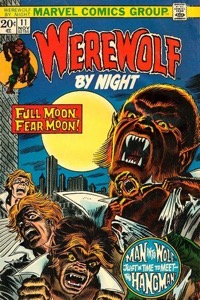
  • Werewolf by Night (1972) #12

    Wbn12

    Don Perlin makes his first appearance in the Werewolf by Night credits, and I felt the tinge of inevitability. He’s inking Gil Kane’s pencils; about the only okay thing ends up being Wolfman Jack. Kane and Perlin’s regular people are pretty bad, Perlin’s fault, but Kane’s layouts for the action aren’t very good, not Perlin’s fault. But the real disappointment this issue is writer Marv Wolfman. He’s got absolutely nothing going with the main plot, the new villain, the Hangman. And then the subplots stumble too.

    The main plot fails because the Hangman doesn’t turn out to be a very good villain for Werewolf. Since Wolfman Jack can’t understand what’s going on—he’s found a Christian fascist psychopath vigilante with kidnaps the women he saves—writer Wolfman compensates with lots of monologuing from the Hangman. It’s not good monologuing, especially since at some point the Hangman becomes afraid of the werewolf, only we never see that moment occur in the comic. Somewhere between the werewolf dodging a blow and the Hangman outrunning the cops, he becomes terrified. Only Wolfman doesn’t write the monologuing like he’s terrified, just fanatical. Maybe Wolfman thinks he’s doing a transition, but he’s not.

    Of course, the Hangman monologues are much better than the regular people’s dialogue. Wolfman’s Jack Russell is an entitled white bro asshole who’s potentially racist to the first regular Black character in the book. Maybe the guy is being a dick to him, but Jack’s barbed responses don’t not seem racist. Luckily, there are two girls who think he’s hot stuff, and he spends the day flirting with them, even though—the comic reminds us—he’s technically got a lady.

    Meanwhile, seventeen-year-old (or younger) sister Lissa has told mid-forties Buck about Jack’s lycanthropy, and Jack blows them off for the chicks after his fight with the Hangman in front of them. Plus, step-dad Phillip is still off being tortured. Wolfman revved all the existing subplots only to let them go cold again, an issue later. He really was just keeping the pans hot.

    Strangely, Wolfman’s Jack Russell narration is fine, sometimes near good—it can’t quite get there because the plot’s failing—it’s some of the best Jack narration in ages. We also get the first mention of Marvel superheroes existing in the real world. Jack thinks about how he’s not Spider-Man.

    Anyway. I was expecting the art to be the most disappointing thing, but it’s the writing. Bummer.

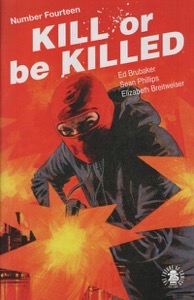
  • Kill or Be Killed (2016) #15

    Kbk15

    But, wait, what if Dylan’s a ghost and he’s been dead the whole time?

    Okay, writer Ed Brubaker doesn’t end the issue on that reveal, but he ends it on one much more similar to it than I’d have thought. It’s definitely an intriguing cliffhanger, though Brubaker’s either going to do something interesting with it, and the first fourteen issues of the comic will be—at best—a partial waste of time (unless we’re looking for clues he’s a ghost), or it’s just a way to gin up an unlikely cliffhanger, and it’s not going to be at all significant.

    Honestly, I’m leaning toward the latter. I’ve no faith in Brubaker to turn Kill or Be Killed around. And not just because he makes a crack about the comic not being “epistolary,” meaning Dylan’s first-person narration isn’t to a psychiatrist, but instead a direct address to the reader. You know, the suckers who’ve been buying the comic in the first place.

    And also not just because Brubaker brags about a film deal in the back matter. I’ve been avoiding the back matter in the comic for ages; I was just skimming, and it jumped out. Also jumping out is Dylan’s complaint things have gotten so bad in the world the Nazis are back when Kill or Be Killed’s colorist is… well, let’s just say the phone call’s coming from inside the house. Not to mention Brubaker sort of blew off the politics earlier in the series, and now Dylan’s telling us how the world’s so changed only he should’ve been telling us as it changed. Or, more accurately, revealed itself.

    Anyway. None of those troubling elements are the main one I don’t trust Brubaker to write the book out of its hole. It just doesn’t have anywhere to go. Dylan might somehow end up vaguely sympathetic but pitiable. It’ll also raise some ableism questions. But the writing on the other characters? The other characters’ writing will always be bad no matter what happens with Dylan.

    And Sean Phillips’s art is clearly never going to get over its problems. It’s a little better this issue… except when it’s not. For whatever reason, Phillips just can’t draw regular people in the modern-day. Or he can’t draw them in this comic.

    There’s still a lot of Kill or Be Killed to go; this issue kicks off the last arc with Dylan in a mental hospital, the demon having hounded him into a public enough outburst he got put on a psychiatric hold.

    It’s an exhausting comic and for no good reason.

  • Batman ’89 (2021) #6

    B6

    Batman ‘89 ends far better than it should, but still disappointingly. Writer Sam Hamm doesn’t go for an action-packed Batman finale, instead letting Bruce Wayne do the final showdown, which ought to emphasize Billy Dee Williams’s Harvey Dent, only doesn’t. It very strangely reduces Michael Keaton’s Bruce Wayne material as well. Hamm seems to know Bruce Wayne hasn’t got the emotional heft in the story, so he doesn’t try to shoehorn any in; it’s somewhat admirable not to refocus the comic, but it doesn’t make the comic any better.

    Worse are all the things Hamm either doesn’t do in the issue or intentionally avoids doing. There’s a difference; with Catwoman, Hamm avoids; with Barbara Gordon, previously a major supporting player, Hamm doesn’t do anything. She’s not even in the main action, instead relegated to the epilogue.

    Not-yet-Robin Drake Winston gets the worst of it. The issue reduces him to third-string, behind Catwoman, and completely avoids the Batman and Robin relationship. It’s like Hamm couldn’t crack the finish, which can work in an ongoing comic book series, which ’89 isn’t, but definitely not in a movie, which ’89 is trying to mimic. It’s too bad.

    Still, another outing for the series would be most welcome. Joe Quinones’s art is good (outside, you know, Catwoman’s strange new leggings, which I thought Alfred would have to comment on but doesn’t), and it’s not his fault the series finishes so flat. Especially the end, which has what should’ve been a recurring theme introduced on the very last page, but then no good Batman finale. No place for Danny Elfman music to swell.

    I had such high hopes for the series, which I knew would be hard for it to achieve, but I still thought they’d finish it better than they do. Hamm really just doesn’t have an ending for the Harvey Dent arc, and the couple monologues he gives the character are lacking; Billy Dee Williams would do a great job, but they’re not heavy-lifting.

    Oh, and the action finale is a visual mess. I don’t know if more pages would’ve helped; Quinones can’t fix the writing with the art, but it’s still a mess.

    So Batman ‘89 remains at best an occasionally successful curiosity and a surprisingly major disappointment.

    But, more, please.

  • Superman for All Seasons (1998) #3

    S3

    Well, I misremembered this issue, and not for the better. I thought Jeph Loeb and Tim Sale were going to do Bizarro. And although they use some of the same characters from the Bizarro origin in Man of Steel, Lex has a very different plan to humble Superman.

    Lex is this issue’s narrator. It opens with him getting out of jail; Superman had him arrested for something, it’s unclear what, and now Lex is out for revenge. But he’s not going to clone Superman or steal kryptonite from Addis Ababa; he’s going to poison the city of Metropolis and let Superman feel helpless and alone.

    It’s not the series’s first misstep—Loeb stumbled last time when he started setting up this plot line with a pointlessly recurring supporting player—but it’s the first significantly damaging one. Loeb shows his Lex Luthor cards, and he’s got nothing special. At the same time, he takes the focus away from Superman to the degree it’s only minimally about his experience here. It’s very disappointing.

    Also disappointing for the first time is Tim Sale’s art. His two-page spreads are for big action sequences, not emotive establishing shots, and his linework changes on them like they’re rushed. And it doesn’t seem like Sale’s particularly proud of some of them either; the other two-page spreads have been signed. Not all of them are in this issue.

    There’s no character development for anyone, another problem since Lex narrates, and one might think he’d get some. But, nope, just some uninspired observations: he’s got a God complex and had an abusive father. Nothing insightful, nothing special.

    The same goes for the big reveal later on, when Sale has to design a new superhero and does a terrible mid-nineties design. It’s an odd issue on many levels and stops the series in its tracks.

    Maybe the next issue will get things going again, but there’s no way to fully recover from this one. I’m bummed.

  • Dracula Lives (1973) #5

    Dl5

    This issue starts with the Roy Thomas and Dick Giordano adaptation of Bram Stoker’s Dracula, which I read in reprint. I’m not going to check the original novel, but I’m not sure Stoker had Jonathan Harker be a shitty racist about China (complaining about how their trains ran in 1897). Harker writes in his diary about how after he and Mina get married, they can get screwing… well, maybe Stoker implied it. Never heard a lot of good about Stoker.

    Anyway.

    The adaptation covers Harker’s arrival in Transylvania up to Dracula opening the door. He goes from train to village to carriage to Dracula’s carriage; for those familiar with the novel (or faithful adaptations), there are good looks at the carriage driver, who’ll turn out to be Drac in disguise. I’m waiting to see if Giordano has visual consistency.

    Harker’s far from a sympathetic protagonist as he Karens his way through Eastern Europe, but the goings-on are mysterious (Dracula’s marking the buried treasure blue flames, though Harker doesn’t know it yet), and the art is absolutely gorgeous. Giordano works his whole ass off on the art. It’s magnificent.

    And the writing’s fine. Thomas does Harker’s narration well, does his snooty, British superiority well; so far, there’s nothing else.

    Though it’s a relatively quick read, sort of half an act.

    While that feature is pretty impressive, the rest of the issue is a less exciting Dracula Lives. And not just because of the text pieces. They apparently ran out of old Atlas strips to run and instead have more original text ones, including Gerry Conway doing a full story. Doug Moench’s Transylvania “travelogue” and Dracula: Prince of Darkness reviews are far more successful. Chris Claremont also contributes a book review (Raymond Rudorff’s The Dracula Archives) and there’s a new feature: “Coffin Chronicles,” upcoming Dracula in other media.

    The second original story is also written by Conway, who again does much better in these Lives stories than he did in Tomb, though Frank Springer’s got some odd designs. He does full Bela Lugosi Count Dracula (albeit with an angular, gaunt face), but it’s set before the French Revolution. Dracula goes to France, where he tangles with magician Cagliostro for the first time.

    The Cagliostro stories have been running in Lives for a while, only in the present. Dracula’s convinced his old foe’s still kicking and is trying to take him out. This story provides the backstory of their rivalry. Or at least the very beginnings of it.

    After surviving an assassination attempt, Dracula bribes his way onto Louis XVI’s court. Cagliostro’s already there and already trying to do away with the Count.

    It’s an okay but somewhat awkward story. It’s too short because it’s got a part two coming, and while Springer’s art is often good, his designs are not.

    The one reprint is a reasonably solid effort with art by Sid Greene. A reporter goes to a village where they feed their local vampire farm animals, and the vampire’s nice to everyone. Unfortunately, some loudmouth in the village convinces everyone they need to get rid of the vampire, which has terrible repercussions. It’s five pages; maybe it could’ve been four, but okay.

    The third original story is a disappointment. Not in terms of art. Gene Colan with Pablo Marcos inking. The art’s remarkable. The story not so much.

    Tony Isabella writes based on a Marv Wolfman story. It’s Dracula on a plane. Some incel is going to blow the plane up to watch everyone die, only Dracula’s got to get back to the Big Apple and his waiting coffin. It’s a follow-up to his Hollywood adventure last issue.

    While no one else on the plane can handle the terrorist (white guy), Dracula’s sure he can handle it. But apparently, Drac doesn’t understand explosives. He also doesn’t think to mist his way behind the guy. It’s not very well-thought-out by Dracula or Isabella.

    But the art’s fabulous. The final gag is neat, though it breaks a bunch of vampire rules continuity, both within the story and elsewhere in the issue. But I was expecting a lot more from it. I wonder if Wolfman had the whole story idea or just the setup. Or maybe just the good punchline.

    Then there’s a one-page “The Boyhood of Dracula” strip to close the issue; Isabella writing, Val Mayerik on art. It’s about when the Turks imprisoned young Vlad Tepes and tortured him. It’s a fairly tepid account and seems like filler. I was expecting more from it as well.

    Still, the novel adaptation makes it more than worth the read, plus Conway’s writing is good on the too-short France story, and Marcos inking Colan is sublime.

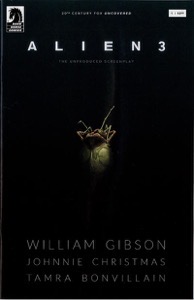
  • William Gibson’s Alien 3 (2018) #1

    A31

    William Gibson’s Alien 3 is two levels of incomprehensible to the non-Alien franchise fan. First, you’ve got to know your Aliens, then you probably should know your existing Alien³. Familiarity with Dark Horse Comics’s original Aliens series might not hurt either, so you can better appreciate when Hicks shows up on the very last page. He was the protagonist in that series, which was a direct sequel to Aliens too.

    This adaptation comes after the two or three deaths of the Alien franchise and its two or three resurrections; it depends on how you want to count them. It’s one of Dark Horse’s last Aliens licensed titles before Disney bought Fox, presumably with Newt the Disney Princess in future offings. Newt’s not awake yet in this issue. Adapter Johnnie Christmas—writing and illustrating—is just setting things up (presumably based on Gibson’s original plotting).

    Instead of crash-landing on a prison planet, the Sulaco (the ship from Aliens) ends up at a waypoint station after passing through U.P.P. space. The U.P.P. is the future Soviets; I can’t remember my Alien³ trivia well enough, but I think the Berlin Wall coming down spoiled them as villains for movies set in the future. The Sulaco passes through their space, so they board it before it crosses their borders, snagging Bishop the android, who has a big alien egg growing out of him. That moment answers one of Alien³: The Movie’s more annoying questions; makes you wish they’d at least kept it from the Gibson script.

    When the ship arrives at the Company waypoint station, there are already weapons department scumbags there ready to intercept. They want the aliens, as usual, only it’s illegal for them to be on the waypoint station because of treaties with the future Soviets, putting them at odds with the station crew.

    The comic gets through the crew waking up the cast of Aliens, but so far, Sigourney Weaver’s knocked out, and Hicks is smoking somewhere he shouldn’t be. Where’d he get the cigarettes?

    It’s a little rushed at the end and a little drawn out at the beginning—Christmas does a 2001 homage with the station boss’s meeting with the weapons division jerks, which is cute but drags. Still, it’s a compelling mix of curiosity, sequel, sci-fi, and politics. There’s not much in terms of character so far, but he’s got four issues to emphasize some of them.

    Though, once again, it’s got a very limited appeal just because of the many pre-existing knowledge assumptions.

  • Harley Quinn: The Animated Series: The Eat. Bang! Kill. Tour (2021) #1

    Hb1

    The Eat. Bang! Kill. Tour picks up right where the second season of “Harley Quinn” leaves off. Harley and Ivy are on the run after Ivy’s failed wedding, Commissioner Gordon in hot pursuit. There’s a very brief recap of the show in general and then Ivy’s not-wedding to Kite Man. It’s well-balanced exposition from Harley to the cops she’s beating up, though I do wish writer Tee Franklin had done a little more about the machinations leading up to the wedding. The ideal time to read the comic is when the show’s fresh in your head, not when you’re gearing up for Season Three.

    Occasional confusion aside, though, it’s a great Harley Quinn: The Animated Series half or quarter episode. Harley’s trying to be supportive of Ivy, who’s got lots of feelings about her failed wedding—especially since Kite Man gave her the boot, not the other way around—but also the excitement over being with Harley.

    The issue opens with the car chase resolution, with some delightful blowhard jackass Gordon, before the couple ends up back at the lair. Since Harley and Ivy are together almost the entire issue (Ivy gets a scene alone, and Harley does have a conversation in her head with her more responsible, psychiatrist self), it’s all character work. Mostly on Ivy, but there’s a little on Harley too. It’s less rambunctious than the show, less erratic, with Franklin and artist Max Sarin hyper-focused on the new couple and their immediate experiences.

    It’s really good, really thoughtful, and sort of strange they’re doing this story in a comic and not on the show. No complaints, however: Franklin’s writing matches the show (and its performances), and while it’s not an exact style match, Sarin’s art is beautifully paced. Eat. Bang! Kill. is a comic, not a TV show turned into a comic.

    I am curious if Harley will ever surpass Ivy in terms of character development; it might be Harley’s book, but it’s Ivy’s story. For now, anyway.

  • Superboy and the Legion of Super-Heroes (1977) #247

    Slsh247

    This issue’s an object lesson in bad art and how it can ruin a story. Not the feature, which has Jack Abel inking Joe Staton, but only because it’s not a good story. Len Wein scripts, finishing last issue’s cliffhanger about the Fatal Five’s latest scheme against the Legion.

    Only it’s not a scheme. The Fatal Five tried to help a developing planet along and get them admitted into the Federation, only the investigating Legionnaires realized they’d broken the Prime Directive. So the Fatal Five then attacked the superheroes. Previously, it was unclear it wasn’t an elaborate ruse; this issue clarifies—the supervillains thought they were doing the right thing, and when the Legion rejected them, they went as homicidal as usual.

    Superboy can’t find any other Legionnaires to help, so he’s got to figure out a way to save the day himself. With better art, it might’ve been an okay story for him. His problem-solving isn’t bad; it’s just got terrible visuals, as do all the fights on the planet. With better inking, Staton’s layouts can have some charm. Well, within reason. Abel’s not up for the task. Not able, as it were.

    Between the art and the patronizing, infantilizing plot—like, if the villains really don’t know taking a planet from the Stone Age to the Space Age in a week is wrong, I’m not sure they can comprehend why being villains is bad either—it’s a disappointing story. Though, obviously, with not terrible art, who knows.

    But then the art’s even worse on the backup. Dave Hunt inks Staton. The figures need to be seen to be believed; I thought it was bad with the female Legionnaires (they’re scantily clad enough to showcase the godawful figure drawing), but then fully clothed Brainiac 5 has a massive, triangular chest in a third of his panels.

    The story—written by Paul Levitz—is a cute anniversary story for the Legion, set during the election for the next leader. Brainiac 5 and Wildfire are campaigning against each other (and both abject dicks), but then strange, disastrous setbacks keep occurring. The punchline ought to be cute but instead comes off harsh and feckless because it’s affecting many people.

    So, with better art, the second story would be improved. Hunt inking Staton, however, just leads to a charmless reading experience, with the goofy punchline no help.

    It’s not a terrible comic, but it’s far from good.

  • Tomb of Dracula (1972) #15

    Tod15

    It only took fifteen issues (plus some Dracula Lives), but I finally get my Marvel Comics Dracula origin details. The issue’s somewhat coy about the revelations, starting with an incredibly entertaining sequence where Dracula’s journaling. A record must be kept of his thoughts and so on, as he’s Dracula. It ought to be obnoxious, but instead, it’s thrilling. He’s so wonderfully full of himself.

    First, he recounts his adventures after last issue. Some evangelical psychopath preacher (hashtag oxymoron) was planning on resurrecting and killing him night after night for his brethren; only Drac escaped. In the exposition last issue, writer Marv Wolfman implied Dracula was scared; that fearfulness doesn’t carry over to his journal. Rejuvenated, he went for a night flight, where some hunter shot him down in bat form. Annoyed, Dracula let the hunter think he’d bagged a giant bat, only to transform and send rats and wolves to finish the guy off.

    Somehow, that recollection leads Dracula to remembering his wife’s murder in the 1400s, which leads him to an anecdote about modern marriage. Some guy kills his wife for her money, only Dracula’s there to help her get revenge.

    That story then leads to something about a pool of infinite blood, leading to 1969 and the significant origin details.

    Dracula and Quincy Harker have been battling since the 1910s, presumably when Quincy was in his teens. Dracula’s been building his legions around the globe, Quincy’s outfitting vampire hunters. The one who gets Drac in ‘69 is a Scotsman in a full Technicolor kilt. The Scotsman ends up in the pit where Dracula kept his snacks in the castle; Dracula ended up in the coffin, waiting three years for Tomb of Dracula #1.

    It’d have been nice for these timeline details to come earlier—especially since the comic toggled between Dracula having some presence in the nearby village and the comic being a direct sequel to the Bram Stoker novel—but it’s relatively worth the wait. Wolfman and artists Gene Colan and Tom Palmer turn in a fantastic anthology issue; with gorgeous art and excellent Dracula narration (both in journaling and direct address to the reader).

    It’s awesome. So, worth the wait. What’s particularly impressive about the art is how well Colan and Palmer do in all the different settings; it’s a breathtaking mix of horror and fantasy. They’ve cracked Tomb of Dracula; Wolfman’s justified egomaniac Dracula is a terrifying delight.

  • All Rise (2019) s03e04 – Trouble Man

    It’s J. Alex Brinson’s first murder trial—as a public defender—and he’s up against jogging pal and former mentor Wilson Bethel, and Simone Missick’s their judge. I like how at some point, “All Rise” just stopped worrying about Bethel and Missick being besties and let her hear his cases. Missick, of course, was Brinson’s judge when he was a bailiff and also a mentor. So lots of personal pressures. Plus, his client, Geoffrey Owens, doesn’t seem not guilty and is antagonistic over Brinson not thinking he’s not guilty.

    While the courtroom bickering sometimes goes unrealistically (for the characters) over the top—Brinson and Bethel bickering, then Brinson talking back to Missick—it’s a good showcase for Brinson. First, he’s got the client he thinks is guilty and his struggling to defend him, then he gets new information and thinks maybe the guy’s innocent, which just makes things more complicated. Especially when Bethel takes him out for beers and a warning, though when Brinson accuses Bethel of playing mind games with opposing council… it’s not like they didn’t work together all of last season, and Bethel never, ever did that thing.

    Missick gets two subplots. She’s still trying to reconcile with now-former clerk, Ruthie Ann Miles, including making her work in her old courtroom for Missick (which makes no sense since Miles’s new boss is around). Then at home, Mr. Mom husband, Christian Keyes, is getting involved in couponing and bulk discounts, which is concerning. It’s a reasonably funny subplot, with Keyes very willing to be the butt of the joke.

    The other main plot is Jessica Camacho trying to get client Tina Ivlev reunited with her kids. Ivlev storming into social services demanding to see them doesn’t help. They eventually end up in front of family court judge Dan Castellaneta (Homer Simpson in a straight dramatic part). It’s not a particularly big plot for Camacho, who also gets to hang out with Brinson for a scene and then moves into Lindsey Gort’s offices just because there’s a spare desk in a throwaway scene (maybe it’ll be important later). But it’s keeping Camacho’s plot line going, and it’s a good one.

    Then Lindsay Mendez’s victim’s advocate for the Brinson case, which has the victim’s son, McCarrie McCausland, demanding the LAPD police Black neighborhoods more. The show does have a conversation about that subject—with new chief judge Roger Guenveur Smith showing up for the first time since the season premiere and doing much better than in that episode. It’s a little much (they’re eventually going to give Missick a “not all cops” t-shirt), but it’s not as bad as it initially threatens.

    Lots of good acting, particularly from Brinson, Owens, and Missick. Rob Greenlea’s direction’s okay, though combined with the script (credited to Corey Moore), the pacing’s a little off.

  • The Boys (2019) s03e07 – Here Comes a Candle to Light You to Bed

    Despite primarily being a setup for next episode’s season finale, this episode of “The Boys” gets a lot done, and most of it’s excellent, with the occasional exceptional. It gives Karl Urban another great acting showcase, even though he’s stuck in a nightmare where he’s entirely reactive.

    Great direction from Sarah Boyd; it’s her first episode of “The Boys.” Also outstanding is the script, credited to Paul Grilling (his first writing credit on the show).

    The episode starts a week after the previous episode’s bombshells. Antony Starr and Colby Minfie are doing damage control on Erin Moriarty telling the world how the superheroes are actually shitheels; Dominique McElligott is still missing, Jensen Ackles is still on the run, and “The Boys” are broken up.

    Moriarty and Laz Alonso are laying low—it’s unclear what they’ve been doing in the week, other than Instagram posts from Moriarty—when Tomer Capone and Karen Fukuhara show up looking for refuge. Fukuhara’s still healing, Capone’s getting high again, and they need help, which Moriarty and Alonso provide. So they pair off, boys and boys, girls and girls, and work on their respective subplots until later in the episode when Fukuhara and Capone get back together for another of their devastatingly tragic scenes. While Moriarty remains the show’s de facto protagonist, Fukuhara’s really the heart at this point, especially since she’s lost her powers and has learned the dangers of being without them.

    Meanwhile, Urban and Jack Quaid are babysitting Ackles at Paul Reiser’s country home. Brief scenes from the very funny Reiser, who dishes the real dirt on Ackles’s “Ultimate Captain America.” Less winning World War II, more bashing in Civil Rights protestors’ heads. Racist Ackles leaps out during an inspired flashback for Nathan Mitchell, who’s still on the run from him; Starr’s so pissed off about Moriarty turning on him, he’s not concerned with Mitchell going AWOL. It’ll probably be crucial next episode, along with a lot of other things.

    Starr’s public breakdowns are getting bad enough Claudia Doumit, now committed to the superhero cause, intercedes to introduce another subplot for later. Of course, given the big reveals at the cliffhanger, that subplot may wait for next season.

    Ackles’s next target is psychic Ryan Blakely, who’s been living off the grid for decades; when they find him, he traps Urban in a nightmare, leaving Quaid to manage Ackles. Ackles, who’s incredibly stoned (Urban’s keeping him that way to compensate for Ackles’s PTSD) and incredibly obnoxious, shatters even more of Quaid’s illusions during their adventure.

    There are a couple significant character surprises throughout—one at the beginning, then one later–both setting up for next episode. The majority of the episode is character work for Urban, Quaid, Alonso, and Fukuhara. Fantastic work from all of them, plus, obviously, Ackles, who’s just getting better the worse his character gets.

    While it’s all technically setup, including some running subplot check-ins, it’s still a great episode.

    Oh, and then Chace Crawford has a humdinger of a comedy scene. It’s actually unclear if it’s set up for anything or just a reminder he’s a depthless jackass.

  • The Orville (2017) s03e05 – A Tale of Two Topas

    Until now, “The Orville: New Horizons” has never felt aware of its own literal limitations. It’s the last season (for now, they keep saying, for now), and A Tale of Two Topas feels like show creator and episode credited writer and director Seth MacFarlane getting something done before the show’s over.

    All they need to do is have alien babies age much faster than expected, just like MacFarlane’s captain’s half-alien child, who gets a mention at the beginning of the episode. But that alien child isn’t the subject of this episode; instead, it’s Peter Macon and Chad L. Coleman’s “son” Topa (played by Imani Pullum).

    In the first season of “Orville,” Macon and Coleman had the baby and decided to surgically alter their female baby into a male one. Their race, the Moclan, are an all-male species who hate females in general and the rare female Moclan the most. Topa's now at least a tween—aging a decade while flying around the galaxy for a few years on the Orville. The timeline irregularities don’t matter because it’s a remarkable episode; as it all wraps up, it’s hard to imagine MacFarlane’s ever going to be able to surpass it as a director. It’s astoundingly good and needs to be; the episode’s a series of big swings, starting with Adrianne Palicki being the focus for the first third or so.

    The episode runs seventy minutes; there’s time for various character spotlights, including Macon and, to a lesser degree, Coleman (who’s been the show’s resident asshole since the forced gender reassignment episode, which, again, was really early on).

    Pullum’s interested in joining Starfleet—Union Point, whatever—and Palicki becomes his mentor. Except Pullum’s having some severe gender dysphoria without any context for it. Dad Coleman, who was also born female and had the surgery as a baby, would rather Pullum kill himself a boy than ever know he was born a girl. Dad Macon disagrees but culturally can’t complain. Macon’s acting is phenomenal this episode and even more impressive given the static alien makeup he’s wearing.

    Palicki’s got a concerned third-party arc, leading to Macon and Coleman’s arc, before moving on to an unexpected complication. There’s only so much autonomy a person can have when the Union’s got to keep its allies happy, even if its allies are a bunch of religious bigots.

    The episode’s main subplot—besides reformed killer robot Mark Jackson’s continued social problems with the crew (who haven’t forgiven the killer robot business)—involves an archeological dig on an alien planet. It provides a nice backdrop for the main action, which eventually requires doctor Penny Johnson Jerald too.

    Great performances from Pullum, Macon, Palicki, and Coleman in the main arc, then Jerald and Jackson in the asides. MacFarlane gives himself a little to do later in the episode, and he’s real good too, but it’s not his episode, and he knows it.

    It’s superb work.

    Also notable is Andrew Cottee’s score. At the beginning, it sounds very Joel McNeely (so John Williams) but only for the Indiana Jones and the Alien Temple intro; once Pullum’s story takes the stage, it’s this emotive combination of lush tragic and romantic music; easy best music of the season.

    And the best episode of the season, too, obviously.

  • Detective Comics (1937) #470

    Dc470

    There’s a lot to be said about this issue, but the “highlight” has got to be when writer Steve Englehart describes Batman as the “pensive prince of shadows.” This line comes just before Batman goes to the Batcave and yells, “I’m the goddamn Batman,” to himself as a positive self-reinforcement.

    I’m only slightly exaggerating; Englehart writes Detective Comics with a boisterous, entirely unwarranted enthusiasm. Unfortunately, he’s incredibly thoughtless too. The first big swing is Batman stops a jewel heist and, while beating up the crook, tells the villain he’s just defending his municipality of residence and, as a citizen, it’s his right to be a vigilante.

    Just then, a process server shows up and hands Batman a subpoena for a grand jury. Gotham’s regular folks have had enough of Batman. The issue implies there’s something shady about these elected officials out for Batman, which makes sense—they’re shitty rich white guys just like… oh, wait, just like Bruce Wayne.

    And even if Batman thinks they’re corrupt, shouldn’t he have proved it at some point instead of going rogue? Or letting them operate for decades. So no, “your feast is nearly over” here. But he’s now been duly, lawfully told he needs to knock off the vigilante shit, and his response is exactly what you’d expect from a mega-rich white guy.

    Englehart writes Batman as an asshole fascist in Detective, but, you know, for kids. Except when Silver St. Cloud shows up, Bruce forgets about his “I’m Bat-Man, and I don’t like girls” monologue. Then Bruce turns on the sultry seventies predatory charm.

    Amid all the nonsense, Batman fights Dr. Phosphorus. The story’s title is The Master Plan of Dr. Phosphorus! but he literally just gases people at a stadium. There’s not much master planning to it. Otherwise, he’s waiting around for Batman to show up and kick his ass. Englehart’s Batman’s a killer too.

    Seriously, the whole thing reads like a potentially better Val Kilmer and Joel Schumacher Batman movie. It feels like a pseudo-gritty riff on “Batman: The TV Show.”

    Either I’m acclimated to Al Milgrom inking Walt Simonson, or the art’s a little better. Simonson and Milgrom’s costumed Batman art is very, very silly—which the exposition sometimes exaggerates, like when Batman “stands motionless” for seven minutes after being served his subpoena. On the other hand, there’s a little more regular people talking this issue; they’re fine with the Bruce and Silver stuff. Not great, but fine.

    The Dr. Phosphorus fight’s weak sauce, though, both writing and art.

    What a weird, bad comic.

  • A Walk Through Hell (2018) #8

    W8

    It’s a very talky, very unpleasant issue. Walk Through Hell has been gross before, it’s been mean before, but this issue, writer Garth Ennis turns it up to eleven. The bad guy—who maybe thinks he’s the Anti-Christ (we don’t get there yet, which will seem like burying the lede)—recounts his life history, starting with killing his family and heading off to juvenile detention, where all sorts of bad things happen.

    Ennis puts a lot of work into the writing. He structures it as a confession to the FBI agents, with the McGregor guy reacting when it’s time to tone down the intensity or at least take a break. It becomes a recurring narrative pattern, which sets up the cliffhanger, though it’s the first time I wasn’t ready for a Walk to end. The reveals are, if not actually engaging, interesting enough after sitting through the previous six issues. Something might finally matter.

    There’s a flashback scene for female FBI agents Shaw and Driscoll, where they talk about the 2016 election—possibly as a sign it’s time for the Old Gods to return and destroy the world (I mean…)—and some day drinkers try to pick them up. It’s an odd bit of professionalism drama in the comic, though it later makes sense why Ennis was doing it. And it nicely passes Bechdel until the intrusive dudes.

    But Walk is clearly never not going to be a mess. Ennis is bound and determined to create another comic George Clooney would toss aside with a “who would ever want to read that,” only not one where Ennis is going to prove him wrong. It’s an exercise in measured excess, not really pushing the envelope, just doing different shocks.

    The Goran Sudžuda art is fine. The content’s so intentionally revolting it’d be weird if the art visualizing it were better.

    Even as I’m curious about what Ennis’s got up his sleeve, I can’t wait for this one to finish up. It’s tedious being so constantly horrified.

  • Code 46 (2003, Michael Winterbottom)

    Code 46 is a budget future-noir, down to the male lead being a fraud investigator (though it’s unclear why there’d be a third-party contractor investigating identity theft). But it’s not just a budget future-noir; it’s also a future eugenics thriller; the title refers to the legal code forbidding procreating with your near relatives. Cousins would probably be all right. The movie opens with the explanation as two title cards; it doesn’t matter for half the movie.

    And once it does matter, it’s another ten or fifteen minutes before someone explains there are clones everywhere. Most people never know their birth parents—just their “nurture” parents—so you’d never know if someone was actually your genetic sibling. Though without ever really breaking it down, the exposition has to be opaque to some degree because not everyone’s going to know about the Code 46. Or at least not at the same time. Though it’s unclear how some people find out about it because Code 46 has some very broken noir-ish narration. Screenwriter Frank Cottrell-Boyce writes just to the edge of the plot hole and then leaves it up to director Winterbottom to cover.

    “Cover” is another of the film’s MacGuffins. To get around in the future, you need to have “cover,” which is basically either a travel pass or a living permit. Some people get to live in the nice cities, and some people live outside the nice cities. Those living outside don’t have “cover.” Though when you want to go someplace and can’t, it’s because you don’t have “cover.”

    Samantha Morton works at a cover manufacturer. Since Code 46 is pre-smartphone (though people do have video phones), the “cover” is a physical object. Tim Robbins is investigating someone making counterfeit cover and giving it to undesirables. Though it turns out, they might not be so much undesirable as in danger. Code 46 doesn’t pay its oppressive future society enough attention—or define it enough—because it seems generally altruistic.

    Like, preventing unnecessary deaths and in-breeding isn’t villain activity.

    Such observations do not matter, however. Any observations about Code 46’s plot or any details with potential are useless; it all goes nowhere; Code 46 has a sparse script, which just draws attention to the worse aspects. Like Morton’s MacGuffin dream sequence. The film opens on her birthday and promises to be about her recurring dream and then is never, ever, ever about her recurring dream. Partially because it’s not a real detail, it’s just something to kill time.

    The film’s only ninety-three minutes. It’s concerning how much time they waste.

    The whole thing hinges on Robbins and Morton having chemistry, which they do not. He becomes infatuated with her and frames someone else for her crime. She apparently has a thing for much older men. Part of Robbins’s character involves him being on an “empathy virus,” which lets him read minds. Including passwords. No one in the future uses good passwords, it turns out.

    The film could get away with all the future silliness and plot conveniences if it didn’t go spectacularly off the rails in the second half and then just keep going, making less and less internal sense as it goes along.

    Morton and Robbins do better than expected. In the first half, anyway, when it seems like Morton’s got a character. She will not, with the film increasingly restricting and erasing her development in the second half. At the same time, it’ll turn out Robbins doesn’t have anything going on either.

    There’s good photography from Alwin H. Küchler and Marcel Zyskind, though Peter Christelis’s editing is probably more impressive, even though the film uses his cutting abilities for questionable purposes. Okay music from Stephen Hilton and David Holmes. Mark Tildesley’s production design is excellent.

    Winterbottom’s direction is just okay. He makes some big swings—having Morton stare directly into the camera a lot, a Coldplay song—and they don’t often connect.

    Code 46 is an unfortunate fail; it seems like there might be a decent picture in the cast, crew, and concept, but Cottrell-Boyce’s script isn’t it. It doesn’t help Winterbottom’s checked out too. There are some solid moments and efforts, but they’re nowhere near enough to compensate for the problems.

  • The Private Lives of Pippa Lee (2009, Rebecca Miller)

    The Private Lives of Pippa Lee is a narrated character study. Protagonist Robin Wright is talking herself through her life while the film observes her, seeing where she’s gained the perspective of time and where she hasn’t. The film starts in the present, with Wright and husband Alan Arkin having just moved to a retirement community from New York City. Arkin is a successful publisher who’s had three heart attacks and needs to partially retire. Wright’s his dutiful, doting, much younger third wife; the perfect “artist’s wife,” their friend Mike Binder calls her in the opening scene, even though she married a publisher.

    Arkin and Wright’s relationship is central to Pippa Lee, except it turns out the most important parts aren’t when Wright’s playing the role because Pippa Lee is Wright recounting her whole life for examination starting with her birth. Maria Bello plays her mother. Tim Guinee plays her father, a pastor of some cloth who’s never around. Bello’s got something like five sons and then Pippa, played by Madeline McNulty as a child. Bello’s phenomenal, with these early flashbacks laying foundation for later. She treats McNulty like an object, which will be a recurring theme.

    In the present, both Arkin and Wright are having trouble adjusting to the new setting. They’ve got a couple grown kids; Ryan McDonald is the son in law school. He’s the rounded, quiet one, who loves mom and dad. Zoe Kazan plays the daughter; she’s the wild one—a photojournalist traipsing around the world’s war zones—and she hates Wright and adores Arkin. Kazan and Wright’s relationship will be significant in the third act, so it’s exceptionally impressive how well writer and director Miller slow cooks that subplot.

    Wright makes a local friend in Shirley Knight, who’s awesome (lots of awesome performances in Pippa Lee but Knight’s special even among them). Knight’s got the common problems for community’s residents—her son’s a mid-thirties burnout, not a still succeeding twenty-something. Keanu Reeves plays the son. There’s a lot of impressive direction from Miller, and, obviously, the way she directs Wright and Wright’s narration and Blake Lively as young Wright is the film’s most masterly achievement.

    But, damn, does Miller get a great performance from Reeves. He and Wright form a tender, tentative friendship; in reality, Reeves is a couple years older than Wright—cinematographer Declan Quinn’s going to shoot Arkin in flashbacks with soft, forgiving light; presumably, Reeves got some of it, too–but it works. Something about it just works.

    They get to be friends because Reeves is a clerk at the convenience store Wright frequents. She needs help one night, and he’s there.

    The film’s second act is mostly the flashbacks with Lively. She starts as teenage Wright and goes to early twenties Wright (the film teases the transition between the two actors in dialogue then later does a great job with it). Lively gets all the great scenes with Bello, running off to live with her aunt Robin Weigert and aunt’s late seventies, early eighties “roommate” Julianne Moore. Wright’s narration from the present packages these memories in three layers. There’s the original impulse for the memory, whether it’s reacting to something in the present or just the next scene in a subplot, Wright’s combination observation and explanation narration, then what the film sees about Wright, through present-day connection, framed narration, and Lively’s performance in the flashback.

    Lively’s got it rough for a while—running away from home, complicated new living arrangements, early eighties New York art scene floundering—so she doesn’t smile. But her expressions so closely match Wright’s in the present; when Wright smiles, you know what Lively’s smiling will look like. As events progress, Wright’s got more sadness, contrasting a happier Lively in the past, but the expressions are all from the same pool. It’s a fantastic two-person performance.

    The most drama in Lively’s flashbacks end up involving how she meets Arkin, who’s still married to second wife Monica Bellucci at the time. Bellucci’s a wealthy, glamorous eccentric who Arkin can’t stand anymore; he’s immediately taken with Lively. They “meet” about halfway through the film, and it’s got to inform Wright and Arkin’s relationship, which the film established in the first scene, but then Wright and Arkin need to forecast where Lively’s going. Such good work from Miller, just achingly good work.

    If the film’s a series of echoes rhyming between the past and present, the second act ends with a drum solo, the sticks hitting so fast the beats overlap; no one has a chance to slow down.

    Then Miller has to wrap it all up in the third act, putting it all on Wright to synthesize this performance she’d only been partially responsible for (plus and minus the narration, which keeps Wright very present in the Lively scenes), and it’s a resounding, gentle, careful success.

    So good.

    There aren’t any bad performances. Binder’s annoying as the annoying author friend with the mad crush on Wright; he’s married to poet Winona Ryder and doesn’t like her having interests other than homemaking. It never occurs to him Wright’s homemaking might not be her whole thing. Ryder’s got a relatively important role in the present-day story, and she’s excellent.

    Kazan and McDonald are good as the kids. They never have the heaviest lifting in any scenes, though Kazan’s got a particularly lovely little arc.

    Moore and Weigert are good in their cameos. Bellucci’s got a similarly sized role, but it’s more important, and she gets a killer scene while Moore and Weigert are just support.

    Bello’s phenomenal. Arkin’s good, Reeves’s great.

    Wright and Lively are mesmerizing. It’s more surprising when Lively’s so good because it seems like the flashback device will constrain her, but she’s got a movie of her own in Wright’s movie.

    No surprise, the film’s technicals are strong. Miller’s composition’s good, beautifully shot by Quinn, perfectly timed by editor Sabine Hoffman against Michael Rohatyn’s score. It’s a great-looking film, great sounding film.

    Miller, Wright, and Lively make a remarkable Pippa Lee.


  • Ms. Marvel (2022) s01e04 – Seeing Red

    Sharmeen Obaid-Chinoy is not an action director but in an okay enough way. This episode’s mostly well-directed; Obaid-Chinoy just doesn’t know what to do with the first superhero fight or the chase scene. But, the chase scene works out. There’s the chaos aspect, and it being Iman Vellani’s first Bond movie chase scene through exotic locales, though pin in the locale. So it’s okay.


    The first superhero fight against Aramis Knight goes on too long. It passes through its awkwardness—Knight attacks tourist Vellani in a deserted train station—into comfortable banter but then drags on some more. Because Knight’s a good guy too. He just thought Vellani was an evil djinn.

    The episode begins with Vellani and mom Zenobia Shroff flying to Karachi almost immediately after the last episode. In between, Vellani’s grandmother, Samina Ahmed, has apparently told Shroff she’s sick and needs them to come over directly. It’s actually subterfuge; Ahmed knows something’s up with Vellani and the superhero business because they share visions. The previous episodes used Ahmed as a grandparent-on-FaceTime gag, but once they establish her, the character’s entirely different. In addition to Vellani finding out some of her superhero origin stuff, the episode’s a mothers and daughters piece contrasting Shroff and Ahmed’s relationship with Shroff and Vellani’s. Vellani gets to find out fun family secrets about Shroff for once.

    Okay, the locale stuff. The episode takes place in Karachi, where Vellani wants to confab with Ahmed about the djinn magic superhero stuff and then look around for the locations of her visions. Her cousins want to goof off, and mom Shroff wants to deep clean Ahmed’s apartment, but Vellani’s on a superhero mission. Her visions reference the 1947 split of India and Pakistan, which figures into Ahmed and Shroff’s joint (and separate) histories. It bundles superhero origin, historical event, and family event. It’s really good.

    And it shows how this thirty-to-forty-minute episode format is hurting “Ms. Marvel.” This episode’s got a cliffhanger, so it’s a two-parter amid the greater series, but it should’ve been its own thing. “Ms. Marvel” would’ve worked better as ninety-ish minute movies or two forty-five-minute two-parters. There’s just so much content.

    The episode didn’t film in Karachi; instead using Bangkok. Director Obaid-Chinoy does a fantastic job showing the visit from Vellani’s perspective; she’s a returning visitor who’s better able to appreciate it than the last time she was there. She’s older, she’s got agency, plus she’s a superhero. The city showcase isn’t about its colonial-minded exoticism; it’s about Vellani seeing the difference between here and home. I initially thought the trip to Karachi would be a layover in the series, but it’s a great character development arc for Vellani.

    And it lets Shroff do a whole bunch more than she gets to do at home.

    In addition to Ahmed, guest star Farhan Akhtar is also outstanding. He’s the leader of the anti-djinn secret society who mentors Vellani a little. Nimra Bucha and the bad djinns are back, too—the MCU Supermax is a joke (I forgot, that scene is another where Obaid-Chinoy’s action directing is a problem). They’re undistinguished villains but still very dangerous.

    Even with the unsteady action sequences—the finale action is an improvement—Seeing Red is probably the best “Ms. Marvel” episode so far. It’s not exactly a fair comparison to the others; it’s “Ms. Marvel Vacation” with all sorts of new stakes, and it’s excellent.

  • Werewolf by Night (1972) #11

    Wbn11

    It took Marvel until Werewolf #11 to get Marv Wolfman writing the book. Just the credit alone is worth it, which they seem to get—the credit reads: “finally a Wolfman written by a Wolfman.” Wolfman does get to create a new villain—The Hangman; I’m pretty sure he goes on to more in Marvel. The Hangman’s a fascist vigilante who goes around with a noose and scythe, killing bad guys.

    Oh, he also kidnaps all the women he saves, taking them down to his sewer lair. Presumably, a different sewer liar than the last villain in Werewolf. Thank goodness L.A.’s so big.

    Gil Kane and Tom Sutton do the art; Kane penciling, Sutton inking. Wolfman Jack Russell is great. The rest varies from okay to good. Sutton inks Kane’s faces wrong. At their best, Sutton’s inks feel like they’re bundling and intensifying Kane’s pencils. At the inks’ worst… well, Sutton takes too much out of the faces. He flattens too much and leaves the eyes and mouth floating. It’d be okay a couple times, but it’s most times.

    The issue opens not with Jack or the werewolf but with Jack’s kidnapped step-father, Phillip Russell. It’s a torture scene. The shadowy group of evil white men—I think the Council but so many of these comics had them—is willing to forgive Russell’s still unrevealed transgressions if he’ll just give them his stepson. We found out last issue the bad guys know Jack’s a werewolf. Also, last time they wanted Jack’s younger sister, Lissa, who hasn’t become a werewolf yet.

    Russell won’t give Jack up, so they have to keep torturing him. It’s weird to have some dad getting tortured in a Bond villain lair but… fine. What’s weirder is how writer Wolfman does a bunch of work on the running subplots. The comic introduced them way back in its Marvel Spotlight days, then forgot about them until a few issues ago when original writer Gerry Conway returned. Conway lined some pieces up, and now Wolfman’s doing the finishing touches?

    I don’t know if Werewolf needed a more constant writer, but it definitely needed better plotting. There’s decompressed storytelling, then there’s taking two years to get to a basic reveal.

    Wolfman also gets to send Jack out on his own; he has a big scene telling Buck and Lissa he’s moving out on his own (he’s got his trust fund). Given we’ve seen Buck and Jack hanging out half a scene in ten issues, it’s not the last episode of “Friends.” Then there’s the on-the-nose moment where the Hangman sees Buck and Lissa together and is like, that old man better not be messing with that teenager.

    There are a few good plot points opened up for next issue; Buck finally sees the werewolf, there’s the big cliffhanger with Hangman, and Phillip’s still kidnapped. But waiting ten issues for anything whatsoever to happen with the character arcs is way too long.

    Even for the seventies.

  • Kill or Be Killed (2016) #14

    Kbk14

    Despite finally giving full context for the bookend writer Ed Brubaker started in the first issue, the comic still can’t make it interesting. The bookending device is less interesting the more protagonist Dylan talks about it, and he talks a lot about it this issue. Well, he talks about the next part of the plan. We’ve been seeing part one over and over.

    Part two involves getting the Russian mob off his back through social manipulation. It’s a good enough plan, but it doesn’t translate to comics. They do it in montage, a series of panels showing the various wheels of the plan rotating. There’s nothing to the wheels, though, just Dylan telling us they exist. It’s boring.

    Though the final payoff is flat too. Even before the ending reveal changes everything we know about Kill or Be Killed (again), nothing before it can compare. Without the big surprise, it seems like the cliffhanger might center on Dylan and his roommate. The roommate’s barely been a character; he used to date Kira, and now she’s told him she’s with Dylan. Dylan and the roommate have a tense confrontation about Kira, and Dylan refuses to back down. There’s a little visual forecasting the situation’s not resolved, but the big reveal is entirely unrelated to everything else.

    Dylan’s got lots of narration in this issue. None of it particularly good, none of it particularly bad. He tells himself he wants to retire from being the vigilante, but then he tries to talk himself out of it.

    Sean Phillips’s art is incredibly loose. The stand-off with the roommate is probably the worst since the roommate gets a splash page, and the figure’s awkward. Then the actual panels with the conversation, both the roommate and Dylan have the oddly sized head thing going on.

    The comic seems to be promising it will be interesting soon for sure this time.

    Guess we’ll find out, though, if Brubaker took fourteen issues to catch up to the first one’s opening hook, who can say how long it’ll take for him to actually progress the story.

    It’s also peculiar because Dylan’s less likable than the roommate. In their stand-off scene, Dylan’s trying to assert his dominance and play alpha, whereas the other dude’s just trying to talk.

    But, again, Brubaker will sort it out later; I’m noncommittally sure.

  • Frasier (1993) s07e08 – The Late Dr. Crane

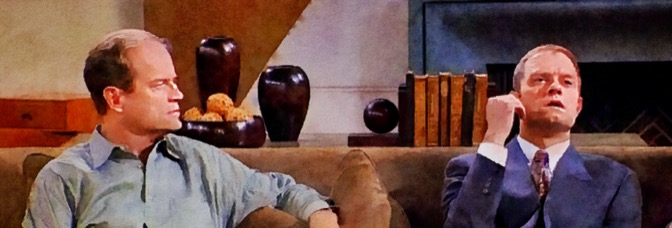
    This episode has wonderful balance. It’s a “bigger” episode than usual, with a couple new big sets—a hospital waiting room, a doctor’s office—and it opens with Kelsey Grammer and David Hyde Pierce in a car. Everything’s going to mix barbed wit with sincerity, giving the episode a bittersweet quality.

    But first, Hyde Pierce needs to accidentally break Grammer’s nose during a car accident in a very funny banter and physical comedy combination for the opening. The episode gives each actor a subplot—the title Late Dr. Crane refers to Grammer, but Hyde Pierce actually slightly more time. Or at least, more impact. And definitely time to himself, while Grammer’s arc is a family arc.

    At the hospital, through an inspired series of events, Grammer is pronounced dead. Only he’s fine, and sitting around watching the evening news with his family for the obituary. This revelation comes after Hyde Pierce has already started his subplot, and brought it into the setting for Grammer’s arc to kick off. It’s exquisitely plotted; the script is credited to Rob Hanning and it’s a good script. It throws a number of mid-scene curves, too, which director Robert H. Egan handles beautifully.

    See, Hyde Pierce’s subplot involves plastic surgeon Jane Adams. Adams is Hyde Pierce’s ex-wife’s doctor and has been billing him by mistake. Going to sort it out while Grammer waits (and doesn’t) in the emergency room, Hyde Pierce becomes quickly enamored with Adams, who’s a fastidious snob. Lots of good physical comedy from both actors when Hyde Pierce starts observing her similar behaviors. It’s awesome.

    Except he’s too nervous to ask her out, which will eventually figure into Grammer’s mortality arc, and instead just starts getting procedures. The first one is Botox, which kicks off lengthy discussion—it’s 1999, Botox isn’t mainstream yet—and jokes from John Mahoney. Plus physical gags with a deaden forehead on Hyde Pierce.

    The episode relay sprints through the scenes, which often have the entire apartment cast. Then once the condolence baskets start arriving and Mahoney wants to keep them, there’s even more going on at once.

    Though not for Jane Leeves or Peri Gilpin. Gilpin gets to do a quick scene involving Grammer’s plot, and Leeves is just around for the apartment scenes. It’s Hyde Pierce’s episode, with Grammer and Mahoney essentially getting a very involved “sending off” support arc for him. Adams’s is clearly going to be back. (Or it’d be a surprise if she isn’t).

    Surprisingly mentioned but not actually back is Gigi Rice’s new neighbor character. She gets mentioned multiple times, even figuring into a plot point, but they manage to keep her offscreen.

    Smartly constructed stuff; it’s an excellent episode. Good performances, good laughs, good character development. Grammer’s obsessing over his mortality arc might end up being mostly for supporting Hyde Pierce, but it’s strong work on its own. Great balance here, just great.

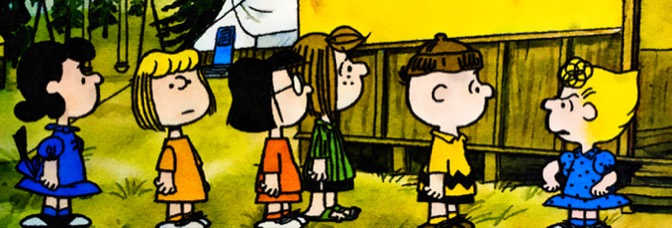
  • Race for Your Life, Charlie Brown (1977, Phil Roman and Bill Melendez)

    There’s only one adult referenced in Race for Your Life, Charlie Brown. When the bus leaves Charlie Brown (voiced by Duncan Watson) stranded, they’ve established the driver’s silhouette. Not having any adults makes a lot of sense since, somehow, the Peanuts parents all decided to send their kids to a camp on the other side of a distant desert with no adult supervision. The camp’s name? Camp Remote.

    The desert bit gives Sally (Gail Davis) a scene to threaten some local kid, which doesn’t go as expected, but since the movie’s setting it up for Sally to back down… it’s a bit of a surprise. I think the local kid is from the comic strip somewhere. She and her little brother (the anti-Browns, in a way) seem familiar, and they’re only in the one gag.

    Sally prominently figures in the first act of Race for Your Life, right up until Peppermint Patty (Stuart Brotman) starts talking about running things as a democracy. The boys and girls have been split into their different tents, with Patty running for tent leader. She confuses the other girls with her version of fair voting (by secret ballot), which becomes a recurring gag, and from then on, Sally’s just got the occasional lovelorn wail for Linus.

    Both the boys and girls have a similar problem in the first act—the camp bullies. There are three of them with their mean cat, and none of them have names. Two of them have the letter “R” on their shirt; it never means anything. What’s so peculiar about them is Race never tries to humanize them, never tries to redeem or even provide context for them. They’re just assholes.

    Okay, now, I’m reading something into the “R.”

    Anyway.

    The second act of Race is all about the best tent competition. The kids do various activities, with the bullies winning by cheating. Since there are no adults and presumably the teen counselors supervising the events are paying attention to the other two dozen campers we rarely see (at least two Peanuts supporting cast members, Violet and Frieda, end up amongst them). The most important race is the raft race.

    It’s more a wilderness survival race, with rafting involved. The kids have to camp at night, feed themselves, and get back on the river. It seems to be a three-day event. If it weren’t a cartoon with a dog and his best friend, a bird, riding around America on an Easy Rider chopper… it’d seem dangerous.

    Though there is danger. For a fairly long section of act two, Snoopy thinks Woodstock’s dead, the kids think Snoopy’s dead, and everyone’s lost in the woods trying to find one another. So it goes on for a while, with Snoopy mourning his presumably lost friend. Oh, and then the evil cat hunting Woodstock as he tries to survive on his own.

    It’s impressive how Charles M. Schulz’s script—the pacing and plotting—and then Melendez and Roman’s direction make it so intense. There’s objectively no danger to the characters, but the movie makes believe so strongly, the emotions come through. It’s a fascinating use of narrative empathy and sympathy.

    The raft race takes up most of the movie. The bullies have a speedboat with a wonky motor, so the Peanuts kids can get ahead often enough for tension. Snoopy and Woodstock add a sail to their inner tube, which leads to some pastoral scenes and disasters, though maybe if Snoopy didn’t sleep while at the wheel….

    The boys and girls each have a raft, with Charlie Brown’s arc for the movie involving him becoming more of a leader. Peppermint Patty’s would possibly be listening to others while leading. No one else gets a character arc. Linus (Liam Martin) gets to defend the kids from the bullies thanks to his blanket snapping, and there are some other recurring personality gags, but not arcs. The movie’s too busy and the race too severe to slow down for them.

    The original songs are strange but not bad; imagine a disco Cat Stevens, and then also more pop-folk. Ed Bogas’s score is good. The animation’s beautiful, with excellent editing from Roger Donley and Chuck McCann. Race has a somewhat peculiar vibe; while there’s a lot of action, including harrowing POV shots, there’s also the tranquil nature stuff, especially for Snoopy and Woodstock. It’s a fine mix. The end credits are a hallucinogenic Charlie Brown sequence, which provides the final synthesis. It’s weird and a perfect finish for the film.

    Acting-wise… Watson’s okay. He’s got some weaker moments, but the movie never leans on him too long or adjusts for it after doing so. Brotman’s good, Davis is good, Martin’s good. I was expecting a lot more from Lucy (Melanie Kohn), but she gets less than Marcie (Jimmy Ahrens), who doesn’t get much.

    The filmmakers know how to get the best out of the performances. Race for Your Life, Charlie Brown’s good.

  • Superman for All Seasons (1998) #2

    Smas2

    Writer Jeph Loeb pushes a little too hard with the soft cliffhanger setting up next issue; it’s two pages plus a panel, but it feels longer because it ties into the final action sequence. It’s Lex Luthor machinating against Superman stuff, which is inevitable but also one-note. Loeb doesn’t give Luthor any depth; he’s caricature.

    It’s also pretty much the only thing wrong with the comic. And when Superman’s around to treat Luthor like a dipstick, it works; the cliffhanger setup is the problem. There’s no Superman in it. Plus, Loeb takes the emphasis away from Lois Lane—who’s narrating—and instead gives it to Luthor. The only real misstep in the lovely comic.

    The issue opens with Lois’s narration; she’s talking about Perry White’s reporting advice, then talking about Superman. Accompanying the narration are visuals of Superman flying around the Art Deco future Metropolis on his way to his first adventure of the day, in this case, a missile headed directly towards the city. After saving the day and introducing Lois—in-person as opposed to her voice—to the comic and establishing the animosity between Superman and Luthor, Loeb downshifts and examines Clark Kent, big-city reporter. Lois’s narration continues, more sparingly, as she doesn’t know Clark’s Superman.

    When Clark goes home to Smallville for his first visit since leaving—presumably he’s seen Ma and Pa Kent, just not anyone else—he finds he’s no more at home there any more than in Metropolis. There’s a great visual callback to the first issue, juxtaposing Clark and Pa Kent and the proverbial stars in their eyes.

    The Smallville visit is very gentle, very sweet. Most of the comic’s sweet, with Superman charming everyone but Luthor, who’s jealous enough of the visitor from another world he’s maybe supplying terrorists and definitely endangering public safety with hastily designed drone heroes of his own.

    There’s a lot of nice art from Tim Sale; lots of two-page spreads, some for action, some for mood. Both carry it; For All Seasons is a splendid, casually familiar comic book. Loeb’s Lois Lane narration is near perfect, with only a handful of iffy lines; given she’s narrating but not present, her lines have to at least minorly relate to the visualized action. Loeb does it well every time.

    It would be nice to see some of the Daily Planet cast; Lois talks about Jimmy Olsen and White in the narration, but there’s nothing to them besides their presence in her narration. They’re not characters yet.

    Some of Sale’s action art is breathtaking. All of it’s pretty darn good; great colors again from Bjarne Hansen.

    I vaguely, trepidatiously remember where For All Seasons is going now, but hopefully, it’ll maintain its current level of quality.

  • Evil (2019) s03e03 – The Demon of Sex

    This episode ends with an odd, incomplete feeling. There’s no oomph to any of the storylines, and the resolutions are all put off until next time. There’s not even a cliffhanger, just Katja Herbers and Andrea Martin not being shitty to each other. It feels like a long episode cut up, but it also feels like the first really streaming episode of “Evil.” Whenever there’s an F-bomb, it’s a good F-bomb, onscreen, in scene, not tacked on later to flex.

    The investigation plot this episode involves a newly married couple—Freddy Miyares and Freddy Miyares—having troubles in the martial bed. They’re both virgins, and whenever they try getting busy, he gets nauseous and she breaks out in hives. Initially, now priest Mike Colter thinks they just need a couples’ counselor, but nun Martin convinces him there’s a demon. Because she can see and talk to the demon. I’m not sure if it’s a new demon costume, but it’s not a good one. It’s like “Evil” knows it’s got its audience; it doesn’t need to try anymore.

    Colter calls Herbers in to consult, then disappears for the episode, presumably off on secret Vatican secret service business like covering up more Indigenous Canadian child murders or something. Herbers and Martin don’t hit it off, but they agree to work together—there’s a weird “we’re being condescending to another woman” stand-off they do, but it’s well-acted weird, so it’s okay.

    Will Herbers figure out how to keep the demon out of the martial bed? Will Martin get in trouble for talking during the meetings? It’s high-stakes stuff.

    Aassif Mandvi’s got the other main plot. He’s suffering from depression thanks to his job; specifically, the mysteries of “Evil” leaves unresolved after the episode finishes. His sister, Sohina Sidhu, decides she’s going to help him out of his funk. It’s a good character episode for Mandvi, who gets to do more and different things than usual. His semi-breakdown starts when he can’t fix Herbers’s toilet; her husband flushed a shrunken blood sacrifice to Satan head down the toilet in the first episode of the season, and it’s been causing plumbing problems since. It gets to be too much for Mandvi.

    Then there’s some stuff with Herbers and her kids being mentally abusive to one another. It’s unsuccessful except for tying into Christine Lathi’s superior workplace subplot. Michael Emerson tasks her with selling demonic crypto, only he really puts her millennial drones in charge. Lathi’s not going to take their shit and has to figure out how to succeed selling nonsense. Crypto and religion. “Evil”’s got all the nothing for sale.

    Lathi’s great this episode, Mandvi’s great this episode. Martin’s only okay, which isn’t great. And Herbers is only okay, too; despite being around a bunch, she’s got nothing to herself.

    It’s a peculiar episode. If it’d had some kick, it’d be one of the better this season. But, instead, makes you wonder if they know what they’re doing. Like when Monsignor Boris McGiver comes off like a total rube and draws attention to him always being a total rube, which is a problem since he’s the patriarch.

    Nelson McCormick’s direction is fine; it’s the dramatically stalled script, credit to not new-to-“Evil” Aurin Squire.