• Passing (2021, Rebecca Hall)

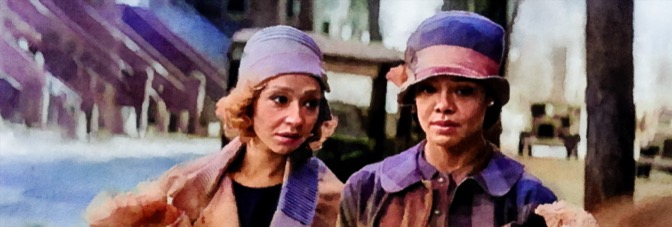
    Passing is a genre-buster, which heavily contrasts the very strict mores the film’s subjects live within. The film is an occasional Southern Gothic (set in 1920s Harlem), occasional character study Hitchcock homage. Harlem Renaissance society lady Tessa Thompson has a peculiar day when shopping for her son’s birthday; the sometimes very shitty white folks just assume she’s white. So, on a whim, she goes to a hoity-toity hotel to get out of the heat.

    We have none of Thompson’s backstory or context at this point. Instead, director Hall guardedly introduces her to the film, then follows her, the camera as hesitant as Thompson in her whim. Once she gets to the hotel, however, things get real when she’s people-watching, and one of the people starts watching her back. When this other person approaches her, Thompson’s fear of being found out pervades the film, breaking her collected demeanor (which only happens a few times in the film and always echoes beautifully).

    Except this person is Ruth Negga, and she knows Thompson, and Thompson knows her. But Thompson knows Negga as a fellow Black girl, not a vaguely Southern white lady with her husband (Alexander Skarsgård) in a ritzy New York hotel.

    Negga’s thrilled to see an old friend, even as Thompson gets increasingly uncomfortable with the situation. Their impromptu reunion culminates with Skarsgård revealing himself to be an avowed white supremacist; we watch as Thompson experiences the awkward, problematic situation become grotesque. Understandably, she gets out of there as soon as possible, heading home to normality.

    Normality is doctor husband André Holland, two sons (Ethan Barrett and Justus Davis Graham), a housekeeper (Ashley Ware Jenkins), and loads of charity work for the Negro League. The first act is set against Thompson preparing a charity ball. But, eventually, Negga will get herself invited, effectively inserting herself into Thompson’s life and home.

    It’s Harlem Renaissance, so white people are touring north of the Park, meaning Negga can be seen without raising too much suspicion. After all, regular white tourist Bill Camp, who’s Thompson’s closest thing to an actual friend, is always around. In the second act, Thompson’s tea party for Camp will be another significant moment in the film and for Thompson.

    While Thompson and Negga’s rekindled friendship only goes so far, with Negga less interested in society goings-on than taking Thompson’s roles in her home. Negga befriends housekeeper Jenkins, who Thompson treats curtly. Then, when the boys need someone to play with them in the afternoons, Negga joins them. The first act establishes Negga and Skarsgård have a daughter, and motherhood is on her mind, but pretty soon, it seems like she’s more interested in playing mom to Thompson’s kids, not her own. The motherhood theme is one of the film’s most subtle, but it does a lot of heavy lifting throughout.

    The biggest change with Negga’s presence is Holland, however. He goes from thinking of her life as a curiosity to be ridiculed to being her most ardent supporter. Perhaps too ardent a supporter, especially as Thompson becomes more and more bewildered by Negga’s ability to exist in a state of constant deception.

    The second half of the film becomes a psychological thriller without the thrills, instead focusing tightly on Thompson’s experiences and observations of her changing life. Holland wants their sons to be aware of white supremacist murders, while Thompson intends to keep them as sheltered as possible. Their fears and frustrations run underneath the surface, informing performances and events. It’s delicate, nimble work.

    Because the film sticks to Thompson, Holland remains something of an enigma throughout, as does their marriage. The first act introduces them formed; there’s the perfect, party-throwing, party-going society couple, which Thompson contrasts with Negga’s mysterious, duplicitous, dangerous marriage. The film takes its time revealing more about Thompson and Holland’s marriage, relying on conversations and moods—and Camp and Thompson’s friendship—to fill in.

    The third act is a pitch-perfect synthesis.

    Passing is black and white, era-appropriate Academy ratio, beautifully photographed by Eduard Grau, with picture-perfect composition from Hall. It’s an urban fairy tale turned nightmare. Great patient, often lyrical cutting from Sabine Hoffman and a lovely, sometimes diegetic, sometimes not, sometimes maybe not score from Devonté Hynes.

    After starting with a literal spotlight on Negga, Passing soon becomes Thompson’s film. The whole production hinges on her performance; both are a success. Thompson’s fantastic. For a while, her performance is reactionary—to meeting Negga again, to seeing how others react to Negga—but in the second act, Thompson stops getting fresh stimuli, and her performance essays internal experience, particularly of her status as a society wife and mother. The third act’s a mix of both styles, revealing even more about the character as events unfold. Thompson’s good in the first act, but it really does seem like Passing’s going to be Negga’s movie; then, starting from the inactive position, Thompson dominates the frame. So good.

    Holland’s excellent, Negga’s really good, Camp’s really good, Skarsgård’s distressingly perfect in his part.

    Great production design from Nora Mendis and costumes by Marci Rodgers.

    Passing is spectacular. Hall, Thompson, and company do an outstanding job.

    It’s so good I can’t even be sad Gbenga Akinnagbe isn’t in it more. I mean, I’m sad he isn’t in it more, but he doesn’t need to be in it more.

  • Dracula Lives (1973) #2

    Dl2

    There’s a thirteen-page Neal Adams warlord Dracula comic this issue, and I don’t understand why it’s not a bigger deal. Like, it’s gorgeous. Of course, the other stories have good art, too… well, the Gene Colan and Dick Giordano one, but the Adams one is kind of an immediate classic.

    I started reading Dracula Lives because the Tomb of Dracula editors’ notes promised it’d fill in the backstory. Given Tomb’s unsteady continuity, I got curious; I’d also heard Dracula Lives was pretty good, the PG-17 version of TOD. But it’s not addressing the main series’s continuity issues.

    Adams’s art is on the Dracula origin story, written by Marv Wolfman. Set in the fifteenth century, it begins with Dracula falling in battle against the Turks. They find him almost dead and decide to puppet him around to get everyone else to surrender, bringing him to a gypsy who swears she’ll make him right. Well, maybe, baby, the gypsy lied. She’s a vampire, and she’s going to turn Dracula for being such a shit to her people.

    So, a note. Punishing a megalomaniac by making them immortal seems like a strange choice.

    But the story does give vampire Dracula a better origin than, say, Bram Stoker’s Dracula. He renounces his bad acts, which put his loving wife and little baby son in danger. He’s sympathetic, partially because the lead Turk is cartoonishly evil—though not cartoonish because Adams’s art is detailed and exuberantly so. It’s a good origin. Well-written by Wolfman, singular art by Adams.

    Doesn’t answer any questions about Dracula knowing the vampire hunters from after the novel and before TOD #1.

    Then there’s an old Atlas horror reprint; no credited writer, and Joe Sinnott art. It’s about a grave keeper swindling the local vampires. It’s a fairly by-the-numbers horror strip, and it’s pretty dang good. Sinnott’s got a good sense of humor, a lot of personality in his characters, and great use of shadows.

    So there are two reprints, three original stories, and some of those one-page Dracula movie stills with new “dialogue,” but there’s also Chris Claremont doing a text piece. It’s a letter to the editor about how Bram Stoker got Dracula wrong. It’s not great, but it’s okay. What’s strange about it is the timing–Dracula Lives #2 came out in 1973, and two years later, Fred Saberhagen’s The Dracula Tape came out. Tape’s all from Dracula’s perspective; it’s different from Claremont’s piece, but there are resemblances. Enough to wonder.

    The text piece delays the weak comic. Written by Tony Isabella, from a Steve Gerber plot, with art by Jim Starlin (layouts by Jim Starlin) and Syd Shores finishing. Shores draws everyone like a caricature, which is something. But the story’s about Castle Dracula during World War II when Nazis occupied it and terrorized the local gypsies. One night a vampire appears, but it can’t be Dracula because Van Helsing killed him.

    It should be good.

    It’s not. But it should be. The art’s not good enough, the writing’s not good enough, but the concept’s not terrible. Though it directly contradicts TOD continuity.

    The second reprint is a Stan Lee-penned entry, also an Atlas, about a corrupt politician who hires guys to vote using dead people’s names. Men, specifically, though that detail’s not a plot point.

    Fred Kida does the art.

    Art’s fine. Story’s really long without much pay-off.

    The art in the final story, another original, makes up for it. It’s the Colan and Giordano art. Dracula in New Orleans. Gene Colan drawing the French Quarter with Dick Giordano inking. It’s glorious.

    Roy Thomas writes. It’s an okay story about Dracula mysteriously waking up in New Orleans—directly following last issue’s New York adventure—and it’s got something to do with voodoo queen Marie Laveau. The story opens with a cemetery tour where the guide is talking about Laveau (then saying people who go into debt deserve to die, don’t you agree, which is a bizarre bit of dialogue), and it just happens to figure into the Dracula plot.

    Story doesn’t matter; it’s all about the art. Art’s absolutely fantastic and not even as good as the Adams art on the first story.

    The story also has a panel with The Zombie (Simon Garth), telling everyone to check out his new comic, which is an interesting bit of Marvel shared universe cross-promotion. It’s like reading a Spider-Man comic or something.

    So, overall, three of the five stories are good, two are middling, the text piece isn’t terrible, and the photo dialogue things are bad but brief. Dracula Lives is a heck of a comic. Especially when it’s got such exceptional art.

  • Frasier (1993) s07e05 – The Dog That Rocks the Cradle

    This episode’s a sequel to the previous season finale, a two-parter where one of the subplots had Peri Gilpin sad about dating and ending up in bed with Dan Butler. The story resolves with Butler leaving the radio station—fired for bad ratings—saving Gilpin from having to address her seemingly growing but decidedly unwanted feelings for him.

    Months later, Butler delivers a pizza to Gilpin and Kesley Grammer. They’re working late, she doesn’t have a babysitter, her love life hasn’t improved, but she’s finally got a date. Butler’s not doing well but tries to play it off, so Gilpin hires him to be her babysitter.

    And Butler’s great babysitter, he’s just also sabotaging all of Gilpin’s dates.

    It’s story editor Bob Daily’s first writing credit, and it often feels overly “Frasier”-y. Grammer and David Hyde Pierce have really funny snob moments; John Mahoney gets to be gruff and put the boys in an awkward spot; Jane Leeves gets mostly reaction shots but good ones.

    But the Gilpin storyline—which started last season finale about her loneliness—gets kicked down the road once again. The show emphasizes it and ends on it, but seemingly just making it part of Gilpin’s ground situation, not an active plot in her life. Instead of dealing with her, it centers the story on Butler and his motivations. Again, there’s some hilarious stuff because Butler and Gilpin are great, but it’s a little too slight. Especially taking it being a follow-up episode into account.

    Matt Roth shows up for a couple quick scenes as one of Gilpin’s potential love interests, which is nice. Always nice not to see him being an asshole.

    Grammer doesn’t really get an arc outside the family one—he and Hyde Pierce want Mahoney to make arrangements for his departure from this mortal plane, which Mahoney finds morbid, but then realizes might not be best left in their hands.

    Good direction from Pamela Fryman throughout. The resolution for Butler and Gilpin’s arc gets a little draggy, but the two punchlines—comedy and emotional—pay off. Unfortunately, they just don’t have any idea what to do with Gilpin once those bits’re done.

  • Ms. Marvel (2022) s01e02 – Crushed

    So, there was an end credits scene in the first episode of “Ms. Marvel.” It gets recapped in this one’s intro; there’s no end credit scene in this episode. Marvel/Disney+ needs some consistency, warning, or not to drag out the end credits to make the run times look longer.

    The scene introduces Damage Control agents Arian Moayed and Alysia Reiner. Reiner’s a racist; Moayed knows she’s a racist and tries to manage it internally. Not much else to the characters.

    We don’t find out Reiner’s a racist until this episode when it’s a lengthy scene beat. I actually wasn’t expecting “Ms. Marvel” to be so blunt about the U.S. government being racist against Brown people, especially Muslim ones. I also wasn’t expecting them to do a young Muslim woman empowerment arc either. Lead Iman Vellani’s best friend, Yasmeen Fletcher, is running for mosque council against the odds (meaning entrenched sexism).

    For most of the episode, Fletcher’s second lead. Like, Crushed gets a lot done thanks to the script (credited to Kate Gritmon) and Meera Menon’s direction. The first episode did sitcom-level introductions for most of the cast, particularly Vellani’s family; this episode quickly and efficiently deepens the characters.

    It’s outstanding work.

    The episode starts being about Vellani and her best (guy) friend (who loves her and she doesn’t know), Matt Lintz, doing superhero training for her new powers. Vellani knows the bangle bracelet has something to do with it, but not what. Lintz’s souped-up StarkPad (though Apple exists in the MCU, at least AirPods) determines the bangle just unlocked Vellani’s pre-existing abilities. She thinks it’s got something to do with her great-grandmother, but mom Zenobia Shroff doesn’t want her asking questions about that part of family history.

    Then Fletcher needs her help with the campaign. Part of her decision to run involves their mosque having a shoe thief on the women’s side and the male governing body not caring. It seems like it’d make a good first mission for “Ms. Marvel,” but it will not be her first outing, which this episode ends with. Vellani’s got a doozy of a first night out, like, it’s great stuff.

    The postscript to it, which moves the plot along too fast, is a miss, but the episode’s already done so much. Including introducing a good romantic interest (Rish Shah) and doing an Adventures in Babysitting homage.

    We also meet brother Saagar Shaikh’s fiancée Travina Springer; they crash a sorta date for Vellani and Shah, and it’s a great scene, then Springer’s back at family dinner. It’s a fine device to get in some exposition (Springer hearing family history relevant to the bangle) and strengths the family stuff. Dad Mohan Kapur continues to be an adorable sitcom dad.

    Vellani and mom Shroff get one really nice scene, but Shroff’s secrets are now a brewing b-plot.

    The hard cliffhanger’s a letdown, but the episode’s otherwise excellent, with multiple especiallys.

  • Superboy and the Legion of Super-Heroes (1977) #244

    Slsh244

    There’s no messing around here: writer Paul Levitz is doing a future sci-fi superhero war comic, which is one heck of a flex. He’s even doing it with Joes Staton and Giella art. The art’s nowhere near as bad as I thought it’d be when I saw Staton’s name; the layouts are fine. At their best, Staton and Giella’s faces look like bland teenagers from an Archie comic. Well, except the girls. Sometimes they put effort into the girls’ faces. There’s some lousy art for sure, but Staton does work on it. There’s a whole lot of action in a variety of settings.

    The previous issue ended with a cliffhanger promising this issue would reveal the mysteries of Earthwar, which it indeed does, but without much (if any) fanfare. Levitz is too busy with the story to slow down for the reveals.

    The issue opens with the remaining Legionnaires headed to Earth, led by Wildfire (and Superboy). Why Superboy, who’s going to grow up into planet-juggling Silver Age Superman, can’t take out the invading alien army on his own….

    Doesn’t matter.

    The opening’s a little rocky, with Dawnstar having good ideas and Wildfire being, like, too surprised. And Superboy being dismissive about it. She’s not even being her usual elitist mercenary self. But they quickly listen to her and solve one part of the Earthwar mystery—identifying a mystery bad guy. They don’t clear all the other suspects, though, making things interesting even if the comic loses track of that outstanding thread.

    Levitz shoehorns in some solutions throughout. He’s already introduced the retired Legionnaires—the two married couples—coming to Earth to try to save the day, and they get a big, good sequence for themselves. I’m not sure I’ve ever actually read a comic with Bouncing Boy before (outside Who’s Who), but he kicks ass this issue, which is a hoot and is kind of Staton’s most distinct action.

    But Levitz already hinted at their involvement; Karate Kid shows up from the past to help out and is almost immediately indispensable to the story, while characters who’d had some previous importance are on ice.

    They’re not even imaginative enough to call narrative tricks, so maybe just contrivances, but they’re mere potholes in the greater story. It’s a thrilling read.

    The ending’s got another big reveal… oh, wait a second, that unnamed, pretty albeit otherwise indistinguishable fighting lady is the science police officer from before? They go a little too fast bringing her in, but she should be there for the big reveal. But before the big reveal, there’s another seemingly big reveal. It’s an okay cliffhanger—maybe it’d mean more if I knew the context—but a breather would be nice after the intense issue.

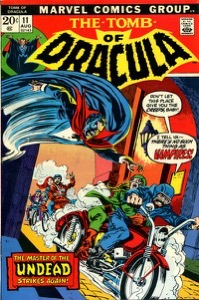
  • Tomb of Dracula (1972) #12

    Tod12

    You know, maybe I’m overthinking the writing on Frank Drake. Maybe he’s just a shitty racist who doesn’t Taj for being Indian. It sure seems like it. Especially after he has a “quaking in his boots” moment before Blade shows up and saves his ass.

    Tom Palmer’s back inking Gene Colan this issue, which is good, but it’d be better if the story weren’t just about Dracula messing with the vampire slayers. Though they’re not very good at vampire slaying, apparently. Drac’s mistake is inviting Blade along because then Blade can save everyone’s butt.

    Mostly.

    The issue opens with the vampire slayers interrupting Dracula’s evening snack, so he kidnaps Edith (Quincy Harker’s kid, whose most personality to date was complaining Blade isn’t polite enough to her) and tells them they have to come to a haunted mansion, or he’ll kill her. Once he gets Edith to the haunted mansion, he explains she’s dead either way.

    The vampire slayers show up and walk right into the haunted mansion—called “Whispering Hell”—knowing it’s a trap. They don’t do anything to prepare for the trap angle; they just muscle their way in, thinking everything will be okay. Basically, because Taj will eventually save them. Only Taj can’t save them this time. Instead, Blade has to save them.

    It’s a strange comic—writer Marv Wolfman seems aware Frank Drake is a bumbler, for example, but he’s still got to be a hero. Dracula, meanwhile, is a mean dude—he’s literally just making the vampire slayers suffer for kicks—but he’s at least not incompetent at it. Sure, inviting Blade was a mistake, but the Count was right about Quincy’s vampire slayers not being up to the task. The story just serves to humiliate the heroes, deservingly humiliate them.

    They’re even more unlikeable when they don’t acknowledge Blade saved their lily-white asses.

    The issue presents the ending as a surprise, but it’s pretty obvious stuff. It initially seems like it’s going to be a new development in the series overall, only—again—Wolfman takes an easy way out with it.

    The art’s good but the content—Dracula versus vampire slayers in an old mansion—limits what Colan and Palmer are going to be able to do with it. Especially since Dracula’s only idea for a trap is, like, a bunch of bats and a bunch of spiders. Admittedly, the slayers can’t contend with either of them, but still….

    Stop playing with your food, Vlad.

  • Detective Comics (1937) #467

    Dc467

    In my youth, I never liked these “solve-the-mystery-yourself” stories. To the degree, I negatively associated them with writer Bob Rozakis. However, I got over it eventually, instead associating Rozakis with bland, cloying stories, much like the feature he contributes to this issue.

    The art’s from John Calnan, and the inks are Vince Colletta. I’m unfamiliar with Calnan, so I don’t know how Colletta’d he’s getting, but Bruce Wayne looks like a forty-something accountant, which can’t all be Colletta.

    Bruce is going to narrate the story for a mystery visitor. Now, I won’t spoil—because it’s one of the mysteries you can solve—but it’s a white guy with brown or black hair. This comic is pre-Crisis, meaning every DC superhero knows Batman’s identity, and they look alike. Could be Clark Kent, could be Hal Jordan, could be anyone but Green Arrow or Flash; they’re still blonds at this point.

    Batman sits down with this mystery visitor and rings for Alfred to bring them breakfast. Then, Batman’s going to tell the visitor a story and see if he can guess the conclusion.

    Now, at this point, I still had vague hope for the comic. I figured it’d at least be a puzzling mystery. Then the title of the story– Pick-Up on Gotham 2-4-6!—references Pelham 1-2-3 so I thought we were in for an elaborate heist story.

    Nope. Batman’s in disguise on the subway, and some guy dressed as Batman runs through the train car, then exits the train. Batman follows him, chases, fights, fights, chases, returns to train for resolution, then poses the mystery question to his visitor (and the reader). But it’s an eleven-page story, and three or four pages are used on the framing. The mystery doesn’t relate to the fight scenes either, so all the mystery stuff occurs in a page or two. And then some of the solution is less about deductive reasoning than reading comprehension.

    As a result, I’m concerned about my youthful reading habits. Or maybe this one’s just not a great Rozakis who-dun-it.

    Anyway.

    Rozakis’s also writing the back-up, which is more of the Calculator messing with various superheroes. This time it’s Hawkman, who’s running a courier service of sorts. Except, oh, no, the Calculator turns out to be his package. And so they fight, with the Calculator using some of the powers from previous foes, like Elongated Man’s extended bendy arm punch. Coming out of Calculator’s forehead thing.

    That costume design is weird.

    Marshall Rogers and Terry Austin do the art (though Austin later said Neal Adams inked some of the pages; I wonder if they were the better or worse ones). The art’s better than last time, but still a bit of a disappointment from Rogers. His best panels are all design-work, too, like they’d make great T-shirts, but comic panels… not so much.

    The next issue promises the Calculator story will be important, just like every one before.

  • A Walk Through Hell (2018) #5

    Wth5

    The art changes so much in the first few pages I thought Goran Sudžuka either left the book or got an inker. Nope, he’s just doing a slightly different style. His lines are thinner, sharper, and with less personality.

    The end of the issue promises we’re going into “Book Two” next, which will apparently be more of the same. Again, FBI agents running around an empty warehouse, discovering various horrors, convinced it all has something to do with a probable child murderer.

    The issue opens with a new character, Goss, who we’ve seen in some flashbacks. He’s the dopey white guy FBI agent with the Black partner, who tries to go along and get along, putting him at odds with the protagonists. Well, McGregor anyway. Goss probably doesn’t get along particularly well with Shaw because she’s a lady. Though it actually never comes up, just the other FBI agents make fun of Goss for not hating Twitter.

    Profound cultural observation from writer Garth Ennis this issue. Hell’s about as deep as a puddle.

    We find out Shaw’s big secret, which comes with Sudžuka’s skinny lines. The lines aren’t at fault for the scene, which is a ho-hum, heavily foreshadowed reveal. Ennis wasn’t saving anything for it. Ditto Goss, who’s running through the warehouse scared of unimaginable childhood horrors. Sudžuka eventually imagines them. They’re not particularly exciting, kind of interestingly designed, and not poorly executed, but not an unimaginable horror.

    Most of the issue is Goss running and the narration explaining he’s a coward. Or it’s McGregor and Shaw bickering about their current situation, including Shaw very obviously lying to McGregor, which doesn’t help her confession seem legit.

    I think we’re far enough to assume Ennis is never going to crack Hell. There’s nothing to crack, just a product to churn.

  • Werewolf by Night (1972) #8

    Wbn8

    Did Marvel have a market research department in the seventies? Was there some editorial edict to make Werewolf by Night aim younger? Despite being about a teenager who just turned eighteen and presumably feeling the weight of adulthood (legally, anyway), protagonist Jack Russell isn’t. Since the comic only ever shows him on his werewolf days and nights, he mostly walks around half-dressed, whining about the werewolf being hungry last night and sleeping away the day because the comic’s got no ideas.

    Or maybe writer Len Wein was just going for a riff on schlock and failed because guest penciler Werner Roth has no sense of humor.

    The issue opens with Wolfman Jack running off from the burning circus, leaving sister Lissa and pal Buck behind to answer the questions for the cops. Lissa’s less explicit about knowing Jack’s the werewolf. She just gazes out at the mountains, implying she knows her brother’s out there furry and hungry. Then Lissa and Buck are gone, their requisite page in. Wein also checks in on seemingly evil, murderous step-dad Phillip, who gets a threatening phone call (like he’s been getting since his second issue) and a visit from copper Lou Hackett. Hackett wants to talk to the family about a werewolf!

    Presumably, these plot lines will be important later, but I’m worried I’m presuming a lot.

    The main story is about Jack happening into a cave with a locked door at the end. When he hears noises behind it and opens it, but the chamber inside is empty except for a skeleton holding a book. Jack settles in for some light reading before he turns into the werewolf—for all the complaining about the werewolf’s constant hunger; otherwise, it doesn’t seem like Jack would eat at all—and reads about yet another Southern California warlock who called another demon into Marvel 616. The warlock locked the demon in the chamber and stayed inside until he and the demon died. The timeline’s shaky but maybe the demon picked the guy’s bones clean over the years.

    Jack doesn’t realize he’s messed up, so he falls asleep, waking up to turn into the werewolf and discover there’s a very talkative demon he needs to fight.

    The demon taunts the werewolf for, I don’t know, half the issue while they duke it out. The taunting is where it feels like Wein is targeting younger readers. It’s distinct, Bond villain taunting, but it’s contentless blathering.

    Roth’s pencils leave a whole lot to be desired. It’s unclear if Paul Reinman’s inks help or hurt. It doesn’t matter. The issue’s entirely disposable.

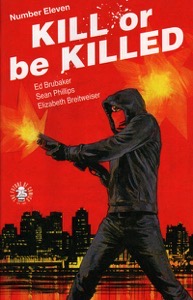
  • Kill or Be Killed (2016) #11

    Kbk11

    The issue opens with Dylan narrating the shootout from the first issue, explaining how narration works. Unfortunately, it’s an entirely pointless few pages, with writer Ed Brubaker unintentionally making the narration incredibly condescending. As if we weren’t talking about narration devices any well-read fifth grader would be comfortable with.

    Then Dylan takes us to therapy, where he’s back on his meds and getting his life back together. No more killing—six weeks have passed, though the narration makes it seem much longer—he’s doing school work again and even ready to hang out with Kira. We find out he dumped Daisy for stealing his dad’s art as a surprise to him; she just did it to impress her boss, he tells Kira during their chemistry-absent conversation.

    They make a date for Halloween, and everything seems right with the world. Dylan even writes a letter to the papers telling them the vigilante’s retired. But just because the NYPD gives up the search doesn’t mean the Russian mob is as forgiving (especially not after six weeks). And then there’s the matter of the demon.

    Dylan’s convinced he didn’t see the demon in his dad’s artwork as a kid because he remembers everything from being a kid (I’d forgotten how moronic the character’s ideas get, Brubaker was doing better with it for a while). So the demon must have been haunting his dad too! Or, wait, maybe he just had bad falafel.

    The last scene, with Dylan returning to the Frank Castle impersonating, is pretty good. Easily Sean Phillips’s best art in the book, which is otherwise very, very lazy. The talking heads scene between Dylan and Kira looks terrible. I’m also not going back to see if they reused the art from the first issue for this one. If no one’s got time to make this comic well, why make this comic?

    It’s a flimsy start to the third arc, and I shouldn’t really be… but I’m surprised. I figured, this far along, Brubaker would be better at bullshitting his way through the comic.

    Nope.

  • Evil (2019) s03e01 – The Demon of Death

    The opening titles for this episode show up about halfway through the forty-five-minute episode. They’re full “movie” credits, getting all the guest stars, going through the entire crew; big stylistic flex because “Evil” knows it’s earned it, at least for this episode.

    The action starts right where we left off, Katja Herbers and Mike Colter finally giving in to their sexual tension—he just needed to become a priest for them to give in—and it’s an intense scene. It’s got episode-long repercussions; it’s a long-threatened plot point, and the show delivers on it. Actually, lots of this episode is just “Evil” fulfilling promises.

    For example, there’s no more delay with Herbers telling her kids Michael Emerson is a bad guy and needs to be treated as such. Of course, she doesn’t mention the reason he’s interested in Maddy Crocco is because they got her at a demonic sperm bank or something, but the kids have a good plot in this episode. The show’s obviously still doing its “this online thing is probably dangerous for your kids,” but it’s a valid one this time and has a solid conclusion.

    Then Patrick Brammall’s back home, seemingly throwing a wrench in Herbers and Colter’s timing, but then he decides to pick a fight with literally demonic mother-in-law Christine Lahti. Lots of promise for that story arc coming up; a couple of Lathi’s scenes are particularly great. The character’s got much more potential when not playing rube to Emerson.

    The investigation plot involves a twenty-one grams-type experiment. Scientist Ruthie Ann Miles (who’s good but barely in the episode) wants the Catholic Church to provide her with someone dying so she can measure the weight to the picogram. They give her dying, bah humbug priest Wallace Shawn. Only when they try to weigh his death… Shawn comes out alive and cured. The show doesn’t get into the science, instead focusing on a rejuvenated Shawn’s new outlook, including his friendship with monsignor Boris McGiver. It’s probably McGiver’s best acting on the show, though he’s never had anything particularly difficult before. And Shawn’s a delight.

    Also regulars Andrea Martin and Kurt Fuller show up for a little scene together, which also has Martin and Herbers meeting for the first time. Again, it’s future promise stuff, with everyone thinking about Herbers and Colter only not knowing what’s really going on. Though Herbers and Colter have different perspectives as well.

    Aasif Mandvi doesn’t get anything to do but support. He’s excellent as always, just wish he’d had a little something more but setting the tone for the season—they get to use curse words intentionally now, with this season their first written from scratch for streaming versus broadcast—is more important.

    Written by series creators Michelle King and Robert King (he also directed), it’s one of the stronger hours of “Evil” I can remember. Partially because it doesn’t make any significant fumbles, but also because the cast does so well with the material.

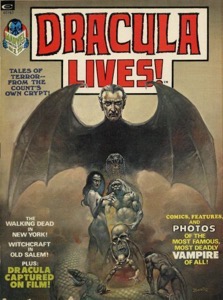
  • Dracula Lives (1973) #1

    Dl1

    Dracula Lives offers a considerable bang for its six-bit cover price. There are three new Dracula features and three old Marvel (from the Atlas days) reprint strips. The reprints are from black and white horror comics and perfectly match Lives’s format. There’s also a Marv Wolfman article covering Dracula movies; Wolfman doesn’t contribute a script for any of the comics. The only places the comic’s not successful are the vampire movie stills with new dialogue; not sure if it was Bullpen interns or if the Marvel guys just aren’t funny, but they’re charmless. Worth skimming to get to the next comic, but charmless.

    The first story is the main attraction—Gene Colan and Tom Palmer in glorious black and white. Gerry Conway writes; freed from the Comic Code, it’s so far his best work on a Marvel Dracula. The Count heads to New York City after reading a news blurb about a successful counter-culture psychic who says he’s reincarnated from some old foe of Dracula’s. So naturally, Drac’s going over to take revenge for past insults but isn’t prepared for the New York lifestyle… specifically sucking the blood of heroin addicts.

    Though I suppose it’s the early seventies, they could’ve been potheads, which would make the entire thing much more amusing. Dracula whining about having too many edibles for a dozen pages.

    But, no, it’s seemingly smack, so Dracula doesn’t just have to recover; he’s got to find a way to get around town in a beleaguered state. He meets a cool chick, and she helps him out—he keeps not having a good opportunity to bite her—before the showdown with the possibly reincarnated nemesis.

    It’s a great comic. Colan and Palmer do a foggy, shadowy Manhattan with a good balance of horror and hip folks. And, again, Conway’s best writing on the character.

    The second comic is another original Dracula, set in the past, about the first time the Count went to the United States. There’s a brief reference to it in the opening story (having been there before), but I wasn’t expecting an entire feature to explain it.

    Roy Thomas writes, Alan Weiss and Dick Giordano do the art. It’s a Salem witch trial story. Dracula’s sick of his low-class vampire brides back in Transylvania, so he uses his dark magic to seek out a willing witchy wife. He, you know, murdered his current wives, turning them into vampires against their will, so they’re damaged goods. It’s not an inappropriate take, given Dracula’s an actual bad guy.

    The art’s good, and Dracula’s kind of a swashbuckler-type when he’s around. Most of the story is about his bride-to-be’s problems with gross men (versus suave vampire men). It’s predictable but acceptable.

    Then come the reprints, three in a row—interrupted, obviously, by the movie still bumpers and then Wolfman’s essay—and I kept wondering if there’d be another original story. They save it for last.

    The first reprint is a Haitian zombie one with art by Tony DiPreta and no credited writer. It’s a little long at six pages but reasonably compelling. It’s moody as hell.

    The second reprint is a two-pager about some guy wanting magic powers and the cost incurred from getting them. Bill La Cava art, no credited writer. It’s low okay, kind of set up for a punchline, but it’s a horror punchline, not a funny or ironic one.

    The third reprint’s the best. Stan Lee script, Russ Heath art. An evil asylum owner gets what’s coming to him over seven surprising pages. The Heath art’s fantastic, but Lee’s has good characterizations and solid twists.

    Then comes the final story, written by Steve Gerber, with art by Rich Buckler and Pablo Marcos. Buckler and Marcos somehow combine John Carradine’s Dracula with the swashbuckler to great effect. It’s the second-best, art-wise, with some great detail.

    Dracula’s heard about a French scientist who can cure vampirism, and, feeling sad over that girl he knew from Salem a few hundred years ago, he heads over to see what’s up.

    It’s not the best Dracula characterization—Gerber writes him a little too naive, especially if this story comes after the feature (though the loose continuity is only to the second, flashback story, not the contemporaneous one)—but the writing’s not bad. The plot’s predictable; the art’s where the story excels.

    Dracula Lives is off to a superb start.

  • The Witch: Part 2. The Other One (2022, Park Hoon-jung)

    The Witch: Part 2. The Other One starts with a flashback to the very late nineties or very early aughts—someone’s still got a cassette walkman, but MP3 players do exist. Now, The Other One is a sequel, but it’s a “start from scratch” sequel, so for a while, it seems like this story will be important.

    Not really. It brings Jo Min-su back in from the first movie, then establishes witches are always twins before jumping ahead to the present. So, just keeping track, we’ve met a new cast, introduced them to the old cast, then jumped ahead and abandoned them. Other One closely tracks four or five characters, with another ten in the background. Writer and director Park treats it as a gimmick, all these different people pursuing the title character, who we’ll meet incredibly slowly and intercut with other characters’ stories. It’s a busy film.

    In the present, a strike team of other witch-powered people—lots of superpowers in Other One; lots—attacks a research laboratory and kills everyone, except then Shin Si-ah gets up and walks out. She’s covered in blood, and it’s snowy out; lots of good visuals. Park spends the first half of Other One putting a lot of time into the composition. Then, in the second half, which is an extended fight scene at night with a couple dozen people and lots of superspeed… it seems like composition’s all of a sudden less important. But, first half, lots of mood.

    Shin gets to a road where a van of bad guys who have just kidnapped local landowner Park Eun-bin. She’s back in Korea from the United States; her father just died, and she’s there to care for little brother Sung Yoo-bin. And to ensure her evil uncle Jin Goo doesn’t sell the farm to resort developers. He’s not just vaguely evil; he’s a crime boss. The implication is Park and Sung’s dad was a crime boss too. Establishing the ground situation on the family dynamics takes Park almost the entire movie. Everyone’s got a history, lots of people know each other, but Park very gingerly reveals those details. The mood is more important than the exposition in scenes, like when Lee Jong-suk goes to talk to Jo about it. They’re suspicious of one another because they’re part of different factions in this super-secret organization, which basically created all the witches.

    If they have superpowers, we don’t find out this movie. Probably next.

    Jo’s going to get old friend Seo Eun-soo to hunt Shin for her, but Seo and Lee have history together, which the film spends too much time on. The Other One runs two hours and seventeen minutes, and there must be at least ten easily cuttable minutes. Unless it matters for the next movie, in which case, release an extended cut. For this movie, The Other One’s got considerable excess.

    Seo’s some kind of government agent who hunts witches. She’s got a literal man-bun bro sidekick Justin John Harvey. They speak in English to one another, with Harvey complaining about Seo swearing at them in Korean. They have a lot of scenes together and no chemistry. Seo’s English language acting is presumably not-native language acting, so she gets some slack. Harvey’s just an amateur. Their scenes are sometimes amusing, but most times, they’re just trying way too hard and never finding a moment.

    Until they start having action scenes, then it turns out they’ve both got superpowers. There are seven people with superpowers fighting in the final sequence. It’s basically an X-Men movie at that point.

    Okay, so Shin saves Park from Jin Goo’s thugs, and Park takes her home to brother Sung. Jin Goo’s going to terrorize the household the rest of the movie, escalating in violence and intimidation, with Shin having to protect her new friends. Meanwhile, everyone else is looking for Shin, too, all headed out to the farm.

    Where there’s a lengthy fight sequence, complete with rocket launchers and flying and knives and all sorts of things. It feels very much like director Park’s trying to make up for not having enough story, so at least there’s whiz-bang gore action. The Other One never feels much like a horror movie, just a gory action one with lots of standing blood. The long fight takes place at night, with Park rushing through it. When you’ve got a dozen people fighting at once, you can be fast while still being slow.

    The acting’s all fine. Seo’s the biggest disappointment (you keep waiting for her to be better when not speaking English, but, first, she’s usually speaking English with Harvey, and, second, she’s not really any better with Korean dialogue). Jin Goo’s good as the villain you didn’t think would be important but ends up driving the plot.

    Shin, Park, and Sung are all good, but they don’t really have much to do. After the first act, Park and Sung are entirely supporting Shin or one of her pursuers. They get no time for themselves. Sung eventually gets more because he’s around while Park’s out picking up red herring.

    Most of the third act is set up for the next movie, which is unfortunate. Just when Shin finally gets some agency, she loses it to franchise building, which is too bad. It’s the worst thing about the movie, which has been teasing post-Other One plot lines throughout, but always additively. Sometimes too much additively, but never at the expense of Shin.

    The end’s at her expense. And the finish—with the uninspired but elaborate nighttime action—doesn’t need any more disappointments. The Other One ends mid-stumble.

    It’s fine and not the same old thing for a sequel, but it’s also long, dense, and sacrifices performances for world-building.

    That said, I’m definitely onboard for another one. Can’t wait.

  • Superboy and the Legion of Super-Heroes (1977) #243

    Slsh243

    The issue opens with that female Science Police officer from a few issues ago thinking her way through an exposition dump. It’s Earthwar! Though they never call it Earthwar (one of the stories was called, Prelude to Earthwar). She’s been hanging out in Legion headquarters watching all the reports come in: Wildfire, Dawnstar, and supporting players are on Weber’s World where the Federation (what’s it called) is negotiating with the Dominators. There are terrorist attacks, and the Federation diplomat’s super-duper suspicious.

    Then Superboy, Mon-El, and their supporting cast have been to the Khurd homeworld to try to stop their invasion of Earth from the source, only to discover it ties into the Weber’s World plot. Meanwhile, the Science Police officer thinks she’s got the answer to both questions, only no one listened to her when she tried to tell them someone’s escaped. Not who’s escaped, because there’s another issue to the arc at least, but one of their old foes.

    With that thought, exit stage left, no idea if the Legion boys will ever acknowledge they should’ve listened to her, lady or not.

    The rest of the issue is a tautly executed espionage and war thriller. The Dominators arrive on Weber’s World—I was wondering if they were the eighties Invasion! Dominators; they are indeed the same aliens, but Todd MacFarlane drew them in Invasion!, and this issue has art from Joe Staton and Jack Abel. It takes a lot to prefer Todd, but, yep… Staton and Abel are low enough he wins.

    Anyway. They’re trying to get the negotiations going, but they want the Legionnaires there to provide security, meaning Earth’s got to fend for itself. Various groups of Legionnaires, including the Legion of Substitute Heroes, try to stave off the invaders, but they keep failing, one after another. It’s incredibly tense, with writer Paul Levitz going ahead with a full-scale invasion of Earth and the Earthlings’ lose story.

    It’s pretty dang cool, wanting art or not. Back with the diplomatic thriller, the heroes are trying to prevent assassinations and kidnappings, unable to trust anyone but themselves. It’s good too. The plotting this issue’s outstanding. Ditto the scene writing once Levitz gets going. He stumbles through a lot of the exposition, particularly with the Science Police officer at the beginning, but he gets passed it eventually.

    The finale’s appropriately grim but also playful, with the next issue teaser panel promoting readers to solve the mystery with some provided clues. Great tone.

    Shame about the art.

    Every time it seems like Staton and Abel are going to do an okay couple panels, it goes wrong. It’s a real shame Levitz didn’t get the excellent art team (James Sherman and Bob McLeod) on this script; it deserves them. But the script’s also good enough to overcome some iffy writing and some bad art.

  • Ms. Marvel (2022) s01e01 – Generation Why

    “Ms. Marvel” gets off to a reassuringly confident start. The only obvious complaints are entirely superficial—don’t promise The Weeknd’s Blinding Lights as a recurring theme song and then not follow through. Secondly, Disney+ needs to more accurately report the run time without credits. I was expecting something like an hour-long first episode. Instead, it’s an extended half-hour, approximately forty-two minutes of action.

    The episode opens setting up the show as a Captain Marvel spin-off. Lead Iman Vellani is an Avengers fanatic who edits great, hand-illustrated videos for YouTube (or whatever MCU YouTube would be). Anonymously, of course. Best friend Matt Lintz knows she does it, but her family has no idea. It’ll be interesting to see if there’s any juxtaposing of her exceptional video talent—I mean, she’s sixteen but cuts video like she’s a multi-million dollar streaming show—with her superheroing. Her family is primed to disapprove of both.

    Vellani’s a modern MCU teenager living with Pakistani Muslim parents who don’t want to let her live her life. The show does a pretty good job with the home life. Brother Saagar Shaikh gets to show a bunch of depth, there’s clearly something to mom Zenobia Shroff (remains to be seen if it’s just performance subtext or if the show will explore it), and dad Mohan Kapur’s a lovable, aloof sitcom dad. The home stuff feels very sitcom. Good sitcom, thoughtful sitcom, but sitcom. Vellani’s the rambunctious one, though only because she’s a girl.

    White guy Lintz has an entirely different understanding of her home life—the first half of the episode is him trying to convince Vellani to ask mom Shroff to drive them to the Avengerscon Convention because since Shroff’s so nice to him, she’s got to be cool all time. It’s very nice detail; again, not sure it’ll really matter. Because this episode’s very first act of a Disney+ Marvel limited series. We meet the characters, get the superpowers, introduce a couple potential subplots, and it’s off to the races.

    But, for now—one episode in—there’s nothing wrong with any of the setup. Lintz mooning over a completely unaware Vellani’s a nice touch (I read the comic for a while, but I don’t remember enough of it, and not a moony best friend), and Shroff’s got multiple finely layered moments in the episode. She’s projecting her insecurities on Vellani. It’s good character work, and Shroff’s excellent.

    The whole show, obviously, is Vellani. She’s doing a Marvel movie version of a Disney Channel teen show, which “Ms. Marvel” does through visualized imagined sequences. So, for example, when Vellani draws out a plan for Lintz, there’s a montage. Or when they’re texting, responses and emoji become part of the urban landscape. Or, when they’re biking, their conversation plays out on the graffiti they pass. It’ll be interesting to see if they keep going with the device. Seems like they can either do it for the “pilot,” then maybe towards the end a couple times, or they’re going to have to keep it going and not stop.

    Though Vellani’s also got a different perception of reality once she gets her powers, so that device might function similarly going forward. The show seems to have a handle on everything; no reason for concern, just moments to enjoy.

    Vellani’s outstanding. With Tom Holland’s Spider-Man off swinging through the land of limited mentions and potential studio squabbling, Vellani’s Ms. Marvel is the obvious heir apparent. The interesting thing about Marvel—comics, movies, and TV—is how the “universe” needs an invested, involved, detached participant observer, usually in the form of an outcast teenager.

    I only hope Marvel uses Vellani so well when she gets promoted to the Captain Marvel sequel next summer.

    We shall see. But for now, “Ms. Marvel”’s capably kicking ass on its own.

  • All Rise (2019) s03e01 – Wanna Be Startin’ Somethin’

    "All Rise" isn't a guilty pleasure so much as I don't want to miss seeing leads Simone Missick and Wilson Bethel act. The show's frequently got ups and downs, but sincere performances go a long way. The show double-weathered the COVID-19 lockdown, first with an adjusted first season finale, then a second season made during COVID-19 about working during COVID-19. CBS ingloriously canceled the show at the end of the second season—despite the show being about racism and sexism, institutionalized and otherwise, show creator Greg Spottiswood was a sexist, racist piece of shit white guy who made his intentionally diverse staff miserable. CBS owed them and failed.

    So Oprah's OWN picked it up, and now, with a couple or three significant changes, "All Rise" is back.

    The show's first big change, which it hammers in for the opening five or six minutes, is Missick's recast husband. Used to be Todd Williams, who I rarely liked; now it's Christian Keyes, who's around a lot but doesn't make much impression. He's just a super-supportive husband. It's not even clear he's got a job anymore.

    The second big change is the music. Adrian Younge does the music, and there's always music. Unfortunately, no matter the scene, it seems like Younge's filling the background. It's so never godawful, but it's eventually tedious. It distracts from the dialogue at times, which isn't great.

    The third big change is the slapstick. There's now some slapstick in "All Rise." Bewildering rom-com-esque slapstick. While I know Missick was pregnant for a lot of season two (another reason they deserved another season), showing off she can do pratfalls or whatever… weird decision.

    Especially since the rest of the episode's pretty serious. "All Rise" maintains a genial tone over all else, even when Anne Heche shows up for a minute. She's a low-key white supremacist, high-key fascist who's out to ruin Missick for being, well, a Black woman, actually. It seems like Heche will be season villain, though Missick's already got a new antagonist in Roger Guenveur Smith. Smith (Smiley from Do the Right Thing, and some other Spike Lee movies) is the super-conservative (Black) new supervising judge because Marg Helgenberger's not doing an OWN series where she's third string.

    So far, Smith's not a great addition.

    They've also lost Reggie Lee (oh, and seemingly Audrey Corsa). Lee played Bethel's supervisor. Bethel doesn't have any cases this episode; instead, he's running the hiring committee for Lee's replacement as punishment for not taking the job. It's far from a good subplot, especially since other parts of the episode are just season premiere delaying devices. Helgenberger takes most of the episode to reveal her departure, everyone's waiting to see if Jessica Camacho's really coming back, and so on.

    Samantha Marie Ware's back, working for Lindsey Gort and trying to make Gort and Ryan Michelle Bathe (who Zoom cameos) pay her for her labor. Of course, Ware doesn't understand part of being a lawyer is suffering, so someday you can make someone else suffer. Strange flex. But that subplot is more prominent than anything Bethel's got.

    The trial involves J. Alex Brinson—now a public defender—representing a foster kid (Taj Speights) who doesn't want his siblings removed from their first good foster situation, so he's been lying. Complicating it—very, very temporarily—is Lindsay Mendez now playing victims' rights advocate; it's barely a subplot and goes nowhere in the episode because it'd be too difficult.

    Hopefully, it's just season premiere, new network jitters, and "All Rise" can find some firmer footing. It's off to a rough start, even taking extremely qualified expectations into account.

  • The Boys (2019) s03e04 – Glorious Five Year Plan

    Following the conventional (Dan O’Bannon) wisdom about second acts ending with things in the worst shape for the heroes… it’s hard to imagine how “The Boys” will further ratchet the situations before the season finale. Everything has gone wrong across every storyline, gloriously so. No pun intended.

    There are two main plots, two subplots. Or like, one and a half subplots because one of them is the hard cliffhanger. The episode’s also got an incredibly dangerous soft cliffhanger, but only one life or death one.

    The Boys’ plot in this episode is a Russian field trip. They’re looking for the gun the Russkies used to kill Soldier Boy (Jensen Ackles) back in the eighties, intending to turn it on Antony Starr, which ties in with Erin Moriarty and Starr’s superhero plot. “The Boys” is incredibly precisely constructed this episode; Meredith Glynn gets the script credit, her first “Boys” as writer (she’s an executive producer this season). It’s a really good script; some of the supporting cast gets short scenes, but they’re good short scenes, and they build.

    Now, Jack Quaid knows Karl Urban is juicing with the superhero serum. His morning begins with Starr humiliating him—Starr’s just decided he’s dating Moriarty to raise his points–and, when they get to Russia, the anti-Homelander Russian state media is running the story making fun of Quaid for getting super-cucked. Seething anger builds in Quaid, leading to big decisions.

    While Quaid’s still good, he’s not great with the anger stuff. Not sure if it’s a limitation of the script, Julian Holmes’s directing (which is otherwise good), or just Quaid not being able to do it, but when he’s got to be angry, he’s throwing a tantrum. There’s a “cute” quality. Too much Meg Ryan, perhaps. Though my good lady wife pointed out Quaid got his dad’s Innerspace butt.

    Anyway.

    The subplot to the Boys is Tomer Capone and Karen Fukuhara getting increasingly sick of Urban, to the point even Laz Alonso’s concerned about morale. Fukuhara’s excellent this episode. Capone’s good too (thank goodness, last episode’s stumbling was momentary), but Fukuhara’s great. She’s got to assassinate some Russians in trade for superhero-killing gun intel.

    Meanwhile, Moriarty and Dominique McElligott (who’s not in this season anywhere near enough) are putting together their rebel strike force to take on Starr once Urban, and Quaid bring back the state-of-the-art bang bang. Moriarty enlists ex-boyfriend Miles Gaston Villanueva in what ends up being an excellent subplot for both of them. So much of “The Boys” hinges on the casting and Moriarty’s in that essential group.

    The superhero plot is more behind-the-scenes drama than epical plot; Jessie T. Usher is getting into it with returning team member Chace Crawford, whose evil Karen wife (Katy Breier) knows how to get into Starr’s good graces at Usher’s expense. Then there’s some more for Colby Minifie to do as the team’s executive liaison.

    The superhero subplot involves superhero company CEO Giancarlo Esposito and his secretly adopted, secretly superpowered government official, mole Claudia Doumit trying to run damage control on Starr. It’s another excellent subplot, with series-best acting from Doumit and season-best from Esposito.

    Then, of course, the episode also gives Urban and Starr a bunch to do. No wasting the transfixing scenery incinerators here. They both get excellent spotlights, multiple ones for Starr.

    It’s an outstanding episode. I’m looking forward to seeing how things get worse because of the incredible creative skill involved, but I’m also dreading them because of the taxing emotional investment. “The Boys” is—even more than witty, gross, hilarious, icky—heavy. It’s always very, very heavy.

    Gloriously so.

  • Tomb of Dracula (1972) #11

    Tod11

    Jack Abel’s inking Gene Colan again, but the issue pulls through all the same. The art’s better than last issue, particularly on Dracula. The writing’s better too, but actually good, as opposed to just not the worst Abel can screw up Colan. There are some particularly great pencils Abel trashes this issue too. With better inking, this issue’d be a contender for best Tomb of Dracula so far. Even with the goofy Haiti voodoo subplot.

    It’s been two weeks since the last issue, and Dracula’s still not used to Clifton Graves being dead. Dracula left him on an exploding yacht because Graves was so useless. Drac briefly ruminates on the departed leech, who’s been pointless since issue two, and it’s nice to know I wasn’t the only one who wanted Graves gone. Dracula, Prince of Darkness, agreed.

    Dracula then goes to sleep, resting up to hunt down the biker gang who tried to drown him a couple issues ago. Now, Tomb of Dracula’s editorial notes are saying I need to read Dracula Lives! to understand Dracula’s Marvel history—which I think I’m going to do so I can better bitch about continuity issues.

    This biker gang’s working for a dying rich guy who wants them to go kill his enemies before the final curtain. He’s got voodoo dolls of all his targets, so he can torture them from afar before the bikers end their miseries. It’d probably play better if there weren’t a “kidnapped in Haiti by savage voodoo natives” flashback. But that section’s quickly forgotten, as Dracula hunts the gang and they hunt their targets. Drac finally catches up when they’re on to the last victim, a mutual acquaintance (who apparently invited Dracula in at some point because he’s got no trouble entering the house uninvited).

    Writer Marv Wolfman’s playing with Dracula character in more ways than just vampire rules or character history; Wolfman’s making Dracula more sympathetic and more personable. When it’s time to feed, Dracula doesn’t hunt the helpless young woman; he pursues the human guy also hunting the young woman. And when Dracula’s soapboxing, he doesn’t sound like a wannabe megalomaniac but rather a slighted aristocrat with anger issues.

    It works.

    It works enough to get through the disappointing art.

    Wolfman hints at future plotlines for the vampire hunters, who mostly take this issue off. Frank and Rachel are on a weekend date, and they’re going to see a Dracula play; the narration promises we’ll hear about it later, presumably next issue. Or in Dracula Lives!. But this issue’s about Dracula and the bikers and their respective prey.

    The ending’s particularly good. Wolfman reveals at the last moment the issue’s a lot more tightly constructed than it initially appears.

    I really hope another inker comes on soon, though. I miss being excited for the art.

  • Detective Comics (1937) #466

    5571

    The feature has Ernie Chan and Vince Colletta art and all the visual failings such a pairing promises. But the story’s… oddly… good?

    A Silver Age Batman villain—The Signalman—returns for a bunch of themed heists. What makes it interesting is how well Signalman does against Bats. Len Wein writes; Signalman has a lot of bravado speeches, which work. Batman has a lot of descriptive speeches, which do not. Though when Batman’s just got thought balloons, it’s a little better. Especially after Signalman gets the upper hand.

    It might just be the Silver Age feel of the story. While Chan’s pencils are still bad, they’re not failing to realize some brooding, dark knight detective Batman; they’re failing to realize Batman stopping a panic at the ballpark. There’s no heavy lifting to the art.

    And Signalman’s outfit is ridiculous, so having a better artist on it wouldn’t do any good. The resolution’s disappointing, but it’s an entertaining enough read on the way there. Signalman’s just a colorful villain. He talks a decent amount of good smack.

    It’s a totally fine feature against some considerable odds.

    The backup’s more of the Calculator series from writer Bob Rozakis. This time he’s got Green Arrow fighting the Calculator, with Elongated Man along as cloying sidekick, and Marshall Rogers and Terry Austin on the art.

    I was expecting quite a bit more from Rogers and Austin, but it’s either just okay, visually confusing, or downright bad. Not like, Chan and Colletta bad, but “someone else drew these faces on these heads, and you can tell” bad. The visually confusing parts come with the Calculator’s attack on Green Arrow (also at a ballpark, which they mention in the feature); Calculator is shooting baseball bats out of his head at Green Arrow, who’s breaking those baseball bats with baseball bats.

    Rogers does a lousy job staging the superhero action. Though Rozakis’s script doesn’t explain Calculator’s plan at all, just having a plan. It’s bewildering, tiring, and disappointing. The only reason I was reading Detective this early was for Rogers’s backup; I wanted to get the whole story. Silly me.

    I probably would’ve bet cash money against ever saying I liked an Ernie Chan and Vince Colletta story than a Marshall Rogers and Terry Austin, but here we are. The only star, obviously, is Wein. He knows how to write that Signalman story and does it well.

  • Tomb of Dracula (1972) #10

    Tod10

    Well, they found the worst inker (so far) for Gene Colan—Jack Abel. But then they had to one-up it with a letterer so bad the comic’s visually unpleasant to read. Denise Wohl’s the letterer (credited as D. Vladimer, presumably because you can’t have too many girls working on a book).

    This issue features the first appearance of Blade.

    And it is a stinker of a comic book.

    It opens with three vampires attacking would-be stowaways on the London docks. Or some docks in England. Doesn’t matter. Blade saves them, then Quincy Harker confronts him. Last issue, when Quincy got a phone call and had to rush away, it was about Blade being active in the area. Quincy’s mad Blade killed a teenage vampire. Blade asks what Quincy would do about it.

    Quincy’s got no answer, then defends Blade when daughter Edith says he’s rude. I don’t know if it’s supposed to come off slightly racist, but calling confident, capable Black people rude doesn’t ever not have connotations. Swell.

    The story’s about Dracula hijacking a yacht. The owner looks vaguely like Paul Williams. I say vaguely because it’s impossible to know what anything should look like after Abel’s inks have mangled Colan’s pencils. Dracula’s on board to convince all of this rich guy’s friends to be subservient to him. Dracula tells Clifton Graves (who’s got different color hair this issue) they’re all too wimpy to resist Dracula.

    But Dracula’s first scene with the yacht party is being a sniveling dipshit. After he snacks on a blonde, though, he’s ready to hijack the ship and threaten to kill them all if they don’t pledge fealty. It’s a stupid plan. For an already stupid comic book, it’s a stupid plan.

    Even with better art, it’d be a bad comic. It’s a lousy script, though Blade’s a fun character once the Harkers aren’t complaining he’s not articulate enough. But I can’t actually don’t know if anything could overcome the lettering. This comic contains a lot of text, and it’s painful to read. Wohl’s lettering is the equivalent of nails on a chalkboard.

    Yuck.

    There are also a bunch of continuity issues—including notes about how we need to be reading Dracula Lives! to know what’s going on—but Dracula knows Blade, which makes absolutely no sense. He’s been making vampires for his legion, which we’ve never seen before in the comic.

    It’s a stinker for sure, start to finish. However, I’m relatively confident it’s just writer Marv Wolfman having a (very) lousy month.

    And at least they didn’t call him Black Blade.

  • A Walk Through Hell (2018) #4

    Walk4

    So, this comic has an editor (Mike Marts). He looked at this script and said, “yep, that’s a comic.”

    Here’s the story: FBI agents Shaw and MacGregor are sitting in the hell warehouse, where Shaw is going to tell MacGregor a secret about their investigation into a child murderer. There’s going to be a scene where Shaw reminds MacGregor he helped her frame the guy, which should be some kind of reveal but isn’t because writer Garth Ennis’s script is plotted so poorly. But the whole thing is about Shaw telling MacGregor something he doesn’t know and him telling her everything she’s telling him he already knows.

    Spoiler, no spoiler: she never gets around to telling him anything new this issue. She just reminds him of various events he participated in or witnessed, while he protests he already knows all about them. Over and over again.

    It’s not decompressed storytelling, it’s not a bridging issue, it’s craven water-treading. I guess it’s only a four-dollar comic. For some reason, I was expecting it to be five dollars for absolutely nothing.

    I guess there’s some decent art from Goran Sudžuka. Still, it’s not four dollars worth of art, especially not when the story is telling you to hang on another month for what’s already going to be a scant detail and nothing actually important. Not the way this comic’s paced.

    It’s not a good sign Ennis is doing a “blathering” issue four in. He obviously didn’t have enough story for twelve issues, but does he even have enough for six. It’s not tripe; Sudžuka’s too good, and Ennis’s writing on a handful of scenes is okay. It’s just literally, intentionally a waste of time and money.

    There’s not even a police procedural angle because Shaw’s not narrating it for expository reasons—MacGregor already knows it all, and she knows he knows it all. I hope the creators at least enjoyed whatever they bought with their paychecks since they didn’t give a crap about the comic they were making.

    Hey, maybe next issue. But, also, maybe not.

    If Ennis keeps it up another seven issues, though, just more and more filler, it might be impressive. Like as a gag.

  • The Boys (2019) s03e03 – Barbary Coast

    We’re firmly in season three with The Boys now, with this episode setting up a couple longer storylines and a few immediate ones. First, the world’s reacting to Antony Starr going megalomaniac on live television—the white men positively responding because they’re garbage—and Erin Moriarty discovering she no longer has any leverage thanks to her better ratings.

    Of course, her ratings don’t matter since a more unhinged Starr’s giddily sharing his plans for a scorched Earth (literally) with her.

    So while Moriarty’s dealing with going from a position of power to Starr’s prime target for abuse, Jack Quaid’s busy getting back into it with Karl Urban, Laz Alonso, and Karen Fukuhara. Tomer Capone takes a personal day to deal with ex Jordana Lajoie’s problems, only it turns out that plot will feed directly into the next episode.

    It’s an unfortunate subplot, mostly because director Julian Holmes doesn’t seem to know how to break Capone out of his worse acting impulses. As a result, Capone’s scene opposite Lajoie was like a spoiled madeleine, reminding of his weaker performance earlier in the show.

    Capone and Fukuhara are both getting sick of working for Urban—who’s recovering from his superhero serum this episode, unable to control his heat vision, and irate about it. Capone’s better with Fukuhara than without, especially since his side quest involved a lot of kink-shaming for comedy with his Russian dominatrix crime lord former boss, Katia Winter.

    Everyone but Capone goes to Laila Robins, who’s hiding out with Cameron Crovetti since Starr lost it last episode. Unfortunately, there’s not enough bridging material between Starr declaring his hostile superiority and everyone reacting to it or everyone discovering Claudia Doumit works for Giancarlo Esposito. Neither Doumit nor Esposito show up in this episode, with Esposito sorely missed in Moriarty’s plot. She keeps hearing what Esposito would tell her about Starr, who’s got all sorts of schemes to make her miserable, whether it’s bringing ex-boyfriend Miles Gaston Villanueva onto the superhero team for drama or even bringing back Chace Crawford, who assaulted her and kicked off the show back in the first season.

    Compounding Esposito’s absence is his character appearing in a flashback. Urban found out something Robins hasn’t been telling him or The Boys, so he confronts her about it, and she does a story time with a flashback. The flashback itself is pretty good, although Sarah Swire isn’t nearly as good as Robins; Swire plays the younger version. But then Justiin Davis does an Esposito impression in his performance as the young version of that character, and it does not work.

    The flashback’s revelations also put Urban in an even worse place, meaning he’s going to take everyone else with him—young and old—to that place. It’s a confined episode, but with a lot going on and lots of smaller season three plot setups. The stuff they can do without all the guest stars.

    The episode does more with man’s inhumanity to man than gore, though there’s a harrowing sequence for Crawford and Starr, where Crawford (or maybe just the audience) discovers his wife Katy Breier is a villain in the making.

    Then Jessie T. Usher gets a somewhat surprisingly proto-storyline with brother Christian Keyes. It’s a packed episode and mostly fine, but it doesn’t have the wow factor of the previous couple. Instead, it’s all either setup or exposition; there is some great “Boys” humor before everyone has a bad day, though, with Quaid needing help calling in sick to work.

    Moriarty’s easily the episode standout, even as she’s entirely reactionary.

  • The Orville (2017) s03e02 – Shadow Realms

    I guess the next episode will be the deciding point—or at least forecast it better–but this season of “The Orville” isn’t treating Penny Johnson Jerald as the “heart of the show” so much as its protagonist. This episode, like last, is mostly about her, which is excellent. Jerald’s fantastic; there’s also some subtext to nineties “Star Trek” writers (Brannon Braga for this episode, co-writing with André Bormanis) doing a show where the lead is the ship’s chief medical officer and her kids aren’t annoying.

    This episode’s full of callbacks and homages, though. The last episode felt like “Orville” Star Wars at times; this episode feels like “Orville” Alien. Down to the music: John Debney does an excellent Jerry Goldsmith but peppy score for the episode.

    It’s also the Borg episode. It’s also a “truth behind the religion” episode, calling back to original series “Star Trek,” and it’s also an homage to schlock sci-fi of the fifties. The monsters look like—terrifying, grotesque—rubber fifties monsters.

    There’s also the episode’s “micro-movie” feel. It doesn’t feel like an extended episode or a truncated two-parter; it feels like an “Orville” adventure. The Orville Into Darkness, actually. Quite literally.

    The episode begins with guest star James Read arriving on the ship to conduct negotiations with the former bad guy, current tenuous ally aliens, the Krill. The Union wants safe passage through their space to explore beyond their star empire’s borders. The Krill haven’t explored it because it’s full of soul-sucking demons with eight eyes.

    The Orville crew, mostly Seth MacFarlane and Adrianne Palicki, give the religious mumbo jumbo an eye-roll, and the Krill don’t care if the ship goes off and gets soul-sucked, so they get the go-ahead. The beginning of the episode is a very “Star Trek” diplomacy bit. After that, it becomes an undiscovered frontier exploration episode—the “New Horizons” subtitle suddenly makes more sense for the season.

    Well, at least for a while.

    But the bigger deal is Read’s former relationship with Jerald. Twenty-five years ago, he was one of her professors and something more, but it’s not something she talks about anymore. He’s interested in rekindling; she’s not. Read’s continued interest leads to him consulting with AI robot and Jerald’s ex Mark Jackson for a sidesplitter scene.

    Read’s also gung ho to accompany the ship on the exploration—at the beginning of the episode, it wasn’t clear the Orville would get the mission, but after the negotiations complete, there’s never a question of it. Maybe they cut a scene. Once guest star Victor Garber gives the okay, they’re off to the Delta Quadrant.

    Or whatever.

    There they discover a bitchin’ nebula and a terrifying section of empty space—the something-something Expanse, where there’s no starlight and a distress beacon going off. Going to the beacon, they find themselves on a bio-mechanical space station of some sort, unknowingly walking into an inspired Alien and Borg hybrid homage.

    Jon Cassar directs the episode, doing a fine job, especially with the actors. While the first half of the episode is mostly Jerald, Read, Palicki, and I suppose MacFarlane (he’s the anti-Shatner, making room for everyone else), the second half gives the rest of the crew more to do. There’s an away mission with J. Lee and Jessica Szohr, then Peter Macon gets a bit (Scott Grimes and new cast member Anne Winters get the least—they’re the helmsmen after all—but they had more last episode). It’s a very nice balance.

    The episode makes big swings in terms of character development, season baddies, and so on. The resolution’s a little abrupt, but the last scene is absolutely fantastic. No surprise, “Orville” is real good.

  • The Staircase (2022) s01e08 – America’s Sweetheart or: Time Over Time

    “The Staircase” finishes with some highs and lows. It’s got Odessa Young’s best acting in the series and some truly phenomenal work from Toni Collette. Young’s gets to be less problematic than Collette’s, as show creator, episode director, and credited writer Antonio Campos gives Collette a hackneyed final scene. It should be series-best work from Sophie Turner, but it’s not. She’s just okay, which is better than poor Rosemarie DeWitt. DeWitt sat around the whole show with nothing until now, and here she gets a bad wig and flat characterization.

    It also ought to be Juliette Binoche’s best episode. It’s not. The show spent the latter half of the episodes setting Binoche up to be some kind of protagonist, only to make her another rube. “The Staircase” treats the audience as rubes; might as well treat its subjects the same way.

    The episode does not have three or four possible reenactments of Colin Firth killing Collette, though it heavily builds toward the “truth” at the end. Except it turns out it showed its take a long time ago and then spent six or seven episodes saying it didn’t. There’s only one red herring, which the opening scene establishes, and then waiting the whole episode to see if it’s relevant.

    There’s a lot with the kids, only not when it’s important. The episode splits between 2011, when Firth gets out of prison for a retrial, then 2017, when Firth’s giving his Alford plea to resolve that retrial. There’s nothing in between because it would give away the ending. Or at least make the conclusion less of a “surprise.”

    Some of the best material in the episode—outside Collette’s final day or two (her white-collar business suspense story’s much more compelling, thanks to Collette, than anything else in “Staircase”)—is Young and Turner finally having their big sister moment.

    Sure, they’ve been putting a pin in it for ten plus years, but it’s the closest thing to pay-off. Campos narratively cheaps out on everything else, including Patrick Schwarzenegger’s internal collapse as Firth no longer loves him the most and shuns him, in fact, in favor of previous screw-up Dane DeHaan.

    Unfortunately, Campos does a terrible job directing Young and Turner’s scene—maybe his worst work in the episode, which is saying a lot.

    Michael Stuhlbarg is around for the courtroom scenes. We find out he’s a rube, too, but it wouldn’t matter because he’s an, at best, amoral lawyer. Tim Guinee might not even get any lines.

    But the real kicker to “The Staircase,” after the ending they lifted from “Daredevil,” is the reality. I intentionally didn’t look up the case, but the real guy is not a vaguely debonair, Southern gentleman on the spectrum Colin Firth type… he’s got the style of a used car salesman, and his vibe appears to be Kramer impersonating.

    Changes the “based on a true story” thing, even as the episode reveals just how much of the show has been pure, exploitative supposition on Campos’s part.

    Even before that Googling, however, Firth’s performance takes a real hit. He doesn’t land any of his scenes this episode, which makes sense because they’re waiting for the big reveal, but still.

    Just like I’d worried from the start, it’s an outstanding Collette performance in an otherwise deficient production.

    They haven’t created the awards she deserves for believably laughing at America’s Sweethearts.

  • The Big Picture (1989, Christopher Guest)

    At its best, which isn’t often, The Big Picture is a vaguely charming Hollywood satire about young director Kevin Bacon discovering making it isn’t all it’s cracked up to be. But also not. Because Picture skips over Bacon’s “making it” period, other than being a dick to best friend Michael McKean and driving a Porsche instead of a quirky AMC Gremlin. The AMC Gremlin has a lot of personality onscreen; unfortunately, the film never makes it feel like Bacon’s car. But Bacon’s real success, working with soulless Hollywood producer J.T. Walsh and his gang… not on screen. We see the build-up to it, but not the actual scenes.

    Then it’s just fall out.

    I’m not sure where Picture’s at its worst. Probably when Bacon runs out on girlfriend Emily Longstreth to hook up with starlet Teri Hatcher, only to discover Hatcher’s got a boyfriend (something the film never addresses again), then comes home and forces Longstreth to break up with him. Unfortunately, Bacon’s already got a paper-thin character, so it makes him unlikable for a long stretch. His eventual redemption won’t even come from within; the film will bring out one of the more successful—though not really successful—big swing performances to facilitate it.

    Blaming Picture on Bacon’s too easy, though. He’s just playing the role as written.

    Most of the time, Big Picture’s a toothless, tepid, inconsistent, lackadaisical mess. The hopefully intentional anti-climactic third act should give the film a lot of character, but Picture doesn’t have the cameos for it. Instead, it’s a Hollywood satire where the best they could do is Eddie Albert and Elliot Gould for cameos. And Gould’s co-star Jason Gould’s dad; the film oddly doesn’t address nepotism. Though there’s a lot it doesn’t address. Longstreth’s not Hollywood, so she’s okay. Bacon’s fellow film student Jennifer Jason Leigh’s too avant-garde for mainstream, so she’s not Hollywood. But the other women are all pretty terrible. Hatcher’s an unthinking succubus, Tracy Brooks Swope’s a soulless studio exec-wannabe, Fran Drescher’s a greedy wife.

    Thank goodness Longstreth’s an angel of redemption. She’s also way too good for how the movie treats her. For the first act, she’s an accessory to Bacon in his scenes. In the early second half, during their breakup, she shows some personality, but then she ingloriously exits so Bacon can complete his move to the Dark Side.

    It’s unclear if Picture forgets its subplots and supporting cast members or if it just didn’t have the budget for them. It’s a Hollywood movie where they’ve got limited time on the lot.

    Again, since Bacon’s just playing the part as written—an Ohio farm boy who can’t be expected to be responsible or accountable when fame and fortune are in grasp—it’s not really his fault. He’s not believable as a film school wunderkind who desperately wants to make a Bergman movie, mainly because Big Picture doesn’t acknowledge he’s trying to make a Bergman movie (without having any insight into the subject, which is a whole other thing).

    Longstreth’s fine. The part doesn’t let her be good. She’s outstanding a few times, especially in the movie fantasies Bacon occasionally has to pad time. He’ll imagine he’s in a noir or something. Bacon’s clearly miscast in the scenes, and Longstreth’s great in the one she gets to play in.

    Speaking of miscast… poor Walsh. He’s an obviously capable actor in a part he’s entirely wrong for. The script doesn’t help him either.

    Don Franklin’s legit good as his flunky. It’s too bad he doesn’t get more.
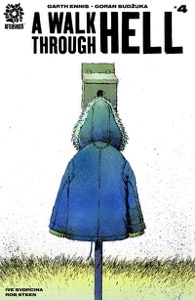
    McKean’s sort of around as Bacon’s conscious for a while. He and wife Kim Miyori are expecting their first child, providing a contrast to Bacon’s pursuit of Hollywood success. McKean—who co-wrote—is the best of the main cast.

    Hatcher’s fine as the succubus. Not her fault she’s one-dimensional. The movie asks a lot of Leigh, and she delivers most of it, but it needs her to be a magician, and Picture frequently proves magic isn’t real. Hollywood or otherwise.

    Guest’s direction is middling. He relies on David Nichtern’s not quirky enough score too much for personality. Then when movie music becomes a plot point, Nichtern’s score is an obvious missed meta opportunity. Ditto Jeffrey Sur’s competent but unimpressive photography (McKean’s a cinematographer trying to make it, and Bacon promises he’ll take him along to Hollywood).

    Martin Short’s got an extended uncredited cameo as Bacon’s agent. He’s the best thing in the otherwise bland Picture.
  • Tomb of Dracula (1972) #9

    Tod9

    This issue starts with one of Tomb of Dracula’s most potent scares—Vince Colletta will be inking Gene Colan this issue. Beware all who enter. That said, it’s not as bad as I thought it’d be. Yes, Colletta ruins a bunch of panels, and he can’t do the shadows, but—at the very least—the art does have some kind of weird personality. The story’s also got a lot of personality, like writer Marv Wolfman going overboard with Dracula’s church-related panic attack but then doing a sublime tall tale recounting.
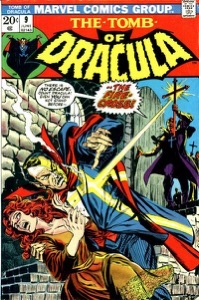
    The action picks up—presumably—soon after last issue’s conclusion, which had Drac flying off into the night after he’d failed to resurrect an undead vampire zombie army. He starts this issue in the ocean, a group of young folks rescuing him and taking his wet, unconscious form to the only place in their village open at such an hour… the local church. Tomb of Dracula vampire logic allows vampires on holy ground, apparently, because it’s not until Dracula wakes up and sees the crosses all around him does he flip out. There’s a particularly poorly inked sequence where he tries to escape, eventually having to wait for the priest to open the front door.

    Outside, instead of attacking the priest and the concerned locals, Dracula makes up a bullshit story to explain his condition, including lying to protect his pride. It’s reasonably subtle—especially for a Marvel comic—and very cool. He won’t accept help from the priest, but he will crash with one of the locals until he regains his strength.

    Of course, he’s only got six hours until sunrise to regain his strength and get away to some good old Transylvania soil. So he goes to get something to eat, failing to realize turning one person in a confined village will soon lead to enough vampires everyone’s going to notice them feeding. Also, the priest sees some vampire activity and decides to get a lynching party together—the priest’s desperate to get his flock involved in church activities again, in whatever form.

    Meanwhile, Dracula makes a new friend in his rescuer, a young man named Dave, who doesn’t want to spend his life in a crappy English fishing village. It would feel like a done-in-one if it weren’t for the flashback tie-in to the last issue or the brief aside with the vampire hunters (immediately recovered from the little kids trying to kill them earlier in the evening).

    It’s a nice issue, despite the overwriting, despite the Colletta. Wolfman keeps making Dracula more interesting a character; for instance, in this issue, he’s in the protagonist slot. Not even the abysmal inks of Vince Colletta can mortally wound Tomb of Dracula!

  • Werewolf by Night (1972) #7

    Wbn7

    Apparently, somewhere in between issues, Jack sat down with sister Lissa, and they had the “your brother’s a wolfman” talk because she knows it in this issue and it’s old hat. If it were a better comic, I might be disappointed, but so long as they don’t pair Lissa off with forty-something Buck Cowan… I’m not going to complain.

    Not when writer Len Wein’s referring to the one Black character as a “Black giant.” It all feels very colonial. And very Christian; in his narration, which Wein writes with incredible detail and verbosity, Jack describes something like Moses’s cane separating the Red Sea, and you’ve got to hope they were smoking something.

    The issue opens with lions versus werewolf—circus lions, which Jack explains in the narration means they aren’t as fierce as his surfer boy werewolf—only Wolfman Jack doesn’t beat them in a fight; instead, it’s the appearance of the Swami. He calms everyone down—and reveals he can mind-read for realsies—and it’s cliffhanger resolved. Jack sleeps off the shaggy dog syndrome, then spends the next day in a hypnotic trance until sister Lissa and buddy Buck arrive to save him.

    Sadly, they’re no match for the Swami’s hypnotism, so it will be up to the werewolf to sort things out.

    The Swami’s plan involves the Bloodstone, which will end up being a Captain America MacGuffin in the eighties—I’m not sure on the continuity. It’s just here to give the Swami an excuse to do a blood sacrifice, as well as to explain why the carnival flunkies work for him. The Bloodstone leads to incredible wealth somehow. It’s not important. Wein overwrites the narration so much and slowing down on it just reveals wanting (or problematic) content; why bother putting energy into parsing it all.

    The art’s okay. Jim Mooney isn’t a good inker for Mike Ploog’s pencils, but he’s also not the worst.

    The conclusion’s so perfunctory and bland—the Swami’s not some great villain—you’d think Wein was finishing off an arc he hadn’t started, but he wrote the last issue too.

    I’m trying to think if there’s anything else notable. Maybe the way Wein writes Jack’s experience of the werewolf’s adventures—but it seems unlikely his approach (Jack’s more lucid observing the werewolf than his own existence) will carry over to the inevitable next writer.

    Though, I guess Jack’s also never not hypnotized when he’s human in the issue. It’s a mess not worth unraveling. Werewolf by Night reads like a joyless churn for everyone involved.

    And I think the series has used the same villain resolution before, which isn’t great given it’s only ten issues in (counting the Marvel Spotlight).

  • The Last Days of Pompeii (1935, Ernest B. Schoedsack)

    The Last Days of Pompeii opens with a disclaimer. Despite sharing a title, it is not based on Edward Bulwer-Lytton’s 1834 novel. That disclaimer should be read as a warning.

    The film runs ninety-six minutes. The last days of Pompeii are the third act; the first two acts… wait, no. The timeline doesn’t even work internally. Vesuvius erupted in 79 AD, but when lead Preston Foster doesn’t give his life trying to free Jesus from the cross on the way to Golgotha, it’s 33 AD. Oh, sorry, spoiler. Last Days of Pompeii is not an exciting disaster movie; it’s a jejune Christian movie about how selfish dipshit jock Foster finds Jesus but not really.

    Anyway.

    In 33 AD, Foster’s got a nine-year-old adopted son—played by David Holt. It’s Foster’s second try at fatherhood; the first time, his selfishness and stupidity got his wife and baby son killed. After their deaths, he became a gladiator, eventually killing Holt’s dad in the ring. So Foster adopts him and strives to provide him with all the money in the world, including taking him to Jerusalem on a business trip. An old lady fortune teller tells Foster to take Holt to see the greatest man in Judea, so he takes Holt to meet Pontius Pilate (Basil Rathbone).

    When the action gets to the Last Days, Holt’s character has grown into John Wood, who’s eighteen years older. Wood’s probably supposed to be playing a teenager, so screenwriter Ruth Rose’s taking the timeline even less seriously than she could.

    Wood’s grown to resent his adoptive father’s greed and is trying to help escaped slaves get away from Pompeii. The slaves are headed to the gladiator games, dad Foster runs the games, but Wood knows he can’t tell his dad to stop being terrible. Even though they both met Jesus once, Foster has been trying to gaslight Wood into forgetting ever since.

    The scary part of Foster’s performance is his angry old man, complete with makeup, is his best work in the movie. He’s lousy when he’s the greasy stud in the first act. He’s not the worst, but he’s bad. He slightly improves in the second act, when Pompeii introduces the real master of Judea, wink wink (not on screen, rather the Marsellus Wallace suitcase device), but only barely. Maybe the improvement is the lack of a greased-up chest.

    Along the way, Foster buys a family slave, Wyrley Birch, who’s supposed to be a tutor but never tutors. Instead, Birch plays butler for Foster and sounding board for Wood. Birch seems like he’s always going to be better, but the movie never gives him anything to do.

    Besides Rathbone alternating between sincere in his Christian movie performance and visibly restraining himself from chewing up the scenery, the most amusing thing about the film is spotting the character actors in the supporting cast. What other movie’s got Ward Bond as a gladiator (uncredited, which is weird because it’s a reasonably prominent role), Edward Van Sloan, Louis Calhern, Frank Conroy, and Jason Robards Sr. hacking it up in a costume drama. Plus a cameo from Jim Thorpe — All-American!

    Unfortunately, the occasional appearance of a familiar character actor isn’t enough to keep the film going. Especially since none of them recur enough to matter. Alan Hale, but he’s second-billed and just not bad like Foster. Hale and some of the character actors can overcome the script, Foster cannot. Neither can Wood, unfortunately. Though he does better than his love interest, Dorothy Wilson. Pompeii’s got no time for ladies; they’re one kind of fodder or another, chariot or class.

    Obviously, if the script were better, who knows. Director Schoedsack’s similarly unenthused, going from one rote setup to the next. He doesn’t even put any energy into the early gladiator fights, instead waiting for the finale when there’s much less time–though for a while, I wondered if they were going to skip the eruption altogether. The amphitheater in the finale’s much more elaborate than in the first act; maybe they weren’t done building it.

    Most of Pompeii is just backlot street shots with questionable architecture. There’s not much special effects work outside some composite establishing shots. Unfortunately, the finale’s nowhere near enough to make up for it.

    There’s more to say about Pompeii, especially the film’s presentation of slavery, but there’s not much reason to say it. It’s atrocious from the start, with some good but not good enough special effects at the very end.

    Presumably, the Bulwer-Lytton novel has to have a better story, but I’ve got no inclination to find out.


  • Tomb of Dracula (1972) #8

    Tod8

    Oh, no, Tom Palmer’s not inking Gene Colan this issue, and they got Ernie Chan to do it instead!

    While I suppose Chan’s inks could be worse, it’s a profound downgrade in the art. During the human vampire hunter stuff, it’s reasonably okay—if chunky-lined. During Dracula’s vampire plot? It’s just wondering what it would’ve looked like with Palmer or someone better. Especially during the giant bat fight, which takes place over a few pages, and Chan does an abysmal job with.

    The issue’s not just unsteady due to Chan, unfortunately. Writer Marv Wolfman employs an ill-advised declarative statement expository device, and it’s not good. His dialogue’s got more expository dumps, too; luckily, both devices go away by the comic’s second act, like Wolfman thought he had to keep it accessible for the potential new reader. Who wouldn’t have seen Chan’s name in the credits and put it back on the spinner.

    Anyway.

    While the vampire hunters try to survive a dozen hypnotized children trying to kill them, Dracula rushes off to tend his wounds. Quincy Harker shot him with a poison dart at the end of last issue, and it’s apparently toxic to vampires… which, obviously, makes no sense. How’s it going to move through the inanimate heart of a vampire?

    It also doesn’t make sense when Dracula flies to a doctor’s house in a faraway village and reveals the doctor’s a vampire. Who’s got a twenty-year-old daughter, either meaning vampires can have babies the old-fashioned way, or Dracula wasn’t on ice very long before the first issue of Tomb. It wouldn’t be a big deal if they’d just establish some actual pre-series continuity instead of being so wishy-washy. They could even have vampires' hearts work if the swimmers still swim.

    Dracula’s got plans, though. He’s in full Bond villain mode; turns out his vampire doctor pal has created a ray to awaken the dead and turn them into vampires. I’m not sure why they wouldn’t be zombies or how Dracula found a graveyard with so many still fleshy corpses, but it’s Chan inking Colan, so I also don’t care. I can’t imagine Chan would ink bony zombies any better.

    The vampire hunters and the kids plot is less disappointing in terms of art. It doesn’t need to imply the supernatural, just the mundane gone terribly wrong, and Chan doesn’t detract. The writing, on the other hand, is a little pat. At no point do the vampire hunters consider killing the kids, which is dark, but it also should’ve been discussed. The resolution is a deus ex machina with a Bond gadget; the Dracula plot compensates, concluding with a whole lot of impressive dramatic heft.

    It’s impossible not to wonder how the issue would read without the Chan inks. Still, it’s all right. The Dracula plot makes up for the vampire hunters one.

    Also, they really need to deal with Renfield-wannabe Clifton Graves. He starts the issue with Dracula smacking him aside for being useless, then the vampire hunters smack him aside for being useless. It’s almost like he’s useless to the book.

  • The Staircase (2022) s01e07 – Seek and Ye Shall

    Okay, so Toni Collette’s work subplot and the bat infestation in the attic have gone unaddressed to this point because they figure into the eventual motive. One of the reasons I didn’t have any interest in “The Staircase” was Collette playing the victim; it meant all her acting would be for naught. Almost to the end of the series, watching her go through the entire arc—I’m sure the final episode will have a “but what really happened was” sequence with Tim Curry narrating (or at least it should)—I was right. It’s a shitty, exploited part. Might get her an Emmy, hope it gets her an Emmy, but it’s a bad part.

    Speaking of bad parts, the show does a last-minute reprieve on Parker Posey. There’s a red herring investigation from an innocence project, led by a good Deja Dee, but it’s clear it’s a red herring, so there’s only so much. She interviews Posey about corruption in the DA’s office and the “independent” investigation agency. We find out Posey only got into the prosecution racket after defending too many abusive men. It doesn’t address Posey being a bigot, but it does give her character more depth than… well, almost any other character on the show.

    This episode’s main plot involves Juliette Binoche’s latest attempt to clear Firth’s name. The owl thing went nowhere and was just a fun way to burn an episode. She accidentally (or mysteriously) gets emailed an autopsy where the victim has the same wounds as Collette had ten years earlier and does a fake interview with cop Cory Scott Allen. It’s a good episode for Allen, who was barely in the first one but is one of the better performances. It leads to Binoche discovering Firth had affairs with lots of dudes while married to Collette, which somehow escaped her notice from the documentary she edited, including when she rewatches the raw footage of it.

    It’s never been addressed before, so it seems late, and it makes Binoche’s character weaker, but then there’s no actual dramatic weight to it because the 2017 scenes—six years later—establish she’s still with Firth, so it wasn’t a big deal, after all. The show’s subtitle could be: “It Wasn’t a Big Deal, After All.”

    There’s not much with the kids. In the 2017 scenes, Michael Stuhlbarg low-key gives Firth shit about his kids abandoning him. In 2011, Sophie Turner is now divorced and sad. Odessa Young is content, but Turner doesn’t believe it. There’s the strong implication Young’s never come out to any of her family. She goes to Germany to see her real mom’s place of death, visiting an again excellent Trini Alvarado, then hearing the whole story about Firth beating her as a kid from former babysitter Monika Gossmann. The last time Gossmann was on “Staircase,” it characterized her as an opportunistic liar. This time she’s a truth sayer. Whatever.

    The real kick of the scene is it means Turner never told Young all the shit she found out about Firth before Collette died.

    Boys Dale DeHaan and Patrick Schwarzenegger only come back for the finale montage, which is hilariously bad and made me feel better about crap-mouthing Antonio Campos’s direction. Campos is real, real bad.

    I feel like “Staircase” can’t do only one more “did he or didn’t he” sequence for its final episode next time, and two would be underselling it, so maybe three?

    Hopefully, it’ll get Collette (and Firth, though he’s not particularly good this episode due to material) better parts.