• Tomb of Dracula (1972) #18

    Tod18

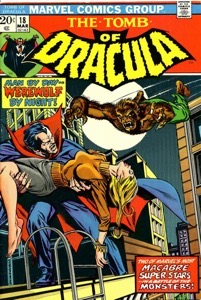
    This issue ought to be good. It’s Marv Wolfman writing, it’s Gene Colan, it’s Tom Palmer. Wolfman’s written Tomb; he’s written Werewolf by Night, so there shouldn’t be any problem doing a crossover. Except Wolfman’s amalgamation of Tomb and Werewolf doesn’t work. Colan and Palmer do a great job illustrating Jack Russell and his psychic girlfriend Topaz, but they do a lousy one with the werewolf. Maybe it medium long shots, but the face is terrible. It’s the first time Colan hasn’t been able to do something exquisitely.

    The story has Jack and Topaz investigating his family history in Transylvania, which at one point is described as a Romanian village, another time as a country. Unfortunately, the issue often feels like it didn’t get enough editorial passes, or maybe they were focusing on the wrong things, like shoehorning Dracula into Jack’s werewolf story.

    Because it’s a strange Werewolf by Night comic, not a Tomb of Dracula. Wolfman overwrites the scenes with Jack and Topaz, which doesn’t help them at all because Jack’s still a surfer bro. It’s more of a bad thing but written to be accessible for Tomb readers, so it’s all exposition dumps. Gorgeous Colan and Palmer art, lousy scenes. Over and over again.

    The Dracula stuff is limited and middling. Drac’s back in Transylvania because Quincy destroyed all his coffins in England; it’s Dracula’s first time back since he left in Tomb of Dracula #2. Except he’s only staying a night, and then it’s back to England. He literally went home for long enough for there to be a bunch of editor’s notes telling you to read Dracula Lives to understand paintings and exposition, but it’s all a retcon. It’s a little bold, a little too much, but also Wolfman and company emphasizing Tomb is different now than when it started.

    It’s a nice flex.

    When Dracula goes out for his evening snack, he sees Topaz and Wolfman Jack—they’ve just destroyed the inn, and Wolfman Jack’s killed a rapey sailor—and Dracula attacks Topaz. Then he’s surprised when the werewolf attacks him.

    The next time, Drac sees Topaz and Jack, then sees the werewolf and Jack gone, and is bewildered. He also can’t mind control the werewolf, which maybe is normal, maybe isn’t. Wolfman’s indecision hurts the already mildly grating crossover guest stars.

    There are some hints for next issue, post-crossover (after it finishes in Werewolf), and it’ll be nice to have the book back on track after this unnecessary detour.o

  • Frasier (1993) s07e09 – The Apparent Trap

    The Apparent Trap is another episode “Frasier” can only do because it’s been running seven seasons, and there’s lots of back story. Plus, guest star kid Trevor Einhorn has aged enough he can more fully participate in the episode. He’s not quite full supporting, but he’s closer than he’s ever been before. It’s a Lilith (Bebe Neuwirth) episode and a Thanksgiving episode (the second Neuwirth Thanksgiving episode), so there are the traditional John Mahoney can’t stand Neuwirth, and she weirds Jane Leeves out material.
    But it’s the first Neuwirth appearance she and David Hyde Pierce made the beasts with two backs last season, which means there is all sorts of new material for them to work through. And Kelsey Grammer, reacting to all of it. So Apparent has a lot going on before the A-plot finally reveals itself—Einhorn’s trying to get his parents back together. The title, obviously, lends itself to that story, though it also could’ve involved a previously unknown twin.

    Anyway.

    It’s a funny episode. The main plot’s not spectacular, but they’re able to get a lot of laughs from it. While Einhorn machinates, Neuwirth and Grammer are co-authoring an article (for The New York Times Magazine!) about single parenting when you’re rich, white, and smart. While the beginning of the episode focuses on Neuwirth as the regular cast’s cause for consternation, the second half almost plays like a backdoor pilot for a “Lilith” show. We get to see her as single parent, dealing with Einhorn’s day-to-day problems while (almost always offscreen weekends) weekend dad Grammer mainly just supports her. Despite Einhorn visiting Grammer (Neuwirth’s an unexpected guest), Grammer doesn’t spend much time with him.

    Instead, Einhorn’s got a good video game subplot with Hyde Pierce, then the standard boyishly lusting after Leeves (in knowing competition with Hyde Pierce).

    But the episode’s mostly Neuwirth’s. She gets a couple great showcases, which just make the opening animosity stuff with Mahoney a little tired after seven seasons.

    Grammer also directs the episode, showcasing how far he’s come; when he started, Grammer didn’t appear in the episodes he directed, and now he’s second lead. Though he’s the one giving Neuwirth the showcase. He’s good about sharing the show’s spotlight, especially when directing, even when he’s around.

    Leeves has only got a little bit—a funny monologue about unseen fiancé Donnie’s Thanksgiving is the highlight—while Peri Gilpin is only in the first scene, setting up Grammer’s plans, so there are some balance issues. Like Mahoney being missing for the beginning of Thanksgiving dinner like they don’t have enough chairs.

    The script credit goes to Dan O’Shannon, his first “Frasier” writing credit. The script does a good job of a traditional, annual, very special episode (Neuwirth or Einhorn guesting, a holiday). It’s an easy episode, but when it’s strong, it’s bending steel bars. Neuwirth’s superb.

  • Detective Comics (1937) #473

    Dc473

    Steve Englehart writes Bruce Wayne as a narcissistic asshole who bullies and psychologically abuses ward Dick Grayson. Grayson, for his part, has drunk the Kool-Aid; at one point, he talks about how mental illness is no excuse, and at another, he waxes on about Batman’s such a great man. It’s such weird, bad writing.

    Though Englehart does his version of a Bob Rozakis, “can you solve it,” and Englehart’s a complete prick about it. It’s not even a good mystery. It’s a boring one and a distraction. This issue has Batman and Robin going after the Penguin, who’s in town to rob some gallery. The Penguin’s giving them clues, which Robin’s overconfident about solving, and Batman gleefully berates him for his mistakes.

    There’s also Robin being creepy about Silver St. Cloud, who has a kiss-and-make-up scene with Bruce. She apologizes for investigating Bruce’s weird behavior, even though she’s the one who got the ball rolling on saving the day. The boys try to assuage her, but then it’s just kissy time. The scene might play better without Robin being a creep. Unfortunately, he’s a little creep multiple times in the issue.

    The issue opens with them just a moment too late to discover Hugo Strange is dead—and piece together who killed him since the thugs dumping the body work for Councilman Rupert Thorne. There’s lots this issue about the people of Gotham still liking Batman even though Thorne’s outlawed him. Robin agrees elected officials have no right to limit Batman’s vigilantism, so they’re going to buck the system and go on the Penguin hunt.

    The draw’s the art; Marshall Rogers and Terry Austin do a much more design-oriented book than the last couple. It’s all superhero stuff with Batman and Robin, no mood, no time for tone. It’s good art, sometimes beautifully designed, but rarely exciting.

    The pacing’s good, which helps. It only drags once Penguin’s silly caper is revealed. Until then, Englehart’s got a good momentum going.

    It’s just it’s momentum for a middling issue.

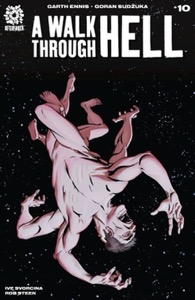
  • A Walk Through Hell (2018) #11

    Wtf11

    Goran Sudžuka made it until issue eleven to rush the art. Before, when he stopped putting effort into the inks, it was noticeable and unfortunate because Walk Through Hell lost its greatest asset. It wasn’t bad; it just lost the charm. Though, obviously, it’s not clear anything could’ve brought Walk “charm.”

    Anyway.

    This issue Sudžuka’s done putting in the work. He’s got to illustrate a cavern full of skeletons a couple times, then a room of snakes; he’s not putting the time into the figures or the faces. There’s a prologue flashing back to Agent Shaw’s dysfunctional childhood (which has zilch to do with the issue), and Sudžuka does an excellent job with it. Then the rest of the issue, with Shaw yelling at her iPhone in response to off-screen, now damned for all time McGregor’s text messages, is not excellent. Given writer Garth Ennis’s bewildering understanding of smartphone coverage in Hell, which includes text-to-speech and ghostly voice chat, it seems impossible anyone could’ve done well.

    And so, it’s a nothing issue, even more than the usual Walk nothing issues. Writer Garth Ennis is burning through twenty pages to make the twelve-issue limited series count. Nothing else. Nothing significant this issue happens outside some unnecessary explanation, and Ennis closing a red herring from a couple issues ago. Nothing’s necessary for the comic. It’s just more pages.

    No wonder Sudžuka didn’t want to put in the effort.

    There’s only one more issue of Walk Through Hell. The series is definitely worse than I thought it would be—so much for it being a World War I war comic, as I’d assumed for some reason, but I don’t know if it’s ending worse than its lowest point. I mean, it probably will. I’m predicting Ennis has got a couple twists before he’s done.

    I wonder how bad they’ll be.

  • Werewolf by Night (1972) #14

    Wbn14

    Marv Wolfman writes the h-e-double hockey sticks out of this issue. Unfortunately, it’s got a lousy ending as Wolfman gets stuck resolving Jack’s subplot with his step-father, Phillip, in a resolution seemingly intended to conclude the aged arc as quickly as possible. But there are some real highlights, including Jack’s moody romance narration for him and Topaz—who steal a passionate kiss before he heads to a showdown—but the best is the car chase.

    Out of nowhere, Wolfman and penciller Mike Ploog do this impromptu California mountain highway car chase. It’s awesome. Since it’s mostly in long shot, Frank Chiaramonte’s inks don’t do it too much disservice either. It’s a shame Chiaramonte seems to know to give expression to the werewolf and the bad guy, Taboo, but everyone else is relatively bland. It’s not the worst Ploog inking; it’s just not… well, it’s not good Ploog inking. It’s just not blithering incompetent.

    There’s a lot of plot to the issue, too, something most Werewolf writers have avoided. Wolfman resolves the cliffhanger with a fight scene, gets Jack and Topaz back to his place for some smooching, stern words from sister Lissa, and discovers step-dad Phillip’s been brain-transferred to Taboo’s monster.

    So Jack’s got to go back and defeat the monster, which should cure the step-dad. But, little does Jack know, the escape was all part of Taboo’s master plan, leading to some surprises in the second half. Maybe not the most consequential surprises, but Wolfman’s generating new, contained subplots, which is nice to see. Because he writes the heck out of it. Just superb work from Wolfman.

    I mean, the wrap-up’s a disappointment on a couple levels, and there are some very repetitive series elements—at one point, I was expecting Jack to get turned to stone again, just like in his second adventure—but it’s still an outstanding issue of Werewolf. The big subplot conclusion—going back to the first issue—is just too slight, too easy.

    Because they’ve got to get Jack and Topaz on a plane to catch a train so they can guest star in next month’s Tomb of Dracula, which should be interesting.

    I feel like there’s some other unresolved plot thread I’m forgetting but maybe not.

  • Kill or Be Killed (2016) #17

    Kbk17

    Does writer Ed Brubaker actually not see the possibilities he raises with scenes? It’s fascinating. For the second or third time, Brubaker’s started an issue completely invalidating a possibility the previous one raised. There’s an anecdote about a short story being a room in a house, a novel being a house. Maybe Gordon Lish (but probably not). Brubaker keeps staring out the window in Kill’s room without opening it. It’s restrained in all the worst ways.

    However, this issue’s the best in a while.

    Dylan speaking directly to the reader is… problematic, but at least Brubaker’s not prostrating himself trying to obscure the narration device. It’s a simple issue. Dylan’s going to off the rapey mental hospital orderly, who looks just like the rapey mental hospital orderly from Terminator 2. He’s got to figure out how to kill the guy and whether or not he wants to confirm the guy’s a creep.

    In the background, Dylan’s thinking about the copycat vigilante in New York and his roommate going to the cops (though Dylan can’t know the roommate’s going to the cops yet, which he awkwardly comments on). In some ways, Kill or Be Killed feels like Brubaker trying to take what he’s learned from doing pulp-influenced comics for fifteen years and apply them to a more traditional comic book character.

    If the series is a big creative swing from Brubaker, it doesn’t work out, which is too bad. Or it’s just a half-assed attempt at a comic in search of a movie or streaming deal, which makes more sense with the art. Artist Sean Phillips feels like he does not have time or care for Kill or Be Killed. Everyone this issue’s got big head issues; looking like Phillips taped the heads onto the bodies and didn’t take the time to get the scaling right.

    Seeing as how the comic’s finally a little more sturdy thanks to Brubaker not having to as constantly deceive the reader, who knows how the series would’ve played straight.

    But it’s nice for one of the issues not to be lousy. It’s been so, so long since I thought this book had even a minimal chance, and, at least now, it’s not going to finish as unpleasant as it could.

    Knock on wood.

  • Evil (2019) s03e06 – The Demon of Algorithms

    It seems like it’s been a while since “Evil” has done a “modern technology will ruin our lives” fear-mongering episode. Or maybe it’s just Algorithms fully integrates “Evil”’s streaming status (f-bombs galore) with the format, making it feel like the epitome of the sub-genre. This episode’s about TikTok and how it ruins everyone’s life. The episode accidentally raises the real concern TikTok’s format could have terrible consequences for someone suffering Munchausen by proxy but someone psychiatrist Katja Herbers doesn’t realize it.

    The episode starts with Herbers, Mike Colter, and Aasif Mandvi investigating a possession. The episode’s got two cases; teenager Malina Weissman’s live-streamed possession and single mom Lena Hall’s live-streamed house haunting. In between, Mandvi posts debunking videos, which bring him more hate than hearts, and Herbers and Colter also become addicted to the videos. Herbers watches drunk mom tips while Colter watches horny or marginalized priest confessions. The trio is constantly getting notifications to watch new videos, which raises some real questions about whether the “Evil” writers’ room knows how to silence notifications or if they just assume their viewers are too stupid to silence notifications. Neither option’s great.

    Especially since we’re supposed to believe Mandvi’s a genius.

    There are also some other yuck connotations once Colter gives up the TikTok for letting a demon suck on his soul. “Evil” always plays like the Catholic Church pays half the budget, but this episode also feels like the FCC is writing plot points. However, the TikTok stand-in is American (and intentionally ruining people’s lives), not Chinese. It’s also unrelated to Christine Lahti’s subplot about working for a literal demon at a tech start-up. It feels like the things should be more connected.

    Other than the Gen-Xers discovering TikTok, the main subplot is Herbers’s daughters outing Michael Emerson as a sixty-year-old man pretending to be a teenage boy on their Animal Crossing internet game. It ought to be a lot more fun, though it’s nice to see Emerson getting even limited comeuppance. Then the finale has a big, concerning reveal for another subplot.

    Decent direction from Peter Sollett keeps things moving, even though Hall’s bad as the haunted house mom and the script (credited to Patricia Ione Lloyd) condescends to the audience. It’s a strangely hacky episode. While it’s got the best use of cursing on the former network show, it feels most like a network burner episode. “Evil” can’t catch a break.

  • Dracula Lives (1973) #7

    Dl7

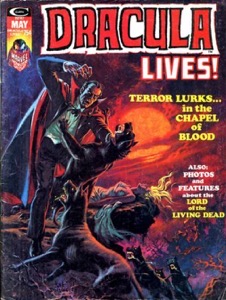
    I fear Dracula Lives has reached a turning point and not for the better. While this issue retains the same page count as previous issues, there’s a lot less content. Comics content. There’s still text content, including Tony Isabella finding his voice in his Taste the Blood of Dracula review, but there’s a little bit less of it. Lots more ads. No reprints, just the three original Dracula comics… including the Roy Thomas and Dick Giordano Bram Stoker adaptation. It’s a far cry from three fifties Atlas reprints, three originals.

    And the art’s not great. The art’s usually pretty good, but it’s never great. Giordano’s is the best and even he’s clearly rushed, slowing down when he can but he’s never not visibly in a hurry. There are some good panels; they’ve reached the point in the novel where Jonathan Harker runs afoul of Dracula’s brides. It’s good work from Thomas and Giordano.

    Though they include two pages from the previous issue’s entry at the start, which isn’t the worst idea for reminding readers, but with this specific cliffhanger, doesn’t work.

    Still. At least there’s the Thomas and Giordano entry. Because otherwise, the high point’s Isabella’s review.

    The first story is the most disappointing because it seems like writer Gerry Conway’s excited at the beginning. It’s Dracula in Washington D.C., getting involved in political intrigue. Or at least politics-adjacent intrigue. A bunch of people are getting killed in mysterious ways and Drac’s invested because one of them is a Dracula stooge.

    Vicente Alcazar’s art is okay. Lives’s turning point includes not getting inkers, so Alcazar’s looks like high contrast pencils. Lots of work in the pencils, but still… it feels unfinished. It also can’t save from Conway not having a plot. Turns out Dracula playing Woodward and Bernstein with a disposal guest star doesn’t the Parallax View make.

    The second original’s worse but not more disappointing. Dracula versus pirates only seemed so interesting to begin with. At twelve pages, it’s also the longest story in the issue, which is strange. Just what a boring story needs, two more pages.

    The script’s from Mike Friedrich, who does an okay pirate story. Shoehorning Dracula in doesn’t do any good, especially not since Friedrich doesn’t write Dracula well. Or, at least, he doesn’t have a handle on Dracula Lives Dracula. If it were a pirate story about raiding Dracula’s castle (traveling across land to do it) and Dracula guest starred, it’d be fine. But Friedrich opens with a retcon involving Dracula’s dead human wife’s necklace, tying it to Lives’s Dracula origin stories. They’re usually so much better.

    George Evans does the art. It’s competent, never anything more. In a good issue, this misfire would be the lacking outlier. In this issue, it’s way too close to the norm. It’s also misogynist, which just makes it more unpleasant as it goes on too long.

    Throw in another chapter of the Dracula text story (written by Thompson O'Rourke, illustrations by Ernie Chan), a recap of Dracula in other media, and the issue’s done.

    I hope it gets better next time. But I’m scared it won’t.

  • Weekend at Bernie’s II (1993, Robert Klane)

    Suppose one makes it to the third act of Weekend at Bernie’s II, which is not a suggestion or recommendation to undertake such a burden. In that case, one will see some bewilderingly competent underwater photography. Including what appears to be Terry Kiser doing takes without any oxygen nearby. Maybe it’s Kiser, maybe it’s not. He already deserved an Oscar nomination for his physical performance in Bernie’s II; if he actually did the underwater stuff, it’s just more apparent he was robbed. Tommy Lee Jones should’ve called him up to the stage and handed over the statue.

    Kiser gets a lot to do this movie because he’s a voodoo zombie. See, something something criminal conspiracy, it turns out Kiser was in league with some voodooed-up mobsters. It’s unclear if Novella Nelson’s voodoo priestess runs the mob or what, but she’s certainly in charge of getting Kiser’s money back. So she sends Tom Wright and Steve James to resurrect Kiser in the New York City morgue; the spell will have him leading Wright and James to the money, which they’ll then bring to Nelson.

    Wright and James are actors playing a comedy routine. A lousy comedy routine, poorly directed, and entirely composed of Black media stereotypes (Wright and James are Black men). It’s sometimes a lot, sometimes quite terrible, sometimes actually impressive. Wright and James are atrocious at the physical comedy, but their dance sequence is good work. Technically. There’s not a lot of good work in Bernie’s II, so it stands out. Their dancing, the underwater photography, the rest is pretty terrible. Except Kiser.

    But Wright and James are just one set of comedy duos in the film. Bernie’s II recasts returning leads Andrew McCarthy and Jonathan Silverman as a comedy team. McCarthy’s the obnoxious dumb one (with what I think McCarthy thinks is a New Yorker accent); Silverman’s the cautious, sweet, probably Jewish one. In this sequel, both actors literally repeat the performance from last time, just mixed up. They even have McCarthy repeat his lines like they were pop culture catchphrases. It’s terrible. And while it’s embarrassing to watch McCarthy humiliate himself for what cannot have been worth it pay-wise, he’s also never sympathetic. You feel bad for Silverman, you feel bad for Kiser, you feel bad for Troy Byer (as the not love interest love interest), for Wright, James, Nelson—even Barry Bostwick. But you never feel bad for McCarthy because you’re watching his complicity.

    Byer’s a resort employee who makes the mistake of going out with McCarthy, which embroils her in the plot later on because she’s the only islander they know. Bostwick’s the insurance company investigator who follows McCarthy and Silverman down to St. Thomas. I assume they got a tax break to shoot in St. Thomas, who mustn’t have realized Weekend at Bernie’s II wasn’t going to do them much good tourism-wise.

    See, McCarthy and Silverman want into Kiser’s safety deposit box, so they’re going to steal his body and Bernie’s him into the bank. It might be too macabre if it weren’t such an insipid film.

    Anyway.

    There’s nothing good about it (except Kiser, the underwater sequence, and the one dancing scene). Klane’s direction is much better than his script and still godawful. Bernie’s II leans in heavy to misogyny and racial stereotyping but then doesn’t even do anything once it’s there. There’s no joke, just a shitty setup. Klane’s not edgy; he’s just desperate.

    It’s a terrible movie. And long. So long.

  • All Rise (2019) s03e06 – I’ll Be There

    “All Rise” has a history of ingloriously dumping unsuccessful subplots—I think Simone Missick running for state senate or whatever in season one warranted in-show commentary they dropped it so fast—but this new one, where Missick’s got the hots for law school ex Sean Blakemore, is something else. Maybe because the show’s on streaming now and has ten episodes instead of twenty, maybe because they didn’t test Blakemore and Missick enough, but it’s a bland disaster. It’s not terrible; Missick has the chops to act her way through it, but it’s a profound nothing-burger.

    The episode opens with Missick having a From Here to Eternity dream about Blakemore, interrupted by a crying baby and a messy husband (Christian Keyes). Missick’s dilemma this episode is whether to have lunch with Blakemore, who’s probably moving to L.A., actually; something Missick (and the audience) find out from Wilson Bethel. Bethel’s got almost nothing to do in this episode. His most important contribution is standing around. Literally. It’s a Missick and Jessica Camacho episode; since Bethel’s not in court with them, he’s benched. The show’s got so many characters. So, so many.

    Anyway.

    Camacho’s representing falsely convicted John Marshall Jones (who’s so exceptionally solid he ought to guest star on everything). He’s been in prison twenty years for a crime he didn’t commit. An off-screen friend is coming forward with new testimony, and Camacho’s trying to get a new hearing. Marg Helgenberger—I was shocked to see she really came back—is the appeals judge, which means she gets some scenes with Missick later. Helgenberger grants a hearing, so there’s an episode and Camacho’s up against assistant DA Suzanne Cryer.

    Cryer’s been on the show for ages, and it’s possibly her best episode. She’s had to build this character between guest spots, always playing the bad guy, and she finally gets some character development. It’s nice.

    The trial plot is a fairly straightforward legal procedural. Camacho will find out things about her client, the witnesses, and the case. Since it’s an old case, everything will come through in exposition. Outside some early stumbling, it’s all solid. It helps Jones is great; it helps Missick’s sympathetic to his case but also under scrutiny from new Chief Justice Roger Guenveur Smith (who’s back to being weird and bad), though the wrap-up with Camacho is a little forced. The show’s keeping Camacho treading water, character-wise, like if it gets renewed, she won’t be back.

    The subplot—outside Missick’s home life one—is Lindsey Gort and Samantha Marie Ware (back for the first time since the season premiere) and a contested will. As TV lawyer show cases go, it’s middling, but it does give Gort and Ware something different to do; it works out. Though the show entirely avoids whatever’s up with Ware since she failed the bar.

    “All Rise” keeps on chugging. Unfortunately, the show’s ill-suited for a ten-episode season, so we’ll see how they wrap it up (they’re in the back half now), but hopefully, they figure it out.

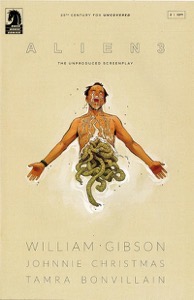
  • William Gibson’s Alien 3 (2018) #3

    A33

    It’s old home week this issue; not only do Newt and Hicks have (relatively) big scenes this issue, but Bishop is also back in one piece. All of a sudden, it feels more like a sequel to Aliens, but only slightly. This Alien 3 hasn’t got any time for a kid, so Newt’s got to get gone. Adapter Johnnie Christmas has a wonderful sense of how to handle the scenes he can’t actually convey—in a movie, Carrie Henn and Michael Biehn saying farewell would have some timing, some just right music cues to refer back to their adventures in the previous film.

    Christmas barely has time for them in the adaptation, and he can’t do music cues. So instead, he just plays it like an old comic book movie adaptation. He’s got the moment, but the filmic context is gone, and it’s just awkward but earnest. He gets credit for the trying, not the succeeding.

    Both the Company and the future Soviets are experimenting on the alien eggs they’ve got. The future Soviets—the U.P.P., yeah, you know me—are working on an alien embryo; the Company scientists are just growing tiny versions of the alien eggs. When there’s the inevitable containment problem, it’s entirely unclear what happens. Christmas’s art has a lot more personality than it needs for a traditional comic adaptation. It’s pretty good art.

    But Christmas isn’t good at the action layouts. They’re confusing. With personality.

    The issue ends with the station staff getting together and telling Hicks about the bad Company weapons division people. Next issue it’ll be important. This issue was about getting the supporting cast arranged and bringing an alien into Alien 3.

    I’m not sure how Christmas will wrap this one up in time. He’s only got two more issues, and he’s barely into the second act. More movie adaptation tricks, no doubt, but it’s still bizarre to have Sigourney Weaver sleep through Alien 3. Even if it’s on purpose, it seems like it’s not.

  • Jurassic World Dominion (2022, Colin Trevorrow)

    It’s not hard to pinpoint what’s wrong with Jurassic World Dominion, the inglorious (hopefully) end of a twenty-nine-year-old franchise. Director Trevorrow does a bad job directing, he and co-writer Emily Carmichael do a bottom-of-the-barrel job with the script, the actors all seem contractually bound and miserable (even the new additions, with one exception), and Michael Giacchino’s musical score is so terrible they should’ve stopped payment on the check. Otherwise, Dominion would be fine. Just needs a better director, an entirely different story and script, and—I don’t know—the music from the original Jurassic Park SEGA Genesis game instead of Giacchino.

    The film opens with a news break, which Trevorrow and Carmichael are incapable of writing. Dominion’s what happens when blockbusters don’t even need to hire script doctors so they don’t embarrass themselves. Trevorrow’s only positive quality is his dogged determination in not letting each horrifyingly embarrassing moment of film slow him from reaching the next. Dominion’s third act is nowhere near as bad as it could be, but the first and second acts—all two endless hours of them—are crashing behind it and the debris distracts from the film at least not getting any worse. Except for Giacchino’s music. Giacchino’s music always gets worse, right into the credits.

    Jasmine Chiu plays the newscaster. She wouldn’t be believable as a TikToker on “CSI: Sheboygan,” so introducing twenty-nine years of cloned dinosaur backstory is out of the question. Especially since her news report also sets up this movie’s villain—and the only person who seems like he’s having a good time—Campbell Scott. Scott’s playing a character from the first Jurassic Park, but the part’s recast (for good reasons). Now, Scott’s got a lousy part. He’s playing the not-so-smart head of a genetics company; they’re using prehistoric DNA to cure diseases and create monster bugs. The monster bugs are important. If Trevorrow were any good, there’d be a great Godzilla 1985 reference. But he’s not any good. Instead of an on-point Godzilla bug reference, there are desperate Indiana Jones, Star Wars, and Jaws references like Trevorrow’s still sucking up to executive producer Steven Spielberg.

    But Trevorrow directs Scott like he’s doing an incompetent, megalomaniac hipster Steve Jobs. It’s a string of terrible decisions and Scott’s willingness to commit to the bit and somehow get through. He’s never good; it’s impossible, with Carmichael and Trevorrow’s lousy script, for anyone to actually be good, but he’s never boring, bored, or defeated.

    Everyone else goes through those emotions, though no one more despondently than Chris Pratt. He’s fifth fiddle in his own franchise, but he doesn’t even care. He’s got one good scene, and it’s from Congo. The rest of the time, he looks like he’s trying to disappear, similar to Bryce Dallas Howard.

    Laura Dern and Sam Neill work pretty hard to make their parts work. Either Trevorrow didn’t direct them, or he told them to play their characters exactly the same as they did thirty years ago, only Neill doesn’t have the same American accent anymore. It’s a better accent, but it’s a different one. They get some genuinely terrible dialogue but get through all right.

    Also back is Jeff Goldblum, who doesn’t get very much to do, even when he’s around. The second half of the movie is about putting the Jurassic World characters together with the Jurassic Park characters to they can fight the Thanosaurus at the end. Goldblum’s around, but it’s like Trevorrow and Carmichael are scared to write him. Goldblum seems ready to work but never gets asked to do any.

    Isabella Sermon plays a cloned human who’s supposedly important to the monster bug plot. It’s all nonsense. Sermon’s fine, but fine in the way you’re being nice about a middling child actor. She was in the last movie.

    Then BD Wong’s back, of course. He’s shockingly good in a silly role.

    New characters this movie—besides Campbell (sort of)—are pilot DeWanda Wise and lackey Mamoudou Athie. The film would be an excellent showcase for both actors if Trevorrow weren’t terrible. But, instead, he flops with both. More with Wise because she’s got more to do—she and Pratt are chemistry-free action buddies. Athie’s just around for various exposition dumps and plot contrivances, but he’s not bad doing them.

    Technically, Dominion’s fine. Good CGI. Good photography from John Schwartzman. Not good editing from Mark Sanger, but he’s working from Trevorrow’s footage, set to Giacchino’s music. There’s no way to edit Dominion into a good movie with those quality sinkholes.

    Despite teaming up two generations of Jurassic adventurers, Dominion’s a bad, boring, anti-trip down memory lane. Even when Trevorrow’s aping old Park moments, they’re just so desperate they don’t get the nostalgia going; instead, they just further embarrass this entry.

    All set to Giacchino’s godawful music, of course.

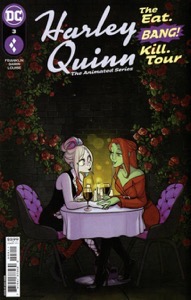
  • Harley Quinn: The Animated Series: The Eat. Bang! Kill. Tour (2021) #3

    Hq3

    I’m not sure last issue’s protracted Catwoman cameo really put Eat. Bang! Kill. off-track as much as behind, but this issue more than makes up for it. Nightwing’s constant butt shots alone get the series back its goodwill.

    Harley and Ivy are in Blüdhaven for a date night. It started with a rest stop, which led to the cops (and Nightwing) getting called, which led to a stand-off with Gordon. Harley tells the story, partially in dialogue, partially through flashbacks. Oh, Hush has interrupted their date night. He’s taken a liking to Harley and decided to try his Bruce Wayne moves on the ladies.

    It’s silly but not benign, retaining the cartoony but never losing the danger. Writer Tee Franklin moves things away from Ivy’s perspective, giving everyone at least one narration block (hence knowing Hush’s plans for the evening), and it works better. Harley and Ivy still get to be the leads, but the guest stars get to participate in the fun.

    Nightwing–making his first appearance in the Harley Quinn: The Animated Series universe—seems like he’ll be a lot of fun if the characterization holds.

    Outside Ivy and Harley occasionally making sweet talk–Ivy’s still in a bad mood from her spoiled wedding and so on—most of the comic’s action, comedy, or a combination of both. But Franklin and artist Max Sarin bring a nice romantic comedy vibe to the project. It’s still not quite a “road movie,” just because they keep stopping in major settings for action sequences, but Franklin and Sarin don’t necessarily need to fit a genre.

    Especially not when Sarin’s glorious gluts on Nightwing and Franklin’s sincere attention to Harley and Ivy as a couple.

    The book’s working out.

  • Superboy and the Legion of Super-Heroes (1977) #249

    Slsh249

    The back-up, starring Chameleon Boy, is nine pages, only a page shorter than the feature, which resolves last issue’s shit monster story. Sort of resolves. Also, the shit monster looks leafier this issue, presumably thanks to Jack Abel’s inks (it’s like they’re fighting Oscar the Grouches). Even if the feature weren’t so slight, the back-up would stand out because it contains the most surprising thing I’ve seen in Superboy and the Legion. My world is shook.

    Joe Staton inking himself is… not bad.

    It’s not great. He does have trouble with faces, but at least when he’s inking himself, he understands how they work. And his figures aren’t as… I’m trying to pick between gelatinous, wobbly, flimsy, and wonky. Comparing the art in the feature with Abel inking Staton to Staton inking himself, it’s hard to believe they’re the same penciller. It raises several questions, but mostly why they would have Staton ink himself on the nine-page back-up to greater success than on the ten-page feature. Is it too much to ask for better art to be on the feature?

    Gerry Conway scripts the feature; he also wrote last issue, which I didn’t remember. It feels very fill in.

    The shit monster is attacking the Legion headquarters, kicking Sun Boy’s butt. Brainiac 5 is able to stop the monster, all while whining about how no one appreciates him for always being the smartest and bestest Legionnaire. There’s a little bit with Mon-El and his comatose girlfriend, Shadow Lass. He’s refusing to help the Legion, even though Brainiac has figured out Shadow Lass will be fine.

    Though I don’t think Brainiac actually tells Mon-El his discoveries.

    Another team of Legionaries headed to the sewer; the shit monster kidnapped their financier, R.J. Brande, and they figure the sewer’s the place to be. That subplot actually goes unresolved, presumably for follow-up next issue, but the Legionaries seemingly forget they’re looking for Brande in the sewer. Even after they discover the secret behind the shit monster, it’s all about Brainiac 5 feeling unappreciated, not their bankroller being missing.

    And bankrupt, but they don’t know he’s bankrupt yet; maybe next issue.

    Even if the art weren’t terrible, it’d be a too slight story.

    The back-up is a simple mystery for Chameleon Boy. Some disgruntled employee is terrorizing his place of employment—the Science Police station—and Chameleon Boy’s got to figure it out. Throw in a fetching alien lady and a lot of exposition, and it’s somehow nine pages. Paul Kupperberg scripts; I think it’s his best Legion work I’ve seen so far, but he’s got the added benefit of each competent panel from Staton bewildering more than the mystery ever could. It’s a reasonably pat mystery, actually. It’s unclear why the Science Police couldn’t figure very obvious things out themselves.

    The art’s far from a total success, but Staton shows previously unrevealed design chops. It’s a Silver Age story with a decidedly Bronze Age feel, which has its charms.

    Who knew Staton inking himself would save the issue?

  • The Orville (2017) s03e07 – From Unknown Graves

    I’m not sure if this episode’s the best “Orville” of the season, but it’s definitely the best constructed. The script—credit to David A. Goodman, who’s written “Orville” in previous seasons; this episode’s his first “New Horizons”—is magnificent in every respect. There are four perfectly balanced plots. First, the Orville is on a diplomatic mission to a matriarchal society, so captain Seth MacFarlane and first officer Adrianne Palicki cook up a scheme to appear more palatable to the potential allies. The female crew will assume all the leadership and command roles; the male crew will be red shirts with no responsibility. At least when the diplomats are present.

    Except that main plot comes after the episode’s cold open—a suburban alien family getting their first home robot… a Kaylon. The family’s experiences with the Kaylon “assistant” will pop up throughout the episode, tying into the second main plot—MacFarlane discovers a scientist (Eliza Taylor) who has reprogrammed a Kaylon to feel emotions. They come on board the Orville so MacFarlane can report the development to Starfleet Command. Or Union Central. Whatever.

    Christopher Larkin plays the emotive Kaylon, who is full of regret about his species trying to irradiate all the humans and their other biological friends. Larkin will be a touchstone for various ongoing, Kaylon-related plot lines; specifically, Penny Johnson Jerald and reformed but still unemotional Kaylon Mark Jackson’s romance, and then Anne Winters hating all Kaylons for killing her best friend (and all those other people). I can’t believe what Goodman and MacFarlane (who directs) achieve with those resolutions. They have percolated since the season premiere, with Winters’s hatred of Jackson creating palpable tension through many of her scenes on the show overall. The episode works through all of it, slowly, deliberately, carefully. MacFarlane gives all the actors time to process; sometimes, it seems like he’s being slow instead of patient, but then every time the actor delivers on the moment, and it’s exceptional.

    I don’t know if it’s the best episode—there’s another big contender—but it’s definitely the best use of “The Orville”’s new format for streaming. Seventy-ish minute episodes, but still with commercial breaks; the commercial breaks here work beautifully to relieve tension or adjust narrative perspectives. It’s an outstanding episode, start to finish.

    The final subplot involves J. Lee and Jessica Szohr’s burgeoning romance, which the show’s been building up for a while. It’s played mostly for laughs, fully utilizing Szhor’s deadpanning abilities and Lee’s incredible likability. It’s a lot of fun in an otherwise mostly serious episode.

    John Debney’s score stands out this episode, and not only because it often sounds like he’s doing a Star Wars riff (so much so I thought it was Joel McNeely, who’s also composed Star Wars stuff). The score provides a lot of support for the action; MacFarlane, as director, leans on it just right.

    Great acting from Jerald and some terrific turns from Palicki, Jackson, and Winters. MacFarlane gets a little more to do than usual in support of Palicki; they have some excellent character relationship moments.

    The ending takes sentimentality by the arm, dances a steamy tango, then leaves it behind on the way to more profound, sincere emotion. It’s a spectacular episode.

  • Whose Life Is It Anyway? (1981, John Badham)

    Director Badham intended Whose Life Is It Anyway? to be black and white, which would probably help with the staginess. It’s a play adaptation. Badham handles the relatively big, busy cast well, but he doesn’t know how to shoot lead Richard Dreyfuss. Dreyfuss is playing a recently paralyzed sculptor who, after approximately six months, realizes he’s not going to get better and doesn’t want to go on. On stage, the physicality of Dreyfuss’s performance matters. On film, it doesn’t. Or, at least, Badham doesn’t figure out how to make it matter. Especially not in he and cinematographer Mario Tosi’s wide Panavision frame.

    Dreyfuss is good in the lead but nowhere near singular or even exceptional. His character development is defined by monologues, which refer back to scenes we’ve seen and add peculiar, narratively contrived context. He does get a good lengthy monologue during his mental health competency hearing, but it’s table stakes for the film. If there’s a courtroom scene, you expect the lead to get a good monologue. But it’s earnest enough. Badham really does try; he just can’t bring any nuance to the film.

    He gets universally solid performances out of the supporting cast. There’s hospital administrator John Cassavettes (who’s arguably got the least depth), doctor Christine Lahti, lawyer Bob Balaban, hospital orderly and reggae punk rocker Thomas Carter, and then a series of nurses. Kaki Hunter plays the main one; the film opens with Dreyfuss’s accident. He’s an accomplished Boston sculptor who’s just installed a waterfront installation, then he gets in a terrible wreck. After the ER scene—look fast for Lyman Ward (and Jeffrey Combs later)—time skips ahead to Hunter’s first day, where she meets charming, irascible Dreyfuss.

    While the film always accounts for Hunter’s experience of the events, she’s barely a character. She’s the object of Carter’s affections after a certain point and little more. Not Hunter’s fault, but rather the script’s. Even Badham knows to give her extra attention just to maintain a rhythm.

    Janet Eilber plays Dreyfuss’s dancer girlfriend. They used to spend days at his studio with her dancing, possibly in the nude, probably not through dry ice fog, because there’s a black and white dream sequence. The one black and white sequence they let Badham do, and he wastes it early on in the picture; Dreyfuss has refused valium, so Cassavettes gives it to him anyway. He dreams about the past. A black and white dream sequence in the middle of a color melodrama, it’s an unsuccessful but not unambitious piece. If the whole thing were black and white, who knows.

    Even if the film were in its intended color palette, there’d still be Arthur B. Rubinstein’s music. Rubinstein does a somewhat jazzy, upbeat score, which clashes and brings energy from those clashes. It’s just maybe not the right energy. They probably would’ve done better with no music, especially since Badham occasionally emphasizes the sound of the machines keeping Dreyfuss alive… but only occasionally. The machine noise would be omnipresent.

    Back to Eilber. She gives the film’s worst performance when adjusted for importance. If she were better, another who knows.

    Lathi’s good in a just okay part. She gets a lot to do in the second act, but it doesn’t go anywhere. But she tries. Eilber tries too, which helps. Badham makes sure everyone’s appropriately serious. And appropriately comical when Dreyfuss’s bad jokes break the tension.

    Whose Life Is It Anyway? is stage adaptation Oscar-bait melodrama, but not bad stage adaptation Oscar-bait melodrama. It’s thoroughly competent; while Badham can’t crack the important adaptation stuff, he does a fine job with the day-to-day hospital and tracking its staff. It looks gorgeous thanks to Tosi’s soft lighting. Nice cuts from Frank Morriss. Rubinstein’s score is amiable. The cast works hard.

    It’s perfectly acceptable and never anything more.

  • Ms. Marvel (2022) s01e06 – No Normal

    “Ms. Marvel” wraps up with its inevitable MCU third act finish, with Iman Vellani teaming up with her friends to save Rish Shah from the racist Damage Control agent (Alysia Reiner, who seems strangely unconcerned with the type-casting). Reiner starts the episode explaining it’s not just brown people she doesn’t like; it’s teenage brown people especially. She escalates from trying to take the teens down with non-lethal rounds to just shooting her service pistol at them. In front of the neighborhood. “Ms. Marvel” ends with a superhero with public support sequence.

    Obviously, coming after Vellani’s trip to Pakistan with mom Zenobia Shroff to visit her grandma (who sadly doesn’t appear this episode) and find out her superhero origin, this episode’s a letdown. Shroff’s gone immediately from an over-concerned, controlling parent to the proud mom of a superhero. There’s a brief scene getting dad Mohan Kapur on board, with brother Saagar Shaikh amusingly whining in the background. But they needed another episode. Especially once the high school action sequence starts, Vellani and best guy friend Matt Lintz figure out the science, while everyone else runs around to confuse the federal agents. Who are shooting pulse rifles at the teenagers. They’re the non-lethal weapons, but they take out chunks of concrete.

    “Ms. Marvel”’s message is very much, “The U.S. government will kill your white kids if they have Muslim friends.” They’re not wrong, obviously; it’s just a lot for a Disney show. And it doesn’t get addressed in the epilogues. There’s no accountability for Reiner. It’s a little too realistic.

    Shah’s got the biggest arc in the episode; he doesn’t know his mom is dead, doesn’t know she’s zapped him full of energy, so he’s almost as powerful as Vellani. It too could’ve been a couple episodes. Like I said before, the biggest disappointment of “Ms. Marvel” is it not being a real show, instead a (very) extended cut of a feature film.

    Vellani gets some excellent superhero origin moments, with Kapur and Shroff helping out at different times, which is really nice. Laurel Marsden returns, entirely shoehorned, for the high school action conclusion. Yasmeen Fletcher has a little bit more to do, but she and Vellani’s friendship repairs incredibly conveniently so as not to give the episode any subplots or character development. It’s a rush job for everyone. Particularly Lintz, who’s second-billed on “Ms. Marvel” but hasn’t made any significant contributions since the first couple of episodes.

    Though he does get to drop an MCU-relevant reveal on Vellani. It’s a cute moment, but it’s there to avoid any resolution to their relationship. Vellani still doesn’t know Lintz’s mad-crushing on her. Maybe in the movie.

    Adil El Arbi and Bilall Fallah are back directing. They do an adequate job. However, while they handle some of the action better than the other series directors, they don’t handle the characters better.

    The credits scene setup for Vellani’s big screen adventure, The Marvels, is decent. It’s going to be a long year waiting for “Ms. Marvel” to return.

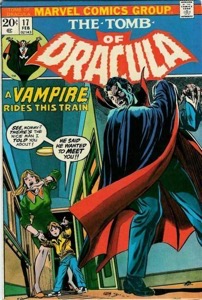
  • Tomb of Dracula (1972) #17

    Tof17

    This issue isn’t my favorite Tomb of Dracula (though I’m not keeping track), but I think it’s the most impressively written one so far. Writer Marv Wolfman does an espionage on a train thriller, just with Dracula and his supporting cast. And tying into the big Doctor Sun subplot he’s been working on for five or six issues at least. So Wolfman’s finally answering some of those questions, albeit guardedly, and the pay-off comes in this exceptional done-in-one.

    Wolfman’s got a three-act structure for the issue, which is always impressive to see in twenty pages of story, with the plot taking full advantage of Dracula’s increased range of mobility. The issue starts in Paris, with Dracula trying to find a coffin for the night, only for Blade to attack him and reveal they’ve been cleaning out Drac’s Parisian stashes.

    There’s a fight with Blade, then there’s Dracula getting to a safe place, with Wolfman changing the perspective and sticking with this French farming couple. The husband’s been Dracula’s brainwashed lackey for thirty years. It’s a great mix of text exposition and brief, suggestive art. There aren’t any particularly big set pieces for artists Gene Colan and Tom Palmer this issue; instead, they’re just doing this tense, impatient story.

    See, Dracula’s going back to Transylvania. No explanation why. He doesn’t deign to reveal.

    So he’s taking a train home. On the train are Frank Drake and Rachel Van Helsing, whose characters have been reduced to a vampire-hunting couple; while Frank doesn’t have the chance to be racist, he does tell Dracula they’re after him for scarring Rachel. Yes, sure, killing their pal Edith, but also the scarring was just as bad. It’s a very Frank Drake moment, and it’s hard to root for this asswipe.

    But also on the train are a couple secretive guys with a briefcase who are convinced someone’s out to get them. The bruiser sidekick is convinced it’s Frank and Rachel; the other guy’s convinced it’s someone else. But we don’t get to see the someone else. Because suspense.

    And it’s very effective suspense. It’s just not horror suspense, except maybe when Dracula goes out looking for a snack and can’t control his urges. Wolfman shows how genre doesn’t apply to Tomb of Dracula, not with such capable artists and such a strong protagonist. Dracula’s such a good lead.

    So, yeah, maybe it is my favorite issue so far.

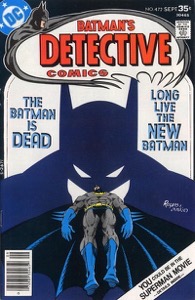
  • Detective Comics (1937) #472

    Dc472

    I’ve the sneaking suspicion last issue, when the evil nurse commented on Hugo Strange and Batman complementing each other’s physical and mental prowess when they should be fighting, it wasn’t writer Steve Englehart acknowledging the absurdity of the machismo; it was him making fun of the silly woman for not getting it.

    There’s a scene with Robin, and he’s a little fascist, muscles bulging and breaking his uniform to leave him with a heck of a V-neck. Throw in the ending, which has a character ruminating on the pure machismo of Batman… I think Englehart’s on the level with this nonsense.

    Bummer. It’d be nice for the story to have some black comedy.

    That not inconsiderable observation made, it’s a reasonably good issue. There are some genuinely great moments thanks to Marshall Rogers’s pencils, Terry Austin’s inks, and Jerry Serpe’s colors. Not great Batman moments—for reasons—just great comic booking. Silver St. Cloud is a thunderstorm, for example. It’s five panels; four vertical rectangles (two of them skinny) and one horizontal. She’s mad at Bruce Wayne for breaking up with her, so she decides to go to the private hospital where he was being treated. It’s just a beautifully visualized sequence.

    There are a few of them throughout the comic. Makes up for some of the shortcomings.

    Hugo Strange has assumed Bruce Wayne’s two identities; he’s Batman now, too (something the cover makes a lot of noise about but has zip to do with the comic); Alfred’s imprisoned with an unconscious Bruce Wayne; Silver’s gotten dumped by an imposter; that imposter is set on bankrupting Wayne Enterprises and selling Bruce’s secret identity to the highest bidder. There are three bidders—corrupt politician Rupert Thorne, the Penguin, and the Joker.

    One of them will skip the auction and attack Strange, even if he’s traveling with his monster men. Rogers and Austin do a great job with Strange and the monster men. Just something about the designs and how they fit in the panels; they look great. Rogers does well with those layouts—they’re a gangster movie homage. When it comes to acrobatic Robin action? Not so good. Rushed and not so good. The issue turns it around because Rogers can handle the finale. His sense of design works for the overwrought, dramatic finish, but he can’t do simple fisticuffs.

    There aren’t really any story highlights—though, depending on next issue, the plot might be quirky. It’s too soon to tell here. Maybe Englehart’s got some ideas; maybe he doesn’t. He needs to follow through. This issue is a delay but also an often gorgeously illustrated one.

    I’m not as enthusiastic a fan of this run as I used to be, but it’s got some definite pluses.

  • A Walk Through Hell (2018) #10

    Wth10

    I’m not sure this issue takes more than five minutes to read—there’s a lot of dialogue to pad it out—and, at this point in A Walk Through Hell, it’s fine. The shorter the read, the better.

    It’s a flashback issue to FBI agent McGregor’s high school years and something terrible. But the something terrible isn’t the point; instead, it’s the follow-up to the something terrible, so another flashback to some years later. It’s an authentic look at futility and man’s inhumanity to man, but it’s also utterly pointless.

    As Shaw watches this flashback unfold—it’s unclear how she’s experiencing the flashback, though McGregor is changing shape and age in front of her—she pleads with Patton Oswalt John Doe to make it stop. He keeps telling her he’s not in control of people being shitty to one another.

    The flashback’s maybe unpredictable for people who haven’t ever watched a TV show, movie, or read a story about straight people being shitty to gay people. But it’s relatively standard—going back to the eighties at this point—and writer Garth Ennis doesn’t bring anything new to it. The flashback doesn’t inform McGregor at all, though Shaw defending him is… I don’t think it rises to interesting, but it’s something. Though it’s something Ennis uses to fill out another forty-five seconds of read time.

    Goran Sudžuka’s art is smoother than usual, even with the thinner lines. He’s gotten a handle on it, even as the series has meandered in circles.

    Of course, there is no resolution to last issue’s cliffhanger, but I’m guessing Ennis will do another big surprise reveal cliffhanger at the end of next issue, only to reveal it’s not really what’s up in the final issue.

    I don’t think A Walk Through Hell was supposed to refer to reading the comic, but it comes close. While not a complete failure, it’s a waste of time and expense, just not incompetent.

  • Werewolf by Night (1972) #13

    Wbn13

    Has Frank Chiaramonte gotten better at inking Mike Ploog, or am I just so happy to see Ploog pencils, I’ll take whatever I get, inking-wise. The inks cut into some of the pencil’s roundness, making people more angular—Phillip Russell in particular. But the werewolf’s still nice and Ploog-y, plus there are plenty of great page layouts. Ploog’s flexing on the composition.

    The story involves Jack again getting captured and held prisoner by someone out to get his werewolf magic (or something related). His captor, once again, has a comely female accomplice who gets sympathetic to Jack, putting herself in danger. And then there’s a monster guy to fight.

    With minor adjustments, it’s the same story Werewolf by Night has been doing since the second or third issue. The bad guy—Taboo, an Indian mystic—is even after the Darkhold, which one of the first villains was after, though it got ingloriously destroyed ten issues ago. His pretty lady sidekick is Topaz. She’s the one with the real power; Taboo wants her to use her powers to soul-suck Wolfman Jack and put it into Taboo’s sickly son. Taboo was going to heal his son with the Darkhold twenty years ago, but Jack’s real father stole the book from him.

    Or stole it back from him. Jack’s father’s history is very muddled.

    Further complicating matters is Jack’s step-father, Phillip Russell, also being one of Taboo’s prisoners. Turns out Taboo hired the Committee to harass Russell on his behalf, all so Taboo could get the Darkhold. Werewolf by Night’s plotting appears to be determined by dice roll and bingo card.

    Marv Wolfman’s scripting again. Instead of trying to unravel all the outstanding subplots and make sense of them, he’s bundling them together—the mysterious Committee being reduced to a proxy for Taboo, the Darkhold coming back. Jack has a little character development (he wants to be a stunt man). He’s also semi-racist to his Black neighbor again. While the neighbor’s a dick, to be sure, there’s some major subtext. Not to mention Jack’s just a bro.

    No sign of his little sister, Lissa, who ought to be werewolfing out any time. The issue picks up at least a month after the previous, without addressing any outstanding plot points (i.e., also absent Buck now knowing Jack’s a werewolf).

    I hope once the book loses Ploog for good, the writing somehow ups the ante to compensate because, otherwise, Werewolf’s going to be a Seventies slog.

  • Kill or Be Killed (2016) #16

    Kbk16

    Well, writer Ed Brubaker is not overcomplicating matters with a last-minute reveal. He’s just stumbling along, as usual, the comic suddenly with far less momentum as Dylan’s in a mental hospital.

    The slowing down makes sense—after confessing to being the vigilante and finding out there’s still a red-masked vigilante in New York (a copycat, Dylan’s sure), the doctors put him on tranquilizers. He’ll get off the tranquilizers eventually—the passage of time does matter to the bigger story, but Brubaker doesn’t address it—and realize there are bad guys even in the hospital he can take out.

    There’s a lot of action, quite a bit of Dylan’s head being disproportionate to his body—I swear, if that detail’s addressed, Kill or Be Killed might be brilliant—and a lot of treading water. Brubaker’s trying to wait out the issue. It’s not a bridging issue because those involve movement from A to B; there’s no movement here, just continued braking.

    The end’s simultaneously cryptic and not. Is Brubaker going to try for a Fight Club ending? It’s not impossible. He wrote it for a movie adaptation, so he had to be thinking second act reveal, and we’re closing in.

    I’m trying to remember the last time the comic didn’t feel a combination of stale and desperate, like an Entenmann’s coffee cake on remainder. I think it’s been six to eight issues. It’s been ages.

    Sean Phillips is fine with everyone else’s head size this issue, which is a plus.

    The issue’s other problem is its genericness. It’s a series of mental hospital tropes from other media; there are inanely written psychiatrist sessions, sad visits with the family (all done in montage to avoid character development), and even Dylan’s new target is a trope. In a better comic, it’d be embarrassing. In this one… I just hope Brubaker doesn’t finish too badly.

  • Superman for All Seasons (1998) #4

    Sas4

    I just realized… with writer Jeph Loeb leaning heavily on the Protestantism for this final issue (in addition to the pastor giving a sermon, Pete Ross is getting churchy), there’s no good reason to not have some Christmas in it.

    Clark is back in Smallville, having run home after discovering Lex Luthor can kill people and get away with it because he’s rich. Lana Lang is back home too. She narrates. She starts by telling the reader her only dream in life was to be Mrs. Clark Kent, and Superman ruined it for her.

    Lana’s been gone since the first issue. Halfway around the world, she says. She didn’t learn anything there or have any valuable experiences—her “Eat, Pray, Love” convinced her to return to Smallville and find herself a good man, flying or not.

    While Lana doesn’t have any character, Ma and Pa Kent have even less. Even though there are plenty of scenes from Clark’s perspective—heck, Lois Lane’s perspective—which Lana’s narration conveniently fits, there’s nothing with the parents. If Clark’s going to get his head right about superheroing, it’s going to be because there’s a crisis only he can handle.

    Oh, wait, that solution doesn’t provide any actual character development. And it doesn’t even provide an iconic sequence. After wandering from Lana’s narration the whole issue, he gets super-close to her for the big action sequence.

    Then, since Lana’s not in Metropolis and not going because the good men are in Smallville, the finale’s a rush. It’s a finish to this particular issue of the comic, but not a finish to For All Seasons. Doing vignettes works if there’s noticeable character development between them. Without, they’re just static.

    Okay art from Tim Sale. His splash pages aren’t the family stuff, and Tim Sale doing Superman versus natural disaster art will only ever be so cool. It’s okay.

    And the comic’s… better than last time, anyway. It’s a tepid finish, with Loeb overwriting the narration and underwriting the story. Since Lana Lang hasn’t mattered in the comic book at all, it doesn’t make sense her narration at the end matters. Think about the new readers.

    Anyway.

    Glad it’s over. Curious if it’s actually any better than Man of Steel but not willing to take that bait.

  • Evil (2019) s03e05 – The Angel of Warning

    The sad thing about this episode is Matthew Kregor’s direction is good. The episode starts with Mike Colter getting called to his first emergency crisis intervention; a building collapses, and he’s there to talk to the Catholics. He doesn’t remember his collar; everyone thinks he’s a cop; it’s fairly amusing despite the grim circumstances; it’s probably the best the episode gets.

    A handful of survivors see an angel. Throughout the episode, Colter and Katja Herbers will have independent experiences with the same angel. Obviously, the show gives some reasonable doubt outs for the experiences—with Colter’s being the show’s running subplot, is all this religious mumbo jumbo real?

    The show’s got four plot lines: the angel investigation, Colter defending nun Andrea Martin at her hearing, Christine Lahti’s professional stuff (albeit demonic), and Herbers’s kids being scared at the right-wing fear-mongering grandma Lahti publishes to the internet. But, of course, no one in the family knows about Lahti’s job because Lahti doesn’t want Herbers knowing she’s a cannibal.

    None of the plot lines pay off. Most intentionally. The angel investigation is all a red herring to tie into Colter and Martin’s hearing. Martin’s always trying to convince Colter to believe his visions, but he has a very obvious eureka moment during the angel investigation about race and religious idolatry. All of it wraps nicely into the resolution for Martin’s hearing, which gives Kurt Fuller one of his two scenes; there are still big unanswered questions outstanding with him. The show’s been ignoring one of Herbers’s kids having a demon tail all season; ignoring Fuller’s possible religious conversion is small potatoes.

    Lahti’s arc is the most amusing. She gets to be funny, awkward, enthusiastic, confident, scared, uncomfortable, confused. All sorts of things. The rest of the cast gets maybe two emotions; Aasif Mandvi gets one. He doesn’t get jack this episode.

    The script—credited to Rockne S. O’Bannon (which I think should be a red flag) and Erica Larson—impressively ties some of the threads together and gives director Kregor a lot of setups for character development, but none of it goes anywhere. “Evil” is all about kicking the can down the road another few episodes; they haven’t even been back to the demonic adoption agency since saying they would be at the end of last season.

    Episodes like this one, with its big but presently unimportant reveals, seem geared for fifteen-second clips in future recaps, not an actual story.

    I’d been getting too bullish on “Evil.” This episode’s an adjustment.

  • Dracula Lives (1973) #6

    Dl6

    I’m trying to decide if this issue is lackluster or if I’m just peeved I’ve managed to outpace Tomb of Dracula in my Dracula Lives read-through. The first story refers to future issues of Tomb, which would be spoilers if the comics weren’t fifty years old and I hadn’t read them already. Well, except this Lives.

    The first story is from Steve Gerber, who does a better job than his last story in Lives, but it’s just a Tomb of Dracula story. Complete with Gene Colan pencils. Inked by none other than Ernie Chan, who does… dare I say it… a fine job. It’s easily the best art in the comic, though they’ve only got one serious contender, unfortunately.

    Dracula’s off in Rome, hunting a priest who knows a dangerous spell—dangerous to Dracula, anyway—except there’s all sorts of Christian imagery around, which Drac doesn’t like. Crucifixes don’t cause physical damage; Dracula just really doesn’t like looking at them. It’s a far more amusing distinction than it should be, especially since it just means they haven’t thought through the 616 vampire lore.

    But it’s Colan illustrating the Vatican, Dracula in disguise; it’s a good read even if it’s just a “too extreme for Comics Code” story. No way they’d let Dracula off a bunch of priests in the regular series. So it’s rote, I’m reading it out of order, but it’s also perfectly okay. And it’s gorgeous.

    The text pieces might be some of the issue’s luster lacking. Doug Moench contributes a lengthy historical Dracula piece, which is fine, but it doesn’t allow him to show much personality. Later, when Tony Isabella takes over the Hammer film criticism (Dracula Has Risen from the Grave), the write-up severely lacks Moench’s personality from previous entries.

    Then Thompson O’Rourke writes a prose story with Chan art. It fills pages, not much else.

    The only Atlas reprint is a quick one illustrated by Mac Pakula; four pages. A man is convinced his newly arrived brother is a vampire terrorizing the town and has to deal with it before the villagers get wise. It’s middling; Pakula’s art always seems like it’s going to get better but never does, then ends up working against the story.

    The second original story’s the weakest in the issue, though for complicated reasons. Isabella writes, with John Buscema and Pablo Marcos doing the art. I read the credits thinking I was in for a treat. Instead, I got a decent French Revolution history lesson from Isabella and a meandering Dracula tale. All Isabella’s energy goes into the lesson, not into integrating Dracula.

    The story’s a direct continuation from last issue—a different team—and continues the Dracula vs. Cagliostro stories they’ve been doing since Lives started. Only Cagliostro has almost nothing to do with this story, certainly not the rivalry between him and Dracula, and instead focuses on the French Revolution aspect. Fine, but it’s a Dracula comic… right?

    I don’t know if it’s Buscema’s pencils or Marcos’s inks, but the art never delivers either. While some of the faces are good—not Dracula’s, ever—the figures are usually off, like Buscema’s drawing them too big for Marcos’s inks.

    It’s a rather disappointing story.

    Luckily, the second chapter in the Bram Stoker’s Dracula adaptation is fine. And has Jonathan Harker realizing Dracula was his carriage driver last issue, though he makes the connection in narration, not thanks to the art.

    This entry covers Harker’s arrival at the castle—burning through at least a page on recap, which is interesting—and Dracula attending his guest. They get through the shaving scene, Dracula telling Harker to write home and say he won’t be back, and Harker getting lost throughout the castle. No vampire brides yet. The cliffhanger’s the wall walking.

    I’ve read the adaptation before—they reprinted it in the early aughts—but reading it in the context of Dracula Lives is a little different. The details echo not just through the adaptation but into the new continuity; is this Dracula story the 616 Dracula story?

    Harker’s not so obnoxious this issue either; he’s a victim-in-waiting, far outclassed by the count. The cliffhanger’s at a weird point; writer Roy Thomas is keeping straight to the novel’s narration now, so he’s too tied to Harker.

    Dick Giordano’s art is good too, but I remember it being better in the previous issue. His Dracula looks a bit like an old guy playing dress-up. Hopefully, it’ll get better once they get to England.

    So, it’s not a bad issue; it’s just not a particularly special one. Except for making me compliment Chan.

  • All Rise (2019) s03e05 – It Ain’t Over Till It’s Over

    Last season we got a plot about Wilson Bethel’s relationship with Lindsey Gort getting unsteady as college crush Ryan Michelle Bathe started hanging around. It got very soapy. This season, it’s Simone Missick’s turn. And it again involves Bathe. She’s in L.A. (for the first time this season) with her new beau, Sean Blakemore. Blakemore was Missick’s college love, and he’s giving her feels.

    Unfortunately, Blakemore’s not particularly charming, and he and Missick don’t have any chemistry, so she’s working overtime to sell it. It’s a waste of Bathe, who doesn’t get anything else to do in the episode, despite she and Gort presumably having law practice stuff to go over.

    Most of the episode focuses on the cliffhanger trial. J. Alex Brinson is defending an accused murderer, Geoffrey Owens, against pal Bethel. The last episode ended with a double-DNA bombshell, which the opposing lawyers spend the runtime sorting out. Kind of. Bethel’s investigation keeps hitting convenient dead-ends, padding out the time until they can set up a second act surprise.

    The other case is Jessica Camacho getting her first juvie case, defending a criminal TikToker, Kayla Maisonet.

    The main case is mostly character development stuff for Brinson—they’ll probably spend at least a couple episodes repairing his relationships after his bombastic court performance—but it’s also a procedural for Bethel. An ongoing procedural. I can’t remember if “All Rise” has ever tried a more-than-two-parter arc, but apparently, they’re going for it now, halfway through their first streaming season.

    The episode’s well-directed—Paul McCrane does a good job—but the script’s middling (Katrina O’Gilvie gets the credit). Between Missick’s character 180 on the college ex and the A-plot being constructed for multiple reveals, nothing else… well, it’s good the Camacho plot works out so well. Despite being third-billed, she feels like the fifth wheel this season since she’s no longer hanging around the halls of justice.

    The juvie case, requiring her to learn new procedures and protocols, gives Camacho a nice professional arc. Especially as she bonds with Maisonet. Camacho’s really good this episode too. Maybe because she’s the only one not trying to force behaviors to fit the plot.

    Also, good performances from Owens, Maisonet, Brinson, and Bethel. It’s nice to see Bathe back, but she’s got nothing to do.

  • Ms. Marvel (2022) s01e05 – Time and Again

    While director Sharmeen Obaid-Chinoy continues to have action scene problems, the rest of the episode’s direction is so spectacular it doesn’t matter. There are only a couple minutes of superhero action, with the rest being child-missing-in-crowd stuff. Obaid-Chinoy’s perfectly fine with the latter; it’s just the superhero stuff.

    Last episode left Iman Vellani stranded in the past; the cute boy she likes has an evil mom, Nimra Bucha, who tracked Vellani to Pakistan to force her to open a rift between worlds. Vellani didn’t want to destroy the space-time continuum and refused; they tussled; Vellani ended up in 1947 India, witnessing her grandmother (as a child) trying to make it on the last train out during the partitioning.

    All of that setup will be important for Vellani, but she doesn’t start the episode. Instead, it follows her great-grandmother, Mehwish Hayat, from her arrival in a small Indian village to the train station action event. Hayat’s an otherworldly magical being, but once she meets local Muslim farmer Fawad Khan, she’s delighted to settle into a human role.

    The episode tracks their meet-cute, which is cute, and the salad days of their marriage. Right up until Bucha arrives, vaguely threatening Hayat. It just happens to coincide with the partitioning, making now the time to run.

    The show’s been talking about Hayat for ages, so there’s built-in curiosity to see her story realized. Especially once her path crosses with visiting Vellani, it gets very emotional, with some interesting contrasts (Vellani’s emotional because she knows she’s Marty McFlyed into family history, and Hayat’s emotional because she’s scared of losing her family). It’s a beautiful protagonist hand-off.

    Then comes the two-part action sequence, past and present, where the punchline involves Vellani’s mom, Zenobia Shroff, and grandma, Samina Ahmed, tracking her down during her big superhero origin battle. Then, after a potentially too brief farewell to Aramis Knight, the local superhero who’d been helping Vellani, the episode focuses on the three generations of women, Vellani, Shroff, and Ahmed, for bonding.

    They’ve got regular stuff to bond over—Vellani not knowing mom’s teenage rebellious years—the historical stuff to bond over—Ahmed finding closure with her past–and the fantastical stuff to bond over—Vellani is, after all, literally magic. It’s beautifully paced, with gentle timing from Obaid-Chinoy, and fantastic performances from the three stars.

    Fatimah Asghar gets the script credit. It’s outstanding.

    The only place the episode slips—besides, obviously, the superhero action—is the end setup. Once again, the MCU is the easiest place to travel around the literal globe, in this case setting up Matt Lintz and Rish Shah for next episode’s action thrills. Shah seemingly takes four hours to get from Pakistan to New Jersey. It’s a good scene for Lintz and Shah, arguably long overdue, but it’s a functional tack-on compared to the otherwise sublime episode.

  • The Boys (2019) s03e08 – The Instant White-Hot Wild

    So, before getting started with the episode itself, I just want to say it’s a very good episode, with excellent direction from Sarah Boyd, a great script (credited to David Reed and Logan Ritchey), and fine performances from most of the cast.

    There aren’t any bad performances. Well, maybe Cameron Crovetti as Antony Starr’s superpowered son, but we won’t know until next season if he’s hitting his limit or if it’s part of the role.

    But the end of the episode, setting up season four, goes on forever. It goes on so long, it becomes clear lots of season three was just very slowly moving the pieces in position for next season. Or, worse, the action and the arcs were all for nothing. With some of the character development, it’s too soon to tell; they’re pushing off having to address it until next time.

    The episode leaves many unanswered questions, even about the ground situation after the big blowout. The episode only runs an hour but could use at least another five minutes to make the epilogue not feel so tacked on. It sets up each epilogue beat as an ending—even when they’re clearly not—then drums on and on. The longer it goes, the more it cuts into the show’s effectiveness.

    Most of the season’s stakes get wiped out or reverted this episode to one degree or another. The characters have more history between them now, but their pieces are in more or less the exact same spots (with some exceptions).

    Things kick off with Karl Urban ditching Jack Quaid at a gas station so Quaid won’t get killed when Urban and Jensen Ackles go to take on Starr. They’re planning on directly attacking the skyscraper where the superheroes hang out, which will have massive civilian casualties.

    Quaid rejoins the Boys, who’ve teamed up with Erin Moriarty and an escaped Dominique McElligott to stop Urban and Ackles. Except since Ackles is Starr’s biological father, all sorts of loyalties are getting confused and questioned, and everyone’s got additional hurdles before reaching the objective.

    Eventually, there’s a big superhero fight, lots of wanton destruction, lots of lasers, lots of fisticuffs. It’s a reasonably good fight sequence, though the editors let it run long between checking on the various fronts. Sometimes it’s for emphasis; sometimes, it just runs long. It’d be fine if the big finale weren’t so lackluster.

    So maybe the episode needs another five minutes during the first and second acts, then another five during the epilogue. Given where it takes certain characters, it’s rushed.

    Lots of good acting from Urban, Starr, Ackles, Quaid, Moriarty, McElligott, and Laz Alonso. The episode gives Tomer Capone and Karen Fukuhara very little compared to how much they’ve been getting lately, but it’s okay.

    Jessie T. Usher and Chace Crawford get their arcs pushed until next season (presumably, they could run them as C plots forever, I suppose). Though it certainly seems like they’re setting up season four to be the finish, but since everyone spent season three acting like it was going to all resolve—which makes sense for the characters anyway—it’s too soon to tell.

    But other than the visuals of the big fight literal finish, some of the editing, and the epilogue ad nauseam, it’s an excellent episode.

  • The Orville (2017) s03e06 – Twice in a Lifetime

    I was expecting a lot more from a time-traveling romance episode written by Seth MacFarlane. “The Orville: New Horizons” seems to be focusing on a character an episode, sometimes a character and a half, but usually a character. There are nine principal cast members. There are ten episodes. They should get to everyone (it’s going to be weird if they don’t, especially since Penny Johnson Jerald got two episodes). For this episode, it’s Scott Grimes’s turn.

    After a comedy opening—Grimes is throwing a party where he plays acoustic guitar (it ties into his later arc but isn’t important)—he shows off his replica iPhone to Anne Winters. Grimes got the iPhone in a previous episode from a time capsule, which had him falling for a long-dead twenty-first-century woman (Leighton Meester). Meanwhile, robot Mark Jackson asks J. Lee for help bonding with Winters. Winters, of course, is angry Jackson helped his robot species try to annihilate humanity, including killing her best friend. Winters’s unforgiving animosity is “New Horizons”’s longest-running subplot, and I really hope it pays off because it’s leaden.

    Once the seemingly unimportant but actually essential setup is done, it’s time for the first act sci-fi action. Lee and Jackson have developed a time laser, which can easily be weaponized, so the Union wants it protected. Only the Kaylon (Jackson’s robot race) somehow already know about it and ambush the Union convoy. The Orville manages to escape after doing a previously untried energy pulse maneuver. That energy pulse activates the time laser and zaps Grimes into the past.

    “The Orville”’s time travel operates with Somewhere in Time mechanics; your subconscious wills you to your location, so obviously, Grimes goes back to crush Meester. While it’s entirely obvious what’s going on to the audience, the Orville crew are completely bewildered at Grimes’s eventual destination. In the present, they quickly discover he’s missing, then where he’s ended up. They can use the device to get back in time to save him, only it takes up too much fuel.

    Actually, it seems like it was always going to take too much fuel, and they shouldn’t have been surprised. Regardless, Jackson and Winters will have to team up and head to the naval base in Alameda, where they keep the nuclear wessels. MacFarlane and Adrianne Palicki are going to go get Grimes back. In another apparent gaffe, neither MacFarlane nor Palicki read the lengthy obituary of time-stranded Grimes because they’re surprised when they discover details mentioned in that obit.

    Jackson and Winters have a somewhat comedic subplot, with some great acting by Jackson, but it’s getting hard to sympathize with Winters. Especially since her big reveal, this episode isn’t a reveal at all. The audience knew about it in the season premiere. The scenes are decent enough, just redundant and familiar.

    MacFarlane and Palicki also get a less than fun arc as past Grimes doesn’t want to go back to the future. Instead, he’s tracked down Meester and wooed and married her using information from her smartphone. There’s some surprisingly good acting from MacFarlane—little, textured stuff, which he usually can’t do—and some unfortunate characterization and acting from Meester. It’s a bad part, but still.

    Andrew Cottee does the music again, and it’s great. Jon Cassar’s direction is pretty good. But it’s not quite the episode it should’ve been, especially for Grimes; it’s “his” episode, but it’s entirely disposable.

  • William Gibson’s Alien 3 (2018) #2

    A3 2

    Apparently, William Gibson’s Alien 3 was going to be one of those sequels where the franchise lead spends a bunch of time off-screen or unconscious; Ripley’s knocked out this issue, so Sigourney Weaver would be doing the Jamie Lee Curtis Halloween II thing in extremis. We get a couple scenes with Newt, but some more significant ones with Hicks. Sort of. He’s not allowed to phone home and debrief, so he spends the issues asking the same questions over and over. Well, at least in his few scenes.

    The longest scene involves the U.P.P.—the future Soviets—discussing how they’re going to return Bishop the android to the Americans—the Company—forcing them to reveal they want to use the alien for biological warfare. It’s four pages, with a couple of them recapping everything we already know about the alien thanks to having seen Aliens. The scene’s long, redundant, and a potential waste of time. It provides context for later on when the Soviets call the Americans, but that call suggests it’d be more compelling if we didn’t know there was a scheme.

    Otherwise, the comic moves between the various crew members of the space station as they deal with two sets of unexpected visitors: the Aliens survivors and the Company biological warfare team. Writer and artist Johnnie Christmas does a good job making everyone visually distinct, but their characters are all pretty bland. There are about fifteen characters in the comic already; it’s way too many, especially for a sequel, especially when Christmas isn’t doing any character setup. People have personality traits to get them through scenes, but it’s setup.

    It’s so set up the cliffhanger doesn’t raise the pulse. Someone gets threatened with bureaucratic menace. It’s an inert finish, and I was hoping Christmas would figure out a better stopping point.

    I just wish there was a single good character. Unfortunately, Christmas keeps pushing off character development, but only three issues are left; these interchangeable red shirts aren’t cutting it.