• The Life After 3 (September 2014)

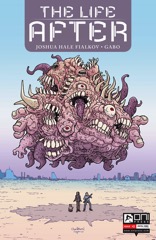
    The Life After #3Ah, the systems of a human imagined afterlife… such compelling ideas, such boring narrative. Fialkov does have some all right ideas and Gabo does illustrate them well, but The Life After is stumbling.

    The protagonist–Jude (still maybe for Jesus, but Fialkov’s waiting)–and his sidekick–Hemingway, who makes references to the Spanish Civil War in about the only subtle thing Fialkov does–walk through purgatory some more. They aren’t exploring, they aren’t searching. They’re wandering. And the comic is a little lost.

    Fialkov’s biggest problem as a writer seems to be a lot of good ideas, some really good characterizations and no idea how to marry the two into a narrative. The comic isn’t exactly boring; instead, it’s meandering.

    When Fialkov does get to the cliffhanger–after teasing a huge action sequence and then not delivering–it’s decidedly unexciting. Cliffhangers need to be parts of compelling narratives after all.

    B- 

    CREDITS

    Writer, Joshua Hale Fialkov; artist and colorist, Gabo; letterer, Crank!; editors, James Lucas Jones and Ari Yarwood; publisher, Oni Press.

  • Flash Gordon 6 (October 2014)

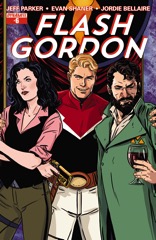
    Flash Gordon #6Parker does a great job with the Arboria adventure–with Dale getting to hang out with some Hawkmen and then rescue Flash and Zarkov on her own. There’s a lot of personality for the Arborians–well, the people with the wings, less so for the sirens who don’t have wings. Parker keeps it relatively simple; maybe too much so, but it’s Flash Gordon and it works with simplicity.

    He resolves the cliffhanger, moves into Dale’s adventure, has some good laughs at Flash and, especially, Zarkov’s expenses and then brings in Vultan. Now, he and Shaner don’t do a lot of obvious Flash Gordon: The Movie references but something about Vultan’s introduction just screams Brian Blessed. It’s a wonderful touch.

    The final has a too abrupt cliffhanger, but then there’s some nice epilogue art with Ming from Greg Smallwood. And Parker’s finally giving Ming some real personality.

    It works out well.

    A- 

    CREDITS

    Writers, Jeff Parker and Jordie Bellaire; artists, Evan Shaner and Greg Smallwood; colorist, Bellaire; letterer, Simon Bowland; editor, Nate Cosby; publisher, Dynamite Entertainment.

  • Ms. Marvel 9 (December 2014)

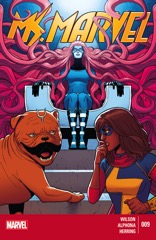
    Ms. Marvel #9It’s secret origin of Kamala Khan time. Does she particularly need a secret origin? Maybe. But the way Wilson brings in the Inhumans–they’re not quite deus ex machina, but they’re a very convienient way to tie Ms. Marvel into big Marvel publishing events–doesn’t take advantage of anything.

    Wilson literally beams Kamala, her admirer and Lockjaw over to Inhuman City for a quick expository scene with some decent Star Wars jokes. Much better than the Star Wars joke later in the issue, when Kamala returns to her nemesis’s hideout to free the kids. It’s a messy scene, leading to a pat cliffhanger. Wilson doesn’t have the issue plotted well at all.

    Worse, Alphona’s artwork doesn’t work out–not in the opening cliffhanger resolution at the high school and not later when Kamala’s talking to her parents. The panels are too busy, too full.

    It’s fine, but definitely not standout.

    B 

    CREDITS

    Generation Why, Part Two; writer, G. Willow Wilson; artist, Adrian Alphona; colorist, Ian Herring; letterer, Joe Caramagna; editors, Devin Lewis and Sana Amanat; publisher, Marvel Comics.

  • Transformers vs. G.I. Joe 3 (September 2014)

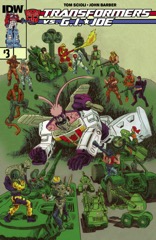
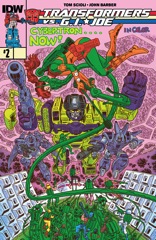
    Transformers vs. G.I. Joe #3Something very bad happens this issue of Transformers vs. G.I. Joe. It becomes inane. Writers Scioli and Barber don’t exactly stop giving characters arcs of their own, they just get rid of having the overall issue story have anything to do with characters.

    It’s full of annoying big action moments too, where Scioli lets the art get too confusing and never takes his time with anything. The issue gets worse as it goes along too, as Scioli and Barber continuously make bad choices.

    It’s unfortunate. But maybe the concept just couldn’t work out to an actual comic book series. The characters are all so obnoxious, only the end of the world from the attacking Megatron would make them sympathetic. And, even then, not because of any work the writers do, but maybe Scioli could make it work.

    As is, however, the comic has prematurely run its course. It’s a shame.

    D 

    CREDITS

    Writers, Tom Scioli and John Barber; artist, colorist and letterer, Scioli; editor, Carlos Guzman; publisher, IDW Publishing.

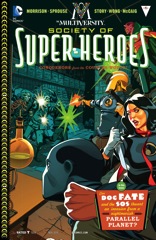
  • The Multiversity: The Society of Super-Heroes #1Besides the awkward bookends, which writer Grant Morrison seems to be writing as close to pulp as possible, The Society of Super-Heroes is an excellent Multiversity tie-in. Chris Sprouse is the perfect artist for the time period–it’s set in the forties or fifties, with some familiar heroes in newly designed, functional, period appropriate garb.

    Morrison is real fast when it comes to establishing the characters–the Al Pratt Atom and Doc Fate get about the most attention–and there’s a mix of pulp sensibility and old science fiction magazine stories. It works out pretty well in the setup, but then Morrison and Sprouse get to the action and nothing else really matters. The comic is fast and entertaining.

    There’s some rather nice work in the dialogue too, with Morrison handling the large cast through brief expository dialogue.

    Until the really lame, tying to the greater event denouement. Until then, it’s quite good.

    B 

    CREDITS

    Conquerors from the Counter-World; writer, Grant Morrison; penciller, Chris Sprouse; inkers, Karl Story and Walden Wong; colorist, Dave McCaig; letterer, Carlos M. Mangual; editor, Rickey Purdin; publisher, DC Comics.

  • Ghosted 14 (October 2014)

    Ghosted #14Williamson finally finds a great cliffhanger for Ghosted. What’s so strange about it is how it continues the trend of somehow being either too intimate or too grandiose; but maybe for the first time he’s got his lead in real, scary danger. Ghosted is a supernatural heist story and Jackson is the mastermind and Williamson has spent the series setting him up as being smarter than everyone else.

    So finally putting him in an impossible situation and having it work? Great cliffhanger.

    The rest of the comic is excellent, opening with various action sequences–Anderson in angry ghost form is awesome–before getting into some character level arguing. There’s not a lot of room for character development this issue, but Williamson does at least acknowledge it a little in the dialogue asides. There’s no time for a break.

    And then the conclusion… starts quiet, gets loud. It’s one of Williamson’s best issues.

    CREDITS

    Writer, Joshua Williamson; artist, Goran Sudzuka; colorist, Miroslav Mrva; letterer, Rus Wooten; editors, Helen Leigh and Sean Mackiewicz; publisher, Image Comics.

  • Sons of Anarchy 14 (October 2014)

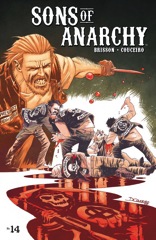
    Sons of Anarchy #14Brisson wraps up the arc wonderfully. Everything comes to a collision, there's lots and lots of action, lots and lots of violence. So much violence and action, in fact, it becomes very hard to follow the art. Couceiro just has too many bikers to draw and Michael Spicer's colors are so dark, it's difficult to keep them apart.

    So, even though Couceiro's art is strong as usual, it's the reason the issue isn't a total success. Too many pages have to ride on momentum to get through the visual confusion. Brisson has reminders throughout scenes and so on–and the cuts back and forth between sets of characters is good–but there are just too many players in motion. Eventually, people start getting lost.

    But it all does wrap up and it's impressive how Brisson makes it happen. He intricately plots these arcs and the pay-off makes it all worthwhile.

    Great comics.

    CREDITS

    Writer, Ed Brisson; artist, Damian Couceiro; colorist, Michael Spicer; letterer, Ed Dukeshire; editor, Dafna Pleban; publisher, Boom! Studios.

  • Chilling Adventures of Sabrina (2014) #1

    Cas01

    For Chilling Adventures of Sabrina, writer Roberto Aguirre-Sacasa takes a very serious approach. It works well with artist Robert Hack, who does horror well, but also does creepiness and the period–Sabrina is set in the fifties and sixties–well too.

    So while there's that classic horror look from Hack, Aguirre-Sacasa works in just enough humorous reference to the anticipated Sabrina comic–her cat familiar chastising her, Sabrina using her spells to meet boys, her cousin being obsessed with rock and roll–to give this new variation a personality.

    The comic does open far more traditionally, with Sabrina's origin and her father and a scene out of Rosemary's Baby involving her mother, but the second half is where it really gels. Aguirre-Sacasa quickly establishes the Sabrina character as she enters high school, even if her aunts do take an unevenly reduced role.

    The cliffhanger's iffy, but very effective visually.

    The comic works out well.

  • Transformers vs. G.I. Joe 2 (August 2014)

    Transformers vs. G.I. Joe #2Even though I can remember having some of the toys–or wanting them–I can’t remember the name of the Transformers planet. But all the action takes place there, with Lady Jane leading an attack force of Joes who are trying to green the planet to take out the evil robot aliens.

    Barber and Scioli’s script takes the regular G.I. Joe and Transformers mythology into great account, but there’s also an element of humor involved with how they present the absurdity of the situation. It creates a fantastic tone–it’s never realistic, but they throw in seriously vocabulary to show they know it can’t be taken too seriously.

    It’s an all-action issue, with some big reveals at the end–but still no Autobot team-up with the Joes–and Scioli has some wonderful art. My favorite has to be Lady Jane zooming on a motorcycle, jumping off a Transformer.

    B+ 

    CREDITS

    Wheeljacked; writers, Tom Scioli and John Barber; artist, colorist and letterer, Scioli; editor, Carlos Guzman; publisher, IDW Publishing.

  • War Stories (2014) #1

    Ws01

    Garth Ennis is back with more war stories–this time appropriately titled War Stories–and he’s off to an excellent start. The first arc of the new series has him covering an American flier in Britain in a bomber; well, the flier doesn’t actually get into a mission yet, with Ennis instead concentrating on his experiences before his first mission.

    Then the first mission takes an unexpected turn or two.

    Ennis writes in first person from the protagonist, talking about all the things he’s seeing as he journeys across the United States and then to Britain. There’s muted culture shock, there’s character development, there’s attention to detail. It’s excellent writing and Ennis obviously takes it very seriously.

    Matt Martin’s art works out too. He has good composition and attention to period detail. Those pluses make up for the occasionally loose physical traits on people. Great tone though.

    It’s outstanding stuff.

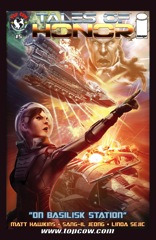
  • Tales of Honor #5There’s some great stuff in the issue, specifically where Hawkins describes how space battle works between ships. He does some quick, but detailed exposition, then carefully maneuvers the dialogue to reinforce what the reader already has passing familiarity with. It works out very well.

    And the issue, which takes place over an hour or two, works out. It’s tense and compelling, with Hawkins never giving any comic relief. There’s no relief valve for the tension, except maybe through the art, which is never good enough to transport the reader to the battle. There are some good establishing shots in the issue, for double-page spreads, but it’s otherwise the same weak Jeong art as always.

    The problems come at the end of the issue, with Hawkins wrapping things up too quickly. He’s been telling a story directly related to the bookends and not clear enough about the important connections throughout.

    B 

    CREDITS

    On Basilisk Station, Part Five; writer, Matt Hawkins; artists, Sang-Il Jeong and Linda Sejic; letterer, Troy Peteri; editor, Besty Gonia; publisher, Top Cow Productions.

  • Copperhead (2014) #2

    Ch02

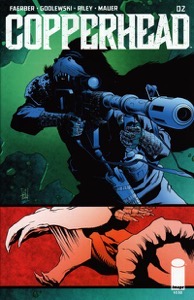
    How can this comic be so good? Faerber keeps up the fantastic mix of sci-fi and Western in the second issue, with a couple plots. The sheriff's son is in trouble in the desert from giant bugs, with the neighbor girl, and a mysterious protector (calling him Ishmael is a cute touch from Faerber).

    So that plot is mostly danger, with Godlewski's art concentrating on keeping the reader on edge. The giant bugs aren't clear at first, they get introduced all. It moves very fast.

    The investigation is the other plot, the sheriff and deputy Boo. The best moment in the comic is when Faerber reveals Boo isn't stupid; he's smart, but looks stupid and slow. It's a great, quiet scene in the issue.

    There are some new characters, some unexpected scenes with already introduced scenes; Faerber just writes them all wonderfully and Godlewski's art is perfect for it all.

  • Batgirl #35It's the all-new Batgirl, which is mostly just a “Veronica Mars” in college where Babs solves hip crimes–the supervillain this issue is hacking phones and putting the embarrassing private information online. Why? Because he's a bad guy. And he's got a cybernetic brain and can hold his own with Batgirl in a fight.

    Writers Cameron Stewart and Brendan Fletcher write a painfully hip comic for hip comic reading college girls, but they do so with fervor and a real understanding of how to tell a story. For all the visual, modern gimmicks, this issue of Batgirl is just seventies DC Comics updated. The dressing is just a little different.

    Babs Tarr's art is fine–Stewart handles the page layouts. Stewart and Fletcher do it like an episode of “Sherlock” how Babs sees the world with her photographic memory.

    It feels a little too like Kate Bishop Hawkeye but it's successful enough.

    CREDITS

    Burned; writers, Cameron Stewart and Brenden Fletcher; pencillers, Stewart and Babs Tarr; inker, Tarr; colorist, Maris Wicks; letterer, Jared K. Fletcher; editors, Dave Wielgosz and Chris Conroy; publisher, DC Comics.

  • Birthright (2014) #1

    Birthright  1

    If the first issue is an indication, Birthright is going to be a trip.

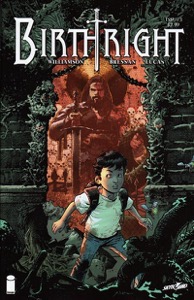
    Writer Joshua Williamson has a big twist at the end–the story of a missing child who returns as a grown, savage warrior out of a fantasy world–but the better stuff is how he’s handling the regular characters. The back and forth between the family is great, especially how Williamson is carefully positioning the older (but not anymore) brother as the protagonist. He’s the one who’s had to be literally responsible for his father but also monitoring the mother.

    Williamson opens the issue with the child going missing, showing the family in the happier days. It also seems like he’s going to try for some science with the child’s return.

    Andrei Bressan’s art is a little slick, but his composition and visual pacing are both strong.

    The cliffhanger’s an obvious one, but Williamson sells it.

  • Ghosted 13 (September 2014)

    Ghosted #13Williamson keeps this issue in constant motion. Even the expository scenes are in motion–with both Williamson and Gianfelice putting the emphasis on keeping things moving. The pace is important because Williamson needs to get in an unexpected turn regarding the villain of the arc before the cliffhanger.

    On the way to that cliffhanger, there’s time for Jackson to bond with his new crew, the old witch who gives them information and the ghost hanging over his shoulder. Williamson maintains a certain level of danger throughout, but it’s always relatively funny… if dangerous. The issue does open, after all, with Jackson basically revealed as doubly impervious to physical and magical threats.

    Given the reveals in the last few pages, the issue probably qualifies as a bridging issue but Williamson does such a good job with the trip across said bridge, it never feels like it.

    Ghosted is a sturdy read.

    CREDITS

    Writer, Joshua Williamson; artist, Goran Sudzuka; colorist, Miroslav Mrva; letterer, Rus Wooten; editors, Helen Leigh and Sean Mackiewicz; publisher, Image Comics.

  • Big Trouble in Little China 5 (October 2014)

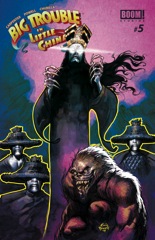
    Big Trouble in Little China #5Big Trouble isn't exactly in big trouble yet, but Carpenter and Powell's plotting is definitely getting long in the tooth. The comic opens with a very funny trip through various hells; this trip seems like it should be setting up the showdown between Lo Pan and Jack Burton. But it doesn't.

    Instead, Jack is on the road again, this time with a different sidekick. If Powell and Carpenter's plan is just to send Jack away from Chinatown with one person and then back to pick up another, it needs to be handled a lot more obviously. This issue is also the first without some funny and slightly disquieting flashback to Jack's past.

    It's a fine enough issue–and Churilla does get some excellent action sequences–but the series has stalled out a bit. It remains to be seen if there's anywhere for the comic to go… all of a sudden, seems not.

    B 

    CREDITS

    Writers, John Carpenter and Eric Powell; artist, Brian Churilla; colorist, Michael Spicer; letterer, Ed Dukeshire; editors, Alex Galer and Ian Brill; publisher, Boom! Studios.

  • Gotham Academy #1Gotham Academy manages to be entirely competent without being compelling at all. Becky Cloonan and Brenden Fletcher do a good job setting up the series–they go through the cast, making sure to make supporting players just memorable enough (the fireworks dealer, for example)–while raising questions about the protagonist.

    Said protagonist is Olive, who is at Gotham Academy on the Wayne Scholarship. So she knows Bruce Wayne–she even sees Batman standing in his place sometimes when groggy–and she's got a sort of ex-boyfriend and she's the mentor to his little sister. It's all very formulaic, all very melodramatic, all very well handled from Cloonan and Fletcher.

    Karl Kerschl's art is fine. He brings a lot of personality to the cast, getting their emotions across.

    Gotham Academy is better than I would have thought, but there's still nothing special about it other than it being a decent young, female protagonist DC comic.

    B 

    CREDITS

    Welcome to Gotham Academy; writers, Becky Cloonan and Brendan Fletcher; artist, Karl Kerschl; colorists, Geyser and Dave McCaig; letterer, Steve Wands; editors, Matt Humphreys and Mark Doyle; publisher, DC Comics.

  • Dream Thief: Escape 4 (September 2014)

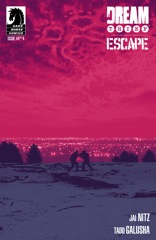
    Dream Thief: Escape #4Nitz closes up the limited with just enough good will. Galusha doesn’t hack the talking heads scenes any better than he does the action scenes and there are lots of both this issue. All of a sudden Dream Thief has these ineptly composed sequences, something the comic just can’t support.

    The fault isn’t entirely Galusha’s either; Nitz seems like he’s ready for the Escape series to be done. He rushes through the big action finale, something he’s been promising for all four issues of this series and even hinted at during the first series. He hasn’t introduced much of a supporting cast this series and, as he closes it down, he’s setting Dream Thief up for a much different continuation.

    And, thanks to Galusha’s unfamiliar–and inconsistent from page to page–art, it seems like a perfectly good idea.

    It’s too bad this series wasn’t great, but good enough works.

    B 

    CREDITS

    Writer, Jai Nitz; artist, Tadd Galusha; colorist, Tamra Bonvillain; editors, Everett Patterson and Patrick Thorpe; publisher, Dark Horse Comics.

  • Dream Thief: Escape 3 (August 2014)

    Dram Thief: Escape #3Things take an unexpected turn when John’s sidekick takes him hostage (after he’s been possessed). It’s a bit of a spin on the Dream Thief standard but Nitz also has a new artist on the book–Tadd Galusha–and everything feels a little different.

    And not just because Galusha draws everyone too squat.

    Nitz turns the possession into more of a gimmick than ever before this issue, even though there’s not a lot to do with it for a while. He forecasts the gimmick in the flashback, with John’s dad having a sweet moment with his family before rocketing from the house following an unintended snooze.

    Galusha composes all the panels just fine… but he doesn’t have enough sense for the violence. While peculiarly stylistic, it feels unresponsive. Galusha doesn’t bring the series’s despondence (even if the script does) and the result is lacking.

    It’s still pretty good, of course.

    B 

    CREDITS

    Writer, Jai Nitz; artist, Tadd Galusha; colorist, Tamra Bonvillain; editors, Everett Patterson and Patrick Thorpe; publisher, Dark Horse Comics.

  • Sally of the Wasteland 3 (October 2014)

    Sally of the Wasteland #3Gischler slows down a little too much this issue. Not enough to hurt Sally’s momentum exactly, but enough the cliffhanger feels protracted.

    The ship gets attacked again, the cast is shipwrecked again. Gischler and Bettin don’t draw any attention to the similarities–and it does make sense, given the world is full of aquatic mutants (in this issue, they’re cannibals) but there’s only so much Bettin can do with shipboard action sequences.

    The issue does move things forward–though somewhat confusingly–for Sally and her crush. Gischler takes an odd approach to the supporting cast–they’re immediately memorable and well-drawn, but they’re really just background to Sally and whoever else is important in a scene. The supporting cast is texture not possible subplots.

    The abrupt cliffhanger kills the tone of its scene. But, otherwise, solid stuff.

    B 

    CREDITS

    Writer, Victor Gischler; artist, Tazio Bettin; editor, Tom Williams; publisher, Titan Comics.

  • Men of Wrath 1 (October 2014)

    Men of Wrath #1What if the Punisher was a mob assassin who killed babies? What if he had a son who was in trouble with the mob? What if their last name was Rath? Wouldn't it be cool to have a hard-boiled crime comic called Men of Wrath, since they're both men and their last name is….

    I sort of tuned out on this first issue when writer Jason Aaron ripped off one of the more famous lines from Unforgiven. I'm pretty sure Aaron has ripped it off before, for one of his other comics about poor people, probably in the South, behaving badly.

    The comic does offer some thoroughly decent art from Ron Garney though. It's not great, because Garney's figures are big and thick and somewhat unbelievable and his action is a little too static, but it's fine.

    The comic's generally fine too. It's a waste of time, sure, but generally fine.

    C 

    CREDITS

    Among the Sheep; writer, Jason Aaron; artist, Ron Garney; colorist, Matt Milla; letterer, Jared K. Fletcher; editor, Sebastian Girner; publisher, Icon.

  • The Fade Out 2 (October 2014)

    The Fade Out #2Brubaker goes all over the place in the second issue of Fade Out. There's a bunch of stuff with protagonist Charlie's secret partner and best friend–and the way Brubaker narrates from a close third person on Charlie is phenomenal–but there's a lot at the movie studio too.

    Not to mention the scenes with Charlie and his friend's wife or Charlie and the dead girl. Those scenes are just great. Brubaker doesn't do anything with the murder investigation; the comic doesn't feel like a too gimmicky noir, it feels like Brubaker trying to figure out this story and it's often great.

    Overall, there are some problems towards the end because there's still the narrative–it's still about this dead girl and protagonist Charlie's involvement in it. But Brubaker's emphasis on the cast and making sure the texture of the setting comes through, not to mention Phillips's illustration of those things, is great.

    B 

    CREDITS

    The Death of Me; writer, Ed Brubaker; artist, Sean Phillips; colorist, Elizabeth Breitweiser; editor, David Brothers; publisher, Image Comics.

  • Letter 44 10 (September 2014)

    Letter 44 #10It's an okay issue. It's not a great one, probably not even a good one. Soule coasts on a lot of good will and a lot of promise of what's to come–misunderstandings with the aliens, possible American-backed terrorism, the First Lady stepping out for a vote–and he doesn't actually do much here.

    In addition to the promise, there's also a lot of action art from Alburquerque–and more of his lame futuristic army armor. There's energy to the art, but very little control and the sequences become visually boring rather quickly. Alburquerque can't do the big reveals in Soule's script either. He's got two, one physically small, one physically large, and both of them completely bomb.

    Letter 44 is about big events and small events… Soule tries too hard to big events this issue. Telling it small doesn't do any good. It's a way too manipulative issue as it turns out.

    B- 

    CREDITS

    Writer, Charles Soule; penciller, Alberto Jiménez Alburquerque; colorist, Dan Jackson; letterer, Crank!; editor, Robin Herrera; publisher, Oni Press.

  • I Confess (1953, Alfred Hitchcock)

    I Confess is unwieldy.

    Director Hitchcock is extremely precise in his composition, the same goes for Robert Burks' photography (especially the photography) and Rudi Fehr's editing (which changes in harshness based on the story's tone); sure, Dimitri Tiomkin's music is all over the place and intrusive, but it fits the script. George Tabori and William Archibald's ties together three very different stories–Confess is from a play, which explains some of the problems–but the end result is a disservice to the fine production values and some wonderful acting.

    Besides the disjointed nature of the narrative, which keeps a big secret from the audience for the first fifteen minutes for a pointless surprise. The film never recovers from it, right up until the last scene.

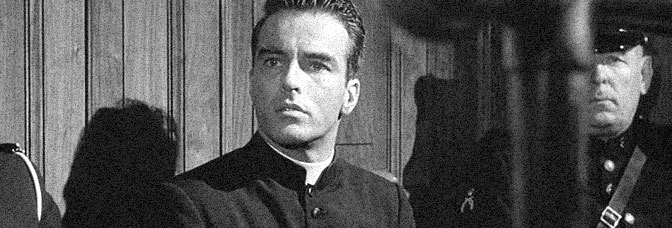
    Hitchock just has too many MacGuffins–is Confess about priest Montgomery Clift's struggle to cope with evil rectory worker O.E. Hasse's confession, is it about Clift's struggle to figure things out with pre-vows love Anne Baxter, is it about Clift trying to evade bulldog (but inept) police inspector Karl Malden's investigation? No, it's about all three and none at all.

    Clift is phenomenal in the film, even though he only has a handful of full scenes. Hitchcock seems more comfortable having him silently react to events; Clift's great at such reactions, he's just capable of a lot more.

    Instead, Hitchcock gives Baxter some big dialogue scenes and she nails them.

    Thanks to the script, I Confess wastes its potential (Clift, Baxter, the gorgeous Canadian locations and everything else).

    2/4★★

    CREDITS

    Directed by Alfred Hitchcock; screenplay by George Tabori and William Archibald, based on a play by Paul Anthelme; director of photography, Robert Burks; edited by Rudi Fehr; music by Dimitri Tiomkin; produced by Sidney Bernstein and Hitchcock; released by Warner Bros.

    Starring Montgomery Clift (Father Michael Logan), Anne Baxter (Ruth Grandfort), Karl Malden (Inspector Larrue), Brian Aherne (Willy Robertson), O.E. Hasse (Otto Keller), Roger Dann (Pierre Grandfort), Dolly Haas (Alma Keller) and Charles Andre (Father Millars).


    Print

    THIS POST IS PART OF THE O CANADA BLOGATHON HOSTED BY RUTH OF SILVER SCREENINGS and KRISTINA OF SPEAKEASY


    RELATED
  • The Comics Fondle Podcast – 1×17
    A couple weeks late, but Vernon and I are back again with an extra long episode. Comic news and comic reviews. Give it a listen.

    WHERE TO LISTEN

    Apple Podcasts
    Spotify
    Stitcher
    RSS
  • Princess Ugg 4 (September 2014)

    Princess Ugg #4Somehow Naifeh manages to get through all of Ugg's problems to get the comic to a good spot for the finish. He's still on the horse–sorry, unicorn–where Ülga is helping her hideous mean girl roommate get ready for a house competition.
    Ülga has the awesome mentor guy for support, but then she has some awfully mean teachers as well. Naifeh has this problem of creating a fantasy school for princesses visually and technologically set in the Middle Ages but socially far more modern and having a mean teacher creates a disconnect. He spent so much time setting up the reality of Ülga's people and nowhere near enough setting up the reality of the other princesses and their respective kingdoms.

    He also lays out a couple coming plot lines–romance and war. Presumably they'll do better than bonding over horses, because he still doesn't redeem the nemesis.

    But it's a steadier read.

    CREDITS

    Writer and artist, Ted Naifeh; colorists, Warren Wucinich and Naifeh; letterer, Wucinich; editors, Robin Herrera and Jill Beaton; publisher, Oni Press.

  • Sally of the Wasteland 2 (September 2014)

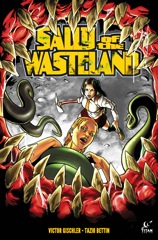
    Sally of the Wasteland #2Gischler finds the perfect mix of all action and enough story to get things along. Sally takes front and center, with her stranded party getting into trouble with some pirates. It leads to glorious ultra-violence, which both Gischler and Bettin relish in. Bettin has some slight problems on the art–it's a little too slick–but he delivers on the action, time and again.
    Similarly, Gischler goes for the occasional easy dirty joke–which makes Sally all of a sudden feel like distracted Garth Ennis–but then he'll bring it around with moments of sincerity to his characters. Well, those types of moments but also some great action and great supporting cast stuff. There's a texture to Sally of the Wasteland; Gischler sees the obvious, sometimes engages with it, but he also does the work on everything else.

    So, besides the two or three tepid jokes and Bettin's occasionally problematic art, it's awesome stuff.

    A- 

    CREDITS

    Writer, Victor Gischler; artist, Tazio Bettin; colorist, Jon Chapple; editor, Steve White; publisher, Titan Comics.

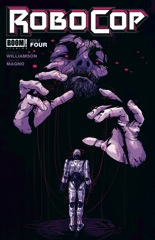
  • Robocop 4 (October 2014)

    Robocop #4Williamson does a couple unexpected things this issue. First, he brings a level of what one has to call Robocop 2 ultra-violence–well, technically Magno brings it–but Williamson wrote the scene. It's a big hero moment for Robocop and it's awesome. Robo saves the day.

    Then Lewis turns around and figures out a way to save the day a little bit more, if only temporarily, because Williamson doesn't have a short game for Robocop. He's going long with the series and he's asking the reader for something of a significant investment. He's going beyond the accepted norms for a Robocop comic.

    Sure, the cliffhanger–gun control is so tight Robocop has to lose the sidearm–is a Robocop 2 moment in the worst way, but the issue shows some definite ambition on Williamson's part.

    The really awkward scene where Murphy talks about dying is great too.

    It's a difficult, not entirely successful comic.

    B 

    CREDITS

    Writer, Joshua Williamson; artist, Carlos Magno; colorist, Marissa Louise; letterer, Ed Dukeshire; editors, Alex Galer and Ian Brill; publisher, Boom! Studios.

  • A Voice in the Dark: Get Your Gun 1 (September 2014)

    A Voice in the Dark: Get Your Gun #1A Voice in the Dark is back and in full color now. Well, not exactly full color–the figures get fully colored while the background are muted and messy. It’s a great look for the book, especially since writer and artist Larime Taylor doesn’t emphasize the backgrounds. The colors are striking.

    The issue opens with a bookend and then goes back in time to fill in the details. Protagonist Zoey and her paramour–another college-aged serial killer–are in trouble in the present action bookend. The flashbacks start explaining how they got there.

    As usual for the series, Taylor is precise in both his composition and his plotting of Zoey’s daily life. Dark is very well-crafted, which is why the love interest is such a problem. Taylor goes too fast, tries too hard. The first date scene is mediocre, not sublime.

    Still, it’s fine enough and definitely ambitious.

    B 

    CREDITS

    Writer, artist and letterer, Larime Taylor; colorist, Jay Savage; editor, Duncan Eagleson; publisher, Image Comics.

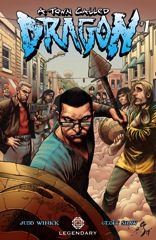
  • A Town Called Dragon 1 (September 2014)

    A Town Called Dragon #1A Town Called Dragon would be a whole lot better with a different artist. Or maybe even if Legendary were willing to get a good inker for Geoff Shaw's competent but unimaginative pencils. Or not, actually. His composition is humorless, which works better for the flashbacks to Vikings fighting dragons but fails during writer Judd Winick's frequent comedy exchanges.

    It's a double-sized issue, which is good because Winick wastes about half the comic on the Viking flashback. They take the last dragon egg to the New World and dump it. Leif Erikson's expedition. That aspect of the story–along with a lot of Erikson's journal entry about it–isn't interesting because Winick's very closed off about it. It's setup, not a real part of the story.

    The real story is this goofy tourist concept town called Dragon and the assorted townspeople. Winick does well with them; Shaw does not.

    It's engaging though.

    B- 

    CREDITS

    Drop It On the Other Side of the World; writer, Judd Winick; penciller, Geoff Shaw; colorist, Jamie Grant; letterer, Sean Konot; editors, Greg Tumbarello and Bob Schreck; publisher, Legendary Comics.