• Red One 1 (March 2015)

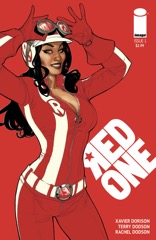
    Red One #1What’s Red One all about? Being sensational. It opens with a Christian fundamentalist psychopath killing a porn star–oh, Red One is set in the seventies so pornos are still being shown in the theater (in this case, a theater resembling the White House). Then the action jumps to the Soviet Union and the top Russian super-spy.

    I think her name’s Vera. Her name is less important than her being a bustier version of Wonder Woman who’s also something of a nymphomaniac. The Soviets aren’t happy with the Christian fundamentalist serial killer–who is going after commies and gays too in the U.S. (not sure where Xavier Dorison came up with his Soviet history but he’s wrong all the time)–so they send Vera to do something.

    When it’s not trying to be more sexist than Frank Miller, Red One is sometimes fun. When it isn’t fun? It’s icky.

    CREDITS

    Welcome to America, Part One; writer, Xavier Dorison; penciller and colorist, Terry Dodson; inker, Rachel Dodson; letterer, Clayton Cowles; publisher, Image Comics.

  • The Hearts of Age (1934, Orson Welles and William Vance)

    The Hearts of Age is a funny short film. It’s weird funny, but it’s also funny funny. The weird has these grotesquely made up people–the film centers on an old woman, sitting on a bell, being pulled from below by this servant (in blackface). People pass her, going down these stairs. She watches them.

    Then the creepiest of the creepy people shows up and convinces the servant to kill himself.

    All the while, directors Welles and Vance cut all around–lots of forced symbolism (the bells, the bells), but the cutting is done to emphasis the obvious strangeness, not focus the viewer on the implied uncanny. It’s like the directors don’t want to have to try too hard with the symbolism.

    The end has the action changed to the creepiest man by himself. And it’s when the humor starts coming through. The final sequence is a gag even.

    Weird.

    3/3Highly Recommended

    CREDITS

    Directed by Orson Welles and William Vance; written by Welles; director of photography, Vance; produced by Vance.

    Starring Orson Welles (Death), Virginia Nicholson (Old woman / Keystone Kop), William Vance (Indian in blanket) and Edgerton Paul (Bell-ringer).


    shorts-ginger

    THIS POST IS PART OF SHORTS! A TINY BLOGATHON HOSTED BY FRITZI OF MOVIES SILENTLY.


  • The Unbeatable Squirrel Girl 3 (May 2015)

    The Unbeatable Squirrel Girl #3It’s another good issue of Squirrel Girl with a whole bunch of action. Doreen gets into a big fight with Whiplash–while I get what North’s trying to do with the dialogue, the Whiplash dialogue isn’t any good, which might be my only complaint about the dialogue–and then has to save her roommate from bank robbers.

    And then get to the moon and deal with Galactus. It’s a busy issue, no doubt.

    North knows how to pace that busy issue out in a way it reads fast and never has to slow for the exposition to set up the next problem. Some of that comes to how North blocks out sequences–emphasizing Doreen talking to her squirrel over her adventures in an Iron Man suit–but it’s also just the approach to the comic.

    Fast and fun; it’s got depth because North’s able.

    Though he does endanger many squirrels.

    CREDITS

    Writer, Ryan North; artist, Erica Henderson; colorist, Rico Renzi; letterer, Clayton Cowles; editors, Jon Moisan and Wil Moss; publisher, Marvel Comics.

  • Giant Days #1There’s something very nice about Giant Days, even if its tranquil UK college campus isn’t an entirely clear setting straight off. One might be able to figure it out from the way writer John Allison talks about college and maybe from the characters’ dialogue, but I didn’t get it until a Northampton reference.

    Was I not paying attention? Perhaps, but only because I was paying too much attention to Lissa Treiman’s fantastic artwork. Treiman’s got a detailed, personable style but so much movement. Reading Giant Days feels like watching an expertly animated cartoon–Treiman’s not just masterful at movement in a frame, her panel composition is extraordinary.

    The story involves three female college freshman, each different, who make fast friends. One of them has a figure from her past return, which causes her complications. Allison’s got great plotting–a funny A plot while he develops the dramatic B.

    Days rocks.

    CREDITS

    Writer, John Allison; artist, Lissa Treiman; colorist, Whitney Cogar; letterer, Jim Campbell; editors, Jasmine Amiri and Shannon Watters; publisher, BOOM! Box.

  • Invisible Republic (2015) #2

    Invisible Republic  2

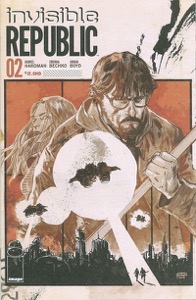
    This issue of Invisible Republic has a little too much flashback and not enough with the reporter in the present. The problem is how little the flashback stuff actually matters; sure, the girl is sympathetic, but only because she’s in an unfair situation and she has a psycho future-dictator for a cousin.

    The stuff in the present is actually, if underrepresented as far as the narrative, less interesting than the flashback. The present feels too 1984-lite at times, while the stuff in the past feels like sci-fi caste system stuff. Far more interesting.

    Hardman and Bechko have put a lot of thought into Invisible Republic, so much they’re clearing spinning their wheels at times to see how Hardman’s going to visualize that spinning (well, he visualizes it well). The enthusiasm gets the comic past its various bumps and it’s an engaging read.

    But flashback cliffhangers are weak.

  • Repulsion (1965, Roman Polanski)

    At around the seventy minute mark, Repulsion finally gives Catherine Deneuve some personality. Sure, she’s gone completely insane at this point, but she sings a little lullaby to herself. And Deneuve is in at least sixty-five of those seventy minutes without any personality (she loses it again soon after). She is the subject of the film, not the protagonist.

    The titular Repulsion refers to Deneuve’s repulsion towards sex. She’s this beautiful young woman who doesn’t appreciate the lecherous men of London–and director Polanski’s very clear about it, all the men in London are lecherous. Even Deneuve’s affable though clearly obsessive suitor, played by John Fraser. Even Fraser’s male friends, who exude piggishness towards women while leaving the door open for male company. That last bit is implied, just like when Deneuve freaks out when a girlfriend stops talking about hanging out with her and instead talks to her about men. There’s some brief, but hateful speech about lesbians.

    And, even though the hateful opinions come from the piggish guys, it’s not like the script (from Polanski, Gérard Brach and David Stone) is against it. If Deneuve’s been driven insane by her virginity–and unrealized lust for male attention–then all the men in the film get a pass.

    Including when Fraser becomes a dangerously unhinged stalker and when Patrick Wymark tries to rape Deneuve. They’re victims of her insane actions.

    It’s a creepy movie; it’s calculated and insincere for its entire running time, which I guess is something.

    0/4ⓏⒺⓇⓄ

    CREDITS

    Directed by Roman Polanski; written by Polanski, Gérard Brach and David Stone; director of photography, Gilbert Taylor; edited by Alastair McIntyre; music by Chico Hamilton; produced by Gene Gutowski; released by Compton Films.

    Starring Catherine Deneuve (Carol), Ian Hendry (Michael), John Fraser (Colin), Yvonne Furneaux (Helen), Patrick Wymark (Landlord), Renee Houston (Miss Balch) and Valerie Taylor (Madame Denise).


    RELATED

  • War Stories (2014) #7

    Ws07

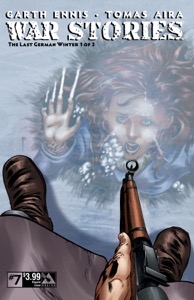
    Garth Ennis is back to form on War Stories; his artist, Tomas Aira, is probably worse than the last time I saw him working on the book (could’ve been last issue… he’s not memorable).

    But what is memorable is Ennis’s setup for this story. German civilians leaving Russian–in January 1945–the Russians kind of not making it easy for them to leave. It’s a refuge story from the perspective of a German girl. Ennis is trying again with War Stories; he’s trying really hard.

    The story has action and a fair bit of drama. There’s no humor, except when the narrator too is aware of the irony of the jokes. Ennis does a great job establishing his cast members when not even giving them distinct enough names. The action goes okay but the drama’s all beautifully paced dialogue exchanges from Ennis.

    Nice to see him caring about it again.

  • Invisible Republic #2This issue of Invisible Republic has a little too much flashback and not enough with the reporter in the present. The problem is how little the flashback stuff actually matters; sure, the girl is sympathetic, but only because she’s in an unfair situation and she has a psycho future-dictator for a cousin.

    The stuff in the present is actually, if underrepresented as far as the narrative, less interesting than the flashback. The present feels too 1984-lite at times, while the stuff in the past feels like sci-fi caste system stuff. Far more interesting.

    Hardman and Bechko have put a lot of thought into Invisible Republic, so much they’re clearing spinning their wheels at times to see how Hardman’s going to visualize that spinning (well, he visualizes it well). The enthusiasm gets the comic past its various bumps and it’s an engaging read.

    But flashback cliffhangers are weak.

    CREDITS

    Writers, Gabriel Hardman and Corinna Bechko; artist, Hardman; colorist, Jordan Boyd; publisher, Image Comics.

  • War Stories #7Garth Ennis is back to form on War Stories; his artist, Tomas Aira, is probably worse than the last time I saw him working on the book (could’ve been last issue… he’s not memorable).

    But what is memorable is Ennis’s setup for this story. German civilians leaving Russian–in January 1945–the Russians kind of not making it easy for them to leave. It’s a refuge story from the perspective of a German girl. Ennis is trying again with War Stories; he’s trying really hard.

    The story has action and a fair bit of drama. There’s no humor, except when the narrator too is aware of the irony of the jokes. Ennis does a great job establishing his cast members when not even giving them distinct enough names. The action goes okay but the drama’s all beautifully paced dialogue exchanges from Ennis.

    Nice to see him caring about it again.

    CREDITS

    The Last German Winter, Part One: Babes in the Woods; writer, Garth Ennis; artist, Tomas Aira; colorist, Digikore Studios; letterer, Kurt Hathaway; publisher, Avatar Press.

  • C.O.W.L. 9 (March 2015)

    C.O.W.L. #9This issue of C.O.W.L. is an excellent bit of work from creators Higgins, Siegel and Reis. First off, Reis’s art really makes the issue. He gets to do talking heads and action, but he has a bunch of variety when it comes to the talking heads. The style fits the conversation and the players beautifully.

    Since there’s so much talking heads, it’s important the conversations work and they do. Higgins and Siegel reveal quite a few things–like the murdered guy having a wise to the corruption wife; C.O.W.L. is nine issues in and the writers are still able to expand it naturally.

    The sixties Chicago setting–whether in the politics or just the visuals–gets utilized quite well this issue too. It’s beginning to feel like natural. The comic has found a reliable groove.

    I just realized–the lack of a frame really helps C.O.W.L.; it’s historical superhero fiction.

    CREDITS

    The Greater Good, Chapter Three: The High Ground; writers, Kyle Higgins and Alec Siegel; artist, Rod Reis; letterer, Troy Peteri; publisher, Image Comics.

  • Forza Bastia (2002, Jacques Tati and Sophie Tatischeff)

    Forza Bastia chronicles a day in Bastia (France). A Corsican island. It’s an important day because it’s April 26, 1978, when Bastia (the soccer team) played PSV Eindhoven. Bastia was an obscure team and the first leg (I had to learn soccer terms) was a tie at zero.

    Jacques Tati shot Bastia at the time, but never finished editing it. His daughter, Sophie Tatischeff, came in and fixed it. The result is a very uneven, very long (twenty-seven minutes) collection of footage. If Tatischeff did carry through with Tati’s intent, then he intended Bastia to be boring and not insightful.

    It’s about a big deal football match. Of course people are going to be acting weird. Nowhere in any of the footage does Tati (or does Tatischeff) find any moments of real human observation. It’s all obvious, even the quirky stuff.

    Forza Bastia should’ve been shorter, would’ve been better.

  • The Order of the Forge 1 (April 2015)

    The Order of the Forge #1There’s really no other way to say it.

    Dude, The Order of the Forge is some kind of Star Wars hero’s quest–updated with more modern vernacular and R-rated interests for everyone–starring George Washington, Paul Revere and Ben Franklin.

    And, dude, it’s awesome.

    Writer Victor Gischler seems to know exactly what he’s got and exactly what he’s doing–historically accurate, full of supernatural mumbo jumbo, father-son issues, friendship issues, Ben Franklin being too busy whoring to discovery electricity–it’s simultaneously reverent to historical figures and full of piss and vinegar.

    Piss figuring into the story as well.

    And Tazio Bettin’s art is perfect. He handles the proper stuff just fine and he handles the action really well. The historical setting is nice looking when it needs to be and ominous when it needs to be.

    It’s awesome. Gischler knows what he’s doing and is enthusiastic about it.

    CREDITS

    Writer, Victor Gischler; artist, Tazio Bettin; letterer, Nate Piekos; editors, Ian Tucker and Daniel Chabon; publisher, Dark Horse Comics.

  • Big Trouble in Little China 10 (April 2015)

    Big Trouble in Little China #10This issue of Big Trouble is unrepentant in its awesomeness. It’s Jack Burton versus the probably dimwitted demons of Hell as he tries to plan his escape. Powell goes for humor the entire issue–so much so, when Jack gets into a fight at the end, it’s hard to see there being any danger.

    And that cartoon aspect of the comic has become one of its pluses. Big Trouble isn’t straight-faced at all, but it often deals with “serious” issues (well, mostly just its cast being in danger); the silliness (and Powell’s attention to character detail) puts it past being a successful licensed comic and into its own territory.

    In many ways–though it’s impossible see imagine this comic coming out in the eighties–it feels more like the movie is an adaptation of this comic than the other way around.

    There’s some lovely, fun Churilla Hell art too.

    CREDITS

    Writers, John Carpenter and Eric Powell; artist, Brian Churilla; colorist, Gonzalo Duarte; letterer, Ed Dukeshire; editors, Alex Galer and Ian Brill; publisher, Boom! Studios.

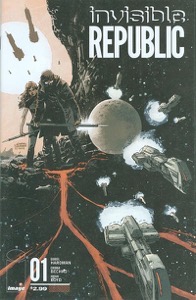
  • Invisible Republic (2015) #1

    Invisible Republic  1

    I’m going to be cynical for a second and remember Orson Scott Card did a spin-off of his Ender’s Game novels where he told the story of the brother turned benevolent dictator. Gabriel Hardman and Corinna Bechko’s Invisible Republic does the story of the cousin turned regular crappy dictator.

    It’s not, from what I can tell (I’ve never read aforementioned spin-off novels), a knock-off. There’s a really good framing device–after the dictator’s reign falls, the press flocks to this small moon (it’s also a sci-fi story, a similarity to the Ender’s Game stuff) and the issue is this reporter’s investigation.

    It gives Republic a post-WWII movie mixed with some very 1984 sci-fi visualizations, even though it’s set in the far future.

    Nice dialogue from Hardman and Bechko, great art from Hardman. Republic’s familiar sounding and all, but expertly executed sci-fi comics.

  • Ei8ht 2 (March 2015)

    Ei8ht #2Not really enough story for this issue of Ei8ht. There are quite a few scenes and a bit of information–without being exposition–but there’s not a lot of story. In fact, as far as story goes, there’s only like five pages. The protagonist gets up and walks around and hears about the Meld.

    The rest of the comic, with the female soldier arguing for the protagonist visitor guy’s survival (instead of being given to the bad guy) and a bunch of stuff with an exploration vessel from Earth, isn’t exactly story or subplot. It should be, but something about the way Johnson writes it, it’s not.

    The opening of the comic is confusing as all heck, just because–at issue two–Johnson hasn’t done enough to establish these characters. And even though Albuquerque’s art’s magnificent, his people aren’t exactly distinguished. They’re all human, all fit.

    It’s okay enough stuff.

    CREDITS

    Writers, Rafael Albuquerque and Mike Johnson; artist, Albuquerque; letterer, Nate Piekos; editors, Spencer Cushing and Sierra Hahn; publisher, Dark Horse Comics.

  • Invisible Republic #1I’m going to be cynical for a second and remember Orson Scott Card did a spin-off of his Ender’s Game novels where he told the story of the brother turned benevolent dictator. Gabriel Hardman and Corinna Bechko’s Invisible Republic does the story of the cousin turned regular crappy dictator.

    It’s not, from what I can tell (I’ve never read aforementioned spin-off novels), a knock-off. There’s a really good framing device–after the dictator’s reign falls, the press flocks to this small moon (it’s also a sci-fi story, a similarity to the Ender’s Game stuff) and the issue is this reporter’s investigation.

    It gives Republic a post-WWII movie mixed with some very 1984 sci-fi visualizations, even though it’s set in the far future.

    Nice dialogue from Hardman and Bechko, great art from Hardman. Republic’s familiar sounding and all, but expertly executed sci-fi comics.

    CREDITS

    Writers, Gabriel Hardman and Corinna Bechko; artist, Hardman; colorist, Jordan Boyd; publisher, Image Comics.

  • Satellite Sam 13 (April 2015)

    Satellite Sam #13It’s an action-packed issue of Satellite Sam. At least it’s action-packed for Satellite Sam. And not even the kinky sex, which Chaykin must’ve loved getting a crack at. No, Fraction is moving Michael’s murder investigation to what seems to be its third act (and the third act for the series, based on some developments for supporting cast), and there’s action.

    There’s revenge and action.

    And kinky sex.

    The only thing Satellite Sam doesn’t have this issue is television. The television plots don’t come in at all, with the exception of a sort of Godfather homage and TV isn’t the point of that scene. It’s Fraction and Chaykin being a little funny and showy, which they can afford to be; Satellite Sam is good stuff.

    Fraction’s character work this issue is exceptional, maybe the best in the series so far. And it’s with practically melodramatic sequences where he excels.

    CREDITS

    Goodbye, Aristotle; writer, Matt Fraction; artist, Howard Chaykin; letterer, Ken Bruzenak; editor, Thomas K.; publisher, Image Comics.

  • The Parallax View (1974, Alan J. Pakula)

    Not quite halfway through The Parallax View, the film loses its footing. Director Pakula keeps the audience a good three car lengths from not just the action of the film–with long shots in Panavision–but also understanding the action of the film. Parallax even goes so far to introduce protagonist Warren Beatty with a proverbial wink.

    But Beatty isn’t a traditional protagonist. Screenwriters Dean Giler and Lorenzo Semple Jr. don’t just keep viewers from passing judgement on Beatty, the writers keep viewers from even thinking they might want to think about the character at all. Beatty moves through the film just fine, but he’s being endearingly indignant or running most of the time. It’s not a hard job.

    It’s especially not a hard job since a lot of the effectiveness comes through due to the technical aspects of Parallax. Gordon Willis’s photography is amazing, even if Pakula does mostly utilize the right side of the frame for action; the left tends to be for setting information and the shots are beautiful, just beautiful with too much free space.

    John W. Wheeler’s editing is also of note. Every cut in Parallax, which is always trying to surprise the viewer–whether with big conspiracy stuff or, in the first half, Beatty’s roguish behavior–and it works thanks to Wheeler.

    Well, Wheeler and composer Michael Small. Parallax’s a cynical take on a patriotic hero story; Small’s music plays to it sincerely.

    Parallax may have its problems, but it’s also gorgeous filmmaking.

    2.5/4★★½

    CREDITS

    Produced and directed by Alan J. Pakula; screenplay by David Giler and Lorenzo Semple Jr., based on the novel by Loren Singer; director of photography, Gordon Willis; edited by John W. Wheeler; music by Michael Small; production designer, George Jenkins; released by Paramount Pictures.

    Starring Warren Beatty (Joseph Frady), Paula Prentiss (Lee Carter), William Daniels (Austin Tucker), Walter McGinn (Jack Younger), Hume Cronyn (Bill Rintels), Kelly Thordsen (Sheriff L.D. Wicker), Chuck Waters (Thomas Richard Linder), Earl Hindman (Deputy Red), Anthony Zerbe (Prof. Nelson Schwartzkopf) and William Joyce (Senator Charles Carroll).


    RELATED

  • Frankenstein Underground 2 (April 2015)

    Frankenstein Underground #2Besides the art–I mean, who doesn’t want to see Frankenstein’s monster fight a dinosaur–there’s not much going for this issue of Frankenstein Underground.

    The villains do villainous things for a page, but not too villainous. Just plotting villainous and kind of evil. Then they’re gone and the story jumps to the monster going into an inner Earth, full of dinosaurs and cavemen.

    And giant squids. Because it’s not just Edgar Rice Burroughs, it’s got some Jules Verne going for it too.

    It’s kind of okay, Stenbeck’s art makes it work out. Like I said, the Frankenstein Monster versus monsters. I think that idea was even a Toho movie. And Stenbeck’s art is classy.

    Notice how much I repeating myself? It’s because Mignola didn’t write enough story for a fourth of a comic book, forget about a full length one.

    This issue is a pretty waste of one’s time.

    CREDITS

    Writer, Mike Mignola; artist, Ben Stenbeck; colorist, Dave Stewart; letterer, Clem Robins; editors, Shantel LaRocque and Scott Allie; publisher, Dark Horse Comics.

  • The Doll (2007, Danté James)

    The Doll is adapted from a short story and falls victim to a standard adaptation problem. Director James uses the protagonist’s internal monologue for exposition; he doesn’t open the film with it either, so it just pops in a few minutes later.

    Luckily, James’s direction is good and his attention to detail meticulous. Oh, and he’s got Clayton LeBouef in the lead role and LeBouef is fantastic. So much of The Doll just happens in LeBouef’s expressions, it makes the narrated sequences stick out.

    LeBouef plays a black businessman sometime post-Reconstruction, Jan Forbes is a visiting Southerner; they have history. Forbes overacts; every one of his scenes comes off exaggerated, which LeBouef’s scenes temper.

    The Doll isn’t subtle but it’s successful. LeBouef and James’s sincerity and seriousness is obvious. James’s decisions might make the film more accessible, but subtly (and better actor in Forbes’s role) would’ve made it better.

    2/3Recommended

    CREDITS

    Produced and directed by Danté James; screenplay by James and Joy Kecken, based on the story by Charles W. Chestnut; director of photography, Josh Gibson; edited by Marian Sears Hunter; music by Anthony M. Kelley; production designer, Richard Montgomery.

    Starring Clayton LeBouef (Tom Taylor), Monique Brown (Daisy Taylor), Jan Forbes (Colonel Forsythe) and Carter Jahncke (Judge Breeman).

  • The Comics Fondle Podcast – 1×24
    It's the Comics Fondle Podcast Episode #24 for 25 April 2015. Comics: Giant Days, Manifest Destiny, Satellite Sam, Sabrina, Crossed +100, Letter 44, Lazarus, Luther Strode, Curb Stomp, Rebels, Fade Out, Jupiter's Circle, Copperhead, Kaijumax, Descender, Chrononauts, Batgirl, Invisible Republic, Ghosted, Runlovekill, Frankenstein Underground.

    WHERE TO LISTEN

    Apple Podcasts
    Spotify
    Stitcher
    RSS
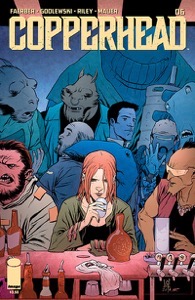
  • Copperhead (2014) #6

    Ch06

    It’s a new arc for Copperhead and Faerber’s off to a strong start.

    The story moves ahead a bit–Clara and Boo are partners, Zeke’s got a babysitter and a secret friend in the fugitive android. There’s futuristic action in Western themes, there’s a lot of texture in the joining of sci-fi and Western in Godlewski’s art–Copperhead is working. Even if Godlewski’s full last pages are still a bad idea. Faerber’s attention to character detail is paying off. Even when it’s a gradual buildup, the comic feels worthwhile. Faerber’s not using accrued goodwill to get through this slow, first act issue, he’s still accruing more of it.

    All of the elements play well together–female sheriff, Western town, sci-fi elements, single parent. Copperhead is perfectly arranged and it’s nice to see Faerber has a way of continuing the comic. Hopefully for quite some time and many issues.

  • Birdman: Or (The Unexpected Virtue of Ignorance) (2014, Alejandro González Iñárritu)

    The funniest thing in Birdman is, surprisingly, not when Michael Keaton and Edward Norton get into fisticuffs and Norton’s in nothing but speedos. The funniest thing in Birdman, which is about former superhero movie megastar Keaton staging a pseudo-intellectual comeback stage production of a Raymond Carver adaptation, is–after Norton makes fun of Keaton’s character’s overly wordy adaptation (Carver wasn’t a wordy writer, as published)–how pointlessly wordiness of director Iñárritu, Nicolás Giacobone, Alexander Dinelaris and Armando Bo’s script.

    There’s also a huge gaffe when Emma Stone talks about Carver’s story being sixty years old (unless Birdman takes place in 2041 and, given the constant references to social media networks, it isn’t).

    Birdman is a pretentious, Hollywood “indie” melodrama. Iñárritu’s fake single shot style, expertly manipulated by cinematographer Emmanuel Lubezki, brings nothing to the film except a distance from the audience. Iñárritu uses the style–and Antonio Sanchez’s drum score–to keep up the film’s energy, because otherwise, there’s nothing but Batman references, superhero movie jabs, New York condescension of Hollywood, trite father-daughter problems and expository dialogue.

    Oh, and Keaton being haunted by Birdman, the superhero his character played to great financial success.

    There’s nothing in the script for Keaton to do. He does it all pretty well, but his part’s exceptionally shallow. The “deep” scenes with ex-wife Amy Ryan suggest Keaton and Ryan could make a good film. Not this one.

    Norton’s great, Stone’s awful. Nice supporting work from Naomi Watts.

    Birdman’s gallingly light stuff.

    1/4

    CREDITS

    Directed by Alejandro González Iñárritu; written by Iñárritu, Nicolás Giacobone, Alexander Dinelaris and Armando Bo; director of photography, Emmanuel Lubezki; edited by Douglas Crise and Stephen Mirrione; music by Antonio Sanchez; production designer, Kevin Thompson; produced by Arnon Milchan, John Lesher, James W. Skotchdopole and Iñárritu; released by Fox Searchlight Pictures.

    Starring Michael Keaton (Riggan), Edward Norton (Mike), Emma Stone (Sam), Naomi Watts (Lesley), Zach Galifianakis (Jake), Andrea Riseborough (Laura), Amy Ryan (Sylvia), Lindsay Duncan (Tabitha), Jeremy Shamos (Ralph) and Merritt Wever (Annie).


    RELATED

  • Copperhead #6It’s a new arc for Copperhead and Faerber’s off to a strong start.
    The story moves ahead a bit–Clara and Boo are partners, Zeke’s got a babysitter and a secret friend in the fugitive android. There’s futuristic action in Western themes, there’s a lot of texture in the joining of sci-fi and Western in Godlewski’s art–Copperhead is working. Even if Godlewski’s full last pages are still a bad idea. Faerber’s attention to character detail is paying off. Even when it’s a gradual buildup, the comic feels worthwhile. Faerber’s not using accrued goodwill to get through this slow, first act issue, he’s still accruing more of it.

    All of the elements play well together–female sheriff, Western town, sci-fi elements, single parent. Copperhead is perfectly arranged and it’s nice to see Faerber has a way of continuing the comic. Hopefully for quite some time and many issues.

    CREDITS

    Writer, Jay Faerber; artist, Scott Godlewski; colorist, Ron Riley; letterer, Thomas Mauer; publisher, Image Comics.

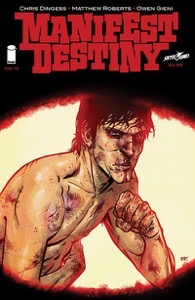
  • Manifest Destiny (2013) #14

    Manifest Destiny  14

    It’s another too fast issue of Manifest Destiny. Or maybe it’s just how Dingess uses the cliffhanger. He’s actually doing character development, both in scene and through the journal narration device, but it doesn’t get to go anywhere because the last few pages are all setting up the cliffhanger.

    Most of the issue has a calm about it, even when the fantastic happens–in this issue, a baby giant bird attacks the crew and gets imprisoned (and, of course, Mama comes looking)–Roberts and Dingess keep it calm. The calm also affects the cliffhanger; because the lead-in is so calm, the characters don’t seem engaged enough to get to the cliffhanger.

    And Manifest Destiny is about its cliffhanger. Roberts gets a whole page for them, they’re the advertising to get the reader back, the promise of something great. So a useless cliffhanger hurts the book.

    The rest is great.

  • Mystery Train (1989, Jim Jarmusch)

    Mystery Train is a comedy. It’s many other things–an examination and comparison of various kinds of differentness–but it’s also a very funny comedy. In fact, Jarmusch keeps characters around for nothing else. Train is the interconnected story of seven people (across three chapters) all culminating at a Memphis hotel. Cinqué Lee is the suffering bellboy, Screamin’ Jay Hawkins is the far more chill clerk. Hawkins and Lee get some great scenes together; both actors separately build their performances and then Jarmusch sits them next to each other. It greats a wonderful energy.

    With the exception of the first story–which has Nagase Masatoshi and Kudô Yûki as Japanese tourists obsessed with classic rock–all of the characters come defined. Since Train is interconnected and set in the same locations at different times of one day, Jarmusch occasionally introduces characters early and momentarily, but distinctively enough to jump start their character development.

    Or, in the case of Joe Strummer’s British emigre, he gets introduced in dialogue.

    The first two parts of the film are the most independent. Nagase and Kudô have their own story arc going separate from the location; ditto for Nicoletta Braschi (as an Italian on an unplanned layover) in the second part. When Elizabeth Bracco shows up (halfway through the film), Jarmusch starts revealing how things might come together. And it’s great. What is background in the first and second stories is foreground in the third.

    Great acting. Gorgeous photography from Robby Müller.

    Train is singular.

    4/4★★★★

    CREDITS

    Written and directed by Jim Jarmusch; director of photography, Robby Müller; edited by Melody London; music by John Lurie; production designer, Dan Bishop; produced by Jim Stark; released by Orion Classics.

    Starring Kudô Yûki (Mitsuko), Nagase Masatoshi (Jun), Screamin’ Jay Hawkins (Night Clerk), Cinqué Lee (Bellboy), Nicoletta Braschi (Luisa), Elizabeth Bracco (Dee Dee), Joe Strummer (Johnny), Rick Aviles (Will Robinson), Steve Buscemi (Charlie), Tom Noonan (Man in Arcade Diner), Vondie Curtis-Hall (Ed), Rufus Thomas (Man in Station) and Tom Waits (Radio D.J).


    RELATED

  • The Fade Out 5 (April 2015)

    The Fade Out #5It’s a sort of gentle issue of The Fade Out, with Brubaker and Phillips heading to the country. The movie production is doing location shooting–albeit on sets, but they’re away from the studio and things are developing. Charlie the protagonist continues his flirtation with the replacement girl while his flashbacks reveal his relationship with the original. Blacklist Gil goes and gets drunk and finds himself in a pickle.

    Plus there’s Hollywood stuff. There’s the tawdry stuff out of James Ellroy, but Brubaker’s got a lot about how the characters react to being away from the studio. While in Hollywood, The Fade Out just seemed like a noir set during the making of a film noir, but on location? Brubaker’s showing his research through Charlie’s narration. The setting feels fresh, real.

    And Brubaker doesn’t go for a cliffhanger. He brings up some things, he stirs a pot, then it ends.

    CREDITS

    The Broken Ones; writer, Ed Brubaker; artist, Sean Phillips; colorist, Elizabeth Breitweiser; publisher, Image Comics.

  • Manifest Destiny #14It’s another too fast issue of Manifest Destiny. Or maybe it’s just how Dingess uses the cliffhanger. He’s actually doing character development, both in scene and through the journal narration device, but it doesn’t get to go anywhere because the last few pages are all setting up the cliffhanger.
    Most of the issue has a calm about it, even when the fantastic happens–in this issue, a baby giant bird attacks the crew and gets imprisoned (and, of course, Mama comes looking)–Roberts and Dingess keep it calm. The calm also affects the cliffhanger; because the lead-in is so calm, the characters don’t seem engaged enough to get to the cliffhanger.

    And Manifest Destiny is about its cliffhanger. Roberts gets a whole page for them, they’re the advertising to get the reader back, the promise of something great. So a useless cliffhanger hurts the book.

    The rest is great.

    CREDITS

    Writer, Chris Dingess; artist, Matthew Roberts; colorist, Owen Gieni; letterer, Pat Brosseau; editor, Sean Mackiewicz; publisher, Image Comics.

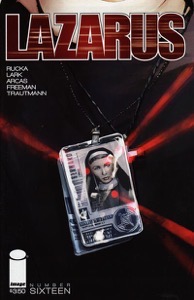
  • Lazarus (2013) #16

    Lazarus  16

    For the first time in ten issues or so, Lazarus doesn’t sit well.

    Oh, it’s fine–the script’s certainly stronger than the first arc of the series, but Rucka’s got a problem. He’s got an artist without time for the comic so what’s he going to do? A fill-in issue. But Lark does most of the art, just nothing exciting. Instead of exciting, there are these graphic design fill-in pages by Owen Freeman and Eric Trautmann. Diagrams, journal entries, all sorts of malarky.

    And it is malarky. Rucka’s got his story–this secret agent nun trying to do something–and he tells it so Lark never has to get too involved with the art. Lots of night scenes, lots of black. Long shots with narration. No one actually talking for most of the comic.

    Fill-in issues, done-in-one issues, they’re a necessary evil to modern comics.

  • Batgirl #40This issue of Batgirl is a little weird. Stewart and Fletcher sort of do an adaptation of… Captain America 2. Satellite going to shoot people from space because they’re bad or might someday be bad. Big plot point in that movie. In the previews, I believe. Just a few years ago.

    Yet, here it is in Batgirl. Not the most original suspense plot.

    The rest of the comic–except the way Stewart and Fletcher refer back to Killing Joke–is pretty good. Stewart and Tarr’s art has a lot of energy, with Tarr’s details giving the comic a distinct style of its own, not quite Stewart, not quite not.

    The epilogue sort of reestablishes Batgirl again, which is way too many times, but it’s a reasonable setup for whatever comes next. Barbara’s still not a character, Dinah’s still not a character, but the writers are getting there. Just too gradually.

    CREDITS

    Ghost in the Cowl; writers, Cameron Stewart and Brenden Fletcher; pencillers, Stewart and Babs Tarr; inker, Tarr; colorist, Maris Wicks; letterer, Jared K. Fletcher; editors, Dave Wielgosz and Chris Conroy; publisher, DC Comics.