• Frasier (1993) s07e18 – Hot Pursuit

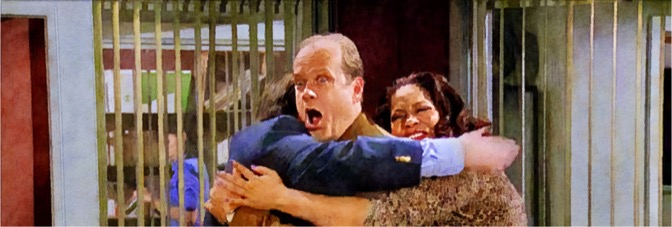
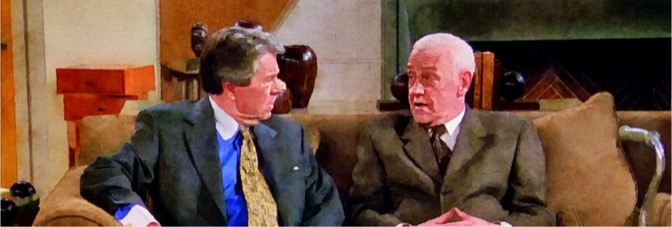
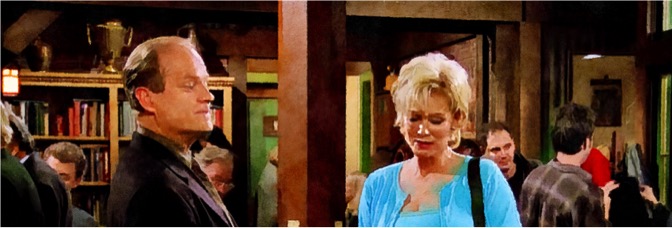
    Hot Pursuit is the second of two season seven “Frasier” episodes credited to writer Charlie Hauck. Considering the job he got on this one, it’s understandable he wouldn’t be back. It doesn’t seem fair to give a new writer an episode about Kelsey Grammer and Peri Gilpin wondering if maybe they ought to just get it over with and jump the shark and sleep together. It’s not a bad idea for an episode. It’s executed poorly here, but it’s not necessarily a bad idea. It’s just too basic, which is a surprise since the other half of the episode is a subtle delight.

    The episode opens with Grammer returning from a week in Boston to visit son Freddy and, consequently, ex-wife Lilith. And, consequently, her late twenties stud boyfriend. No cameos, just exposition and some mid-life crisis facial hair for Grammer. He’s only home for a scene before Gilpin shows up at the door to pick him up for their broadcasting conference. While they rush out, Saul Rubinek—Jane Leeves’s fiancé, only in the episode for this one scene—tries to hire John Mahoney to do some light surveillance. Mahoney’s enthusiastic, but David Hyde Pierce makes him promise not to do it.

    Oh, in addition to the Rubinek bit, Hyde Pierce is around long enough for he and Grammer to make fun of Gilpin being jealous of blondes. It’s a nasty bit for everyone; it’s intentionally bad for Gilpin, but it also makes all three regular male cast members come off like assholes when they tease her about it. It’ll be back later. It’s Chekhov’s reductive female character trait.

    Half the episode will be Hyde Pierce and Mahoney doing a bonding arc, while the other half is a single-set comedy of offscreen errors to get Grammer and Gilpin alone together and having big singles sads. They also talk about how long they’ve been working together—seven seasons, sorry, years—and how it makes them one another’s most successful opposite-sex partnership.

    If the writing were great, if it were some kind of very special episode (maybe Gilpin directing, at least Grammer), there might be something there. Instead, it’s an awkward kicking of the show’s tires, trying to decide how desperate they are to gin up a new twist. Except, of course, they were one of the last nineties sitcoms not to have made a similar move, which… just makes it seem more desperate.

    The resolution is okay but not good.

    The Hyde Pierce and Mahoney arc, however, is sublime. It’s heartfelt, funny, and incredibly well-acted. Grammer and Gilpin try in their arc, but there’s nothing to work with. Sure, they’ve been playing these characters for seven years, but Grammer’s been hung up about Lilith’s never seen new boyfriend for twelve minutes, while Gilpin’s been jealous of blondes her whole life for eleven. It’s nowhere near enough ado about nothing.

    Sigh.

  • Frasier (1993) s07e17 – Whine Club

    Whine Club is half a regular “Frasier” episode, half a “mythology” episode, meaning working on the season’s low-burning arc about Niles (David Hyde Pierce) and Daphne (Jane Leeves) getting serious about other people when they should (?) be getting serious about each other. It’s also got an excellent subplot for John Mahoney where he and his friend’s widow, played by a wonderful Anita Gillette, enjoy commitment-free naughty sexy-time in their sixties or whatever. And it’s directed by Kelsey Grammer, who usually does more auspicious episodes.

    It all might be okay if it weren’t entirely about villainizing Hyde Pierce’s new girlfriend, Jane Adams. She comes over for brunch, and everyone hates her. Will they or won’t they tell Hyde Pierce fills the last five or six minutes, comedy of errors-style. Except, as the episode points out earlier, everyone hated Hyde Pierce’s always-unseen ex-wife Maris, so it’s no surprise they don’t like the new girlfriend. Since we’re seven seasons in and Hyde Pierce’s marital problems subplot started in season three, I can’t remember if there was ever a period when everyone didn’t make fun of Maris (with Hyde Pierce around).

    The whole point of the episode is to show how wrong Adams is for Hyde Pierce, what with Leeves right there and almost out of reach again because she’s getting married, but it just comes off as shitty to Adams. We get it; she’s a harpy. Mahoney reminds Grammer everyone hates all he and Hyde Pierce’s romantic partners (they don’t bring up Shelley Long, but Mahoney hated her too). Grammer and Hyde Pierce hated Mahoney’s steady girlfriend, played by Marsha Mason (who the show didn’t like for being working class). Way to remind the show’s got lousy parts for women.

    The writing credit goes to executive story editor Bob Daily (his first scripting credit on the show) and Jon Sherman (his second). It feels like two episodes smooshed together because there’s actually not any whining in the brunch section. Unless you count Peri Gilpin complaining Grammer roped her into a brunch from hell. Grammer planned it before he and Hyde Pierce got into a fight about their wine club, which only takes up seven minutes of the episode (and feels like the non-mythology part of the show).

    Anthony Head guest stars during the wine club scene. He’s great. It’s a shame it’s just the one scene.

    There’s some hilarious stuff in the episode—drunk Leeves is a standout—but it’d be a lot better if it weren’t so craven.

  • The Night of the Hunter (1955, Charles Laughton)

    Night of the Hunter is a singular experience. Definitionally. It’s the only film Laughton ever directed, which makes sense. The film’s visuals are decades too early for the composites they can do; Laughton did direct plays, which also makes sense. Hunter feels “stagy,” but not. Laughton directs his actors for close-up without ever losing track of their place on stage. Plus, there are some fantastic big sets of the Ohio river shore. They’re during the children’s fairy tale adventure, which makes them more successful.

    Hunter doesn’t start as a children’s film, not exactly, but it will be one for the majority of its runtime. The last third or so is Lillian Gish’s movie. It’s a strange misogynistic patriarchal boot-straps reinforcement arc, but she’s also phenomenal, and Laughton directs it like a Disney cartoon, so it’s troubled but outstanding. Actually, Gish starts the movie. She appears over a star field with some relevant Bible quotes because Hunter is ostensibly about top-billed Robert Mitchum.

    He’s a charming, serial killer preacher, traveling from rich widow to rich widow during the Great Depression. The film opens with a helicopter shot of some boys playing, then zooming in to them finding a murdered widow. Cut to Mitchum talking to God while driving away. It’s a bunch of quick character setup because we’ll never see him justify himself again. He becomes a… well, he becomes a Hunter, but also just a function of the kids’ story.

    The kids are Billy Chapin and Sally Jane Bruce. Their first scene is dad Peter Graves getting home after a bank robbery, with the cops in hot pursuit. He hides the cash, telling Chapin not to tell mom Shelley Winters about it because she’s flighty. Graves soon gets hanged, but not before his cellmate–Mitchum, of course—hears about the stolen money (thanks to Graves talking in his sleep).

    Pretty soon, Mitchum’s sniffing around widow Winters and her kids. Chapin’s suspicious, but Winters’s gossipy church lady best friend and boss Evelyn Varden likes the idea of her settling down with a man of God. And Mitchum seems all too happy to oblige. Plus, Bruce thinks Mitchum’s just great, even if Chapin’s old enough to know something’s not kosher.

    Unfortunately, Chapin’s only confidant is his drunken uncle James Gleason.

    The first half of the movie is Mitchum worming his way into Winters’s life and affections—and setting up his ministry, something the film rushes through because Gish isn’t back to establish Mitchum’s not a true Christian because he’s not her kind of Christian—then there’s the children’s dreamy adventure, then foster mom Gish’s juxtaposition with Mitchum.

    The setting plays a big part in the first half. It’s a small, suffering Depression-era town. Chapin and Bruce’s dad killed two people and then got hanged; they’re infamous. Mom Winters is infamous. Varden’s a good friend to her. The character relationships are delicate and complicated, something Laughton understands and directs for. Both the actors’ performances and how he frames those performances. The film’s screenplay—based on a Davis Grubb novel (better name than anything in the movie) with James Agee adapting—has a particular ear to the dialogue. It’s smooth but stagy; only, since Laughton never lets the film be stagy, it’s something else. It does make sense later with Gish and the Christian patriarchal reinforcement thing; the acting and filmmaking are so good, it never really matters until then.

    Mitchum’s the runaway great performance. He starts scary and just gets worse. He goes from killer stepfather to nightmarish demon. Especially once he and Gish start squaring off. The film sets it up as real versus fake Christian, but… it’s not even different sides of the coin. The reveal of Mitchum’s actual brand of Christianity informs a whole bunch about the character (intentionally). The similar reveal on Gish—even with all its (qualified) humanity—informs a bunch about the filmmakers.

    Anyway.

    Gish is great too. Winters is real good but doesn’t get a full arc because the kids’ adventure takes over. Though, actually, neither does Mitchum.

    The kids are okay. Low okay. Chapin’s better with Bruce or the other kids than with the adults, which isn’t great. He and Bruce fade out in the third act, with Mitchum preying on Gish’s teenage ward, Gloria Castillo. Or at least Castillo wishing he would. Hunter can get away with it because of the fairy tale structure.

    Bruce is often adorable but not particularly good. Gleason’s fun but the part’s poorly written. It’s a caricature with too many details. Varden’s a little much but likable enough.

    Even with their big performances, Mitchum and Gish aren’t ever the whole show. Laughton ensures it’s always Night of the Hunter, a heart-warming, audiovisual spectacle of starvation, robbery, murder, and ice cream.

    The technicals are all phenomenal. Stanley Cortez’s photography, Robert Golden’s cutting, and Walter Schumann’s music. Laughton loves using sound, whether the score, diegetic sound, or diegetic signing. Mitchum’s smooth-talking preacher knows he’s got a good singing voice, which pays off in one of the third act’s most incredible sequences.

    Night of the Hunter’s a beautifully made, often beautifully acted, achievement of a motion picture. Just a tad too reductive of its female characters. Even if you give it the terrible parenting advice because 1955… the patriarchal messaging is a bridge too far.

  • Shadows on the Grave (2016) #8

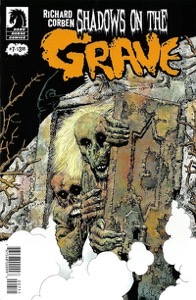
    Shadows on the Grave  8I just got the final reveal in the Deneaus conclusion. Not like I just finished reading it and got the reveal; a few hours later, sitting down to write about Shadows on the Grave’s finish, I got it.

    I should’ve gotten it earlier. Maybe I would in a single sitting reread (I mean, probably not, but we’re pretending here). It’s a nice touch. It doesn’t change anything about the final chapter, but a nice touch. Creator Richard Corben’s had a bumpy road with Deneaus, the only serial in Grave, and it’s nice he’s got it to a solid finish. The art’s particularly lovely, with lots of white space for the open skies and empty landscapes. It contrasts the very busy panels of the rest of the book, which mostly takes place in graveyards.

    Literally.

    Over fifty percent of the other three short stories and two one-pagers takes place in a graveyard. The non-graveyard one-pager, opening the book, involves a corpse. Corben’s got his standards, and he hits them well here. Well, after the first story, anyway.

    The first story’s another robber story; some dude is going to rob an antique shop and pawn the goods somewhere else for cash. The shop owner can tell there’s something skeezy and kicks the guy out, who then watches the store owner acting weird about a cabinet. Of course, the robber will return for the cabinet, with its contents providing scary fodder for the rest of the story.

    The MacGuffin’s only okay because Corben does a weird epilogue thing where he skips some of the action. The epilogue doesn’t work, making the MacGuffin less of a disappointment in comparison. Lots of scary, ominous details, though.

    They really come through in the following story, about a couple of kids playing in a graveyard. One dares the other to go into a child killer’s crypt, only for the gate to get stuck. Corben uses the same epilogue device here and to great success. Corben writes a lot more this issue since he’s still doing eight-page stories, and there’s not much action in them, and the prose here’s better. He’s more patient with it.

    The next story—also a graveyard story—has a woman visiting her mother’s grave, then her three husbands’ graves. Corben does a quick exposition dump, then turns it into a zombie action story with a couple unexpected turns (outside the zombies). No epilogue device in this one (though I’m now thinking about how Corben usually just does them in narration, not scene). Anyway. Another really strong entry. While the first story’s lacking, the second two more than make up for it, then the Deneaus finale brings the issue to a strong close.

    The back cover one-pager bids Grave and its readers an amusing, witty farewell.

    The series has ranged from excellent Corben to uneven Corben. The art’s always been on point, even when the writing’s been wanting (more often than not, that writing isn’t Corben’s). In all, an outstanding Corben horror anthology.

  • Doom Patrol (2019) s04e02 – Butt Patrol

    I’m hesitant to call anything “Doom Patrolling,” a la “Westworlding,” but this episode comes close. The team is recovering from their trip to the future and discovering they bring about the “Butt-pocalypse;” one of the zombie butts from last season has survived to destroy the world. April Bowlby’s all set to lead the team to track down Jon Briddell, the bad guy everyone assumes is involved, but the rest of the team gives her a vote of no confidence.

    So it seems like we’re going to have an introspective mansion episode—and we do for a couple characters—setting up a bigger mission they’d be doing if they were regular superheroes. It’s mostly a first-season device, but they’ve fallen back on it a few times over the seasons. It’s a fine device, and there have been great episodes with it, but it’s the second episode of the new season… little soon.

    Luckily, it’s not that episode at all. Bowlby and Matt Bomer (and Matthew Zuk) have a mansion episode, with Bomer trying to reconnect with his energy parasite—it’s scared of the zombie butt future—and Bowlby is mad Bomer’s not more supportive of her team-leading abilities. Their arc ends up being the least impressive. The show’s not ready to reveal the future energy parasite information, so it’s more about clearing the air; while Bowlby’s mad at Bomer for not being in her corner, he’s angry she came back from the past last season a different person. Albeit, she came back to the future the long way, living ninety years or whatever.

    It’d be excellent acting fodder for Bowlby in particular if it were better. Instead, it’s filler until the rest of the team gets back home. Joivan Wade’s upset no one wants him as team leader, so he’s going to go on his own mission, having tracked down a frozen zombie butt. Diane Guerrero tags along, and they have a decent little subplot. They also get to hash out some of their character drama, setting up nice scenes for the closing montage. Guerrero is doing her best work on the show this season, even back to playing her regular persona.

    Meanwhile, Michelle Gomez realizes they just need to snuff out the problem, so she enlists Brendan Fraser (more Riley Shanahan for the body work) to help her. It becomes this exceptionally depressing arc about Fraser’s newfound ability to feel (just in one finger, but still) and Gomez’s muted self-loathing as she finds herself again manipulating meta-humans.

    Framing the entire episode are the adventures of Keiko Agena’s linguist; starting in flashback, we see how she went to the Ant Farm to work with the butts before the show started. Agena’s real good.

    Outside Bomer and Bowlby’s filler arc, it’s a strong episode; script credit to Eric Dietel.

    Plus, singing, man-eating butts. What else do you want?

  • Doom Patrol (2019) s04e01 – Doom Patrol

    Last season, “Doom Patrol” had to recover from a Covid-19-induced shortened second season, then get the show into a decent spot for HBO Max to cancel them. Thankfully, HBO Max did not cancel them, and now the show gets to do, presumably, at least this fourth season.

    You never know with HBO Max, however.

    Anyway.

    This season premiere picks up about six months after the finale, which saw the Doom Patrol becoming superheroes under April Bowlby’s enthusiastic, if questionable, leadership. Bowlby’s still team leader, Robotman (Riley Shanahan walking, Brendan Frasier talking), is almost rebuilt, no longer Cyborg Jovian Wade and dad Phil Morris are doing that rebuilding as they try to bond, Diane Guerrero’s having a multiple personality crisis, Matt Bomer and Matthew Zuk (Bomer talking, Zuk wearing the hot costume) are bonding with their new electrical alien parasite, and Michelle Gomez is still trying to atone for her many sins as the latest team member.

    Now, Gomez is in the opening credits as “special appearance by,” which isn’t a great sign for her longevity. I kept waiting for her to do a runner this episode, but the show seems sure she’ll be around for a while. Hope so; she and Bowlby are even more fun together hating each other. Or, Bowlby hates Gomez, while Gomez is trying to play nice but noticing the team leadership problems.

    It’s a fine place to start the season, with Guerrero narrating. Her primary persona now is the psychiatrist, played in the Underground (where Guerrero interacts with the personalities) by Catherine Carlen. The narration is Guerrero’s psychological observations about the team, which is an excellent device.

    However, things go wrong once they go on mission, finding themselves thrown into the future—which the audience has already seen in the episode prologue—and discovering most of their future selves dead, all because of some imminent mistake they’ll be making in the past. There’s a nice mix of action, deception, and character drama, with loads of good acting from the cast. The episode even gets in a great music montage (Clint Mansell and Kevin Kiner) where everyone’s moping around the mansion, realizing the new season’s started and shit’s getting real again.

    There are a couple significant reveals in the third act, along with a cameo in an epilogue, lots of future angst, and contemporary drama—the season hook is solid. The episode might feature Guerrero’s best acting on the show, albeit doing a Carlen impression.

    So glad “Doom Patrol”’s back. So glad.

  • Frasier (1993) s07e16 – Something About Dr. Mary

    I’m not sure where to start with this episode. Jay Kogen’s got the writing credit, and he’s had his name on some good episodes in the past. But why they ever thought they ought to do an episode like Dr. Mary. Dr. Mary is played by Kim Coles, a Black woman (and possibly the first significant Black guest star since the first season), who is filling in for show producer Peri Gilpin while Gilpin has her apartment painted. Guilty white liberal Frasier (played by anti-liberal Kelsey Grammer) met Coles while doing an outreach program for job training.

    After initially being shy about getting on the air with Grammer, Coles quickly dominates the show but changing the format. Instead of stuffed shirt Grammer, it’s hip, sassy Black lady Coles—who adopts the “Doctor” moniker because it sounds good, which is one of Grammer’s last straws. Dad John Mahoney just thinks Grammer’s avoiding talking to her about her performance because she’s Black, while brother David Hyde Pierce points out he once had a Black friend. As though someone in the writer’s room decided the lily-white cringe wasn’t cringe enough… Grammer then points out rich Black people aren’t really Black people.

    The episode also includes an ableist subplot to distract from questioning whether Hyde Pierce, Mahoney, and Grammer are really the ones to be talking about race. Grammer and Gilpin making fun of a colleague with a speech impediment.

    The episode employs various devices to show how Coles’s becoming more popular—apparently, the radio station is taking out advertisements mid-broadcast—to the point, it threatens Gilpin’s return. Station manager Tom McGowan loves Coles because she makes the show more popular and, for a radio show, better. Grammer never considers the possibility radio professional McGowan might be correct. Gilpin’s the only one with a vested interest in staying, and she’s happy to move on if the money’s right.

    The episode’s subplot has Hyde Pierce taking up kickboxing, bumping into Jane Leeves, and then cooking for her and Mahoney because she’s milking the injury (at Mahoney’s insistence). It’s fine. At least Mahoney’s not saying “massa” during it (spoiler, he does in the other plot). And there’s some good physical comedy for Hyde Pierce.

    Grammer’s got a broken part, as does Coles, who will eventually have to forgive Grammer for being too scared to talk to her like a person because she’s Black (and a woman). But both of them have good moments.

    Something About Dr. Mary, besides the title, doesn’t so much not age well as reveal how white creatives had (read: have) such ingrained misogynoir, they can turn it into an entire sitcom episode but never acknowledge its existence.

    Oof.

  • Killer of Sheep (1978, Charles Burnett)

    Killer of Sheep is a series of vignettes, usually connected with a sequence at the slaughterhouse (though not always slaughter, but sometimes, so be ready), always connected with a piece of music. Sometimes the music recalls a previous scene or musical selection, creating a narrative echo between the sequences. And even though Sheep is incredibly lyrical in its structure, somewhere in the second half—as enough time has progressed—more traditional plot lines have formed.

    Mainly because lead Henry G. Sanders has started hanging out with Eugene Cherry and Cherry really wants to get a car running. Except Cherry’s terrible at bigger-picture car stuff. He can install an engine block but is hazy when it comes to gravity, leading to a couple harrowing sequences.

    And then Kaycee Moore has a definite subplot; she plays Sanders’s wife, who’s feeling his depressive episodes in all sorts of ways. Sheep is about being Black working class in the early seventies, with L.A. in some kind of a transition (the neighborhood kids play in unfinished buildings, constructions or destructions), and writer, director, editor, and cinematographer Burnett knows there’s a lot there for a Black woman. But Sheep doesn’t explore it, just how Moore (and the other Black women) experience being around the men.

    The setting and time period mean there’s no way Sanders can call what he’s experiencing depression, but he does know there’s nothing he can do about it. He and Moore have somewhat recently moved to the city with their two kids. Jack Drummond plays the tween son, Angela Burnett’s his little sister.

    At the open, it seems like Drummond will be the more significant kid. Burnett juxtaposes Sanders’s story with scenes of the neighborhood kids at play. Mostly the boys, though the girls get a memorable scene, so it seems natural Drummond’s going to be the more important. He’s ingesting a lot of toxic masculinity, both out playing and (passively) from dad Sanders, and he’s started bullying sister Burnett.

    But since he’s always out of the house and Burnett’s too young to go out on her own—we eventually see she does have friends, but they come over with their mothers—she’s much more present for Sanders and Moore’s unhappy moments together, but also their time apart. Moore and Burnett have a gentle mother-and-daughter arc; lots of lovely moments.

    While Moore and Cherry have plot lines and identifiable arcs, Sanders sort of doesn’t. Yes, he’s the main character, yes, it’s about his work contributing to his depression, but if Sanders’s character knows how to verbalize any of those feelings, he doesn’t on screen. And what we do see on screen suggests he doesn’t. Again, he’s trapped in a depression, knowing there’s no way out. Even when he gets exceptionally asterisked job offers—one’s to be a cabana boy for the liquor store lady, the other’s to be wheelman on a hit—we don’t get his reaction. The liquor store scene ends emphasizing the awkwardness and awfulness of the situation (the owner only cashes checks for the Black men she’s got the hots for, i.e., Sanders), and Moore’s the one who shuts down the wheelman conversation.

    With his male friends, Sanders can find a comfort he can’t with Moore, which even the kids recognize (though Drummond’s acting out from go). Moore’s trying everything she can with Sanders, but he just doesn’t talk to her. There are some devastating scenes for the two of them. While Sanders gives the film’s best performance, Moore gives the most essential. Sheep simply wouldn’t work without her anxious but muted energy. She’s primed in anticipation, but Sanders is utterly resigned. Burnett mixes the contrary tones beautifully.

    Burnett’s most impressive work on the film—well, technically, it’s producer because he made the film—but creatively, it’s his direction and editing. His photography’s excellent, and the writing’s strong, especially for a mostly amateur cast. But the direction is where he’s superlative, whether with the actors (again, the editing and writing working in unison) or with his composition; Sheep’s always phenomenal. The way Burnett bakes looming danger into a film without any violence (against people, anyway) is something else.

    And it relates back to the character relationships. There’s a lot of turmoil between Sanders and Drummond, Sanders and Moore, and Moore and Drummond. Their interactions are sometimes foreboding, especially given Drummond’s seeming lack of, well, sense. Things aren’t going right for the family in Sheep, but only Drummond is actively threatening to make them worse. It’s rending.

    Thanks to the montage device, Burnett’s able to end Sheep whenever and goes out not so much on a surprise, but still abruptly. The third act’s got a nebulous start time until the film’s end when events become a little clearer. It’s bleak but not fatalistic. There’s always a lot of hope, even as Sanders is drowning in hopelessness.

    Sheep’s an exceptional film.

  • Stage Struck (1958, Sidney Lumet)

    Conservatively, Stage Struck has six endings. They start about fifty-eight minutes into the film, which runs ninety-five minutes. Actually, wait, there are probably—conservatively—seven. I forgot how many there are mid-third act before the actual (ending-laden) finale.

    For a while, the false endings add to the film’s charm. Maybe if the third act hadn’t reduced lead Susan Strasberg to a glorified cameo… but by the end, Struck’s already had all its problems. It’s got a doozy—Strasberg’s in a love triangle with Broadway producer Henry Fonda and playwright Christopher Plummer. Strasberg was twenty at the time, Plummer twenty-nine, and Fonda was fifty-three. For context, Strasberg’s real-life dad was only three years older than Fonda. Strasberg’s character is eighteen-ish. They establish she left her hometown in Vermont, where she was in all her (now dead) uncle’s plays. Fonda presumably reminds her of her uncle (ick). She fawns over him, wanting him to Svengali her, and he can’t help but fall for her. It doesn’t hurt his regular girlfriend, younger but not “I’m only a few years shy of being old enough to be your grandpa” territory Joan Greenwood, likes to punish him for slights by withholding physical affections.

    So, yeah. For a while, it seems like Struck’s going to be all about Fonda and Strasberg getting together. It’s not, thank goodness, and any threats to revisit the topic end up just being threats, which also get contextualized for Fonda’s character–rich white guys never have to grow up and think about things if they stay rich and white enough—it doesn’t ever stop being creepy (especially since Strasberg looks like a kid kid), but… I don’t know; it makes “sense.” And Fonda’s really good at playing this old creeper who does try to act responsibly. Somewhat.

    Stage Struck is a remake of Morning Glory, which is based on an unproduced stage play. And Struck filmed entirely on location in New York City, as the opening title promises. Director Lumet and cinematographers Morris Hartzband and Franz Planer have some trouble with the location shooting, but Lumey’s instincts are all good, and when the shots look good, they look great. There’s an exterior location scene between Strasberg and Plummer—if it weren’t a late fifties studio remake of an early thirties studio picture—it’d be exceptional. Lumet and his photographers foreshadow seventies Hollywood New York movies by over a decade.

    And there are some exceptional moments in the film. It’s all about Strasberg wanting to make it on Broadway but not wanting to go the regular route. She was in a play club in her hometown; she knows all the Shakespeare by heart, why should she go to the Actor’s Studio (did they consider having her real dad—Actors Studio coach Lee Strasberg—cameo); she wants to be a star now. It doesn’t work out for her in act one, but when she’s back in act two, she has this line about having to prove herself. Strasberg’s got to prove to the Broadway people in the movie she can be a major stage actor, which means she’s also got to prove it to Struck’s audience.

    She does. It’s incredible. At first, it seems like Lumet doesn’t have the scene, then he does, while Strasberg keeps delivering great moment after the great moment, Lumet holding the shots. It echoes in the third act. It’s so good.

    Sadly, it’s also when Fonda sees something he likes.

    But it’s more Plummer’s movie than anyone else. He’s the new playwright who throws in with commercial success Fonda. The film starts with them going into production on one play and ends with their production on the next. Lumet and screenwriters Ruth and Augustus Gortz do a fine job opening the film up enough it never feels too stagy—Lumet loves the theater so much he bakes in acknowledging the stage—but none of these people exist outside their professions. Even when we see Fonda at home, it’s in the context of Broadway producer.

    Lots of great acting. Strasberg has an unsteady first act, a knockout second then is missing from most of the third. Intentionally, which is a bad choice. Plummer’s great, and Fonda’s outstanding. Herbert Marshall is an older actor who thinks Strasberg’s swell, but since he’s in his sixties, he doesn’t have to be a pervert about it. Greenwood’s good, even though she’s reduced to foil. Nice small work from Daniel Ocko and John Fiedler. Struck’s got a lot of fine performances; given the subject, it’s got to have them.

    The film’s a little too experimental for its own good (with the location shooting), and the third act’s a mess, but Stage Struck’s pretty darn good. A tad too pervy, even if muted, but it’s not a factually inaccurate representation of how Broadway producers behave… and the acting’s superb. Strasberg’s a marvel, and Plummer’s a great lead (in his first theatrical film).

    Oh, the Alex North music.

    It’s a tad much; chalk it in the experimental column, especially when it plays over the actors.


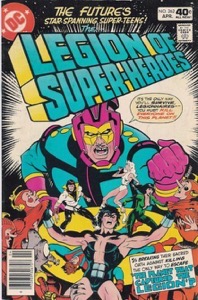
  • Legion of Super-Heroes (1980) #262

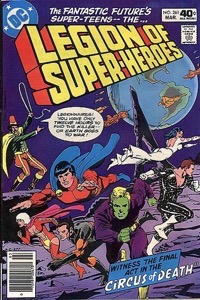
    The Legion of Super Heroes  262James Sherman is back on art after an extended period, now going by “Jim.” His style’s simplified, with a lot less detail. He’s still got fantastic composition and his people—again, simplified—have a lot of personality in what he does give them. Last time he was on the series, he was doing these lush, expansive sci-fi action panels. Now, he’s still got the sci-fi action, just not the lushness (well, a few times). He’s not as good as before, but he’s still pretty dang good.

    Leagues ahead of the norm on Legion, anyway.

    Writer Gerry Conway opens with Lightning Lad and Saturn Girl on Earth talking about the Legionnaires off on their missions. They’re telling readers everything they need to know to jump on (including who’s married to who, who’s dating who, and so on; it’s a tedious exposition dump). Anyway, last issue, we read about the space circus mystery, this issue, we’re going to read about the Legion team trying to help R.J. Brande rebuild his fortune. He makes stars. Zaps space dust and turns it into a star, which he then moves around for performance art. Or something. It’s unclear. And they get distracted from their mission when they discover a destroyed star system.

    It ends up being a pretty good issue. It reads like Conway’s trying out for the “Star Trek” license, with the Legionnaires encountering a strange, dangerous planet with a complicated secret. Conway even makes a “final frontier” reference, inviting the comparison. It’s okay, especially with Sherman’s art giving the characters chemistry on their detour.

    There are a few times the script and the art don’t match. First, when Light Lass rescues some other Legionnaire, he wants to give her a thank you kiss, but they’re seeing other people. In the reflection on Wildfire’s helmet, we see them locking lips, but it’s not written as ominous just fun. Maybe everyone in the Legion can swing now Superboy’s gone with his Midwestern values.

    Later, there’s a space travel moment made nonsensical by the art and writing being out of whack, which is far less interesting than illicit behavior.

    It’s nice to have Sherman around. Conway works better with him—even taking the occasional disconnect into account—than anyone else on the book so far.

    I’m sure he’s not staying. Can’t catch a break on this one.

  • Frasier (1993) s07e15 – Out with Dad

    As usual, I regret not keeping better track of writing credits. Joe Keenan gets the credit this episode; he’s been writing “Frasier” since season two with numerous big successes, but based on Out with Dad, I’d have thought him a newbie. The episode picks and chooses plot points from outstanding—and memorable—episodes and mixes them a bit. Dad John Mahoney tells Mary Louise Wilson he’s gay, so she’ll stop flirting with him, and she sets him up with her… well, wait, Brian Bedford’s English.

    So maybe her brother-in-law? Anyway, Bedford is Marg Helgenberger’s uncle, which is important because Kelsey Grammer’s interested in Helgenberger. Only Bedford’s interested in Mahoney, so Mahoney has to pretend he’s gay for the evening, except gay and unavailable. He can’t come clean about being straight because it’ll mess up Grammer.

    People being confused about Mahoney being gay goes back to season one. And the family pretending they’re something other than cishet WASPs most memorably happened in the “let’s pretend we’re Jewish” episode, but I’ll bet there have been more. Out just stirs them together a little differently.

    Oddly, it’s a Valentine’s Day episode too. Grammer ropes Mahoney into going to the opera because otherwise, Mahoney would be at home watching chick flicks with Jane Leeves and Peri Gilpin. David Hyde Pierce was supposed to go with Grammer, but Jane Adams (who doesn’t appear) stayed in town special for him. Grammer doesn’t want to give up his seat (to Adams to go with Hyde Pierce) because he’s got the hots for Helgenberger, another opera-goer. When he and Mahoney get there, Mahoney waves at Helgenberger to be extra, but Wilson thinks he’s spotted her. Confusion and hijinks ensue, including Mahoney drafting an unlikely person as his romantic interest.

    It’s an amusing episode; it’s just entirely redundant. There are some good laughs (and nice human moments, eventually, for Mahoney), but it’s an adequate episode for a sitcom in its seventh season, nothing more. And Helgenberger makes almost no impression, with first Wilson, then Bedford running all her scenes.

    Solid direction from David Lee probably helps a lot. Again… fine, with asterisks.

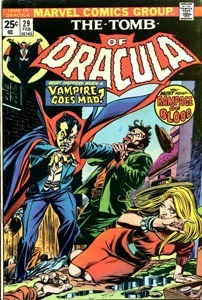
  • Tomb of Dracula (1972) #29

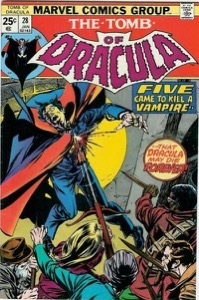
    Tomb of Dracula  29I can’t believe how well writer Marv Wolfman ends up doing with this issue. It very much should not work, yet it ends up working (in no small part due to Gene Colan and Tom Palmer’s superb artwork; it’s one of their best issues). But the story… wow wee. Dracula starts the issue attacking a random babysitter, and after the splash page, Colan goes with the vampire bat attacking from above, which was a visual trope for the first few issues of Tomb. Colan dropped it almost noticeably, and it’s only one panel here; not as much terrifying the victims, I guess.

    See, Dracula’s upset because he got dumped. Familiar Shiela left him for Yeshiva student David and so Dracula’s rampaging. He goes to bed, planning to kill David the next night. Luckily, since Shiela’s so upset about Dracula, David goes to kill him. Even though Shiela and David can’t be more than friends—“right or wrong,” their differing religions get in the way—he wants her to feel safe, so he’s going to succeed where everyone else has failed.

    Sure.

    Wolfman’s second-person narration mainly just lectures Dracula about being such a son of a bitch (Boris Karloff should’ve done readings of this narration, a la The Grinch). It’s not great and initially seems like it’s going to do the issue in. It does not, however, because Dracula’s actions—separate from the close second-person—reveal a much more complicated character arc. I’m sure Wolfman didn’t intend for the narration and the narrative to work against each other, but it’s a success.

    Less successful—though very weird by the end—is Taj’s origin story. Dracula attacked Taj, his son, and his wife. The wife ran and got her legs crushed, a vampire bit the kid, and Rachel Van Helsing showed up in the nick of time to save Taj from Dracula. The wife narrates the origin and tries to trick… well, the reader, but apparently also Taj. It doesn’t matter because even though he’s been shitty to her—presumably okay because she ran out on him during the attack—they get busy in a very sexy scene from Colan and Palmer. Looks like a romance cover.

    The resolution to the main plot’s a little abrupt, but the rawness helps with the emotion. It’s a rather good issue.

  • Frasier (1993) s07e14 – Big Crane on Campus

    Oh, “Frasier: Season Seven,” why do you continue to taunt me? This episode has Jane Leeves and David Hyde Pierce cooking together and being adorable for the first time since Leeves found out about Hyde Pierce crushing on her. It’s a good scene, with Hyde Pierce getting to more fully participate—previously and problematically, these scenes have been from Leeves’s perspective (way to get a big subplot: it’s entirely in service of the dude). Sheldon Epps directs the episode and knows how to make it work. It’s a regular “Frasier” scene, only a little different; Hyde Pierce isn’t the awkward one; now it’s Leeves.

    If I’d been watching this episode in February 2000, I’d have been fully committed to the idea of them getting together. Best thing for the show.

    Whoops.

    Otherwise, the episode’s a Kelsey Grammer-centric episode. He’s just happened to meet his high school crush (a hilarious, brassy Jean Smart) and can’t believe she’s being nice to him. Once they actually start seeing each other (there are some great scenes with Smart teasing a blubbering Hyde Pierce), Grammer discovers she’s a little too brassy for his tastes. Except he can’t give up the prom queen, not with their high school reunion just around the corner.

    Outside Leeves and Hyde Pierce’s kitchen moment, everything in the episode’s in support of Grammer (and Smart). She’s a relatively featured guest star, getting a lot more complicated scenes than Grammer’s girlfriends usually get. Peri Gilpin’s around to talk Grammer through dating for the wrong reasons; she gets a classic literature book club C plot, which comes back in the end credits sequence as a way to be shitty. It’s an unfortunate finish to a strong episode.

    First and foremost, it’s an excellent showcase for Smart, who was only a few years from starting to be appreciated in 2000. Or closer to it than “Designing Women.” It’s also proof they can do a mythology moment well for Leeves and Hyde Pierce. Mark Reisman, another new-to-the-show-this-season writer, gets the credit. And, finally, it’s a solid outing for Grammer. It treads somewhat familiar territory but with a fresh enough angle. He tends to be really good with his guest stars, and Smart’s no different.

    So, another good episode to convince me everything’s fine and we’re not driving toward a cliff in a Winnebago.

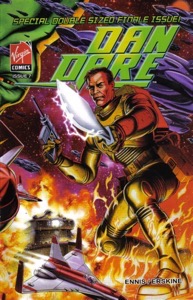
  • Dan Dare (2007) #7

    Dd7

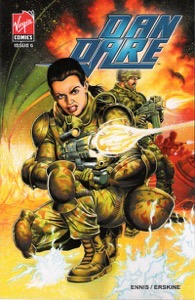
    I’m going to assume Dan Dare had a future-sword in the original comics or whatever, because otherwise, writer Garth Ennis has even more to answer for.

    This final issue is oversized, which I’d been gleefully anticipating, but it turns out it’s too long. It’s fluffed up with lots of double-page spreads and it’s still too long. Worse, Ennis reuses entire bits from previous issues for that fluffing. The issue flops around quite a bit, with Ennis and artist Gary Erskine both at fault, but Ennis not having enough story is the real problem.

    Erskine draws some repetitive space battle scenes—all the ships look alike, so while occasionally visually impressive, it’s not visually interesting. There are occasional fighter spaceship scenes, which end up being where Erskine comes through. It’s nice he’s got something he clicks with because—pretty much everything else—he doesn’t.

    The issue’s split between Dan boarding the Mekon’s ship for the final showdown, which Erskine renders like Luke and the Emperor in Jedi because Ennis doesn’t give him anything else to do, Dan’s newest companion, Lieutenant Christian, commanding his flagship in the space battle, and Jocelyn back on Earth, getting drunk and waiting to hear whether humanity’s conquered.

    The best subplot is Christian’s, which has her butting heads with an admiral who’s never been in a space battle but thinks he ought to be in command. The Dan plot, before it goes Jedi (without a Vader), is essentially a repeat of a couple issues ago, just with the same characters in different parts. Erskine utterly flubs the showdown between Dan and the Mekon, too, though—again—it’s not his fault Dan’s got a sword, and it’s not his fault Ennis doesn’t have a showdown.

    Then Jocelyn’s whining is weird because it’s all about future history after the original Dan Dare and before this series when the newly formed British Neo-Nazis want his support with Brexit or something. It’s utterly superfluous world-building just when the comic’s closing up.

    Ennis and Erskine still get in a few good scenes and moments, mainly when it’s a war comic, sometimes when it’s dealing with the “Dare as legend.” Most of the issue is just hoping it never gets too bad or too visually confusing. Erskine lacks continuity between panels, first occasionally, then all of them. It’s like the pages got lettered in the wrong order.

    I’d forgotten how Dare ends—I do remember waiting forever for the final issue, which would’ve been one of Virgin Comics’s last publications—and I know why I’d much rather remember the series’s successes than its failures. It’s not a terrible last issue, but it’s not a good one, either.

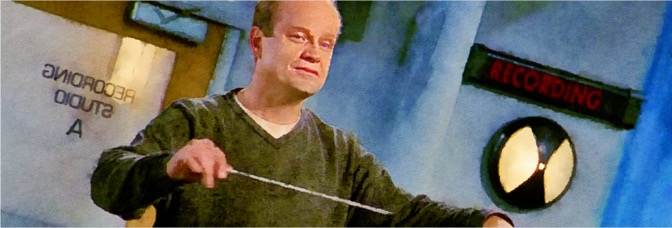
  • Frasier (1993) s07e13 – They’re Playing Our Song

    I’m feeling a little like the boy who cried wolf, on the lookout for “Frasier”’s inevitable, impending fall; the show’s two episodes away from the “mythology” two-parter, and those two episodes have been excellent. This one’s all about Kelsey Grammer going overboard while composing a theme song for his show. Station manager Tom McGowan wants something simple, a catchy jingle. So, of course, Grammer’s got a full orchestra, choir, and David Hyde Pierce on hand to perform some spoken word. All on Sunday overtime.

    It’s mostly a Grammer episode. There’s some ensemble work in the build-up, with Hyde Pierce helping Grammer with the initial composition, dad John Mahoney offering a much better idea and being ignored, and then Jane Leeves finally going after the icky old chair with a super-powered vacuum. Peri Gilpin gets to hang around at the beginning since it’s a radio episode. Eventually, she’s just in the audience, too; everyone’s there to watch whatever Grammer’s going to do.

    There’s a lot of good banter—the script credit goes to David Lloyd, who’s had his name on numerous great “Frasier” episodes—and the finale even brings it around to Mahoney and Grammer having a father and son moment. Mahoney, Leeves, and Gilpin all get a little in their audience portion of the episode. Gilpin’s latest boyfriend is an unemployed musician, Leeves knows Mahoney’s song is good, and Mahoney’s confused about the free donuts. Then Hyde Pierce gets a lot of material, but it’s all in reaction to Grammer and his magnum opus writing. There are lots of smaller guest parts (the orchestra members) who only interact with Grammer, usually with excellent banter.

    It’s also nice for McGowan to get a little more than usual. He sticks around for most of the plot this episode, whereas he usually gets a scene and then disappears.

    David Lee does a fine job directing. It’s just a really good episode. If I’d been watching it at the time, I’d have thought they had their impending big changes all figured out. Little would I have known….

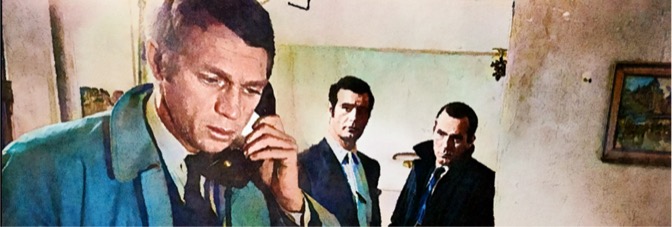
  • Bullitt (1968, Peter Yates)

    Bullitt is from the period when Hollywood wasn’t calling the Mafia the Mafia yet—it’s “The Organization” here—and none of the mobsters had Italian names, but they are mostly Italian (heritage) actors. It’s especially funny because part of Bullitt’s conceit hangs on WASPs like up-and-coming senator Robert Vaughn not being able to tell Italians apart.

    But that inability figures into Bullitt’s solution, which is beside the point. It’s such a nothing burger, the whole thing gets explained in two and a half lines as lead Steve McQueen and sidekick Don Gordon head off to the next set piece. Because while the film’s all about McQueen’s investigation, it’s about McQueen investigating. The film’s a character study of a hotshot San Francisco detective during one of his cases, and, despite the property damage, it might not even be one of his biggest cases. We don’t know. Vaughn wants him on the case because McQueen makes good press, but there’s never any press in the movie.

    And we do see the occasional newspaper. Director Yates is hyper-focused on McQueen, though that focus doesn’t mean we get the full procedural. We don’t even see the resolution to the elaborate, exquisite car chase. Instead, we skip ahead to the next time McQueen’s going to do something idiosyncratic.

    So, despite being (apparently) beloved by his fellow coppers, McQueen is very much not a regular cop. He hangs out with a happening crowd, dating British architect (I mean, she’s working on an architecture project) Jacqueline Bisset. She doesn’t know about his work life, and he likes to keep it that way. For good reason, it turns out. While there are probably a couple significant events in McQueen’s character’s work life covered in the film, the tack-on subplot about his girlfriend realizing he’s around poor people in poor places all day and not liking it seems the most consequential one.

    Though, who knows, because the most relationship-building the film does for McQueen and Bisset has him being charming and then admiring. Otherwise, he’s a little busy with work.

    The film opens with a gorgeous titles sequence (from Pablo Ferro Films) and expressive Lalo Schifrin music recounting a mob accountant getting away from goons in Chicago. In some ways, the titles set the tone for the film; in other ways, very much not. For instance, Schifrin’s score will barely figure in during the main action; Yates is far more interested in the diegetic sound; John K. Kean has the sound credit, with Duane Hansel, the uncredited sound editor. They do singular work. Bullitt’s got its share of genre and style innovations, but the sound design is on a whole other level.

    However, the camerawork in the titles is similar to the rest of the film. Yates and cinematographer William A. Fraker alternate between vérité and precise movement. Yates likes his crane shots too, even limited ones indoors—lots of Bullitt is about watching people work and listening to the environment around them. More specifically, it’s about watching McQueen watch people work. The first major dramatic sequence in the second act involves ER doctor Georg Stanford Brown operating while McQueen (and eventually Vaughn) wait. Vaughn’s agitated, McQueen’s… seemingly not, seemingly reserved, but what’s under the surface? Yates points the camera at McQueen and inspects, which he’s already established as a motif in the first act (when McQueen’s admiring Bisset). Such good direction.

    Until the third act, when Bullitt becomes a detached action thriller—with Yates, Fraker, editor Frank P. Keller, and the sound department all using previously established techniques on a giant set piece set at the airport—it’s all about watching McQueen’s face, his eyes, his breaths; waiting for him to act and react.

    Other characters get similar inspection too. Usually, when dealing with McQueen or Vaughn, but also not: cabbie Robert Duvall takes it all in from the first scene in San Francisco, as the mob accountant turned witness works his way around town. Police captains Simon Oakland and Norman Fell both especially get to stare daggers while waiting on McQueen and Vaughn. But bad guys John Aprea and Bill Hickman watching McQueen (or, more accurately, his car) is maybe the most remarkable since Yates and Keller are implementing the technique in the middle of a car chase. Again, such good direction.

    Most of the performances are outstanding. McQueen’s spell-binding; Oakland, Duvall, and Brown all have great moments. Vaughn’s a piece of shit politician, so he’s somewhat limited, but he’s real good at it. Similarly, Bisset’s a little too thin, but she’s fine. No time for love or architecture in Bullitt. Gordon’s a good sidekick and the occasional comic relief. He and McQueen have fantastic rapport, which makes their scenes work more than the dialogue.

    The script—credited to Alan Trustman and Harry Kleiner, based on a Robert L. Fish’s novel not starring a character named Bullitt (and written under the pen name Robert L. Pike)—is terse and willfully obtuse at times. Bullitt feels like Yates and Keller, especially, made it in the editing studio, but who knows, maybe Trustman and Kleiner really did write it so remote. There are some great one-liners, though; it’s not overtly macho but enthusiastic about its procedural jargon–such a strange, transfixing combination.

    Fraker’s photography is glorious and would be the easy technical standout if it weren’t for Keller’s peerless cutting.

    The third act’s got a handful of problems, but Bullitt weathers them well thanks to McQueen, Yates, Keller, Fraker, and company. It’s a masterful piece of work.


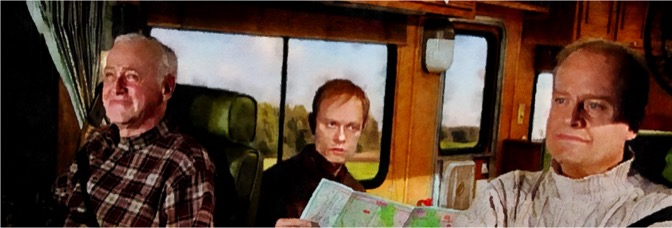
  • Frasier (1993) s07e12 – RDWRER

    Despite the unfestive title, RDWRER is the third “Frasier” in a row to do a holiday. Two episodes ago, it was a birthday episode (sort of) for Kelsey Grammer, then last episode was a Christmas episode, and now this episode is the New Year’s. There’s no specific mention of the new elephant—Jane Leeves knows David Hyde Pierce had a crush on her, but he doesn’t know she knows. Instead, it’s a Crane Boys episode; Grammer, Hyde Pierce, and Mahoney go on a wacky adventure.

    The episode starts with Grammer and Peri Gilpin talking about their respective New Year’s. Grammer’s requires a flashback (and the entire episode). He and Hyde Pierce’s plans have fallen through, so they finagle an invite to a Wine Country party; they just need to get there. Good thing dad Mahoney’s custom plates—RDWRER (Road Warrior, sound it out)—have just arrived for his Winnebago. After a short scene with Leeves (she gets one bit then exits), it’s a road trip episode, with Grammer and Mahoney never letting Hyde Pierce drive.

    New-to-the-show-this-season credited writers Sam Johnson and Chris Marcil do a great job, and Grammer delivers on the directing front. As per usual, he showcases his fellow actors over himself—Leeves’s outburst about late Christmas cards, Mahoney getting into it with a rural cop, Hyde Pierce convinced he’s been kidnapped. Then Grammer lets himself have a great showcase talking to Hyde Pierce—telephonically—about the kidnapping. It’s an “event” holiday episode, much more than the preceding two. The show’s not letting the mega-plot get in the way of an episode this time.

    There are a couple fun and weird bits. First, Mahoney’s obsessed with Austin Powers, even though Grammer assures him he’s missed the pop culture moment. It’s silly and ages awkwardly—if they were really betting on Mike Myers being ubiquitous, they bet wrong—but it gives Mahoney some absurd lines to deliver well. Then Rebecca Schull guest stars. She was on “Wings,” which takes place in the same universe as “Cheers.” I can’t remember if there was ever any post-“Cheers” crossing over with “Frasier,” but… it’s a good bit part. She and Anthony Zerbe are an old couple also on the road in a Winnebago.

    I think there was an episode of “Wings” where Schull had an evil twin. Maybe she’s playing the third sister here.

    Anyway.

    Excellent episode. Clock’s ticking, though. The clock is ticking.

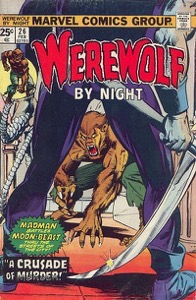
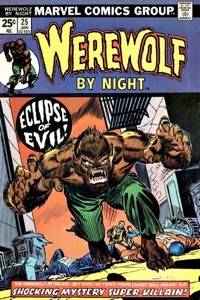
  • Werewolf by Night (1972) #26

    Wbn26

    Artist Don Perlin keeps himself busy this issue. Each page has at least seven panels, usually with Perlin doing the action in small, vertical panels, in long-shot. As detail isn’t Perlin’s strong suit, the composition choices help.

    I have to be honest and admit I dug this issue so much I’m worried about myself. There’s nothing good or interesting about it, but it’s a monster comic set in the Marvel Universe. We get a three-way fight between Wolfman Jack, the Hangman (who Doug Moench writes better than Marv Wolfman, who created the character back in Werewolf #11), and the seventies Mr. Hyde.

    Mr. Hyde’s got a ridiculous name—DePrayve (but better than George Lucas’s prequel proper nouns)—but it doesn’t matter. Werewolf has a relatively low bar to clear, though Moench seems again committed to changing things up. The last time he changed things up, Moench made the comic closer to its ground situation back in the first few issues. Moved Jack in with Buck again, reintroduced Lissa’s frequently forgotten impending werewolf curse, and brought in another dipshit cop. The last dipshit cop was dirty. This dipshit cop doesn’t know the last one was bad news, so has it out for… well, Jack, I guess. Wolfman Jack.

    Moench writes a peculiar comic, from the Hangman’s (restrained but well-focused) rants and then Jack’s narration. It’s still forgotten experience—Jack doesn’t remember the werewolf’s adventures, even though he narrates them in the comic—but Moench ignores the discrepancies better.

    The less you think about Werewolf by Night, reading it or writing it, the better.

    It’s a godawful issue for Jack’s pal, Buck, not just because Perlin can’t draw him the same in any two panels.

    Otherwise, no guest stars. No step-dads, no sisters, just Hangman terrorizing the werewolf. It’s better than it ought to be.

  • Frasier (1993) s07e11 – The Fight Before Christmas

    “Frasier” does indeed run into immediate problems with Jane Leeves finding out David Hyde Pierce has a crush on her (and has had one for quite some time). Leeves has her first moment of romantic interest—post finding out—and it’s when Hyde Pierce puts his jacket on her. They’re standing out on the balcony unraveling the plot-driving confusion. Leeves has spent the episode thinking Hyde Pierce is romantically interested in her again because he’s on the outs with girlfriend Jane Adams, while Hyde Pierce just wants to patch things up with Adams.

    But they’re out in the cold Christmas air (it’s the Christmas episode), and when Leeves shivers, he offers his suit jacket. Why are they out on the balcony? So he can discretely ask her something (related to Adams), and while it’s awkward, it doesn’t require them to be outside. It’s just to set Leeves to get swept away by gallantry in an absurdly unnecessary situation.

    Last episode—the “first part” of this two-parter, quotations because it’s not a real two-parter—neither Adams nor Saul Rubinek showed up. In this episode, Leeves initially thinks Hyde Pierce won’t confess his devotion because Rubinek’s around. Except Leeves has now got the “what ifs,” and it’s derailing the show. Or at least threatening to do it.

    The episode begins an indeterminate time after last episode, which was a birthday episode (initially) for Kelsey Grammer. I’m vaguely curious if they do him having a birthday just before Christmas in other seasons, but I’m not willing to do the work. But some time has passed, only Leeves hasn’t seen anyone to tell them about the crush discovery. Anyone meaning Peri Gilpin, who becomes Leeves’s sidekick this episode, which is fine—they’re great together—but it’s strange and forced.

    Pamela Fryman directs this episode (she did last episode, too) and does a fantastic job. Grammer’s got a Christmas party at work (Tom McGowan and Edward Hibbert briefly guest), and then he and John Mahoney have Christmas antics fun; Fryman does great with that stuff. And she does all right with Leeves’s, but she can’t make it work. The script—credited to Jon Sherman (who didn’t get the credit last episode)—just isn’t there.

    To confuse Leeves, Hyde Pierce has an opening subplot regarding Maris, which means Adams’s most significant contribution is a brief harpy scene. Rubinek does slightly better, at least getting to have fun as Grammer’s Christmas party gofer.

    It’s okay, but the problems are immediately showing. Not assuring.

  • Frasier (1993) s07e10 – Back Talk

    This episode is the first entry in a two-parter, but one of those loose sitcom two-parters where it’s just so they keep them together in syndication. Whatever comes after Back Talk will be inevitably different because, after over a hundred and seventy episodes, “Frasier”’s going to deal with one of its longest-running story arcs.

    Not the chair, though it gets mentioned.

    No, this episode is where Daphne (Jane Leeves) finds out about Niles (David Hyde Pierce) having a crush on her. Possibly. It depends on how drowsy Kelsey Grammer’s painkillers make him, but Leeves is on a collision course with the reveal.

    But it doesn’t start about the seven-year crush; it begins with Grammer’s birthday breakfast and a bad back. And some good jokes with dad John Mahoney giving him gruff. The episode’s script credit goes to Lori Kirkland; Pamela Fryman directs. It’s a near exemplar “Frasier,” from the structure to unexpectedly giving Leeves a big acting task, except it’s too functional. There’s no going back if Leeves finally finds out… you can just see the TV teasers.

    When Grammer tells Peri Gilpin about his bad back, she suggests he list his current complaints about the human condition aloud. He finally gives in to the idea—with Hyde Pierce and Gilpin nicely teaming up against him—only when he confesses (to an unlikely recipient) how much he will miss Leeves when she leaves (no pun; to get married), she overhears and thinks he’s got romantic feelings.

    Something Mahoney reinforces (without elaborating on). So Leeves thinks Grammer’s got the hots for her and gets really uncomfortable—another great sequence from Leeves. This episode gives her a lot more to do than usual.

    Excellent performances from Grammer and Leeves, with some solid scenes for Mahoney too. Gilpin and Hyde Pierce are all support; they’re good and funny, but they’re all support.

    There’s a great subplot about Grammer discovering the best salve for his bad back, which comes back in the credits scene just right.

    It’s a really good episode. But it’s also a really good episode related to the show’s Achilles heel (or so we’ll soon learn). From here, however, it seems like they’ve got smooth sailing ahead.

  • Emergency Declaration (2021, Han Jae-rim)

    Emergency Declaration is a disaster movie made like a horror movie. It’s not just any disaster movie, either; it’s Airport meets Airplane but with bioterrorism. The bioterrorism doesn’t have to do with the horror movie; it’s all the investigation procedural. The horror movie experience is entirely reserved for the victims (and the audience). Declaration doesn’t thrill, it doesn’t excite, it terrorizes. From the start.

    As we’re meeting busy cop dad Song Kang-ho (whose wife Woo Mi-hwa went on vacation with girlfriends without telling him), co-pilot Kim Nam-Gil, single parent Lee Byung-hun, and seeing the flight attendants and class trips arrive, we’re also meeting Yim Si-wan. He’s asking the desk clerk weird questions about the flights because the first act of Declaration is all about how lax Incheon Airport security is going to cause lots of problems.

    Pretty soon, Lee’s adorable daughter, Kim Bo-min, has to go to the bathroom and goes to the boys because the class trip is waiting in line for the women’s. In the can, she just happens to see Yim slicing himself open so he can put a vial inside to get through security. Again, it’s Airport, only with bioterrorism instead of a bomb. And then it’s Airplanebecause Lee’s actually a hotshot pilot who burned out and is now a bit of a drunk. Luckily adorable Kim keeps him in line.

    Now, by the time Kim sees Yim mutilating himself, it becomes clear director Han isn’t stopping the terror any time soon. Especially not when cop dad Song goes on a call about some TikToker threatening to do something to an airplane. Song pretty quickly discovers evidence, and it’s time to start talking about turning the plane around. Except no one listens to Song for a while.

    But it’s okay because we’ve established the pilots made sure to get extra fuel (bad weather in Japan, which comes up again).

    So we’re just waiting for Yim to do something and to see how it affects the lovable or at least sympathetic cast of passengers. Especially Kim, because Yim decides to terrorize her.

    Now, Yim’s just an incel. He’s some other things on top of it, but when the news eventually compares him to someone else, it’s a U.S. mass shooter incel. Declaration came out in 2021, so in the middle of Covid-19, but you’d never know it. It’s a recent movie where Rona doesn’t happen (wow, did South Korea do things better than the U.S.—everyone’s crowded together in this movie, on plane or not), but it’s about bioterrorism and how people react to communicative disease. So it’s this weird, in-direct commentary on Rona only not, starring a generic incel, only not.

    Or it would be such a commentary if Han weren’t just making a terrorizing movie about a lot of people dying horrible deaths and no one really being able to do anything to help, especially not over-promoted men, the United States, or the Japanese. Though Song’s somewhat shoe-horned in so they don’t have to give Jeon Do-yeon too much to do as the government minister in charge of the response. The movie decides in the third act she’s really super-duper important, only they don’t give her enough in the first act. She makes sense; she’s navigating the bioterrorism thriller. Lee’s on the plane doing his Ted Striker thing. Song’s around like it’s Taking of Pelham One Two Three. They needed first and third act drama, so they gave it to Song, while at least some of it should’ve been Jeon’s.

    When I say director Han’s trying to terrorize, he’s not being coy about it. Whether or not the unfortunately constant lens flare is supposed to be ominous as far as foreshadowing (spoiler, yes), the editing and music are just about scaring the audience. Lee Byung-woo’s score is excellent. It’s almost entirely just horror movie slasher stalker music. Relentless.

    Then the editing—from director Han, Lee Kang-il, and Kim Woo-hyun—cuts to and from characters in moments of incredible stress and tragedy, and fear. Whether they’re in the ground or the air, it’s just about scared people in their worst moments. Han brings incredible severity to this fictional remake of Airport. It’d be an opportunistic melodrama if it were a true story. But it’s not, so it’s just terrorizing.

    And it works out pretty well. Declaration starts cracking somewhere in the second half, and it’s falling apart by the third. The film forecasts a lot of the story (intentionally) and occasionally drags things out too much.

    There’s some excellent acting. Song and Woo have some great phone call scenes, Lee’s an awesome imperfect hero, and Yim’s never not scary. Han directs the hell of the film with outstanding CGI plane special effects. It’s gorgeous.

    It’s also manipulative, and a little insincere, but—as with everything else Declaration does—expertly so.

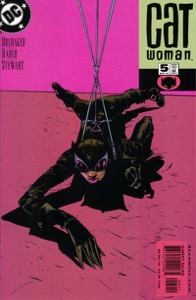
  • Catwoman (2002) #5

    Catwoman  5

    New art team Brad Rader and Cameron Stewart take over for this done-in-one, which brings Slam Bradley into the series proper—he appeared in a Detective Comics backup setting up Catwoman (or at least tying in enough to be reprinted in the first trade… I think). But he and Selina team up this issue, which is a profound style clash. Rader and Stewart visualize Catwoman action scenes akin to previous artist Darwyn Cooke—with one big exception, which I’m saving for later—but their Selina and Holly investigation procedural pages are like Silver Age romance comics.

    And Slam looks like a villain out of a Dick Tracy knock-off, which is some of the point. There’s the contrast in characters, come together in this weird little corner of Gotham City, but Rader’s not great at integrating the two visually. Slam always looks out of place, just slightly too much of a literal caricature to fit.

    It doesn’t really matter because it’s a great issue. Ed Brubaker’s script is superb, and—aside from Slam sticking out—Rader and Stewart do a fine job. And here’s that big exception—out of nowhere in the second half, Rader bakes in this building rage in Selina. She boils over with it, even as her narration is relatively cool. It’s fantastic stuff and one heck of a success for Rader on his first issue, especially following up Cooke. When a pissed-off Selina comes across a bad guy, her anger’s palpable entirely through the art.

    Very cool.

    The story’s about Selina trying to shut down a drug mule operation. The bad guy is getting neighborhood kids to do it, flying down to South America with a fake parent, swallowing a bunch of dope, flying back in intestinal distress, pooping it out. I’m pretty sure there’s another way to get the drugs….

    Anyway, doesn’t matter. Holly has found this bad thing going on, Selina will take care of it. Even after she collides with Slam, who’s working a case somehow involving the Mr. Big.

    But then there’s also the initial bad guy, who Brubaker gives this incredibly efficient character arc. Outstanding work, with Catwoman distinguishing itself well as something other than “Darwyn Cooke’s Catwoman without Darwyn Cooke.

    The creative team seems to realize they’ve got to make a good impression, and all of them do so in unison and separately. It’s real good.

    More, please.

  • Shadows on the Grave (2016) #7

    Shadows on the Grave  7

    I’m back to wondering if they commissioned a bunch of stories from the same prompt, and now it’s creator Richard Corben’s turn to do them himself. There aren’t any co-writers this issue, not even on the one-page strips. It’s just Corben, and it’s a triple.

    Unfortunately, there are four stories, but the first three more than make up for the lag.

    The first story’s the writing prompt one. Some selfish nephews visit a dying relation, looking for some cash. The relation tells them to bugger off—it’s a Shadows standard—and then the money-seeker kills them. Except here, the relation dies of natural causes, and the boys are left contesting a will. It isn’t actually Richard Corben illustrating an estate law procedural, but it’s just as weird in the end. There’s some beautiful pacing on the story too. It feels double-sized, thanks to Corben’s opening narration and how it carries the opening one-page strip’s tone.

    Beautiful work.

    Then the following story is about a gravedigger who works for his corrupt cousin. After being particularly shitty one day, the cousin decides to follow the gravedigger home and check up on his living situation. He’s in for a big surprise.

    Similar to the first story, Corben sets up one horror story trope only to do something else with it. This story also has the biggest haunting factor of the issue (and it’s in the running for the most haunting of the series)–another strong entry.

    The third story’s about a woman getting a ride from some dude, and they stop at a roadside horror museum. Except the only thing in the museum is a creepy garden with moldy statues.

    Corben pushes too hard on the writing—he draws the couple like love interests, but their dialogue just has them acquaintances. It’s so noticeable by the third page I went back to check if he had a co-writer. The story turns itself around enough by the end, with some really dark humor, even for Corben. The art’s particularly gorgeous on this one.

    The last eight-page feature is the Deneaus chapter, the Ancient Greek action epic Corben’s been doing the whole series.

    It’s the penultimate chapter. Most of the chapter is a battle scene with the bad guys falling right into Deneaus’s traps. Some good art, but there’s nothing to the story. Even with all the twists and turns, Corben’s not going anywhere with it or the characters. It’s too bad. Still totally fine, but a disappointment. Especially taking the rest of the issue into account.

    The two one-pagers are fine. The back cover color one gets away from Corben, but the first one’s solid.

    I’m going to miss this series.

  • Black Adam (2022, Jaume Collet-Serra)

    Black Adam opens with kid narration. At first, it seems like the narrator kid is Ancient Kahndaqi Jalon Christian, who’s sick and tired of living under a tyrannical king who has his people mining eternium for him. Eternium is not a “Masters of the Universe” thing; it’s more like the DC Universe version of vibranium. Except not really, because it doesn’t do anything. They set it up like it gives people superpowers, but… no.

    But the narrator is not Christian because the flashback’s not in English. The present-day Kahndaqi people all speak English (and are apparently a Christian Middle Eastern nation-state in the DC Movie Universe—they’re Muslim in the comics, but the movie people don’t have the stones to make sympathetic Muslims).

    Anyway. The narrator is Bodhi Sabongui. His mom is renegade university professor Sarah Shahi (dressed like a less objectified “Tomb Raider”); she’s trying to keep Intergang from getting all the Eternium. Including a magic crown, which we saw in the prologue. The evil king wants to be a demon lord and needs the crown, but then the people’s hero comes to stop him.

    In the comics, Intergang was a criminal organization in Metropolis who gave Superman trouble. In Black Adam, they’re Blackwater, except they’re called Intergang. And they’re committing war crimes daily, but there’s no United Nations to send Jean-Claude Van Damme and whoever in the DC Universe. Instead, there’s the Justice Society, and they don’t give a shit about Intergang committing war crimes. They’re about maintaining the status quo, globally speaking.

    So when Shahi resurrects Dwayne “The Rock” Johnson from his tomb to save her from a bunch of bad guys, Viola Davis calls Hawkman Aldis Hodge to go keep the West’s oil interests safe or whatever. The first act of Black Adam—besides the introduction to the superhero team, which is basically just an X-Men sequence (or Deadpool 1)—is a little like Terminator 2. Sabongui is going to teach Johnson it’s not okay to kill people. Except, not really, because Sabongui’s country is being occupied by a criminal organization who made speeder bikes because they really liked Tron. It’s a complicated situation and might need Johnson’s killer instincts, which Pierce Brosnan realizes, but no one listens to him despite him being a hundred years old with a magical gold helmet to tell him the future.

    Now, I really hope Davis gets two million dollars a minute in these movies on the condition she films on her iPhone in the bathroom, but Brosnan’s hacking through this movie. He gets some energy when he’s opposite the other actors, including Hodge, who’s an intentional charisma vacuum (he’s playing the straight edge who gets in the Rock’s way), and especially Johnson. Still, Brosnan looks exasperated with all the superhero business.

    So, interesting casting choice.

    Quintessa Swindell and Noah Centineo play the young superheroes. Centineo is a legacy hero and a lovable, slightly dopey bro. Swindell has a way too intense origin recap, seemingly just so she can privilege-check Centineo. Black Adam’s got three credited screenwriters, but it feels like Many Hands contributed. Because despite that first act “young John Connor and his pet Terminator” setup, the second act’s mostly a superhero fight movie. Johnson’s dealing with the mercenaries while Hodge tries to stop him and let the mercenaries go back to killing civilians.

    But there’s also the magical archeology subplot with Shahi and then the secrets of Johnson’s origin story.

    The movie’s got a surprisingly effective plot structure. Director Collet-Serra front-loads the best action sequences, set to either pop songs or scene-appropriate selections; the rest of the action’s middling, occasionally a little better. Johnson turns on the charm a little earlier than he should—narratively speaking—but the movie needs it, and he obliges.

    Oddly catchy score from Lorne Balfe; it’s not particularly good, but it earworms all right. The special effects and technicals are all competent, though there’s way too much going on in the third act without enough actual content. Characters have big, action-packed story arcs just to delay them from participating in the main plot. It’s weird. They also use a lot of slow and fast motion effects to distract from the finale’s limited scale.

    Johnson’s the whole show and he’s much better than anyone else in the movie. His closest competition is Brosnan and Brosnan’s not close. Centineo and Swindell are likable, but in a TV show supporting cast sort of way (which is appropriate since they’re TV show supporting cast). But Shahi and Sabongui—occasional affability aside—aren’t good. And whatever Hodge is doing isn’t working.

    With some very specific caveats, Black Adam’s far from a fail.

  • Legion of Super-Heroes (1980) #261

    The Legion of Super Heroes  261

    Ric Estrada takes over on pencils—John Calnan still inking—and I guess I hope he takes over from Joe Staton. Estrada’s not great on distance or action shots, but his close-ups are okay. And his not-great stuff fits with writer Gerry Conway’s Silver Age-y Legion. For example, this issue has the Legionaries hitching a ride on a warp trail. One of them just grabs it. And not Star Boy. Timber Wolf can do it.

    Though based on Conway’s occasionally insipid narration, Timber Wolf can do anything. Except keep his mouth shut. He barks a bunch of orders before chasing a bad guy, with the narration talking about how he never talks.

    He just talked–more than anyone else.

    The story has the Legion stopping the Space Circus Assassin, who is apparently trying to start an intergalactic war between Earth and one of its former colonies. The only thing to unite the two peoples was the Space Circus, but if meanies are going to try to incite violence, what’s even the point? The silliness gets the comic through quite a bit.

    It also helps they’re trying to uncover the assassin, so it’s a mystery with various reveals. Brainiac 5 is around to tell people when they’re right or wrong; whether they listen to him is another story, sometimes leading to trouble. Based on the conclusion, not only should they have really listened to him, Conway should’ve written it better. It’s a decent espionage thriller at its core, but the Space Circus stuff is just too goofy.

    Except then again, Estrada does better with the goofy. The finale’s weird and enthusiastic.

    I’m not sure Conway Legion is ever going to be “good,” but it’s certainly better than usual.

    I really hope Estrada sticks around.

  • Tomb of Dracula (1972) #28

    Tomb of Dracula  28

    Writer Marv Wolfman starts this issue with a….

    Okay, here’s a welcome to the future moment. Wolfman starts the issue with a quote about a Hindu king, making me think this issue was the third in his “religion” trilogy of issues (beginning with the Jewish issue, then a generally religious one) with Hinduism. But not only doesn’t Wolfman return to it—he’s just doing it to South Asia up Taj’s brief appearance, which reveals what I remember it revealing—it’s not even from a Hindu text. It’s from A Man and a Woman, an 1892 novel by one Stanley Waterloo, an American newspaperman turned novelist. Despite being a hit in the 1890s, Waterloo didn’t maintain popularity long enough for anyone to turn his works into movies.

    He apparently made it into a book of quotes unless Wolfman was really into willfully forgotten pop literature.

    Anyway.

    After Taj’s scene, which has his wife taking him to see their vampire son, who the villagers have decided—out of fear but no inciting incident—should die. The villagers had been donating their blood for years to keep the kid “alive,” but not anymore. He’s got to go. It’s a well-illustrated scene but dramatically inert. Wolfman’s narration when Taj is protagonist is at best condescending and often worse.

    The main story is Dracula, familiar Shiela, and her new de facto beau, David, fighting an unrevealed villain for control of the Chimera statue. No more spoilers than the following, but the Chimera statue is basically like if the Infinity Gauntlet were made out of toothpicks glued together. It can conquer the universe, but it’s really, really, really delicate.

    The villain gives the leads hallucinations, good and bad, so Shiela dreams of Dracula loving her as a woman. David’s scared his dead dad was actually an atheist and thought his son going to Yeshiva was stupid. Dracula has a fight scene with the vampire hunters. Dracula’s hallucination ends with daughter Lilith delivering the fatal blow as she’s the one he fears the most. I wonder if that detail will come back.

    The ending suggests the series is undergoing another change in supporting cast, which is peculiar for several reasons.

    There’s excellent art from Gene Colan and Tom Palmer, and some of Wolfman’s character development is, if not successful, at least engaging. But there are definitely causes for concern. The series has been in a kind of limbo for a half dozen issues, and Wolfman’s just heading in deeper.

  • Dan Dare (2007) #6

    Dan Dare  6

    As I feared, Gary Erskine continues to fall apart on the art this issue. As I assumed, it doesn’t really matter. Writer Garth Ennis is doing such a phenomenal job with the script, Erskine gets a pass. He’s got exceptional problems with depth—I don’t even know how to describe it but somehow, although Erskine’s figures are three-dimensional, they’re not three-dimensional in relation to one another. It’s actually disquieting, looking into Dan Dare’s now soulless eyes.

    Which are better than busy eyes, which Erskine and colorist A. Thiruneelakandan give acting Prime Minister and former Dan Dare companion Jocelyn Peabody and then one of the admirals. Dan Dare: The Revival companion Christian escapes the busy eyes—you have to see them, it’s like the person’s supposed to be surprised, but Erskine draws it like they’re staring so hard their eyes are watering—but mostly because she’s not in the comic enough. And when she is in the comic, she’s background or conversation fodder. The aforementioned admiral talks smack about Dare putting her in charge.

    Half the comic is resolving last issue’s cliffhanger—the Mekon’s got Dan and is going to torture him, then conquer Earth—then the other half is the final battle getting underway. Ennis works up a rather interesting juxtaposition for the two arch-enemies: they’re the only competent person on their respective side. Well, besides Christian and Peabody, but they’re just lassies, aren’t they? The Mekon’s army is at least genetically predisposed to being easily led (and distracted), while the British admiralty no longer trusts their sailors. Or whatever they’re called in space. Ennis gets in some good military culture digs.

    There’s also a lot of sci-fi stuff as the humans figure out how the aliens have harassed a black hole and so on, along with some battle tactics. Ennis paces this issue beautifully; it feels double-sized, but it’s not. However, the next issue will be, and I imagine it’ll feel like at least three comics. Three great comics.

    Can’t wait.

  • Lady Bird (2017, Greta Gerwig)

    Lady Bird is a loving tribute to Sacramento, California, specifically growing up there as a teenager, from the perspective of a main character who hates Sacramento. Writer and director Gerwig opens the film with a travelogue of Sacramento streets and locations, a device she repeats sparingly (only significantly in the fantastic finale); Lady Bird is set in the fall of 2002; Gerwig and cinematographer Sam Levy shoot it in a grainy, succulent style. It looks seventies; only it’s very, very 2002 (and 2003). It’s particularly particular when Gerwig does an absurdist—but grounded—comedy aside.

    It’s a gorgeous film, start to finish, and Gerwig’s enthralled with her subjects, whether setting, scenery, or character.

    Despite an exceptionally on-point opening quote and irregular narration from lead Saoirse Ronan (and despite her being the Lady Bird of the title), the film is not a character study. Especially not of Ronan. Laurie Metcalf gets scenes from a character study, which ends up just making Gerwig’s big swing of a finale even more successful. Ronan is the daughter, Metcalf is the mom. Lady Bird is all about the two of them missing each other, hating each other, loving each other. From the start.

    Before the Sacramento montage, which turns into a Catholic high school ground situation montage, Gerwig and Metcalf are on their way back from a college visit. They’re bonding over the Grapes of Wrath on audio cassette (2002), and then one of them says just the wrong thing, and the other one gets pissed off, and they argue and ruin their moment. As the film progresses, Gerwig’s going to reveal the depth of their emotionally rending relationship, layering in the details from conversations between the two, but also just comments from the supporting cast. Because Gerwig and Metcalf’s relationship is at the core of the family dynamics; dad Tracy Letts plays peacekeeper, while brother Jordan Rodrigues and his live-in girlfriend Marielle Scott watch from the sidelines. Everyone’s got a slightly different perspective on it, whereas Ronan just thinks Metcalf can’t stand her.

    Which isn’t wrong.

    The family drama is backdrop. In the foreground, it’s Ronan’s senior year of high school. She goes to a ritzy Catholic school on a scholarship. Her best friend is another scholarship kid, Beanie Feldstein. Their friendship is one of the film’s tectonic plates, and they’re fantastic together. Lois Smith is the nun in charge. She encourages Ronan to try theater, which leads to her meeting Lucas Hedges, her first love. Except then they all go to a Thanksgiving concert, and Ronan gets a look at moody boy Timothée Chalamet, and things start getting complicated.

    Chalamet runs with an entirely different crowd—the rich and popular one—while being a tragically hip, soulful, Goth anarchist who sits through everything performatively reading A People’s History of the United States. Chalamet simultaneously looks twelve and thirty-eight; when he’s going, everything stops and stares—Ronan, Gerwig, the viewer. He’s captivating. And such a perfect little jackass.

    But it’s not like Hedges doesn’t come with problems, and Ronan’s never met anyone like Chalamet. She’s not in college yet, where she’ll discover he’s just a trope, albeit with some substantial motivation with his own home life. Besides Ronan, the most family we get is from Feldstein and Hedges, but it’s there for all of the kids. Metcalf’s very aware she’s living working class in expensive circles, something she tries to impart to Ronan without success.

    Things get worse when Letts loses his job, especially since it adds to the things he keeps from or downplays with Ronan. The character relationships are delicate and precise, with Gerwig and editor Nick Houy making all the right cuts.

    The film’s technically superlative. Gerwig’s direction, Levy’s photography, Hoey’s cutting, Jon Brion’s music (though the soundtrack is more important, and—in what can only be described as a baller move—Gerwig has the stones to turn liking a Dave Matthews song into a plot point), and then April Napier’s costumes. But the film’s all about Ronan’s performance.

    Watching Lady Bird is watching Ronan to see what she’s going to do next. The same thing happens with Metcalf, which is such an outstanding echo—but Ronan’s in the spotlight. Gerwig throws a lot at her but then—especially in the second act—skips significant dramatic moments, so Ronan doesn’t have a steady character development arc. Instead, Gerwig uses skip-aheads to adjust the narrative distance, finding a different angle to inspect Ronan’s performance. Ronan’s full-stop great, but Gerwig hinges the entire thing on her being able to do the development arc in summary; Gerwig’s incredibly trusting and fully rewarded for it.

    Ronan, Metcalf, and Chalamet are the best performances, but there aren’t any slouches. Letts, Feldstein, and Hedges are all great too. Smith’s awesome, as is Stephen McKinley Henderson as the theater teacher priest.

    Lady Bird’s one of a kind from its first story beat (in the prologue) and then, over and over, one of a kind. It’s even magical at times. Gerwig, Ronan, and Metcalf do incomparable work.

    It’s so damn good.


    This post is part of the Fake Teenager Festivus hosted by Rebecca of Taking Up Room.

  • The Jericho Mile (1979, Michael Mann)

    The Jericho Mile plays a little like a truncated mini-series. The first hour of the film introduces the characters, the ground situation, and does an entire arc for six characters. There’s a minimal subplot about prison psychologist Geoffrey Lewis trying to convince seemingly super-fast-running inmate Peter Strauss to open up in therapy. Lewis then gets the idea to have Strauss run against some college runners; the subplot involves warden Billy Green Bush and track coach Ed Lauter, but it’s all just set up for the second half.

    The first hour is all about Strauss and best friend Richard Lawson. Strauss is the quiet, obsessively working out white guy, Lawson’s the affable Black guy. They stay away from the Nazis (Brian Dennehy, Burton Gilliam, and Richard Moll), and they stay away from the Black Liberation Army guys (Roger E. Mosley and Ji-Tu Cumbuka). They’re just friends, and it’s a beautiful arc. Both Lawson and Strauss get epic monologues, with director Mann showcasing the performances. Mile’s technically uneven for a TV movie—there’s clearly different film stock, and the sound’s terrible—but Mann, Strauss, and Lawson were definitely approaching the film as an acting showcase. It’s almost stagy, but never in a bad way, just Mann spotlighting the acting well.

    Lawson needs to bump up a visit from his wife and newborn baby, and only Dennehy can get it done, which pisses off Mosley. It feels like a short story, but immediately after, there’s this sports movie about Strauss’s Olympic possibilities uniting the prison behind him. The first hour directly informs the second half—Strauss’s reasons for trying to compete, for example—but there’s also all the ground situation to build on. Mann opens the film with a five-minute montage of life on the prison yard. Mosley’s pumping iron, Dennehy’s holding court, Miguel Pinero and the Mexican gang are playing handball, Lawson and Strauss are running. There’s this great prison newspaper sports page narrative device to kick off Lewis’s interest in Strauss (only not really because Strauss was on his radar already). It goes nowhere in the second half, which is weird, but Mile runs out of track in the third act, so it’s not a surprise….

    Anyway.

    The wide-reaching character development arcs in the second half all build off material Mann subtly baked into the film. Mile’s exceptionally well-directed. It’s a shame Rexford L. Metz’s photography and, especially, Michael Hilkene and James E. Webb’s sound isn’t better because it ought to be a sublime viewing experience. Mann directs it; budget and circumstance don’t allow it.

    The problems all come as the big race approaches. It’s a sports movie, after all, there’s got to be a big race. There are some existing problems, like Bush busting ass as the warden and never being good enough. The part’s written like a reformer with political ambitions, but Bush plays it without motivation and then makes some bombastic choices like he ought to be wearing a novelty hat. In one shot, Lauter appears just as confused by Bush’s behavior as I am.

    And some of the performances aren’t as good as the best performances—Strauss and Lawson—but the movie’s all about showcasing those performances. Mosley, Dennehy, and Lewis are all solid as the main supporting players, but their parts are limited. They exist to react to Strauss and other events, to provide fisticuffs to delay the race.

    Everything’s going along just fine until they need to resolve Strauss’s therapy arc, which they create right at the end of the second—it’s running and then, wham, great Strauss monologue—and then resolve two or three scenes later after the race. It’s so fast, and there’s none of the promised character development for lifer Strauss going outside the prison. Instead, it’s just the second part of his therapy breakthrough monologue.

    It feels like they had three one-hour episodes; they kept the first one, then cut the second two hours down to one. The second act’s bumpy at times too, but Mann nails the sports movie, so it’s okay. But the finale’s just too messy.

    Excellent performance from Strauss, a really good one from Lawson. Strauss gets better writing (script credit to Mann and Patrick J. Nolan).

    Jimmie Haskell’s music is interesting. About a quarter is great, a quarter is bad, another quarter is just there, and then the rest is Sympathy for the Devil but in a non-copyright violation-y way. The movie’s theme music is Sympathy for the Devil, which is on the nose considering it’s about a sympathetic prison inmate.

    Still. Jericho Mile’s beautifully directed, with some phenomenal performances and strong writing.


    This post is part of the World Television Day Blogathon hosted by Sally of 18 Cinema Lane.

  • Werewolf by Night (1972) #25

    Werewolf by Night  25

    I can’t imagine Werewolf will keep it going, but somehow they find themselves this issue. I mean, it’s Doug Moench’s surfer bro pulp and Don Perlin’s “what if I just page layout like it’s 1952” penciling and inking, but still. They’re in sync here, and it’s… fine?

    Or at least closer to fine than I’d have thought. I was dreading Perlin taking over the inks, but it ought to be okay if he keeps aiming low.

    Now, there are caveats, of course. Perlin’s figure drawing is hard to describe without sounding ableist. He seems to draw an oval for the body, an oval for the head, not thinking about necks, shoulders, or chests. There is one panel where he seems to be doing a Mike Ploog homage with Jack’s features. However, Perlin’s got no consistency with Jack’s features, so maybe it’s just roll of the dice.

    The story finishes up last issue’s modern Jekyll and Hyde story (sort of). Wolfman Jack escapes the police—after wrestling with the obnoxious cop in the worst drawn net I’ve ever seen or imagined—and fights the Hyde monster on the streets of Pasadena or wherever. It’s the first time the werewolf seems to have killed someone in ages (for all the killer werewolf talk, Jack’s only killed like one guy), but then Jekyll recovers to turn out to be a future foil.

    Jack’s stepfather (and uncle) Phillip and sister Lisa show up for a few panels. She’s still waiting to turn eighteen and werewolf out; the funny thing about Werewolf is the monthly structure means you could count how many months since Jack’s eighteenth birthday (within a two-month margin of error). In other words, this Lissa thing better pay off.

    (It won’t).

    The finale brings back a previous villain, which is perilous. Moench doesn’t have the space to go overboard with narration (Perlin’s got six landscape panels most pages, no deviations), and it helps immensely. We don’t get seven adjectives a sentence anymore.

    But Werewolf’s in precarious “harmony.” Too much personality from a villain might break it.

    I’m not exactly enthusiastic about Werewolf, but I’m not dreading it… which usually lasts two issues. We shall see.