Category: 1990
-

You know, the Aliens stories in Dark Horse Presents, for whatever reason, never bugged me. However, this Predator standalone… it’s really out of place. Maybe it’s because Arcudi’s writing is so lame (he does have a good twist, but Walton’s art makes it hard to appreciate as everyone looks the same). It’s not so much…
-
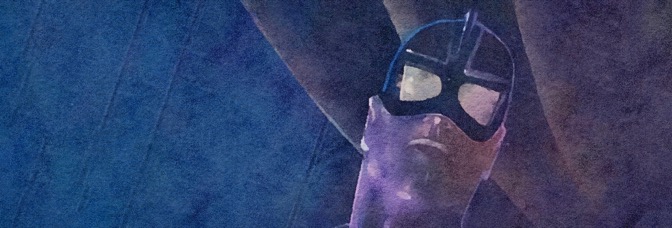
While the letters page informs me Wagner’s Aerialist isn’t homophobic, but then I wonder why I haven’t seen any comics in Dark Horse Presents where a guy forces a woman to have sex to degrade her. Because the story ends with the boyfriend of the protagonist forcing himself on him (after the protagonist was off…
-
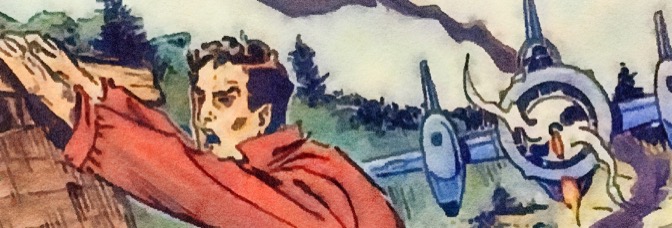
Harris’s Crash Ryan takes place in some kind of alternate 1930s, where America is under attack from some homegrown sky pirate organization called Doom. It’d competently done, but sort of too soon to tell how it’s going to work out. It’s not, you know, guys in tights, but it’s traditional mainstream fare. Then it’s Geary’s…
-
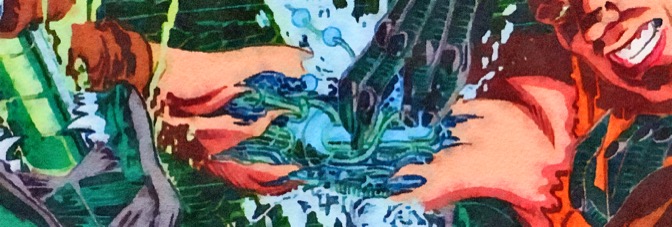
Guinan’s Aliens finish is incredibly weak, featuring not just an Alien reference but some guy in the future running around in an Indiana Jones outfit. The plotting is so weak, it might be construed as a spoof… But I think Guinan’s serious. He’s got some very profound-sounding exposition. Davis does a one page riff on…
-
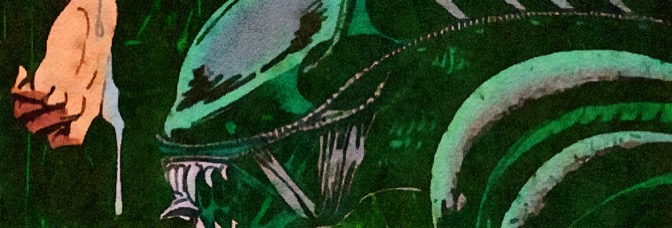
So Guinan’s approach to the Aliens mythology is astonishingly unenthusiastic. By some accounts his Heartbreakers collaborator Anina Bennett assisted on the writing, so maybe some of it is her fault. Guinan sets the story on a planet full of pyramids, with zero wonderment about this awesome alien civilization. Then he does some silly stuff with…
-

I guess up against Zick and The Argosy, Randall’s writing on Trekker seems really good. Maybe the plotting is a little better this time around from Randall–I wasn’t expecting the ending at all–and he’s still doing a lot of good work on the art. It’s crazy how different Trekker looks from when it started, even…
-

You know, I think Matt Wagner’s Aerialist is homophobic. Every man is forced to be gay. Anyway, it’s not at all impressive, a Rollerball knockoff. When his characters aren’t in costume, Wagner’s art is rather weak. I guess the hot air balloons look good. Bob the Alien is absolutely amazing as a) Bob moves to…
-
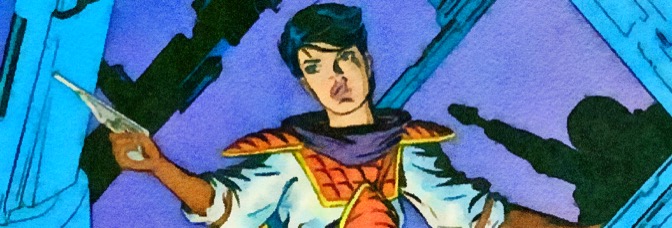
I think Davis’s Delia & Celia has definitively made me hate all fantasy, if I didn’t already dislike it enough. It’s like he sits around trying to think of how much blathering exposition he can fit in each panel, like it’s a contest to one up himself. The story’s completely incomprehensible at this point, but…
-

Chadwick’s Concrete isn’t so interesting this issue for what he does say, but for what he doesn’t. Concrete’s sidekicks get lost in the ghetto and a bunch of Black guys attack the car–presumably to beat the guy and “gang rape,” Chadwick’s words, the woman. When Concrete and the guy are sitting around calmly discussing it…
-

Thank goodness there’s a Bacchus in here because otherwise it’d be a complete loss. Guinan’s art continues to be acceptable on Heartbreakers, while he and Bennett’s writing just gets worse and worse. Some of the issue is with them trying to do too much in such a short amount of pages… But mostly they just…
-
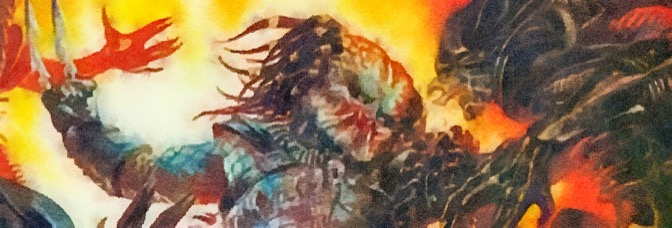
The Aliens vs. Predator story is most impressive for Norwood’s illustration… but not of aliens or Predators. The story opens on some alien world and it’s just breathtaking. Once the actual story starts (Stradley’s two conversationalists talking about hunting experiences while Predators hunt aliens), it can’t compete with those visuals. Still, for what amounts to…
-
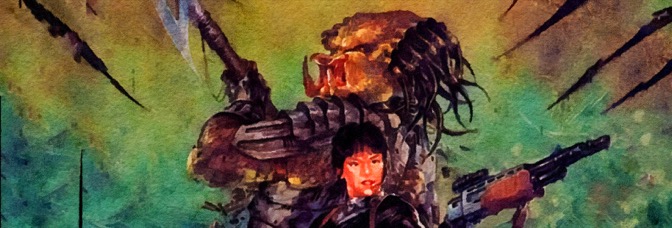
It’s a weak close, partially because Stradley probably needed another issue to fully develop the relationship between the protagonist and the friendly Predator (he also needed space to give it a proper ending), but mostly because Chris Warner is no replacement for Norwood. Warner kills that beautiful design sense Norwood brings to the book. Instead…
-
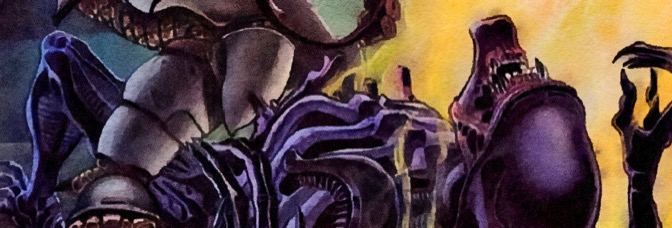
The change in inkers makes Aliens vs. Predator look exactly as drab and boring as I’d expected the first few issues to look. Campanella can’t do much to Stradley’s figures, but he rounds out the faces–not all the time, which makes the art disjointed–but definitely in close ups. Everyone looks like they’ve had the definition…
-
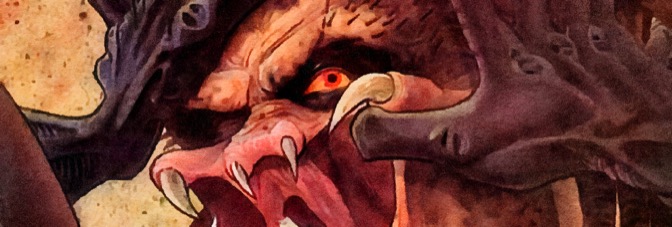
The issue opens with some weak dream exposition. It doesn’t fit the narrator’s voice–Stradley never establishes why he’s using it (I think it’s a callback to the Aliens series where people have nightmares around the aliens)–and it’s a weak opening. But then Stradley recovers beautifully. Until the end of this issue, Aliens vs. Predator is…
-
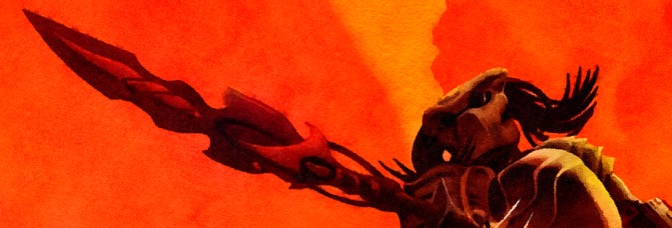
Norwood’s very design-oriented–he’s a Hollywood storyboard guy–and the art suffers for it. The setting, the designs of the human settlement on an alien planet, is great. The panel composition is stunning. The figures are awkward and bad. Everyone’s proportions are off a little bit. They’re too stout for their height. Stradley’s writing here is really…
-
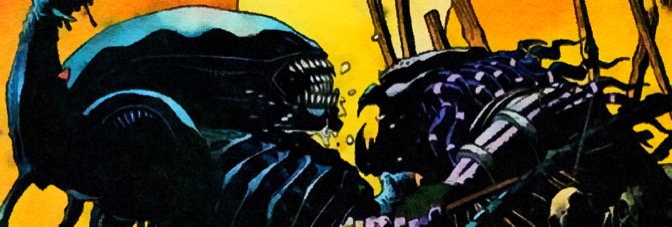
Stradley’s issue is two bored cargo spaceship having a conversation while Norwood’s art shows us all about the Predators getting ready for the Aliens vs. Predator series. First it’s showing the alien eggs, then it’s a bunch of fighting for dominance. The off panel dialogue back and forth constantly relates to the dialogue-less action going…
-
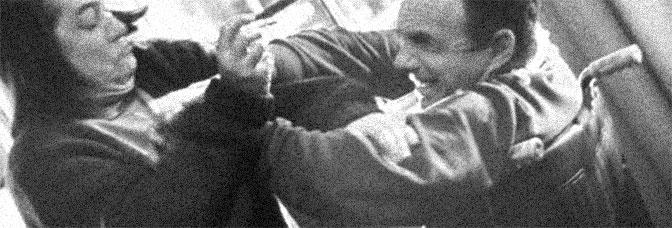
So back in 1990, ignorant, bigoted book burning fundamentalist Christian psychopath women were screen villains on par with Norman Bates (by some accounts). Now they’re presidential candidates. Misery actually owes quite a bit, in its third act, to Psycho. Reiner is no Hitchcock and he doesn’t try to be. His success, directing the film, has…
-
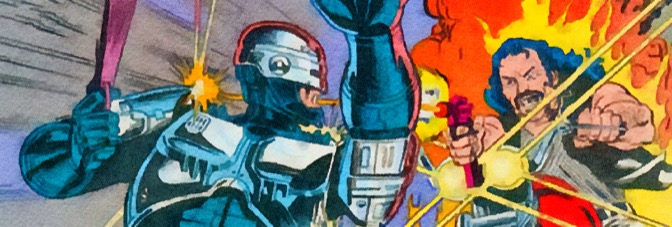
In one of the letter pages, the editor said Robocop would never meet up with any Marvel superheroes (I guess the licensing worked differently than that Spider-Man crossover with the Transformers) and this issue kind of shows why it wouldn’t work. The last two issues have been about costumed vigilantes. Some of them are silly,…
-

Thank goodness, DeMulder’s back. Grant’s doing another multi-part story here, with Robocop trying to deal with OCP (his bosses) inspired vigilantism. It’s a little strange, just because it’s in a comic book so you’ve got the protagonist fighting the traditional protagonists of the medium. There are some absurd vigilantes and then some more serious ones–it’s…
-
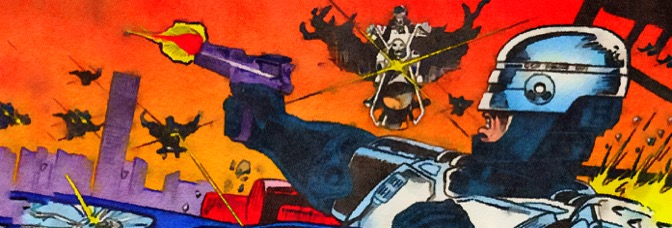
Wow, I really miss Kim DeMulder. Keith Williams inks this issue and it really doesn’t work. Robocop’s definition is silly, he looks clunky instead of streamlined. Worse are faces. I was lamenting the lack of Robocop’s partner, Lewis, in my response to the previous issue, but she’s here all the time and it never feels…
-
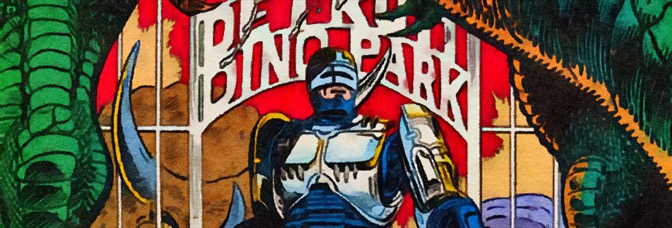
So Alan Grant did Westworld with dinosaurs before Michael Crichton? There’s a dinosaur park in this issue, which came out a few months before Crichton’s novel, and, strangely, things go wrong. They go wrong for different reasons, but still… this issue could have been called “Robocop vs. Jurassic Park.” There’s a lot of action here…
-

Grant’s resolution to the Robocop at war thing is surprising. First, the big revelation (of why the Arabs aren’t really the bad guys) is good enough I’m not even going to spoil it. Second, he’s got a very mild, conclusion (albeit some lame lines about Murphy being a good cop again). Third, he introduces cybernetic…
-

Robocop goes to war. It’s an interesting idea, Robocop being used as a military weapon–leased out by his owners, instead of policing–but Grant seems more concentrated on the action potentials for this issue. There’s a lot of suggestions the morality of it will come into play next issue, but for now, it’s Robocop versus weird…
-
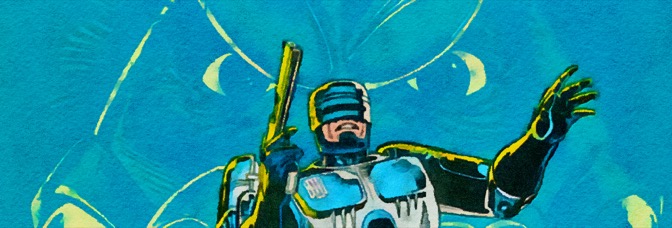
Grant runs a subplot throughout this entire issue–riots caused by poisoned soda pop–just to fill in time and to give a sense of time progressing. It’s a technique way too nice for a Robocop comic, especially one featuring a fight between Robocop, a cyborg gorilla (what did I just read with a cyborg gorilla–B.P.R.D.: 1946)…
-

Grant’s approach to this series–Robocop on a case–is nice. I mean, his future isn’t the greatest thing ever (again, I think it’s just rehashed Judge Dredd trappings), but there’s a procedural aspect to it. All of the Robocop thought balloons are a problem, as Grant has completely humanized the character–he’s just a guy turned into…
-

The Comics Code approved this one? Robocop kills people left and right throughout. Hmm. On we go. The issue ends with Robocop and Lewis making kissy faces at each other. Apparently, all Robocop writers (except the guys who wrote the original movie), want to introduce this plot element. I’m not complaining. It’s better handled here…
-

Alan Grant wrote Judge Dredd, which probably explains some of his Robocop. His Robocop is talkative and makes occasional jokes; neither facet particularly works. But Grant’s Robocop isn’t terrible. It’s a sequel to the movie and, while some of the other film characters do appear, Grant’s taking things in his own direction. He’s got evil…
-

I’d heard of Rosencrantz & Guildenstern Are Dead, of course. I’d probably even meant to see it at one point, probably around the time of Branagh’s Hamlet, which is when I first got big into Shakespeare. But it was only available on VHS and I was already addicted to widescreen. Oddly, this viewing–at the wife’s…
-
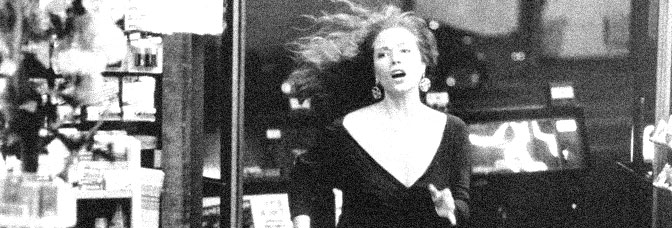
Impulse is somewhat interesting as a piece of pseudo-feminist filmmaking. Not to suggest Locke’s a poser. It’s just her intentions can’t compete with her script. The script appears to have come from two actors turned writers. Leigh Chapman seems to have been brought in to female-up the script. There are some really nice little moments,…
-
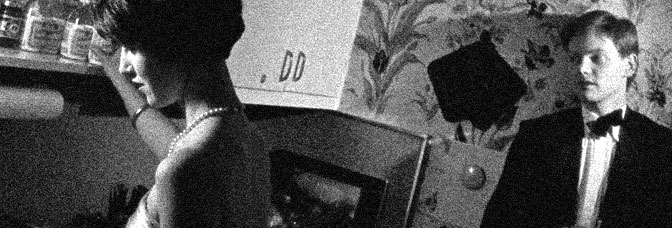
Metropolitan has an incredibly traditional, incredibly cinematic conclusion, which might be why it’s so funny. But why it’s so perfectly in place is the characters–at least the more intelligent ones–impression of the conclusion. They’re aware it’s the Hollywood ending, but it’s a Hollywood ending in the context of Metropolitan, which is something altogether different. Whit…
 The Stop Button