Category: 1942
-

I spent the first fifteen minutes of The Mad Doctor of Market Street wondering why the movie didn’t have a better reputation. Yes, the title’s bad even before it was marginally ableist, but director Lewis has been rediscovered; why not Market Street. It starts as a traditional, albeit modern Universal horror picture with “pseudo” scientist…
-

Just about an hour into Invisible Agent, Axis allies Cedric Hardwicke and Peter Lorre have a falling out. See, Lorre’s smart, actually, while Hardwicke’s just devious. The film had been establishing those traits from the first scene—when they try to strong-arm the Invisible Man formula out of Jon Hall—but what I didn’t realize was Lorre…
-

Destruction Inc. is nearly a success. It’s frustratingly not, particularly because the only thing holding it back is the animation itself. Thomas Moore and Dave Tendlar lack detail on the action, lack detail on the background, and don’t composite the two well. But Sparber’s direction is fantastic. There are some great action sequences in Destruction,…
-
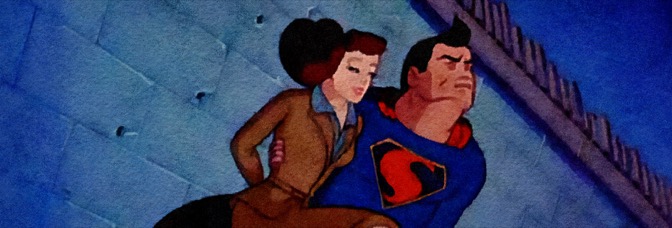
While Eleventh Hour posits Superman as some kind of American war hero–he’s in Yokohama doing all sorts of damage, usually to ships–the cartoon actually portrays him as a big doofus who’s more lucky than anything else. Clark (Bud Collyer) and Lois (Joan Alexander) are under house arrest. In a hotel. In Yokohama. Almost a year…
-
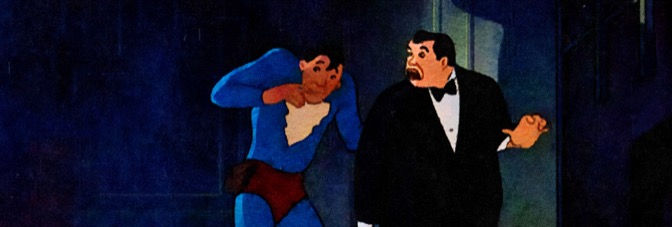
SUPERMAN cartoon about a burglar dressing up as Superman when he robs places. Pretty soon he runs into the real Superman, who viciously scares him off a roof for fun. Boring action, holey plot; it’s pretty tepid stuff. Followed by ELEVENTH HOUR. DVD, Blu-ray, Streaming.Continue reading →
-

Outside the racism, there’s not much to distinguish Japoteurs. There’s a lot of potential for the finale, when Superman (Bud Collyer) has to stop a crashing airplane–the world’s biggest bomber, which Japanese saboteurs have stolen and intend to take to Tokyo–but it’s not an impressive sequence. It’s somewhat thorough, but not impressive. The plane itself…
-

Terror on the Midway has some mediocre animation, some bad animation, and some excellent design and direction. It’s also got a gratuitous Superman butt shot, which angles to show his curves in the red tights. It’s a weird shot. Especially since it keeps angling. The cartoon starts with Clark (Bud Collyer) mocking Lois (Joan Alexander)…
-
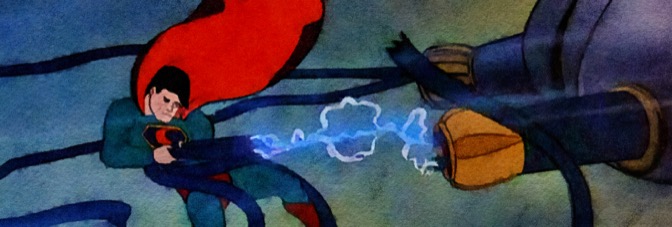
Outside the racist–though not exceptionally racist all things considered–characterization of the villain, a Native American engineer who’s going to level Manhattan because it was stolen from his people, Electric Earthquake is pretty much great. Well, it’s outstanding. For what it does, it’s outstanding. So there’s the opening, where only Clark Kent (Bud Collyer) thinks the…
-

The Magnetic Telescope is about a power-mad astronomer who builds an observatory with a giant magnet on top so he can attract meteors and comets to the Earth for further study. The device, in attracting meteors, is an obvious public safety issue but the astronomer doesn’t care. He’s willing to let thousands die so he…
-

Three genius mechanical engineers come up with a flying, rocket-powered bullet car, with a penetrating nose, and try to extort millions from Metropolis. When their extortion fails, they attack. After some trouble, Superman stops them. The Bulleteers is nothing if not concise. The cartoon starts introducing the bullet car, then its owners. They’re in a…
-
The Moon and Sixpence has a number of serious problems, all of them the fault of director and screenwriter Lewin. As a director, while never spectacular, Lewin manages some competence and ambition. He tells Moon and Sixpence in a series of summarized flashbacks. Those flashbacks, narratively and budgetarily effective, end up being the film’s undoing.…
-

Unfortunately, I feel the need to address some of the behind the scenes aspects of The Magnificent Ambersons. Not because I plan on talking about them, but because director Welles’s career is filled with a lack of control. There are always questions–what did editor Robert Wise do on his own, what did he do with…
-

The Man Who Came to Dinner is, a little too obviously, an adaptation of a play. There are occasional moments outside the main setting–the home of Grant Mitchell and Billie Burke–but director Keighley doesn’t do anything with them. All involve Richard Travis’s character, which suggests maybe his subplot (local reporter in the center of a…
-

The Palm Beach Story is a narrative. Director Sturges opens with a rapidly cut prologue showing stars Claudette Colbert and Joel McCrea getting married, where he inserts clues for what will eventually be the film’s utterly pointless deus ex machina. Sure, Palm Beach runs less than ninety minutes so it’s possible the viewer be sitting…
-

It’s hard to imagine a more supreme melodrama than Random Harvest. Almost the entire first hour (of two and a nickel), the film chronicles the blissful romance of Greer Garson and Ronald Colman. He’s an amnesiac World War I veteran, she’s on the stage–a combination of song and comedy–and she’s his savior. They live in…
-

Busses Roar is a slight propaganda film. It doesn’t fully commit to any of its subplots, not even the patriotism. With the exception of the establishing the villainous Japanese, German and the gangster at the opening and the flag-waving speech at the end, it’s not too heavy on it. Most of the film’s almost an…
-

Even if it weren’t for catching all the future films The Arctic Giant influenced, the cartoon would still be a lot of fun. It opens with the discovery of a frozen dinosaur in the the Arctic. Scientists bring it back to Metropolis–King Kong style, but in a freezer–where it goes on display. Lois does a…
-

Now here’s an awesome outing for Clark and Lois. They’re on assignment to cover a volcano erupting (hence the title); the cartoon opens with a science report on said volcano. It’s a neat sequence, quickly done and well-animated. Fleischer gets a lot of information conveyed immediately, which is good since the second half is all…
-

It’s Superman versus a train full of gold thieves. Only not so much. Lois Lane actually battles the thieves themselves in Billion Dollar Limited, while Superman deals with the runaway train. There’s a lot of impressive action in the cartoon, especially given how little dialogue–I think maybe four or five lines total, including one of…
-

The Ghost of Frankenstein is pretty bad stuff. Running less than seventy minutes, it’s unbearably boring from the twenty-five minute mark, once the picture focus on Cedric Hardwicke. Ghost opens with villagers pursuing Bela Lugosi’s evil hunchback. Though awful, Lugosi’s at least an enthusiastically vile character. Hardwicke–playing a neurosurgeon with his own castle (he’s a…
-

How to Bridge a Gorge isn’t just an instructional video about how to, you know, bridge a gorge… it’s Ray Harryhausen showing off the possibilities for what the short calls “three dimensional animation.” In a lot of ways, the possibilities he suggests in this short–made to showcase stop motion to the Army during World War…
-

I Married a Witch often seems too short. Director Clair rightly focuses the picture around leading lady Veronica Lake, with Frederic March getting a fair amount of attention too, but the narrative outside them blurs. And it shouldn’t blur, given the high stakes election backdrop. Clair’s focus also extends to troublesome plot points. Witch goes…
-

How to describe Cat People…. When a swell, blond American (Kent Smith) meets a dark (but not too dark) Eastern European woman (Simone Simon), she rouses all sorts of non-apple pie passions in him. Being a swell guy, he pressures her into marrying him–she’s clearly emotionally disturbed, but it’s okay… Smith hires her a great…
-

Men of the Sky opens with General Henry H. Arnold addressing a graduating class of air cadets. Charles P. Boyle’s Technicolor photography is glorious and Harold McKernon’s editing is outstanding and Sky feels like an almost too precious time capsule. Only then the realism shatters when Arnold starts directly addressing actors, not actual air cadets.…
-

The Glass Key‘s a murder mystery, but its solution–and even its investigation–is incidental to the rest of the picture. From about seven minutes in, director Heisler defines Key as something quite different. Leading man Alan Ladd isn’t a detective, he isn’t even particularly interested in solving the murder. Seven minutes in is when Ladd has…
-

In the last minute and a half of The Hep Cat, Clampett finally comes up with some really interesting shots. The short’s a cat and dog one. It follows the standard. Dumb dog versus a mean, vain and not much smarter cat. The titular hep cat breaks out into a song routine, but it’s not…
-

Everett Dodd’s editing makes Soldiers in White painful to watch. Some of the fault is director Eason’s, of course. His insert close-ups are awful. Given Soldiers is half comedy and half Army propaganda film (the titular soldiers are Army doctors), it’s hard to believe Eason was worried about running short and felt the need for…
-

Here’s a strange one. So You Think You Need Glasses starts off as an instructional short about common eyesight problems and their solutions. It’s of particular note for the opthamologist’s office… which sports much of the same equipment in 1942 it does today. Art Gilmore narrates the entire short, sometimes to humorous effect when speaking…
-
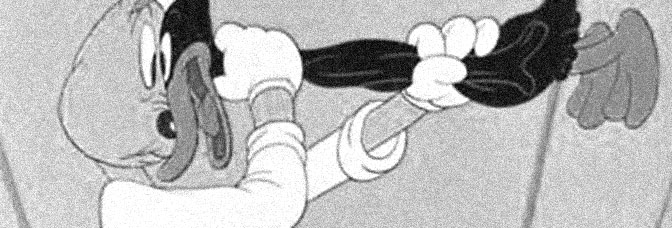
I wasn’t sure what I was going to say about Conrad the Sailor when it started. It seemed pretty simple–Conrad is a lame cat sailor and Daffy Duck makes fun of him. It was a simple case of Daffy being a bully. Maybe I could have done something about how cartoon icons are often callous…
-

The Mummy’s Tomb is better than its predecessor, without a doubt. Harold Young’s direction is strong. It’s not quite scary, but he’s at least going for scary. It’s sort of like an episode of “Cheers;” it takes place in small town Massachusetts and there’s a mummy roaming the streets. You can see the “Cheers” gang,…
 The Stop Button