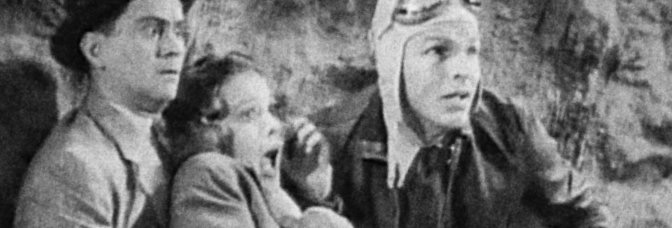
Flash Gordon's Trip to Mars (1938, Ford Beebe and Robert F. Hill), Chapter 3: Queen of Magic

Queen of Magic has a lot going on. After the perfunctory cliffhanger resolution, there’s another chase sequence (of sorts) through the Clay Men’s caves. It takes a while–and has Buster Crabbe and company duking it out with the actual bad guys (Beatrice Roberts’s human thugs)–but eventually the Clay Men get them. The good guys. The leader of the Clay Men, C. Montague Shaw, wants Roberts brought to the caves so she can make the Clay Men human again. He’s going to hold on to Jean Rogers to motivate Crabbe to do it.

Shaw and the Clay Men also strip and redress all the Earthlings… just because.

And it isn’t a particularly difficult task for Crabbe–who brings Frank Shannon along–because Roberts’s troops are a bunch of morons who walk Crabbe into her throne room where he’s able to grab her. The only one who figures out maybe it’s not a great idea to be trusting is Charles B. Middleton (who’s got a major obsession with killing Crabbe, though not enough to stop doing his work around the palace, which appears to be to slowly turn Roberts’s people against her… maybe).

There’s a lot of great production design. Maybe not production values, but the design of the city and the palace–as far as the backdrops and mattes and such–is phenomenal. They’ve got to walk across a “light bridge” at one point, which is a simple effect with a matte backdrop, but it really does bring some scale to the goings on. The miniature sets of the Martian city leave a lot to be desired–the miniature sets of the Martian landscape aren’t exceptional or anything, but they’re at least competent and thoughtfully rendered. Not so with the Martian city. It’s real lazy. So it’s nice to see the backdrops fill it out.

Solid acting all around. Crabbe’s a great lead–though he gets a lengthy exposition dump explaining Roberts and Middleton’s plan to Shaw and it’s a tad much–Shannon’s good, Rogers’s perfectly likable (though she’s way too literally the damsel here). Donald Kerr isn’t annoying this time. Roberts is good. Unfortunately, with the possible scheming subplot thrown in, Middleton is starting to disappoint.

Still, it’s a more than adequate entry. Lots of excitement. And maybe a couple sequences George Lucas borrowed obviously for Star Wars.

CREDITS

Directed by Ford Beebe and Robert F. Hill; screenplay by Ray Trampe, Norman S. Hall, Wyndham Gittens, and Herbert Dalmas, based the comic strip by Alex Raymond; director of photography, Jerome Ash; edited by Joseph Gluck, Saul A. Goodkind, Louis Sackin, and Alvin Todd; released by Universal Pictures.

Starring Buster Crabbe (Flash Gordon), Jean Rogers (Dale Arden), Frank Shannon (Dr. Alexis Zarkov), Charles Middleton (Emperor Ming), Beatrice Roberts (Queen Azura), Donald Kerr (Happy Hapgood), Richard Alexander (Prince Barin), and C. Montague Shaw (Clay King).


RELATED

Flash Gordon’s Trip to Mars (1938) ch03 – Queen of Magic

Queen of Magic has a lot going on. After the perfunctory cliffhanger resolution, there’s another chase sequence (of sorts) through the Clay Men’s caves. It takes a while–and has Buster Crabbe and company duking it out with the actual bad guys (Beatrice Roberts’s human thugs)–but eventually the Clay Men get them. The good guys. The leader of the Clay Men, C. Montague Shaw, wants Roberts brought to the caves so she can make the Clay Men human again. He’s going to hold on to Jean Rogers to motivate Crabbe to do it.

Shaw and the Clay Men also strip and redress all the Earthlings… just because.

And it isn’t a particularly difficult task for Crabbe–who brings Frank Shannon along–because Roberts’s troops are a bunch of morons who walk Crabbe into her throne room where he’s able to grab her. The only one who figures out maybe it’s not a great idea to be trusting is Charles B. Middleton (who’s got a major obsession with killing Crabbe, though not enough to stop doing his work around the palace, which appears to be to slowly turn Roberts’s people against her… maybe).

There’s a lot of great production design. Maybe not production values, but the design of the city and the palace–as far as the backdrops and mattes and such–is phenomenal. They’ve got to walk across a “light bridge” at one point, which is a simple effect with a matte backdrop, but it really does bring some scale to the goings on. The miniature sets of the Martian city leave a lot to be desired–the miniature sets of the Martian landscape aren’t exceptional or anything, but they’re at least competent and thoughtfully rendered. Not so with the Martian city. It’s real lazy. So it’s nice to see the backdrops fill it out.

Solid acting all around. Crabbe’s a great lead–though he gets a lengthy exposition dump explaining Roberts and Middleton’s plan to Shaw and it’s a tad much–Shannon’s good, Rogers’s perfectly likable (though she’s way too literally the damsel here). Donald Kerr isn’t annoying this time. Roberts is good. Unfortunately, with the possible scheming subplot thrown in, Middleton is starting to disappoint.

Still, it’s a more than adequate entry. Lots of excitement. And maybe a couple sequences George Lucas borrowed obviously for Star Wars.

Flash Gordon's Trip to Mars (1938, Ford Beebe and Robert F. Hill), Chapter 2: The Living Dead

If only The Living Dead had some better stock music choices, because the actual content of the chapter is fantastic. Unfortunately, it’s got this passive, tranquil score without any energy or excitement. Meanwhile the onscreen action is all energy, all excitement.

While Buster Crabbe, Frank Shannon, and Jean Rogers are crashing on Mars, their ship has enough time to shed parts so Charles Middleton can recognize their rocket ship as the one they stole from him last serial. For some reason the shed parts fall to Mars faster than their space ship otherwise crashes. Something with that Martian gravity no doubt.

Middleton and evil Martian Queen Beatrice Roberts go to intercept the Earthlings, who manage to outsmart Middleton–which doesn’t seem hard this time around–and steal Roberts’s own ship. The hijacking is a strong sequence, though the music does it no favors; Crabbe’s comfortably back in action hero mode.

Then there’s a sky battle between space ships. Some good miniature effects–though Crabbe having to shoot at ships through with a porthole with a revolver is decidedly lacking–even if some of the miniature ground sets are wanting.

But there’s even more action, with Crabbe and company encountering the dreaded clay people–who Roberts wants to annihilate. They come to life out of cave walls, which is conceptually cooler than visually, but still a rather successful sequence. Except, of course, for the stock music choices.

Crabbe’s great in Living Dead, Shannon and Rogers is good, Middleton’s annoying for a bit but then a good buffoon. Roberts seems like she’s going to be a decent villain. Donald Kerr, as Crabbe and company’s reporter sidekick–who seemed fine last chapter–doesn’t do so hot in Living Dead.

But it doesn’t matter because everything else is so good. Except that dang music.

CREDITS

Directed by Ford Beebe and Robert F. Hill; screenplay by Ray Trampe, Norman S. Hall, Wyndham Gittens, and Herbert Dalmas, based the comic strip by Alex Raymond; director of photography, Jerome Ash; edited by Joseph Gluck, Saul A. Goodkind, Louis Sackin, and Alvin Todd; released by Universal Pictures.

Starring Buster Crabbe (Flash Gordon), Jean Rogers (Dale Arden), Frank Shannon (Dr. Alexis Zarkov), Charles Middleton (Emperor Ming), Beatrice Roberts (Queen Azura), Donald Kerr (Happy Hapgood), Richard Alexander (Prince Barin), and C. Montague Shaw (Clay King).


RELATED

Flash Gordon’s Trip to Mars (1938) ch02 – The Living Dead

If only The Living Dead had some better stock music choices, because the actual content of the chapter is fantastic. Unfortunately, it’s got this passive, tranquil score without any energy or excitement. Meanwhile the onscreen action is all energy, all excitement.

While Buster Crabbe, Frank Shannon, and Jean Rogers are crashing on Mars, their ship has enough time to shed parts so Charles Middleton can recognize their rocket ship as the one they stole from him last serial. For some reason the shed parts fall to Mars faster than their space ship otherwise crashes. Something with that Martian gravity no doubt.

Middleton and evil Martian Queen Beatrice Roberts go to intercept the Earthlings, who manage to outsmart Middleton–which doesn’t seem hard this time around–and steal Roberts’s own ship. The hijacking is a strong sequence, though the music does it no favors; Crabbe’s comfortably back in action hero mode.

Then there’s a sky battle between space ships. Some good miniature effects–though Crabbe having to shoot at ships through with a porthole with a revolver is decidedly lacking–even if some of the miniature ground sets are wanting.

But there’s even more action, with Crabbe and company encountering the dreaded clay people–who Roberts wants to annihilate. They come to life out of cave walls, which is conceptually cooler than visually, but still a rather successful sequence. Except, of course, for the stock music choices.

Crabbe’s great in Living Dead, Shannon and Rogers is good, Middleton’s annoying for a bit but then a good buffoon. Roberts seems like she’s going to be a decent villain. Donald Kerr, as Crabbe and company’s reporter sidekick–who seemed fine last chapter–doesn’t do so hot in Living Dead.

But it doesn’t matter because everything else is so good. Except that dang music.

Flash Gordon's Trip to Mars (1938, Ford Beebe and Robert F. Hill), Chapter 1: New Worlds to Conquer

Until about three-quarters of the way into New Worlds to Conquer, I thought Flash Gordon’s Trip to Mars was going to be one of those mistitled movies. Like the studio changed it for some reason. Because when adventurers Buster Crabbe, Jean Rogers, and Frank Shannon take off, they’re headed right back to Mongo.

Then it turns out Shannon’s bad at reading astronomical photographs and they should’ve been going to Mars.

The chapter opens with Crabbe and company returning to Earth (from the previous serial). There’s no ticker tape parade scene because budget. Instead, some swirling newspaper montages announce their return and lionization… only for a new problem to arise for Planet Earth. Natural disasters. Scientists are flummoxed. Little do they know (previous serial) villain Charles Middleton has teamed up with Beatrice Roberts (a cruel megalomaniac queen of Mars) to zap the Earth with a ray. They’re sucking the Nitron out of the Earth’s atmosphere. Roberts wants it so she can wage war on some of people on Mars; Middleton just wants to suffocate all the Earthlings.

Good thing while in flight to Mongo, Rogers sees the ray and they change course to Mars. Also good thing Crabbe and company’s rocket ship is fast enough for such maneuvers.

After their introduction and landing on Earth, there’s not a lot for Crabbe, Rogers, or Shannon to do in the chapter. Shannon gets the most–he’s got an interview after their homecoming–but then they disappear during the natural disaster response and Middleton plotting. It’s up to reporter Donald Kerr to bring them into the story. He tracks them down–Crabbe’s become Shannon’s assistant, Rogers is presumably hanging around because Crabbe. Kerr stows away on the rocket ship, so he’ll be a sidekick or something.

The acting is all fine. Kerr’s funny. Roberts is truly disturbing in her cruelty. Middleton’s… maybe better than last time. And the three heroes are all solid, of course. Crabbe and Rogers are earnest, Shannon’s scientist-y; they’re all good.

Technically, however, New Worlds starts Mars on ominous footing. Anytime there’s a cut to close-up, it’s a bad one (the serial’s got four credited editors so who knows whose fault it is… could just be lack of coverage from directors Beebe and Hill); the special effects are shaky too. The model work is fine… but most of the effects so far are composite shots. One has at least three layers (maybe four) and it’s far from effective. And Mars, so far, looks a whole lot like Mongo from the last serial.

Still, given Crabbe, Rogers, and Shannon–not to mention Kerr–Mars at least has got a lot of likability going for it. Hopefully it finds some narrative momentum soon.

CREDITS

Directed by Ford Beebe and Robert F. Hill; screenplay by Ray Trampe, Norman S. Hall, Wyndham Gittens, and Herbert Dalmas, based the comic strip by Alex Raymond; director of photography, Jerome Ash; edited by Joseph Gluck, Saul A. Goodkind, Louis Sackin, and Alvin Todd; released by Universal Pictures.

Starring Buster Crabbe (Flash Gordon), Jean Rogers (Dale Arden), Frank Shannon (Dr. Alexis Zarkov), Charles Middleton (Emperor Ming), Beatrice Roberts (Queen Azura), Donald Kerr (Happy Hapgood), Richard Alexander (Prince Barin), and C. Montague Shaw (Clay King).


RELATED


Flash Gordon’s Trip to Mars (1938) ch01 – New Worlds to Conquer

Until about three-quarters of the way into New Worlds to Conquer, I thought Flash Gordon’s Trip to Mars was going to be one of those mistitled movies. Like the studio changed it for some reason. Because when adventurers Buster Crabbe, Jean Rogers, and Frank Shannon take off, they’re headed right back to Mongo.

Then it turns out Shannon’s bad at reading astronomical photographs and they should’ve been going to Mars.

The chapter opens with Crabbe and company returning to Earth (from the previous serial). There’s no ticker tape parade scene because budget. Instead, some swirling newspaper montages announce their return and lionization… only for a new problem to arise for Planet Earth. Natural disasters. Scientists are flummoxed. Little do they know (previous serial) villain Charles Middleton has teamed up with Beatrice Roberts (a cruel megalomaniac queen of Mars) to zap the Earth with a ray. They’re sucking the Nitron out of the Earth’s atmosphere. Roberts wants it so she can wage war on some of people on Mars; Middleton just wants to suffocate all the Earthlings.

Good thing while in flight to Mongo, Rogers sees the ray and they change course to Mars. Also good thing Crabbe and company’s rocket ship is fast enough for such maneuvers.

After their introduction and landing on Earth, there’s not a lot for Crabbe, Rogers, or Shannon to do in the chapter. Shannon gets the most–he’s got an interview after their homecoming–but then they disappear during the natural disaster response and Middleton plotting. It’s up to reporter Donald Kerr to bring them into the story. He tracks them down–Crabbe’s become Shannon’s assistant, Rogers is presumably hanging around because Crabbe. Kerr stows away on the rocket ship, so he’ll be a sidekick or something.

The acting is all fine. Kerr’s funny. Roberts is truly disturbing in her cruelty. Middleton’s… maybe better than last time. And the three heroes are all solid, of course. Crabbe and Rogers are earnest, Shannon’s scientist-y; they’re all good.

Technically, however, New Worlds starts Mars on ominous footing. Anytime there’s a cut to close-up, it’s a bad one (the serial’s got four credited editors so who knows whose fault it is… could just be lack of coverage from directors Beebe and Hill); the special effects are shaky too. The model work is fine… but most of the effects so far are composite shots. One has at least three layers (maybe four) and it’s far from effective. And Mars, so far, looks a whole lot like Mongo from the last serial.

Still, given Crabbe, Rogers, and Shannon–not to mention Kerr–Mars at least has got a lot of likability going for it. Hopefully it finds some narrative momentum soon.

You Can’t Take It with You (1938, Frank Capra)

You Can’t Take It with You has three major plot lines, all interconnected, but separate enough the film often feels stretched. There’s the rather lovely romance between stenographer Jean Arthur and her boss, bank vice president James Stewart. There’s Edward Arnold’s attempt to create a munitions monopoly to take advantage of the coming world war. He’s Stewart’s dad; the only thing standing in the way of his monopoly is acquiring a single piece of property (to build a factory to force his competitor to capitulate). Lionel Barrymore owns the property. He doesn’t want to sell, he’s also Arthur’s grandfather.

Everything intersects eventually, though when Arnold and wife Mary Forbes are disapproving of Arthur, Barrymore, and the rest of the family, they don’t know Barrymore’s also holding up the big deal.

Barrymore runs the house as sort of a hippie commune; albeit a late thirties, Depression-era commune. Arthur’s the normal one. Her mom, Spring Byington, is mildly eccentric, always finding one creative hobby or another. Samuel S. Hinds is Arthur’s dad; he makes fireworks in the basement with Halliwell Hobbes, who showed up delivering the ice one day and never left. Similarly, Dub Taylor came to dinner once and stayed, marrying Arthur’s sister, Ann Miller. Miller’s got a Russian dance instructor (displaced by the Revolution), Mischa Auer. The film introduces Barrymore’s eclectic brood via Donald Meek, who Barrymore recruits away from his awful office job. Also in the house are housekeeper Lillian Yarbo and her fiancé, Eddie ‘Rochester’ Anderson. Going to have to talk about Yarbo and Anderson and the film’s treatment of them at some point. On one hand, they’re Black characters with decently sized parts. On the other, Anderson is the only person in the film who Robert Riskin’s script portrays as lazy.

Before getting to that aspect… the better aspects of the script, which are many. The movie opens with Arnold’s prospective business deal (and introduces Stewart as the disinterested boss’s son), then goes to Barrymore who meets up with Meek, then brings him home. The family gets introduced. Then, twenty minutes into the film, top-billed Arthur finally appears. And begins she and Stewart’s possibly star-crossed, rich boy, middle class girl (not to mention the commune) romance. The first ninety minutes are about the romance and its possibilities and realities. Stewart’s mom, Forbes, is opposed. Her thin characterization will also have to be discussed in a bit. But Stewart and Arthur are in love and, based on their courting scenes, love might be able to conquer all. Joseph Walker’s photography is never better than during Stewart and Arthur’s date night. The actors radiate chemistry, with Arthur beaming at Stewart’s wooing in the two shots (then getting to beaming in her close-ups). It’s also some of Capra’s best direction, particularly when the action then moves to a slightly slapstick posh restaurant scene (from Central Park where Stewart shows he’s not a snob by palling around with some street urchins).

Capra always keeps You Can’t Take It with You moving, he always moves between the various subplots (everyone in the house has something going on, usually with crossover, even if it’s a throwaway C plot), but his best direction is when it’s Arthur and Stewart or Arthur and Barrymore. There’s this devastating quiet scene where Barrymore and Arthur talk about love. Barrymore’s got some phenomenal moments in the film, but that scene has his best acting. He gets to reflect, not act. Usually he’s acting. Or if he’s reflecting, Capra isn’t showcasing it because there’s a lot of other stuff going on. The scene also establishes Barrymore’s reflection, so it only needs check-ins in the bigger scenes. The film’s beautifully constructed; Capra and Riskin excel at it.

Turns out, however, those scenes aren’t actually Capra’s best directed in the film because the third act reveals the protagonist of the film isn’t Barrymore, or Arthur, or Stewart, it’s Arnold. You Can’t Take It with You, somewhere in the second act, becomes about Arnold and Barrymore, then Arnold. Arnold’s conundrum sequence in the third act is Capra’s best direction in the picture. Arnold gets this long sequence to himself and is fantastic. He goes from being a hideous capitalist to someone you can believe Stewart likes having–or liked having before the film started, in the distant past–as a dad. Unfortunately, the film can’t organically tie all the threads together at the end, skipping over Barrymore and the family’s storyline, mega-contriving a finish for Arthur and Stewart, mostly so Arnold gets a satisfactory one. It’s sort of a good full circle since he started the film, but it’s also unfortunate. All of Riskin’s inventive plotting throughout the film and nothing for the finish.

Still, thanks to the acting (and the previous material) the finale is still quite effective. So effective you can almost forget about the plotting problems. Almost.

All of the acting in the film is good, some of it is superior. Stewart and Arthur are great as the romantic leads; they both get some rather dramatic moments as well. Arthur’s better than Stewart in them (but her writing is better). Byington and Hinds are lovable, Taylor and Miller are cute, Auer’s awesome. Meek’s adorable. Harry Davenport is great as the judge who presides over the end of second act night court where everyone’s in trouble (including the narrative because that point’s where things could naturally finish).

Arnold’s fantastic. Barrymore’s fantastic. Arnold gets more of the dramatic acting, Barrymore has to do his dramatic acting (for the most part) amid slapstick absurdity. It’s their movie in the end.

Now the more obvious problems. Riskin tries to avoid getting into Barrymore’s political philosophy too much, but what’s left in the film is some nonsensical jingoistic anti-organized capitalism thing. There’s a funny sequence with an IRS investigator (Charles Lane) where Barrymore’s raving against the government and the film never clarifies whether it’s just federal he hates or local too. Barrymore’s a de facto progressive, but it’s not like Yarbo or Anderson ever get to dine with the family. And as dismissive as the film gets about Yarbo, it’s nothing compared to how it characterizes Anderson solely as a relief defrauder.

And Riskin (and Capra) have nothing but ire for Forbes, who’s really the second biggest female part in the film–Byington’s omnipresent but as support–and Forbes is a thinly sketched society harpy. The filmmakers go so far as to pay her heartlessness off Arnold; as he starts to see the humanity in the poors and reflect on his ways, Forbes doubles down and gets even more shallow. Or at least maintains the shallow.

Makes for a handful of queasy scenes where Riskin and Capra go for the cheapest jokes possible.

Nice enough Dimitri Tiomkin score. Okay editing from Gene Havlick; the actors do so well in their two shots and group shots, you almost never want it to go to close-up. It feels empty.

Look fast for an uncredited Ward Bond.

You Can’t Take It with You has some great dialogue, some fine direction, some exceptional performances; Capra and Riskin are willing to go long with the things they care about (Arthur and Stewart’s chemistry, Arnold’s character arc, the whole pre-court jail sequence), but they don’t know how to make it fit in the narrative. The result is an often glorious, very busy mess of a motion picture.


blogathon-barrymore

This post is part of the Fourth Annual Barrymore Trilogy Blogathon hosted by Crystal of In The Good Old Days Of Classic Hollywood.

Vivacious Lady (1938, George Stevens)

Vivacious Lady strengths easily outweigh its weaknesses, but those weaknesses have a way of compounding on each other as the film moves to its conclusion. The most obvious–and usually forgiveable–problem is how the film can’t decide what to do with Ginger Rogers, the Vivacious Lady. Not the film, sorry, the script. Director Stevens, photographer Robert De Grasse, costume designer Irene, Rogers’s costars, they can all work with Rogers to great success. The script just can’t figure out how to make her “vivacious” and sweet simultaneously. Unless it’s opposite leading man James Stewart, because the film is able to sail over any troubled scenes on their chemistry alone. It’s how the rest of the world treats Rogers where there are problems. Read: how the script has the rest of the world treat her.

And it’s not Code consideration because Vivacious Lady establishes very clearly early on Rogers and Stewart are anxious get a bed of their own. It’s the film’s most vibrant theme, no less.

The film starts with New England college professor–associate professor–Stewart in New York City trying to collect his ne’er-do-well, womanizing cousin, James Ellison. Ellison has fallen in love with nightclub performer Rogers, though she hasn’t fallen for him. One look into her eyes and Stewart falls for her too. Turns out the feelings mutual and after spending the night out on the town, they elope and head back to Stewart’s home town.

Only he hasn’t told his overbearing father (and boss) Charles Coburn about it. College president Coburn’s got big plans for Stewart, so long as he stays in line, which means marrying harpy blueblood Frances Mercer. When they arrive in town, Ellison–very affable for a jilted suitor–entertains Rogers while Stewart tries to figure out how to tell dad Coburn and mom Beulah Bondi about the marriage. And to break off his existing engagement to Mercer (who he forgot to tell Rogers about).

Vivacious Lady runs ninety minutes. It takes about twenty minutes to get Rogers, Stewart, and Ellison from New York to the town–Old Sharon. The next half hour is gentle screwball comedy of errors with Stewart trying to tell his parents, but Mercer screws it up or Coburn is such a verbally abusive blowhard–aggrevating Bondi into heart problems–it just never happens. It culminates in Rogers and Mercer getting into a fight. Those thirty or so minutes, ending in the fight, all happen in the first day.

I think the movie takes place over three days. Maybe three and a half.

Anyway. The next portion of the film has Rogers pretending to be a college student so she can spend time with Stewart, who’s now not telling Coburn about their marriage because of the fight. Stewart’s always got some reason for not telling Coburn–a couple times it’s Bondi’s heart condition–it’s mostly just contrived fear of Coburn. Only there’s no way for Stewart and Rogers not to moon at one another, beautifully lighted by De Grasse; their scenes are the best in the film, they radiate infectous chemistry.

But everyone else just whistles at Rogers (she’s vivacious after all), which just draws attention to how little character development she’s had around Stewart. She has more character development with Ellison, Mercer, and Bondi throughout the film than with Stewart. Even during their whirlwind courtship, as Stewart–the film points out–never shuts up about himself. That radiant infectous chemistry covers up for a lot of it, but it’s still a major script deficit.

The other major problems in the script are structure and Coburn’s character. P.J. Wolfson and Ernest Pagano’s script frontloads one supporting cast member and shortchanges another, only to flip their positions in the last third. Wouldn’t be a problem if the movie’s conclusion didn’t rely on that character with the increased presence so much. It works out–pretty well–because the cast’s great, the direction’s great, and the script is (scene by scene) excellent. But the narrative structure is disjointed.

And Coburn. Coburn’s an unlovable bastard. He’s such an unlovable bastard you forget he’s Charles Coburn and he’s (probably) secretly going to turn out to be a lovable bastard. But he’s a bad guy, who gets worse–the script doesn’t imagine anything about these characters before the first scene–and no one seems to acknowledge the level of internal disfunction. And it’d definitely have external effects.

Stewart would be so browbeaten he couldn’t order a meal without consulting Coburn, much less be sent to New York to fetch Ellison; Coburn wouldn’t trust him to do it.

So problems. The film has some big problems. And they’re script problems (though Stevens also produced so he’s not off the hook). But Vivacious Lady is still an outstanding romantic comedy. Rogers and Stewart are glorious together. Separate, Rogers is better. She gets good material on her own. Stewart doesn’t. He’s still funny and charming, but the material’s nothing special. Rogers’s material–whether it’s showing down with Mercer or teaching Bondi to dance–is dynamic.

Ellison’s the film’s secret weapon. He’s a little annoying at the start, but once Vivacious Lady is in its second act and Stewart abandons Rogers for mean Coburn and Mercer (and suffering Bondi), it’s Ellison who provides the picture its affability. The script shortchanges him, but it shortchanges everyone at one point or another.

Bondi’s phenomenal. As wondrous as Rogers and Stewart’s chemistry is onscreen, when Bondi and Rogers get a scene together here and there, they’re able to do so much with the material. Their performances compliment each other beautifully.

Mercer’s fine. It’s a lousy part. Ditto Coburn. He’s a caricature of himself playing a caricature of himself.

Some good comedic bit parts–Phyllis Kennedy as the maid, Franklin Pangborn as an apartment manager. Willie Best is good as the Pullman porter, but the part is gross.

Vivacious Lady is a definite success. However, Rogers, Stewart, Bondi, and Ellison deserve to be a resounding one.

It almost recoups all (or most all) with the final gag. Then tries to one up itself and loses that ground. It’s particularly frustrating.

3/4★★★

CREDITS

Produced and directed by George Stevens; screenplay by P.J. Wolfson and Ernest Pagano, based on a story I.A.R. Wylie; director of photography, Robert De Grasse; edited by Henry Berman; released by RKO Radio Pictures.

Starring Ginger Rogers (Francey Brent), James Stewart (Peter Morgan Jr.), Charles Coburn (Peter Morgan Sr.), James Ellison (Keith Morgan), Frances Mercer (Helen), Beulah Bondi (Martha Morgan), Phyllis Kennedy (Jenny), Franklin Pangborn (Apartment Manager), Willie Best (Train Porter), and Grady Sutton (Culpepper).


THIS POST IS PART OF THE FRED ASTAIRE AND GINGER ROGERS BLOGATHON HOSTED BY MICHAELA FROM LOVE LETTERS TO OLD HOLLYWOOD AND CRYSTAL OF IN THE GOOD OLD DAYS OF CLASSIC HOLLYWOOD.


RELATED

Flash Gordon (1936, Frederick Stephani)

Flash Gordon is all about its gee whiz factor. The serial goes all out to create the planet Mongo, which has come out of nowhere (in space) and is on a collision course with Earth. Only scientist Frank Shannon has a plan to save the otherwise panicked and resigned Earth–take a rocketship to the new planet and try to change its course. Shannon can’t do it alone, of course, he needs help; luckily, Buster Crabbe and Jean Rogers’s plane has crashed nearby. And Crabbe is Shannon’s colleague’s son. And Rogers is cute. So, of course, Crabbe and Rogers agree to go off to space to save the world.

Right off, Flash Gordon establishes Crabbe is a force more than a character. Crabbe excels at the role’s physicality–he always tries to do something, no matter the odds. Sometimes it’s to advance the plot, sometimes it’s to stretch out a chapter, sometimes it’s just to lose some of his clothes. Until the last three or four chapters, Crabbe’s always getting stripped down, sweaty, or wet. More on the beefcake in a bit. Crabbe’s enthusiasm is one of Gordon’s greatest assets. He doesn’t overthink his thinly written “never give up” preppy fencer rich kid with a heart of gold. Sure, he’s on an alien planet, and he’s nothing but a man, but he’s got to save every one of us.

So Crabbe goes all in on the physicality. It gets more intense as the serial progresses. By the second half of Flash Gordon, Crabbe’s even doing exagerated arm motions while running. He’s all in on Flash, even when he shouldn’t be trying so hard. His overdone expressions during the swordfights are risible, but earnest. He doesn’t have the same problems in regular fight scenes, just the swordfights. Thankfully, swordfights occur less and less frequently as the serial goes on.

Director Stephani focuses the film on Crabbe whenever he’s onscreen. At least until the last third of the chapters; then Crabbe will either literally disappear or take a supporting part in a scene. It feels a little weird–while the chapters have an excellent momentum overall, Flash’s finale is protracted. The last chapter could’ve finished off the serial at almost any point after the halfway mark. Flash starts as Crabbe’s journey around the kingdoms of Mongo but real quick it’s just about him being maybe a prisoner, maybe not a prisoner, of evil emperor Charles Middleton. It depends on Lawson’s mood; she plays the emperor’s daughter and she takes an immediate liking to the cut of Crabbe’s jib. Both in terms of his earnestness and his beefcakery.

Flash Gordon is a serial for kids with beefcake for accompanying parental units. There’s also some degree of good girl with Rogers and Priscilla Lawson. With the cheesecake, there’s at least have the excuse all the Mongo royalty are pigs. With the beefcake… sure, Crabbe’s an Olympian, there’s got to be some interest in him. But Flash doesn’t stop with Crabbe–almost all the male characters are eventually stripped down and coated in oil. And if they aren’t, they’re wearing shorty shorts. Flash Gordon can be a trip. Watching Shannon calmly deliver nonsense science exposition while in black shorty shorts is something else.

The costume design is a strange mix of various costumed drama and adventure styles. You have Greek and Roman soldiers–because shorts, after all–next to a guy in a suit of armor. They all have swords and laser guns. Laser guns don’t get used much, because budget. Budget also comes in on James Pierce’s lionman and Duke York’s sharkman. Lionman just means ZZ Top beard. Sharkman means speedos and a diving cap, maybe some drawn-on fins. The actors give it their all, however, which is stunning. Their straight faces help make the non-complementary styles acceptable together.

The only disappointments in the cast are Middleton and Jack ‘Tiny’ Lipson. Lipson’s the king of the hawkmen and he’s either annoying or too broad. It doesn’t help his first scene has him threatening to let his pet tiger eat Rogers since she doesn’t want to be raped. It’s a fairly intense scene for Flash, though Rogers’s under constant threat, whether from Lipson, Middleton, or Lawson. I think there aren’t any blond people on Mongo? So Middleton wants Rogers and Lawson wants Crabbe.

Anyway. Lipson’s not good. Middleton’s not either. The evil emperor never seems megalomaniacal or even regal. Towards the end, when Lawson is revolting against him too, Flash Gordon momentarily seems like a single dad warring against his rebellious teenage daughter, under the same roof, but in separate worlds. It’s only momentarily, because it’s not like Middleton would do it. The character’s one note, the performance’s similarly one note. If he were just a little better, the costume and makeup would probably carry him better.

But it doesn’t matter because Middleton’s far less important for the bulk of the runtime. He’s only important in the beginning and end. The rest of time, Middleton’s mostly around to crack the whip on scientist Shannon, because even though Mongo has spaceships of various designs and anti-gravity rays, somehow Shannon is smarter than all their scientists.

Crabbe and Rogers spend the first half of the serial making new enemies and then turning them into allies. Lawson’s usually around to undermine them and try to get Crabbe for herself. She eventually has to enlist double-dealing high priest Theodore Lorch to figure it all out.

When Flash Gordon does have its second half slowdown, things start getting repetative. How many times can Middleton lie to Crabbe? How many times can Crabbe and company escape yet end up back in Middleton’s palace? Will Shannon ever get his stupid radio to Earth fixed–seriously, it’s like nine chapters about it; way too much.

These repeats don’t end up hurting Flash much. Turns out its nice to see the actors get some down time and just to hang out. Crabbe and Rogers make cute puppy eyes. Lipson gets less annoying. Shannon’s practically an adorable old scientist guy by the end.

And it’s always exciting. Even when the editing stalls out or the cliffhanger resolution is a little lazy. Because Flash isn’t about the cliffhangers, it’s about the gee whiz. Thanks to Crabbe, most of the cast, and the enthusiastic production values, Stephani is able keep that gee whiz going through all thirteen chapters of Flash Gordon. When it seems like the gee whiz might run out, it just starts back up strong again. Flash can never fail.

The Adventures of Robin Hood (1938, Michael Curtiz and William Keighley)

The Adventures of Robin Hood gets by on a lot of charm. Charm and costuming (good and bad). The film opens with title cards setting the scene. Sherwood Forest, evil King’s brother, righteous nobel, beautiful damsel, insidious villain, and Technicolor tights–Claude Rains looking like a Little Lord Fauntleroy grew up and broke bad.

Rains, with sidekicks Basil Rathbone, Melville Cooper, and Montagu Love, isn’t a terrible villain. When there’s first act banter between Rains and Flynn, it seems like Rains is going to be a great one. It’s like Rains is buying into the pomposity of the production. Maybe it’s when Keighley is still directing the film, maybe it’s Curtiz. They didn’t work together; the studio canned Keighley for weak action scenes.

And action scenes are Robin Hood’s weakness. Neither Curtiz or Keighley has much of a handle on them. There’s almost a discomfort around the castle sets, like neither director knows how he wants to shoot the exteriors. There are some decent moments on the outdoor castle and village set, but not many. Robin Hood’s best directorial moments are indoors. Even the problematic ones; one of the directors has some real issues with framing the grandiose castle interiors, like he’s going for something and it just doesn’t translate.

Olivia de Havilland’s condemned Maid Marian, tinily waiting her sentence, is a somewhat effective moment, but it’s not a style the directors use in the rest of the film. Just for inside the castle for a bit in the second half of the film, specifically as the second act winds down. de Havilland’s gowns are always exquisite–quite the opposite of the men in tights–and the shots sort of showcase them, but her performance during her bigger character moments could’ve been shot a lot better.

There’s also Ralph Dawson’s editing.

But the problem is the script more than anything else. Norman Reilly Raine and Seton I. Miller string together some introductions to familiar Robin Hood supporting cast through the first act–while setting up Rains’s villainry–and that first act is pretty much the most Flynn gets to do in the film actingwise. He and de Havilland flirt wonderfully through the rest of the film, but it’s all easy stuff. And then in the second act, de Havilland gets a lot more to do, only to lose it all for the third act. Third act is a mostly even split between Flynn and Rains, along with the deus ex machina sauntering around, but it’s not a return to the first act.

Robin Hood has a lot of (tighted) buts to it. Basil Rathbone’s an effective strong man villain, but he has no character and Rathbone doesn’t bring one to it. He just sweats well during the sword fights. Same goes for the Merry Men. Patric Knowles gets top billing despite having nothing to do. He’s purely functional. At least Eugene Pallette and Alan Hale eventually bicker, though it comes out of nowhere.

The best parts of the supporting cast are this underdeveloped, but frequently utilized, romance between Flynn’s “squire” Herbert Mundin and de Havilland’s lady-in-waiting Una O’Connor. And Melville Cooper’s cowardly Nottingham Sheriff is eventually funny, just because the script doesn’t forget about the joke. Cooper’s character gets a singular consistency and he does well with it.

Shame Rains doesn’t have a similar success.

Beautiful Technicolor cinematography from Tony Gaudio and Sol Polito. Omnipresent and overbearing, but still good in parts, score from Erich Wolfgang Korngold.

The Adventures of Robin Hood ought to be better, even though some of the cast does all right.

2.5/4★★½

CREDITS

Directed by Michael Curtiz and William Keighley; screenplay by Norman Reilly Raine and Seton I. Miller; directors of photography, Tony Gaudio and Sol Polito; edited by Ralph Dawson; music by Erich Wolfgang Korngold; produced by Hal B. Wallis and Henry Blanke; released by Warner Bros.

Starring Errol Flynn (Robin Hood), Olivia de Havilland (Maid Marian), Basil Rathbone (Sir Guy of Gisbourne), Claude Rains (Prince John), Patric Knowles (Will Scarlett), Eugene Pallette (Friar Tuck), Alan Hale (Little John), Melville Cooper (High Sheriff of Nottingham), Una O’Connor (Bess), Herbert Mundin (Much), and Montagu Love (Bishop of the Black Canons).


THIS POST IS PART OF THE SECOND ANNUAL OLIVIA DE HAVILLAND + ERROL FLYNN BLOGATHON HOSTED BY LAURA OF PHYLLIS LOVES CLASSIC MOVIES and CRYSTAL OF IN THE GOOD OLD DAYS OF CLASSIC HOLLYWOOD.


RELATED