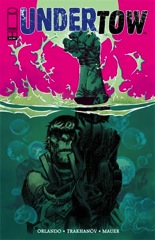
 I would have liked to open with the similarities between Undertow and “Battlestar Galactica” (the new one) but I can’t. Instead I need to open with writer Steve Orlando’s dialogue. He writes it with modern English slang–oh, sorry, the series is apparently about ancient Atlantean explorers coming to the surface (it could go on to be a workplace sitcom, I’ll never know).
Tackling an ancient, made-up language is never easy but combined with the bad pacing and Orlando’s terrible narration… Undertow quickly becomes intolerable. Assuming Orlando gave artist Artyom Trakhanov descriptions of each panel, the comic gets even worse. The narration isn’t over story panels, it’s over cinematic establishing shots. Orlando writes a script out of a bad Gold key comic, but doesn’t even let Trakhanov illustrate it.
Or maybe Trakhanov made that choice. It’s highly stylized art and not bad, just pointless. Much like the comic itself.
F
CREDITS
Messiah Ward; writer, Steve Orlando; artist and colorist, Artyom Trakhanov; letterer, Thomas Mauer; publisher, Image Comics.
