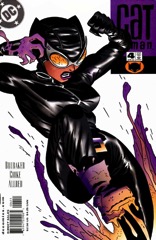
Catwoman (2002) #2

Cw2

Darwyn Cooke owns this issue. It begins with an action sequence: Catwoman breaking into Gotham PD to get a look at the autopsies on the dead streetwalkers. Cooke breaks each page into a dozen or two panels, sometimes splitting a horizontal frame, more often zooming in on one particular aspect of the action. All in his “cartoony” style. There’s never better movement in comic art than the first act of Catwoman #2. It’s a masterpiece.

And he doesn’t let up the rest of the issue ambition-wise. There’s Selina and Holly’s girl talk, done in art deco—to contrast the noir—and then the finale reveal. While Selina (and the reader) have heard about what the killer’s doing to the women and then read the reports, the finale shows the immediate aftermath, complete with the cops robbing the corpse.

Cooke’s superhero noir is a genre itself. Absolutely beautiful, superior work.

Ed Brubaker’s script is mostly successful. The Selina narration’s solid (and appropriately sparse at times), but he runs into a couple hiccups. First, obviously, Selina’s characterization of Batman in her narration is one of a dick—he’d care the women were dying, but they chose that life, didn’t they? Second, when Selina does decide she’ll be the one to stop the killings, it appears to only be after the finale and seeing the latest victim. The narration comes too late in the visuals.

Otherwise, the writing’s excellent. The issue has the lengthy action open, which slows down once Selina’s broken into the morgue, then the flashback to her and Holly’s conversation after last issue, then back to the present and the latest killing. Based on the initial pacing, they could’ve gotten away without having Selina arrive at the crime scene in time. The issue’d earned its two dollars and four bits by then, but Cooke and Brubaker somehow find time (and pages) to continue.

Though had they not paced it so well, that final narration fumble might’ve been avoided. But Catwoman’s inordinately rare faults being side effects of its great successes seems on par for the book.

It’s just too good for its own good.

Catwoman (2002) #1

Catwoman  1

I’ve meant to go back and reread Brubaker’s Catwoman for literal decades now. The last time I tried, I started the post about Catwoman #1 pointing out it proves Ebert’s “no masks in noir” rule from his Batman Returns review wrong.

I’ll never be able to top that one, though it’s impossible not to think of Catwoman in those terms. With Darwyn Cooke and Mike Allred’s brisk, expressive art, Matt Hollingsworth’s lush but dark palette, Catwoman’s a visual feast. Especially once Selina gets back in “the outfit” and goes for an evening constitutional, hanging out on giant heads from a Schumacher Batman only fit to the Gothic city. It’s dark but not depressed; there are moments of such sincere joy in the comic. Not just for the reader but for Selina. She’s been struggling to get her groove back, and she’s finally got the right idea.

The comic’s got full narration from Selina, with Brubaker toggling between first and second person. When Selina’s feeling good about herself, it’s first person. When she’s tearing herself down, it’s second person. Batman ethics and morals have aged terribly, even in the last twenty years—I didn’t even realize I’m starting Catwoman again on its twentieth anniversary—so Selina feeling bad for thinking her friends—poor people, marginalized people—are actually worth it no matter what Batman says… yikes. Batman does show up, and Brubaker (and Cooke) give him the swashbuckler, Zorro feel, not the fascist Frank Miller one, which is good.

But still. Yikes. Find a better role model, Selina.

And she sort of does. She’s been seeing Leslie Thompkins for talk therapy. However, Selina’s been hiding her Catwoman side even though Batman already told Leslie, so she’s known the whole time, which seems professionally questionable. Be careful, Dr. Thompkins; it’s a slippery slope ending it faking the death of the first female Robin or whatever.

The opening has a hook—someone’s killing sex workers and terrifying them before doing so—and the soft cliffhanger gets Selina into the know. She’s been hiding out in the Narrows or whatever it’s called, most people thinking she’s dead, fallen from high society, and not wanting to return to the Jim Balent days of Catwoman. It’s an earnest, speedy character development issue. Not too much backlog, but some panels showing off Cooke’s ability to mix Catwomen of all vintages and costumes; Selina’s trying to move forward and do some good.

It’s such a great first issue. It’s nice. It’s never not tough, never not potentially rough, but it’s also so damn nice.

Catwoman (2002) #4

Catwoman  4

How does noir work when the villain is a Clayface rip-off. I say rip-off because Catwoman is a Batman spin-off and Clayface is a Batman villain. Brubaker knew the similarity. It also gives Cooke something fantastic to draw. Selina in this gross pink muck–the leftover transformative flesh of the villain? Great stuff. Lots of movement in the art.

The villain does have something of a noir origin though. G.I. injured, army docs turn him into a monster, it’s like a film noir with shades of fifties sci-fi. It’s really cool.

But Brubaker relies on it almost too much. The script tries to showcase the art, which is fine and dandy and marvelous. Only it makes for some rushed scenes. One less page of the fight and one more page with Selina and Leslie would have been awesome.

The issue starts fast and rushes. The last few pages seem so short because of the action sequence pacing. Those last few pages are exceptional. Brubaker and Cooke figure out how to give noir a superhero. It’s great comic book storytelling.

Even if the fight goes long.

Catwoman 4 (April 2002)

Catwoman #4How does noir work when the villain is a Clayface rip-off. I say rip-off because Catwoman is a Batman spin-off and Clayface is a Batman villain. Brubaker knew the similarity. It also gives Cooke something fantastic to draw. Selina in this gross pink muck–the leftover transformative flesh of the villain? Great stuff. Lots of movement in the art.

The villain does have something of a noir origin though. G.I. injured, army docs turn him into a monster, it’s like a film noir with shades of fifties sci-fi. It’s really cool.

But Brubaker relies on it almost too much. The script tries to showcase the art, which is fine and dandy and marvelous. Only it makes for some rushed scenes. One less page of the fight and one more page with Selina and Leslie would have been awesome.

The issue starts fast and rushes. The last few pages seem so short because of the action sequence pacing. Those last few pages are exceptional. Brubaker and Cooke figure out how to give noir a superhero. It’s great comic book storytelling.

Even if the fight goes long.

CREDITS

Anodyne, Conclusion; writer, Ed Brubaker; penciller, Darwyn Cooke; inker, Mike Allred; colorist, Matt Hollingsworth; letterer, Sean Konot; editors, Nachie Castro and Matt Idelson; publisher, DC Comics.

Catwoman 3 (March 2002)

Catwoman #3It’s a strange issue. It’s a good issue–though it’s certainly the least ambitious so far–but it’s also a strange issue. Selina doesn’t have as much narration as she had before and now she’s doing much different things. She’s the star of a Bronze Age Batman comic, where Batman dresses up as Matches Malone and investigates on the wharf.

It’s a successful issue. Cooke’s in on the Bronze Age vibe of the issue and the art feels very seventies. The content Cooke’s illustrating, anyway. There’s even a sixties thing with a used car dealer. A lot of thought went into the visual presentation of the book. I just wish Brubaker hadn’t been so quiet.

So far, this series has been about Selina evolving into a do-gooder. This issue continues that evolution, but with the exception of the narration in the first few pages, Selina’s experience is absent from the comic. Even when Brubaker brings back the narration later, it’s to establish that Matches Malone sequence.

Like I said, strange. Expertly, enthusiastically done, but with too much confidence in the narrative effect of the comic to worry about the narrative itself. It’s showy.

CREDITS

Anodyne, Part Three of Four; writer, Ed Brubaker; penciller, Darwyn Cooke; inker, Mike Allred; colorist, Matt Hollingsworth; letterer, Sean Konot; editors, Nachie Castro and Matt Idelson; publisher, DC Comics.

Catwoman 2 (February 2002)

Catwoman #2Cooke mixes a lot of styles in this issue. Selina lives her non-costumed life in a more angular city, one with more art deco designs than when she’s got the costume on at night. But Cooke also finds this mixed style for Selina herself. She’s got the modern look, but he also goes for Silver Ago influences to make her more sympathetic.

And then there’s what Brubaker’s narration does for her character. This series of Catwoman integrates whatever history the character had since Batman: Year One, so the Jim Balent stuff and whatever else, with a continuation of the character from Year One. Or at least something closer to that characterization. Including the history of prostitution.

The prostitution angle–with Holly, Selina’s sidekick from her Year One days–figures into the story, with Gotham’s dirty cops ignoring a serial killer preying on girls on the street. Selina ends up investigating it. There’s no humor in the comic. Not a moment. Not even when Cooke and Brubaker take the time and care to show Selina’s pure joy in running around the rooftops. It’s serious stuff; Brubaker’s very deliberate in how he works through Selina’s thoughts in the narration too.

Again, it’s noir. It’s a noir comic masquerading as a superhero comic (masquerading as a noir comic). Brubaker juggles the mainstream and more artistically ambitious beautifully. What Cooke does is just as important, but it only works because of how well Brubaker does his bit.

CREDITS

Anodyne, Part Two of Four; writer, Ed Brubaker; penciller, Darwyn Cooke; inker, Mike Allred; colorist, Matt Hollingsworth; letterer, Sean Konot; editor, Nachie Castro and Matt Idelson; publisher, DC Comics.

Catwoman 1 (January 2002)

Catwoman #1In his ★★ review of Batman Returns, Roger Ebert said, “no matter how hard you try, superheroes and film noir don’t go together; the very essence of noir is that there are no more heroes.” I disagree about the film, but not all of the quote. I agree with the first part, not so much the second. Because it’s a closed vision of heroes.

It oddly doesn’t seem to occur to Ebert how the “junkies and masochists and hookers and those who have squandered everything… [can be] the ring of brightest angels around heaven.” Because a review of a single comic book from 2002 needs this long of a preamble. One with the only time I’ll agree with Ebert this year and a great Rick Moody quote.

But Ed Brubaker and Darwyn Cooke’s Catwoman requires a significant preamble. Because Brubaker and Cooke crack Ebert’s problem. How do film noir and superheroes go together? Well, the superhero can’t be the hero. Batman shows up in this first issue of Catwoman for two reasons.

First, regardless of how progressive DC was being with a non-objectified characterization of Catwoman, they weren’t being so progressive they didn’t want to sell the comic. There’s an exceptionally tasteful, but sexy, suiting up sequence. Cooke can do that kind of thing, thanks to Brubaker selling Selina’s excitement. It’s believable.

That scene is so well-executed, one might just skip over it as a commercialist detail. But Batman is all commercial. You launch a spin-off of a Batman comic, Batman better guest star, especially in the early aughts, especially going from Chuck Dixon and Jim Balent to Ed Brubaker and Darwyn Cooke. You need Batman. And this issue delivers. A full-on Batman action sequence–it’s hard to remember when Brubaker’s mainstream writing was a DC staple, not how he brought the same thing to Marvel to better sales–then Batman shows up for character stuff.

And that character stuff is the second reason Batman shows up. He’s essential to Brubaker’s characterization of Selina. Selina has an informed but seemingly simplistic view of Batman; he’s her dark blue boy scout. It gives Selina better possession over the shared setting, she belongs.

Brubaker and Cooke visualize that setting as a noir. They start with the already noir-ish David Mazzuchelli Year One visuals then develop it, creating a Technicolor film noir. Brubaker’s script follows Selina–the comic’s narrator as well as protagonist–through her last few days of sabbatical. She doesn’t know it, but she’s going to get suited up again.

There’s a lot of noir framing in the flashbacks and so on. The narrative construction is special stuff. It’s meticulous. Meticulously written, then meticulously illustrated.

By the time the most noir element comes into the comic–in its last pages–Brubaker and Cooke have already delivered an awesome read. The way the last two pages and the soft cliffhanger? It’s the chocolate sprinkles on the frosting.

CREDITS

Anodyne, Part One of Four; writer, Ed Brubaker; penciller, Darwyn Cooke; inker, Mike Allred; colorist, Matt Hollingsworth; letterer, Sean Konot; editor, Nachie Castro and Matt Idelson; publisher, DC Comics.

Wednesday Comics 12 (23 September 2009

Skitched 20130301 152034One should never hope for too much from finales. Especially not from an extremely uneven anthology series like Wednesday Comics.

Batman’s bad. Kamadi flops. Superman apparently only remembered after twelve installments he had a wife at home.

Deadman is okay. One of the better mediocre strips. Green Lantern is bad. Metamorpho is lacking; Gaiman tries too hard for nostalgia.

Teen Titans is awful, Adam Strange is great. Supergirl is cute again, but Metal Men goes out too dreary. I still have no idea what story Caldwell told with Wonder Woman.

Sgt. Rock’s lame again, but in a syrupy way now. Good Flash comic, though confusing, and an almost okay finish to The Demon and Catwoman. Hawkman is severely lacking too.

The winner of Wednesday Comics is easily Paul Pope for Adam Strange. The losers are just as easy–the inept team of Eddie Berganza and Sean Galloway for Teen Titans.

CREDITS

Batman; writer, Brian Azzarello; artist, Eduardo Risso; colorist, Patricia Mulvihill; letterer, Clem Robins. Kamandi; writer, Dave Gibbons; artist, Ryan Sook. Superman; writer, John Arcudi; artist, Lee Bermejo; colorist, Barbara Ciardo; letterer, Ken Lopez. Deadman; writers, Vinton Heuck and Dave Bullock; artist, Bullock; colorist, Dave Stewart; letterer, Jared Fletcher. Green Lantern; writer, Kurt Busiek; artist and colorist, Joe Quinones; letterer, Pat Brosseau. Metamorpho; writer, Neil Gaiman; artist, Mike Allred; colorist, Laura Allred; letterer, Nate Piekos. Teen Titans; writer, Eddie Berganza; artist and colorist, Sean Galloway; letterer, Nick J. Napolitano. Adam Strange; writer, artist and letterer, Paul Pope; colorist, Jose Villarrubia. Supergirl; writer, Jimmy Palmiotti; artist, Amanda Conner; colorist, Paul Mounts; letterer, John J. Hill. Metal Men; writer, Dan DiDio; penciller, Jose Luís Garcia-Lopez; inker, Kevin Nowlan; colorist, Mulvihill; letterer, Lopez. Wonder Woman; writer, artist, colorist and letterer, Ben Caldwell. Sgt. Rock; writer, Adam Kubert; artist, colorist and letterer, Joe Kubert. The Flash; writers, Brendan Fletcher and Karl Kerschl; artist, Kerschl; colorist, Dave McCaig; letterer, Rob Leigh. The Demon and Catwoman; writer, Walt Simonson; artist and colorist, Brian Stelfreeze; letterer, Steve Wands. Hawkman; writer, artist, colorist and letterer, Kyle Baker. Editors, Chris Conroy and Mark Chiarello; publisher, DC Comics.

Wednesday Comics 11 (16 September 2009)

632695Azzarello writes Batman as a rube while Risso tries to ape Sin City as a Batman. Gibbons once again summarizes the action too much on Kamandi. Sook’s barely got anything to do.

Superman is bad. As usual.

Deadman’s okay, Green Lantern’s awful. Ditto, respectively, for Metamorpho and Teen Titans. Hope respectively, in that sense, means Titans is the awful one.

Good (not great) Adam Strange. Poor (not terrible) Supergirl.

For the first time, Garcia-Lopez is too busy on Metal Men. All the large scale action hurts it. And Caldwell breaks out of his little panels for Wonder Woman. It’s a mistake.

Sgt. Rock is okay, The Flash is great. Demon and Catwoman sucks–it’s Simonson’s fault. Stelfreeze just doesn’t have anything good to draw.

Awesome Hawkman–the art’s astounding. Baker really outdoes himself.

Wednesday Comics is wrapping up. Shame most of the creators have no idea how to close.

CREDITS

Batman; writer, Brian Azzarello; artist, Eduardo Risso; colorist, Patricia Mulvihill; letterer, Clem Robins. Kamandi; writer, Dave Gibbons; artist, Ryan Sook. Superman; writer, John Arcudi; artist, Lee Bermejo; colorist, Barbara Ciardo; letterer, Ken Lopez. Deadman; writers, Vinton Heuck and Dave Bullock; artist, Bullock; colorist, Dave Stewart; letterer, Jared Fletcher. Green Lantern; writer, Kurt Busiek; artist and colorist, Joe Quinones; letterer, Pat Brosseau. Metamorpho; writer, Neil Gaiman; artist, Mike Allred; colorist, Laura Allred; letterer, Nate Piekos. Teen Titans; writer, Eddie Berganza; artist and colorist, Sean Galloway; letterer, Nick J. Napolitano. Adam Strange; writer, artist and letterer, Paul Pope; colorist, Jose Villarrubia. Supergirl; writer, Jimmy Palmiotti; artist, Amanda Conner; colorist, Paul Mounts; letterer, John J. Hill. Metal Men; writer, Dan DiDio; penciller, Jose Luís Garcia-Lopez; inker, Kevin Nowlan; colorist, Mulvihill; letterer, Lopez. Wonder Woman; writer, artist, colorist and letterer, Ben Caldwell. Sgt. Rock; writer, Adam Kubert; artist, colorist and letterer, Joe Kubert. The Flash; writers, Brendan Fletcher and Karl Kerschl; artist, Kerschl; colorist, Dave McCaig; letterer, Rob Leigh. The Demon and Catwoman; writer, Walt Simonson; artist and colorist, Brian Stelfreeze; letterer, Steve Wands. Hawkman; writer, artist, colorist and letterer, Kyle Baker. Editors, Chris Conroy and Mark Chiarello; publisher, DC Comics.

Wednesday Comics 10 (9 September 2009)

632694Batman versus dogs, Azzarello’s inspired and Risso can’t even draw a cool Batmobile. Kamandi comes back a little; there’s a big battle scene, lots of panels. Arcudi misses a great Superman: The Movie homage on his dumb Superman strip.

Deadman’s okay, though all the action seems inappropriate. Green Lantern is lame; Busiek doesn’t understand weekly one page pacing. Metamorpho is competent but lame. Teen Titans is awful. Galloway’s a terrible writer.

Pope’s Adam Strange rocks. He’s clearly wrapping it up. Supergirl’s weak again. Too much plot, not enough cute. The Metal Men has some great art and a touching final couple panels. The Wonder Woman is once again confusing but still good. Maybe Caldwell just needs more space to tell the story.

The Sgt. Rock is okay. Far better than the strip’s worst. Decent Flash; very sci-fi.

Predictably lousy Demon/Catwoman and great Hawkman.

Comics is almost over.

CREDITS

Batman; writer, Brian Azzarello; artist, Eduardo Risso; colorist, Patricia Mulvihill; letterer, Clem Robins. Kamandi; writer, Dave Gibbons; artist, Ryan Sook. Superman; writer, John Arcudi; artist, Lee Bermejo; colorist, Barbara Ciardo; letterer, Ken Lopez. Deadman; writers, Vinton Heuck and Dave Bullock; artist, Bullock; colorist, Dave Stewart; letterer, Jared Fletcher. Green Lantern; writer, Kurt Busiek; artist and colorist, Joe Quinones; letterer, Pat Brosseau. Metamorpho; writer, Neil Gaiman; artist, Mike Allred; colorist, Laura Allred; letterer, Nate Piekos. Teen Titans; writer, Eddie Berganza; artist and colorist, Sean Galloway; letterer, Nick J. Napolitano. Adam Strange; writer, artist and letterer, Paul Pope; colorist, Jose Villarrubia. Supergirl; writer, Jimmy Palmiotti; artist, Amanda Conner; colorist, Paul Mounts; letterer, John J. Hill. Metal Men; writer, Dan DiDio; penciller, Jose Luís Garcia-Lopez; inker, Kevin Nowlan; colorist, Mulvihill; letterer, Lopez. Wonder Woman; writer, artist, colorist and letterer, Ben Caldwell. Sgt. Rock; writer, Adam Kubert; artist, colorist and letterer, Joe Kubert. The Flash; writers, Brendan Fletcher and Karl Kerschl; artist, Kerschl; colorist, Dave McCaig; letterer, Rob Leigh. The Demon and Catwoman; writer, Walt Simonson; artist and colorist, Brian Stelfreeze; letterer, Steve Wands. Hawkman; writer, artist, colorist and letterer, Kyle Baker. Editors, Chris Conroy and Mark Chiarello; publisher, DC Comics.