Elmer Gantry (1960, Richard Brooks)

Elmer Gantry is all about possibilities. Possibilities for the plot, for the performances, for the film. Director (and screenwriter) Brooks watches the film along with the audience, specifically the performances. Everyone’s just waiting to see what Burt Lancaster, Jean Simmons, and Shirley Jones are going to do next. Sometimes, Brooks emphasizes the performance with quick cuts—the first act has some spectacular sequences, with editor Marjorie Fowler, Brooks, and composer André Previn in divine sync—sometimes, he lets the camera sit. Perfectly lighted scene (courtesy John Alton) and Lancaster or Simmons monologuing.

Though it’s not all monologuing. Gantry’s got some wonderful banter sequences; the film’s practically designed for them.

Set in the 1920s, the film opens with Lancaster amusing a bunch of traveling salesmen. They meet up for Christmas every year because Lancaster knows where to find the best booze (Prohibition-time) and the best women (bored housewives). Lancaster’s holding court, telling dirty jokes, and having a great time; only then the Sisters of Mercy come in asking for a donation, and the heathens are shitty to them. So Lancaster does a sermon, surprising the bar (and helping him seduce a lady) with his seemingly devout religiosity. The scene establishes the character, that duality, and Lancaster’s exceptional way of essaying it.

The film will explore the contradictions in the appropriately lengthy second act, but first, it’s got to get Lancaster to church. Lancaster resists even as he sees posters for traveling tent revivalist Simmons alongside his own sales route. He ends up there one night out of boredom (and a busy housewife) and becomes immediately enraptured by Simmons. But Lancaster’s not her only admirer, though he’s the only one who’s planning to do anything about it. Both Arthur Kennedy and Dean Jagger revere Simmons. Jagger’s her business manager, a good Christian who thinks he’s enabling a prophet. Kennedy’s the atheist newspaperman tagging along with the tour.

Lancaster can’t give Simmons to give him the time of day—he’s too much of a smooth talker—until he seduces her band leader (Patti Page) and weasels his way along with them. But he still can’t convince Simmons he’s godly, except she doesn’t care, it turns out. She’s more than willing to put a smooth-talking bible thumper on stage if it gets butts in seats and pledge cards signed. There’s a business angle to it; after all, local churches pay Simmons and Jagger in advance to bring the revival to town.

We don’t find out about that side of things until around halfway through, when—thanks to Lancaster’s fire, brimstone, and sexy sermons—the local big city asks Simmons to bring her show to them. The film stays in the big city (Zenith, a recurring fictional city in novel author Sinclair Lewis’s work), which makes sense because it’s where Kennedy’s newspaper is based and Jones lives. Jones is an ex-lover of Lancaster’s with a very big, very sharp, very justified ax to grind. The film introduces her early, as Lancaster and Simmons start making news together, raising expectations for when she’ll figure into the main plot. Jones is exceptional.

So’s Simmons. Somehow, Simmons manages to give just as showy a performance as Lancaster (or Jones), but they’re absurdly extroverted, and she’s reserved. It’s Simmons’s revival, no matter what Lancaster or Jagger thinks. However, Lancaster and Jagger’s prickly relationship turns out to be one of the film’s sharpest, subtlest subplots. So good.

Kennedy’s good, too; he’s just not extraordinary. Lancaster, Simmons, and Jones all give these singular performances, while Jagger and Kennedy excel closer in character parts. Of course, Jagger and Kennedy’s characters are mostly reacting to the others, which also affects how they function and what they can do with the parts. The film’s practically overflowing with great performances; for instance, Page never gets enough.

All the technicals are excellent. Brooks’s direction is patient, enthusiastic, and reserved. He never rushes a scene or a delivery. He gives Lancaster and Simmons time for their preaching; the film’s about these characters’ relationship with religion, internal and external, and Brooks wants to showcase it. Done wrong, it’d be anti-climactic; Gantry doesn’t do it wrong, quite the opposite.

Alton’s photography, Fowler’s cuts, Previn’s music, all superb. Dorothy Jeakins’s costumes too. Lots of character development in the changing outfits, sometimes subtle, sometimes not.

Lancaster and Simmons are the whole show. Brooks and his crew are just trying to create the optimal narrative distance on Lancaster, specifically on his experiences with Simmons. Even when she’s not around, when it’s Lancaster and Jagger, Kennedy, or Jones, Simmons’s presence is always felt. She’s the show; they’re all spectators, except Lancaster wants to be on stage too. Kennedy and Lancaster have a great friendship throughout, two cynics on different paths.

As far as who’s better, Lancaster or Simmons, it depends on the scene. Though we get to know Lancaster better through the film, whereas Simmons gets to keep some secrets, which makes her performance inherently more complicated. They’re both so damn good. And then Jones. So damn good.

The whole picture. So damn good.
The Happy Ending (1969, Richard Brooks)

Jean Simmons doesn’t smile until over halfway through The Happy Ending. The movie runs almost two hours and has a present action of like eighteen years. The first eight minutes are a mostly wordless summary of John Forsythe courting Jean Simmons in the early fifties. The time period’s not important–even though the film taking place in 1969 is brought up multiple times in the present–because it’s a storybook (for the early fifties) romance where college girl Simmons falls in love with tax lawyer Forsythe. Eventually we find out Simmons dropped out to marry Forsythe.

The present action is at least sixteen years later because daughter Kathy Fields (in the film’s greatest botched role, both in Fields’s performance but mostly in director Brooks’s weird script–more on that later, obviously) is sixteen. The film opens on Simmons and Forsythe’s wedding anniversary party. Simmons wants to run off for the night, just she and Forsythe. He doesn’t want to cancel the party because it’d embarrass them in front of their friends. More on the friends later too.

So after Forsythe tells housekeeper Nanette Fabray–they’re not rich enough for Fabray to live with them, just to have her do the daily housework and hang out until after midnight when needed–to inform on Simmons’s behavior. See, Simmons’s drinks. Forsythe found her stashed booze. But it’s not open, because Simmons is recovering and being good. Through the course of the film, flashbacks reveal what she’s recovering from while also showing how she finally has to deal with it.

Simmons runs off to the Bahamas. Instead of doing the anniversary party thing, which makes sense as it’s later revealed Forsythe and Simmons don’t have any real friends, their social life solely consists of Forsythe’s clients. But we’ve already met some of the clients’ wives–they get together and get wasted and play cards in the health club locker room while berating one another for their affairs (Tina Louise has a small role as the ringleader; it’s a weird role, given Brooks’s narrative distance to it, but she does all right; the script gets her in the end). Because what the first half of The Happy Ending is about is how hard it is for women to get old and loose their looks. Brooks’s script has… sympathy, I guess, but no insight. It’s also completely unaware of the ingrained misogyny or… I don’t know what it’s called, patriarchal reinforcement. Like, the only two guys in the movie with any honest characterization are Bobby Darin as a gigolo and Lloyd Bridges as an adulterer running around the Bahamas with Shirley Jones, a friend of Simmons’s from college.

It’s a good thing they run into each other on the way too because Forsythe doesn’t let Simmons have any money since she got drunk and went clothes shopping a little while after she survived a suicide attempt, which she attempted after finding Forsythe was cheating on her with a client and–if the somewhat confusing flashback timeline does indeed progress linearly (and it seems too, Brooks’s numerous narrative devices are all way too obvious)–it’s not the first time. Forsythe goes with divorcing clients to Reno and then shakes up with them in their moments of weakness. No one ever says it because it’s not clear Brooks even recognizes it because Brooks breaks the script to coddle Forsythe. On one hand it works he never wakes up and gets it–the audience perception of Forsythe changes a lot throughout and a tad too gradually since it just gives Forsythe and Fields more screen time than they deserve, performance and character-wise. The reason it’s important it takes so long until Simmons cracks a smile in the present action, delayed by all those flashbacks? Because she’s been the subject of her own movie until then. Brooks does everything he can to avoid developing her character, particularly in the flashbacks. Because then he can’t keep Forsythe from ever seeming like a dick, which is the goal of the film. Right up until the very end.

Oh, right–Nanette Fabray’s housekeeper. Turns out she’s Simmons’s only friend, because even though her house is used for wife-swapping, Simmons herself has never participated. Because all of the other women have either slept with Forsythe or tried. Brooks is downright misanthropic in his depiction of upper middle class America but he never embraces it. Simmons is at least a dreamer; we learn right away she cries at all romantic endings, happy or sad.

Hence the title. At the wedding scene, Forsythe’s face is replaced with clips of happy endings from old Hollywood movies. Like, Brooks gives Simmons a very definite character and then avoids letting her develop the character for about half the movie. It’s not until she meets up with Darin’s gigolo where Simmons gets to do anything. Until then it’s mostly being functionally drunk and pissed off at Forsythe’s utter lack of self-awareness. And to get betrayed by mother Teresa Wright (who apparently had Simmons at age ten) and ignored by super-annoying daughter Fields.

Oh, right, and for Forsythe to track her by phone to make sure she’s all right since she’s a suicidal drunk and all. Like, he calls all the places she goes. The only place she gets any privacy is her bar, where her uncredited bartender doesn’t snitch on her to Forsythe.

And Brooks discreetly establishing Simmons’s situation is fine. It would even be efficient if it didn’t get so confused with flashbacks. There’s nothing but melodrama in the flashbacks as Simmons keeps getting into trouble and whatnot.

It’s such a relief when Jones and Bridges show up. Jones’s life philosophy as a professional mistress is a little… messed up. Like Brooks has good instincts for what kind of exposition the film needs, he just doesn’t write it well. Or direct it well. He’s got these walking and talking scenes where he cuts from location to location as the conversation continues. He doesn’t have a reason for the gimmick other than it maybe stretches the film’s verisimilitude to allow for these unlikely conversations and whatnot. But it’s not like the film has a different style first half to second, once the dumps become more frequent, it’s always the same dialogue tempo, with Michel Legrand’s music not booming but pressing, and Conrad L. Hall’s way too soft lights. Happy Ending really ought to look better. Like, it’s fine, but it ought to look a lot better. Brooks’s direction is tediously competent and always really safe. He never goes big, he never goes small; he avoids them equally. And it does the film no favors.

Simmons is really good when she’s got material of her own, which is maybe a quarter of her scenes. Brooks abjectly surrenders on trying to write her with Fields, which is incredible. Forsythe’s not good. He could be a lot worse. But he couldn’t be any blander. Somehow Forsythe’s bland performance doesn’t inform the bland character.

Jones is great. Bridges is better than any of the other male performances. Darin’s not good but at least he’s trying something, which is more than Forsythe does. Or Fields. Or Wright, who’s utterly pointless except for a late stage revelation which does nothing for the film but instead absolves fathers of responsibility.

Fabry’s good as the confidant, but she’s got zilch to do on her own. She’s literally the help in story and script.

There’s probably a lot you could pick apart in Brooks’s script and film, but it’s not really worth looking at in those terms. There’s gristle but so what. It’s not distinct gristle.

The film does give Simmons a potentially great role and then denies it to her. She’s still able to give a rather good performance. If the material had met her, however, it’d be a better one. Brooks is just too afraid to let her be the protagonist. It’s mildly then significantly disappointing, because he never improves and it’s almost two hours long.

Plus, Legrand’s music and (especially) the original songs grate.

And the Hall cinematography is wasted.

Happy Ending is a mess of missed opportunity and bad choices.


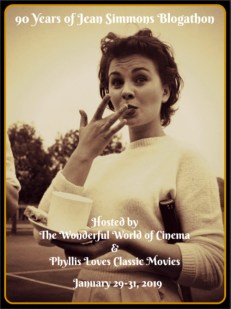
THIS POST IS PART OF 90 YEARS OF JEAN SIMMONS BLOGATHON HOSTED BY VIRGINIE OF THE WONDERFUL WORLD OF CINEMA and PHYLLIS OF PHYLLIS LOVES CLASSIC MOVIES.

Deadline – U.S.A. (1952, Richard Brooks)

Deadline – U.S.A. is about half a great movie. Director Brooks fills the film with a superb supporting cast of character actors–Paul Stewart, Audrey Christie and Jim Backus are the standouts–and lets them share the runtime with lead Humphrey Bogart. It’s a newspaper drama… is the paper going to close down? Brooks’s script complicates it with squabbles between the heirs, a gangster (Martin Gabel in the film’s only bad performance), and Bogart’s ex-wife (Kim Hunter) about to remarry.

Brooks takes about twenty-five minutes (of the film’s ninety minute runtime) to get to the gangster story. He’s established the paper’s imminent closing, the cast, then he brings in the “big story.” Bogart and Ed Begley have wonderful scenes where they try to reason out the story. Even when Brooks’s plotting goes wrong, his scenes are extraordinarily strong. But he can never make the gangster story as important as the newspaper’s staff or whether Hunter’s going to fall for Bogart’s wooing.

In a lot of ways, Deadline is a big, glorious mess of a picture. Brooks doesn’t follow through with his initial narrative impulse–Hunter disappears for a while, to let Bogart pursue Gabel–and he plays way too loose with the time. Brooks seems to consciously avoid addressing the time.

Bogart’s fantastic–he and Ethel Barrymore (as the paper’s owner) are excellent together, as are he and Hunter. Awesome photography from Milton R. Krasner makes up for William B. Murphy’s weak editing.

Deadline‘s good, but it should be amazing.

2/4★★

CREDITS

Written and directed by Richard Brooks; director of photography, Milton R. Krasner; edited by William B. Murphy; music by Cyril J. Mockridge; produced by Sol C. Siegel; released by 20th Century Fox.

Starring Humphrey Bogart (Ed Hutcheson), Ethel Barrymore (Margaret Garrison), Kim Hunter (Nora Hutcheson), Ed Begley (Frank Allen), Warren Stevens (George Burrows), Paul Stewart (Harry Thompson), Martin Gabel (Tomas Rienzi), Joe De Santis (Herman Schmidt), Joyce Mackenzie (Katherine Garrison Geary), Audrey Christie (Mrs. Willebrandt), Fay Baker (Alice Garrison Courtney) and Jim Backus (Jim Cleary).


RECENTLY

[display-posts tag=”Ed-Begley,Ethel-Barrymore,Humphrey-Bogart,Jim-Backus,Kim-Hunter,Paul-Stewart,Richard-Brooks” posts_per_page=”5″ taxonomy=”post_tag” tax_term=”deadline-u-s-a” tax_operator=”NOT IN”]

The Last Hunt (1956, Richard Brooks)

Here’s a strange one. I just had to look to see where it fell in careers, Richard Brooks’s and Robert Taylor’s, because it’s… well, it’s something else. It’s sort of early in Brooks’s directing career, before he took off, and it’s at the very end of Taylor’s MGM contract. Taylor plays a villain in it. And Brooks handles his villainy in a singular way–he never lets anyone get away from it. Some of the scenes play like a hostage situation, but hero Stewart Granger can always leave. Lloyd Nolan and Russ Tamblyn play skinners to Granger and Taylor’s buffalo hunters and they too can leave. Even “Indian girl” (literally, the character has no other name) Debra Paget could, until a point, leave. But no one does. Taylor holds them–and the viewer–captive.

At a certain point–the film gets off to a rocky start, with Brooks having the most trouble establishing the character relationships effectively–it becomes clear it’s not about watching Taylor’s crazed gunslinger turned buffalo hunter (he’s an Indian War veteran, clearly suffering from the experience) redeem himself, but about seeing if the rest of the cast can survive knowing him. And Taylor’s performance might be his best. Once it becomes clear he’s the villain, he’s amazing. Absolutely terrifying, with all the trappings of a tragic character, but he’s so evil, it’s impossible to feel any sympathy.

Brooks juggles two big issues (The Last Hunt certainly signifies, the same year as The Searchers no less, the developing consciousness of the American Western… it also shares a theme with The Searchers, which is a little odd)–buffalo hunting and racism. The two wear heavy on an already somber Granger. Granger, second-billed to Taylor here, gives a great performance too. Brooks doesn’t deal much in subtext here and Granger’s perfect at dealing with conspicuous unrest (even though a lot of his internal turmoil is silent).

The rest of the cast, except Paget, is fantastic. Brooks’s direction is excellent, as is (after the first act) his dialogue. He has some problems with the day-for-night shooting and some rear screen projection, but it’s forgivable. Brooks really makes something great here and it’s a quiet (even though it’s Cinemascope) mid-1950s great.

4/4★★★★

CREDITS

Directed by Richard Brooks; screenplay by Brooks, based on the novel by Milton Lott; director of photography, Russell Harlan; edited by Ben Lewis; music by Daniele Amfitheatrof; produced by Dore Schary; released by Metro-Goldwyn-Mayer.

Starring Stewart Granger (Sandy McKenzie), Robert Taylor (Charlie Gilson), Lloyd Nolan (Woodfoot), Debra Paget (Indian girl), Russ Tamblyn (Jimmy O’Brien), Constance Ford (Peg) and Joe De Santis (Ed Black).


RELATED