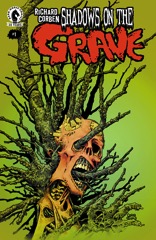
Shadows on the Grave (2016) #8

Shadows on the Grave  8I just got the final reveal in the Deneaus conclusion. Not like I just finished reading it and got the reveal; a few hours later, sitting down to write about Shadows on the Grave’s finish, I got it.

I should’ve gotten it earlier. Maybe I would in a single sitting reread (I mean, probably not, but we’re pretending here). It’s a nice touch. It doesn’t change anything about the final chapter, but a nice touch. Creator Richard Corben’s had a bumpy road with Deneaus, the only serial in Grave, and it’s nice he’s got it to a solid finish. The art’s particularly lovely, with lots of white space for the open skies and empty landscapes. It contrasts the very busy panels of the rest of the book, which mostly takes place in graveyards.

Literally.

Over fifty percent of the other three short stories and two one-pagers takes place in a graveyard. The non-graveyard one-pager, opening the book, involves a corpse. Corben’s got his standards, and he hits them well here. Well, after the first story, anyway.

The first story’s another robber story; some dude is going to rob an antique shop and pawn the goods somewhere else for cash. The shop owner can tell there’s something skeezy and kicks the guy out, who then watches the store owner acting weird about a cabinet. Of course, the robber will return for the cabinet, with its contents providing scary fodder for the rest of the story.

The MacGuffin’s only okay because Corben does a weird epilogue thing where he skips some of the action. The epilogue doesn’t work, making the MacGuffin less of a disappointment in comparison. Lots of scary, ominous details, though.

They really come through in the following story, about a couple of kids playing in a graveyard. One dares the other to go into a child killer’s crypt, only for the gate to get stuck. Corben uses the same epilogue device here and to great success. Corben writes a lot more this issue since he’s still doing eight-page stories, and there’s not much action in them, and the prose here’s better. He’s more patient with it.

The next story—also a graveyard story—has a woman visiting her mother’s grave, then her three husbands’ graves. Corben does a quick exposition dump, then turns it into a zombie action story with a couple unexpected turns (outside the zombies). No epilogue device in this one (though I’m now thinking about how Corben usually just does them in narration, not scene). Anyway. Another really strong entry. While the first story’s lacking, the second two more than make up for it, then the Deneaus finale brings the issue to a strong close.

The back cover one-pager bids Grave and its readers an amusing, witty farewell.

The series has ranged from excellent Corben to uneven Corben. The art’s always been on point, even when the writing’s been wanting (more often than not, that writing isn’t Corben’s). In all, an outstanding Corben horror anthology.

Shadows on the Grave (2016) #7

Shadows on the Grave  7

I’m back to wondering if they commissioned a bunch of stories from the same prompt, and now it’s creator Richard Corben’s turn to do them himself. There aren’t any co-writers this issue, not even on the one-page strips. It’s just Corben, and it’s a triple.

Unfortunately, there are four stories, but the first three more than make up for the lag.

The first story’s the writing prompt one. Some selfish nephews visit a dying relation, looking for some cash. The relation tells them to bugger off—it’s a Shadows standard—and then the money-seeker kills them. Except here, the relation dies of natural causes, and the boys are left contesting a will. It isn’t actually Richard Corben illustrating an estate law procedural, but it’s just as weird in the end. There’s some beautiful pacing on the story too. It feels double-sized, thanks to Corben’s opening narration and how it carries the opening one-page strip’s tone.

Beautiful work.

Then the following story is about a gravedigger who works for his corrupt cousin. After being particularly shitty one day, the cousin decides to follow the gravedigger home and check up on his living situation. He’s in for a big surprise.

Similar to the first story, Corben sets up one horror story trope only to do something else with it. This story also has the biggest haunting factor of the issue (and it’s in the running for the most haunting of the series)–another strong entry.

The third story’s about a woman getting a ride from some dude, and they stop at a roadside horror museum. Except the only thing in the museum is a creepy garden with moldy statues.

Corben pushes too hard on the writing—he draws the couple like love interests, but their dialogue just has them acquaintances. It’s so noticeable by the third page I went back to check if he had a co-writer. The story turns itself around enough by the end, with some really dark humor, even for Corben. The art’s particularly gorgeous on this one.

The last eight-page feature is the Deneaus chapter, the Ancient Greek action epic Corben’s been doing the whole series.

It’s the penultimate chapter. Most of the chapter is a battle scene with the bad guys falling right into Deneaus’s traps. Some good art, but there’s nothing to the story. Even with all the twists and turns, Corben’s not going anywhere with it or the characters. It’s too bad. Still totally fine, but a disappointment. Especially taking the rest of the issue into account.

The two one-pagers are fine. The back cover color one gets away from Corben, but the first one’s solid.

I’m going to miss this series.

Shadows on the Grave (2016) #6

Shadows on the Grave  6

Shadows has a nice rally this issue. It works out even when the stories are too long (or too slight). They’ve all got eight pages, but creator Richard Corben and (especially) first story writer Mike Shields pace them out beautifully. Also, there aren’t any stories on repeat this issue, which is nice.

Although, that first story does open with a con man approaching a small, isolated town, ready to score off the yokels. It quickly becomes a comedy of errors, with the townspeople mistaking the con man for someone else, and he’s all too happy to pretend, so long as he can still get out ahead. The story feels like it’s at least twelve pages. Another page in the resolution would’ve probably made it feel like sixteen; Shields is writing a feature story and getting all the Corben art he can for his script.

It’s a standard, not-unpredictable story, but it’s still awesome.

Then the second story—Corben writes the rest in the issue—is this fantastic art piece about a trapper on a snowy mountain hunting the wrong kind of animal. Corben goes from whiteouts to blackouts, with lots of playing with the narrative distance as the trapper gets increasingly afraid. It’s a simple story, maybe three events, and Corben draws the heck out of it to fill the eight pages.

The third story combines talking heads and a graveyard scare story. A guy’s in with his therapist, talking about his recurring nightmare of a zombie stalking him through a cemetery–lots of good scary art, excellent talking heads composition, and a familiar but solid twist ending. Again, Corben uses empty space to pace out the story but also takes the twists into account to change the reading pace. The trapper story’s better because the art’s got more places to go, but Corben’s story is tighter here.

And then the Greek epic chapter is back on track. Corben does a slightly different style for one of the scenes, and it nicely turns it into a prologue, though the chapter benefits from a second read, thanks to the reveal. But the story gets back to the main characters, throwing them on an unexpected story arc. I’m still confused why the ninja isn’t around; I guess she’s not coming back, which is a shame.

Corben gets to do an Ancient Greece subterfuge sequence followed by a hack-and-slash fight scene. Great pacing, plus a glorious two-page action spread.

I’m not sure if this issue’s the best overall, but it’s a serious contender. It’s an awesome start to finish.

Oh, the bookend one-pagers. There’s a creepy eating thing with Corben and co-writer Beth Corben Reed showing off how gross certain words can be to read; then there’s another food-related punchline color strip for the back page. Good stuff too, but the meat’s inside.

Shadows on the Grave (2016) #5

Shadows on the Grave  5

Creator Richard Corben’s got some co-writing help again on this issue of Shadows and it doesn’t work out. The whole issue just never quite works out, including the Greek epic, which bums me out.

The issue starts okay, with a one-page romance comic gag. Nice art too. The issue’s got excellent art from Corben throughout—including some great art on one of the stories—but it’s not enough to compensate for the slight writing.

The feature stories are all eight pages, which is a Shadows no-no. Corben does much better when he varies the length for what the story actually needs. None of the four features are balanced well this issue. It’s such a bummer.

The first story is about a guy who gets lost in the rain in rural America, pulls up at a stranger’s house, demands the old lady put him up for the night. Now, elements of that narrative have already appeared in Shadows within the last couple of issues. What’s the house’s secret, will the rude dude survive, and so on. It’s a mad-libs Corben horror strip.

The following story is the exact same situation. It feels very familiar—the protagonist is a shitty nephew gone to swindle a rich aunt (same setup as a story… in the last couple issues). When he gets there, his aunt’s got a secretary who makes him wait to see her, which gets the guy curious enough to snoop. Disaster ensues.

Beth Reed co-writes both stories. The first one’s better than the second, but the second is where it’s clear what’s going on. The script’s trying too hard to fit the “formula,” which seems to be because of Reed. It doesn’t make sense for Corben to write “more Corben” but with a co-writer.

I did just have the thought maybe a few writers used the same prompts from Corben. If so, those stories obviously should’ve been presented together and with context. This issue’s entries would still be lesser compared to whenever they appeared before, but the book wouldn’t seem repetitive, at least.

The third feature is Corben solo writing. A blind woman is in Africa trying to find a cure from a remote, hostile tribe. If Corben establishes the time period, it wasn’t forcefully enough I remember, but hopefully, it’s sometime in the mid-twentieth century and not today.

The art’s phenomenal, with Corben illustrating from the point of view of the blind woman, which is incredible stuff. The script’s just okay—the plot’s underwhelming, and the twist is creaky—but the art makes up for it. Though it’s still a bummer. The first story didn’t work out, the second story didn’t work out, the third story didn’t work out.

Surely the Greek epic will come through.

Incomplete. The Deneaus chapter gets an incomplete. It’s eight pages too, which is way too short. Corben rushes the opening hook, which brings the Greek gods into the story, but then the main action is about the shitty prince and his shitty king dad. Corben pads around it a little, but the whole story is just their villainous banquet.

It doesn’t hurt the story, big picture-wise, but it does stall it out and bleed momentum all over the road. Some exquisite art on it too. Just not the story.

I once worried Shadows would be a “one good issue, one bad” situation. Now I hope there aren’t any more of these troubled issues before this wraps up.

Unsuccessful Shadows is still successful comics, of course, so the issue’s time reasonably well-spent.

Shadows on the Grave (2016) #4

Shadows on the Grave  4

Okay, so this issue’s the best so far. In addition to the three strong stories (with guest writer Jan Strnad again contributing, this time a better tale), the issue’s got three one-pagers. Inside covers, back cover. Basically a pin-up punchline with a small panel setting it up, Mag the Hag narrating. They’re all good. The one-pagers are all good, the opening story’s awesome, the Strnad collaboration’s good, the Ancient Greek entry’s fan-flipping-tactic.

The opening story is about a pickpocket at the circus. He’s trying to score, but there’s just not much visible cash floating around. Plus, he keeps seeing this particularly creepy clown decoration all around the place. The pickpocket’s industrious, though, and he’s not going to give it up, even if he has to get his hands bloody. Richard Corben’s art and his pulpy script set the tone for the whole issue. Lots of darks for people (and clowns) to get lost in, but also bright refuges in that dark.

It’s a great little tale, eight pages. Two eight-page stories, double that count for the Ancient Greek story. It’s the right formula, especially since—in theory—Corben could connect the one-liners. But Shadows is definitely hearing me from the future as far as story lengths. This issue’s perfectly balanced.

Strnad’s story involves a bodybuilder frustrated at repeatedly losing to an Arnold Schwarzenegger analog. The bodybuilder hears about some special steroid and is willing to do whatever it takes to get it, regardless of cost to his soul.

It’s a more straightforward story than the opener, instead concentrating on some outstanding art from Corben. The story gives him some strange opportunities to (no pun, it just happens to be the story’s title, too) flex.

Then the coup de grâce, chapter four of Deneaus. It hasn’t been collected by itself, which is a shame. I’m very interested in how it’d read in a sitting.

This issue has Lustea, the Amazonian in love with dopey Deneaus, getting to the other side of the same island he’s questing on. She’s hanging out with her ninja friend, who takes her home to her village, where they talk ominously about things for later in the story. Not this issue matters, except magical weapons. They can’t miss. It’s important before the end of the chapter because Corben’s not wasting any time getting to the cyclops fight. Deneaus and his royal rube charge have their showdown with the great beast.

Ancient Greek soldiers versus cyclops, with a bit of comedy but also ultra-violence, apparently perfectly fits Corben’s very particular set of skills. There are black nights and bright days in the story, both incredibly full (and contrasted in a way similar to the opening circus story). The action is fast and fierce, and the comedy is sardonic. Excellent writing from Corben. This entry fulfills and surpasses my hopes for the Greek epic.

Shadows finishes its first half on a series high. It’s such a good issue.

Shadows on the Grave (2016) #3

Shadows on the Grave  3

And now Shadows on the Grave is doing the very bizarre thing where the subsequent issue does what I said it should do; only it’s years later. In this case, creator Richard Corben does differing page lengths on the horror stories and lets the Greek story be the feature with the most pages. It’s twelve pages, which is enough time for Corben to do a prologue, feature, and epilogue setting up the next issue. I had been wondering if the Greek story was good enough, would it cover the rest—it could (the story’s great this issue), but it doesn’t have to do any covering. The other stories work out.

The first story is a four-page quickie. A woman goes to a mansion where she used to know the owners but hasn’t been able to reach them. There she finds some odd brothers and has a tense encounter. Exquisite art. It’s dark, dangerous, and action-packed.

It’s also only four pages, so Corben’s able to ride that momentum into the second story, about a group of grave robbers who get their just desserts. This one runs ten pages, which is a little long but successful. Again, lots of good art and design work with all these curious artifacts. It’s got the most story of the three horror tales, which Corben otherwise truncates.

Like the third story, scripted by Jan Strnad, two hikers get lost in the woods and must stop at a cabin. There’s a hospitable host, maybe a little too enthusiastic about his many cryptid encounters, but it’s all good. The hikers start getting curious about what else is happening in the cabin, leading to a surprise finish.

Or not. I mean, it’s a decent trope-full story, but it’s a little long for the punchline. They could’ve shaved a page, at least.

Though I’m not sure I’d want it on the Greek story, Denaeus. When I started Shadows, I had hoped this one would be the standout and the last issue disappointed. This one does not, far from it.

Corben splits the story between Denaeus on his mission, which seems doomed, but he’s too dense to realize it, and his would-be sidekick, Lustea. Despite clearly being a warrior, some sailors pick on Lustea, leading to a fantastic action sequence. Lots of fighting and hand-held weapons, unlike anything else in the issue for sure.

The fight has a resolution to move things along, then there’s some convenient lightning—or is it because Lustea’s new friend, Malgia, can’t stop cursing Poesidion as they try to cross the sea? Then there’s an epilogue with Denaeus to prepare things for next time.

It’s a fantastic entry. The art, the writing—Malgia’s hilarious and Lustea’s characterization is excellent—Corben’s delivering the goods.

I just hope Grave doesn’t run hot and cold every other issue.

Shadows on the Grave (2016) #2

Shadows on the Grave  2

Shadows on the Grave #2 is not a bad comic, but it does show how far down I’ll follow creator Richard Corben without batting an eye.

Once again, Corbin’s got multiple done-in-ones, then a chapter in his Greek epic. If it weren’t for the Greek epic featuring a cyclops eating a bunch of soldiers, it’d be a talking heads story. But, damn, can Corben draw a rampaging cyclops. It’s also incredibly confusing since there’s no real recap of the previous entry; I’d forgotten it was all about some Greek hero who needed to get out of town. I thought it was all about the cyclops.

I’d be very curious to read the story on its own, not the fourth entry in every issue in an anthology. Especially if there aren’t any recaps.

The first three stories are all fifties or sixties-era stories set in the very rural South. Not connected, of course, but fertile ground for horror comics. They just go on a little long. Every story runs eight pages; for the three horror stories, it feels like Corben’s trying the vamp a couple of pages away. The Greek chapter? He needs at least another couple pages, if not all six he’d get from cutting down the horror stories.

The first and third stories are the most successful, with both having a nephew robbing a rich aunt. The first, the aunt’s alive, and the would-be robber is bringing along his girlfriend to do the deed, his brother presumably around trying to do the same thing. They go out to the aunt’s house in the woods, and strange, horrible things happen with little explanation. Corben races to get to the murderous intent section but then drags the rest of the story.

Beautiful art, though.

The second story’s the least successful. Some kid follows his uncle into the swamp, where the uncle has a strange, horrible experience, then the nephew has a strange, horrible experience, and nothing gets explained at the end. Corben goes for haunting and doesn’t pull it off, making it one of his least successful stories… ever. Corben always pulls it off.

The third story’s the best, just because the setting’s excellent. This time the robber nephew–a different one, obviously; the first story’s robber nephew was a beatnik or at least adjacent, this robber nephew’s a greaser—this time, he’s robbing a corpse. He just can’t find his way around the graves, so he asks an old mourner lady for help and, damn, if he doesn’t want to rob her too. The graveyard’s phenomenal.

Then there’s the Greek epic chapter, with the hero starting his quest with some ominous foreshadowing. Or possibly a cliffhanger tragedy; it’s unfortunately hard to tell because Corben does a montage on the last page without establishing what’s changing. Other than the lighting.

So also not successful. But Corben does have the cyclops kicking ass, so it more than covers.

Corben was seventy-seven when this book originally came out, so he gets all sorts of passes, but still. I was expecting Grave to be great start to finish; I hope he gets his groove back next issue.

Shadows on the Grave (2016) #1

Shadows on the Grave 1

Despite having read this comic before, I did not heed Mag the Hag and was surprised when the last story in the anthology really is a straight Greek tragedy. The comic opens with Mag the Hag introducing herself—she’s Shadows’s Crypt-Keeper—and then going on at length about the contents of the issue, including the story of Denaeus.

What stands out about Denaeus’s story is how differently creator Richard Corben plots a chapter versus a stand-alone. The other three stories are all done-in-ones horror stories; Denaeus is an epic; it’s Corben with more time to play. He has a great time with it, including a lot of humor, which would be out of place in the other stories.

The first story is about a traveling puppet show and the incredible life-like puppets. Two little boys get curious about the puppeteer’s secret, especially after hearing strange noises from the wagon.

It’s a somewhat obvious story with beautiful art from Corben. Whether it’s the reaction shots on the little boys, the way the action unfolds, or the haunting inhumanity, Corben does it all. It’s a great start to the comic.

The second story is about a couple emergency landing on an island. It reads rather quickly but features some more incredible art.

Corben’s style changes are a little different in the third story. He’s got his rounded, deep style, and then he’s got his inky style. The third story is inky. Well, some of it. He’s got a little bit of the rounded but mostly inky.

This farmer beats his wife one time too many, so she poisons him. Only he doesn’t die. Or maybe he does die. Either way, he’s still walking and talking. The story tracks the events from a distance as neighbors wonder what’s happening. It’s got one hell of a money shot, which Corben drags out magnificently. In the first and second stories, he’s not coy; in the third story, cards are close to the chest.

Then the Greek tragedy for fourth and the issue. The aforementioned humor comes both in dialogue and sight gags. But it’s still straight Ancient Greece stuff—Denaeus is a strong man and potential Royal Guard officer; he’s a great angle of entry for telling the story.

Plus, there are some potentially interesting plotting decisions; while the first three stories are all about Corben’s control, the Ancient Greece one is where he’s got room to let loose. Presumably. Hopefully.

I can’t wait to see what’s next in Shadows.

Rowlf (1971)

Rowlf  1971 5ec8ea9b77a340439f8944dac26f324e

Rowlf is the story of a very good dog named Rowlf who does not play the piano but is devoted to his owner, the fair maiden Maryara. Maryana’s sort of royalty, just of an impoverished land. So her best suitor ends up being a twerp who wants to assume command and lead the land to a more prosperous future. It’s never clear how, but it involves a similarly twerpy wizard, Sortrum.

The suitor, Raymon, is convinced the dog doesn’t like him—we never find out whether Raymon’s right in the first place; Rowlf definitely knows what’s up later, but creator Richard Corben tells it like a fable, never really centering on Rowlf. Not even after he’s turned into a bipedal humanoid dog creature.

See, bad demon guys—who speak Esperanto—come in their tanks and kidnap Maryana. She sends Rowlf to get Raymon and her father to come save her, but instead of following Rowlf to the well, Ramon convinces his future father-in-law they need to kill the beast. Well, first, they need to magic him into a human so they can interrogate him, then they’re going to kill him. Presumably. Raymon’s not a great planner.

Unfortunately for Raymon, the invaders’ next stop is the palace, which is in the same shelling range as the wizard’s lair, and Sortrum screws up the spell. Rowlf doesn’t become a full human, just a dog-man with opposable thumbs and a lot more intelligence. Both are going to come in handy as he decides it’s up to him to save Maryana. So it’s a dog-man versus demon soldiers in tanks with a couple slimeballs trying to steal the kingdom if he can rescue the princess.

Corben does a great job balancing the strangeness of settings and details—there’s fantasy for the sorcerer and princess and sort of the demons, there’s the war comic stuff, then there’s the man-shaped dog hero. The art’s exquisite, with lots of dark shadows, which lend to these deep panels, whether foreground and background action or just Corben’s cheesecake on the princess.

The third act of the story is a three-page fight scene with ten or eleven panels a page. The visual pacing is outstanding.

The resolve is as satisfactory as it’s going to get for such a star-crossed romance; Corben maintains the fable-ish narration well, occasionally using a couple long paragraphs to move things along. And the imagery with the tanks is just astounding. The fantasy aspects are more obviously impressive; the tank odyssey is quieter but better. It’s somehow the touchstone in the fantastic story, as Rowlf is a stranger to it as well.

It’s gorgeous; great comic.

Shadows on the Grave 1 (December 2016)

Shadows on the Grave #1Corben does horror anthology. Except for the feature story, everything moves quickly and perfectly. There’s a narrator, there’s a variety of disturbing situations–all beautifully rendered in various Corben styles, smooth to rough to smooth–it’s perfect. Except the feature, which lacks the other entries’ effective, accessible, plain narrative style.

CREDITS

Writer, artist, and letterer, Richard Corben; editors, Katie O’Brien and Scott Allie; publisher, Dark Horse Comics.