 D-Day Dodgers ends with a ten-page series of splash pages, with artist John Higgins moving through a battlefield, a poem accompanying the imagery. The poem, “The Ballad of the D-Day Dodgers,” is from an unknown author. Higgins’s pages tie the poem’s lines to the various characters we’ve met throughout the issue, which is a fairly standard war story until the “D-Day Dodgers” plot point arrives.
Writer Garth Ennis’s opening text block informs the reader of the setting and situation—the Allied troops working their way (too slowly to be exciting news) through Italy, which has taken long enough they’re basically forgotten, even though they’re still very active. A new second lieutenant is arriving, a blue blood named Ross, whose never been in battle before. He falls for the enlisted men’s chicanery, he’s shocked at the captain’s disillusionment with the war, and he can’t believe the British military would sacrifice all these men to keep the Germans distracted.
Even with the captain, Lovatt, calmly explaining the situation—sometimes while taking potshots at the local destroyed church’s Jesus on the cross (he’s not an atheist, just a disappointed Catholic)—the comic’s about Ross waking up to the reality he’s found himself in. He’s thick enough he doesn’t realize when he’s learning things, like when the capable sergeant major takes him out on patrol, and Ross proves himself to his fellows but doesn’t know it.
Much of the comic’s talking heads, Ross is going overboard trying to prove himself to Lovatt, who can’t make the new officer understand the bleakness of their situation. Not even after they get their mission briefing, and Lovatt explains (both to the brass and Ross) what’s wrong with the plan.
It’s a good comic throughout. Ennis brings up some interesting ideas but can’t really bring them into focus well enough; they’re ground situation instead of foundation when they ought to be the latter. But the visual montage and how Lovatt and Ross’s last conversation leads into it put Dodgers over.
Oh, right. “D-Day Dodgers.” Right before the army sent these soldiers to their deaths, some lady (literally a lady) told Parliament they were all a bunch of lazy “D-Day Dodgers.” However, since Ross is from the same social class (which gets addressed) and new (which doesn’t), it doesn’t really resonate other than as an apt (and tragic) title.
Higgins’s art is excellent; he changes his line thickness based on emotional intensity, which is cool. Then his montage sequence is just one emotional gut punch after another. It’s a rending, rewarding read.


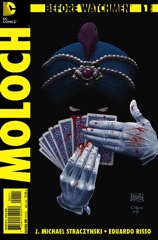 Even though Moloch appears in the original Watchmen, there’s a lot more talk about him than show. J. Michael Straczynski turns the character into a quintessential sympathetic villain. He was born with deformed ears, leading to teasing in childhood and other tragedies later in life. Straczynski uses first person narration, making the reader identify with Moloch even more.
 And another good one. Azzarello likes doing war comics; he should stick to them. Even though there are some confusing parts to the narrative–Azzarello fractures it without establishing the bookends–and the song lyric excerpts don’t work, it’s a successful issue.
 It’s another surprisingly good issue.
 Yeah, Azzarello definitely enjoys writing Comedian. There’s a lot of Vietnam War history here, a little American political history and almost no Watchmen connection. The Comedian could just be anyone. Azzarello never gives him anything superhero specific.
 I thought J.G. Jones was a better artist. I don’t know why exactly, but I did. His figures in Comedian are terrible. People change size, make no sense when standing next to one another. And his faces are even worse. It’s an ugly comic. I guess the editors didn’t think they could tell him to actually work at it.
 Travis Bickle guest stars in this issue. Azzarello’s deep, man, he’s really deep.