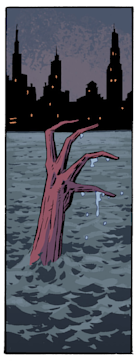
Black Hammer looks like a horror comic. Dean Ormston’s art always suggests there’s something darker going on, even if writer Jeff Lemire didn’t hint at it all the time. There’s something creepy about the comic’s world; the cast of characters doesn’t know what’s going on, the reader doesn’t know what’s going on, Lemire doesn’t really hint at the details, just implies details exist. It makes for a disquieting reading experience, even though there’s nothing too dark going on.
More so, Lemire hints there isn’t anything much darker to be revealed, just sadder. Black Hammer is all about sadness. Sadness and secrets.
It’s also about a bunch of superheroes who find themselves transported to a farm in a rural town after they defeat a great enemy. Lemire bakes in the sadness–the superheroes weren’t happy before they left, so when the comic opens ten years after the event, it’s unlikely anything else is going to make them happy.
Abraham Slam in his younger days.Except maybe Abe Slam, who’s pretty much the protagonist. He’s Captain America without the powers, only he didn’t leave his home dimension in the forties, he left it in the seventies or eighties when he was an old man and felt like he didn’t have a place anymore. Much to the chagrin of his fellow captives, he does find a place, being an old white guy farmer who romances the woman who runs the local diner. Her ex-husband’s the sheriff, which Lemire hints will come into play later, but not yet. Mostly Abe’s just contentedly getting by, mostly because he’s the only one of the captives who can.
The rest are either aliens, robots, mystically de-aged, supernaturally winged, or just plain unstuck dimensionally.
J’onn J’onzz–sorry, Mark Markz–arrives on Earth.The alien is the Martian Manhunter stand-in–Lemire borrows from both Marvel and DC to fill out his cast, who weren’t a super-team so much as an assortment of superheroes. Barbalien. Turns out his not just hiding his true form, he’s also hiding he’s gay, which leads to some trouble. Because he’s keeping it a secret. Ten years stuck together on a farm and none of the characters seems to be upfront with any of the other. Some of it is the baked in sadness Lemire does, some of it is the sauce for the gander. Black Hammer is a heavy read. There’s not a bright sky in Lemire’s writing or in Ormston’s art. When the comic’s really going for it, it’s impossible to say who’s more effective, Lemire or Ormston. It’s impossible to imagine the comic without the two of them.
The robot is Talky-Walky, who is probably female–she doesn’t get her own issue in this collection–because she’s the sidekick of the unstuck fellow, Colonel Weird. He’s the Adam Strange stand-in who knows more about what’s going on than he can explain but in learning it, he’s gone mad. There’s the implication of unrequited love on her side. Back in the day, they used to travel to other planets and eradicate life because what else were they going to do to aliens in the Golden or Silver Age. Lemire makes a lot of subtle comments on old comics matter-of-factly. Again, he bakes it in.
Captain Weird explores… the weird.Colonel Weird’s issue has some foreshadowing, but mostly it’s a dejected look at how these previously powerful characters can’t have any more power. Even though they do still retain a lot of their powers, if not all of them.
The de-aged person is Golden Gail. She’s a female Captain Marvel (Shazam Captain Marvel). Only she became Captain Marvel in the forties and whenever she changed into the hero, she became a nine year-old. So now she’s a middle-aged woman stuck in a nine year-old’s body. She’s probably the closest thing to comic relief, only it’s all so tragic and all so heavy, it’s never funny. Worse is when it turns out she’s got a crush she shouldn’t have. Lemire’s not happy unless Black Hammer is making someone unhappy; he’s also willing to take on that burden. He’s asking the reader for a lot of emotional investment and is doing so responsibly. There’s not a single time he asks for too much without it being necessary.
Shazam! Oh, you know what they mean.Then there’s Madame Dragonfly. She’s got the wings. She’s a witch consigned to a cabin who went out to save the world because just because she’s a cursed witch doesn’t mean she’s a bad guy. She’s the coolest character in the book. Lemire plays with tropes and standards, but Madame Dragonfly is something entirely her own. What if the narrator of a horror comic, gross with dragonfly wings and eye of newt and zombie dolls, wasn’t a bad guy. Her story finishes the collection; it’s where Lemire hints at things too terrible for even Black Hammer to reveal. Not too terrible in terms of horrific reveals, but too terrible in terms of human reveals. He takes his characters very, very seriously.
Madame Dragonfly helps save the world.While most of the issues–except the first–have a single character emphasized, Lemire’s careful to continue his B plots and C plots. It’s a tightly constructed comic, both in Lemire’s plotting and how Ormston visualizes it. The series is upfront about its despondence, upfront in its deconstruction. It’s never overly ambitious. Lemire and Ormston are ambitious with it, but they always hit their marks.
It ends on a cliffhanger of sorts, both for the reader and the characters, which is sort of annoying. Not because it’s not well-executed, but because it means I need to wait for more Black Hammer.
CREDITS
Writer, Jeff Lemire; artist, Dean Ormston; colorist, Dave Stewart; letterer, Todd Klein; editors, Ian Tucker, Cardner Clark, Brendan Wright, and Daniel Chabon; publisher, Dark Horse Comics.
I’m not sure if I’m more on board Descender after this issue, which doesn’t reveal where Lemire’s going, but does show he’s got some actual ideas. Many of them are, as usual, familiar sci-fi tropes. He just arranges them a little better this issue.
And the story itself feels very comic book. Lemire puts the emphasis on the supporting players, mostly the ship captain, as well as pulling back and letting the reader see the familiar cast members in a new environment. Descender feels a little more solid.
So why aren’t I more excited about it? Because it’s still not clear Lemire’s got anywhere to take this story worth going and this issue features the first less than great Ngyuen art of the series. Where’s the art go wrong? The outer space stuff. Where’s Lemire taking the story? Outer space stuff.
The rest of the issue’s gorgeous.
Descender frustrates.
CREDITS
Tin Stars, Part Four; writer, Jeff Lemire; artist, Dustin Nguyen; letterer, Steve Wands; publisher, Image Comics.
I want to be able to keep reading Descender, but I’m getting close to my limit. It’s just A.I. with some flourishes on it. It’s like someone tried to make a comic book sequel to A.I., only instead of taking its visual template, Nguyen is grabbing from Alien and Outland and other seventies to early eighties sci-fi.
This issue has robot Tim dying and going to robot purgatory, where all the souls of the robots from the alien invasion are living. Okay, maybe more A.I. mixed with one of the Ender’s Game sequels, suffice to say, Lemire doesn’t have anything original in this series. And maybe he’s not supposed to, maybe he’s just supposed to sell the option to Hollywood and the comic’s going to sell on Nguyen’s art.
After all, Lemire’s just unoriginal, it’s not bad.
But I don’t know if Nyugen’s art alone is worth the time.
CREDITS
Tin Stars, Part Three; writer, Jeff Lemire; artist, Dustin Nguyen; letterer, Steve Wands; publisher, Image Comics.
Lemire sure does know his sci-fi–this issue of Descender continues the A.I. vibe while throwing in some Outland. He also knows how to go straight for the heartstrings, which he does with a bunch of flashbacks to Tim–21 (he’s the android protagonist) in happier days.
And Lemire does a good job with it. He can get away with almost anything with Nguyen’s art. Descender will always be worth looking at. Nguyen’s color washes give each page a distinct separate feel, even when the action continues between them. It’s a lovely comic.
This issue doesn’t do much to develop the world of the comic, just Tim–21. Lemire’s careful not to give the robot too many emotional observations (again, A.I.) and it’s unclear if he can get legs out of story with a purely sympathetic lead character.
But he’s off to an okay start. It’s gloriously manipulative stuff.
CREDITS
Tin Stars, Part Two; writer, Jeff Lemire; artist, Dustin Nguyen; letterer, Steve Wands; publisher, Image Comics.
Descender isn’t the most original thing under the sun. It’s hard to read it and not be reminded of the Spielberg movie, A.I.. Writer Jeff Lemire borrows major android concepts, but apparently not a lot of emotional heft concepts, which is good. Because, even though it’s got a lot of problems, Descender is far more successful than A.I..
Dustin Nguyen’s art makes the comic. He does this watercolor-looking thing and it’s great. He still has detail in his panels; the painting style doesn’t overtake the lines. It’s fantastic looking.
And the story has some unexpected moments, but there’s a nice collaboration between Lemire and Nguyen going on. Like Nguyen’s got more detail than Lemire’s putting into the story. Even though the story’s somewhat predictable and the details are mostly bland sci-fi things, the comic engages. Nguyen’s art is the right mix of mainstream and not to sell it.
CREDITS
Tin Stars, Part One; writer, Jeff Lemire; artist, Dustin Nguyen; letterer, Steve Wands; publisher, Image Comics.
Lemire has a great device in this issue–lots of small panels full of conversation to show a rapid-fire exchange. Not sure if it's his own creation but it's a wonderful tool for pacing the reader while still having visually dynamic panels. They're just smaller panels.
The good composition and pacing continues until about halfway through the comic, when it all goes to pot.
Lemire goes for a really cheap ending to Trillium; really obvious, really self-indulgent (he changes styles at one point and I think photoshops in panels from earlier issues, regardless where the panels are from–he photoshops badly). The ending reveals how the series's pacing problems disabled it too much. The characters have changed too much, too quickly and the ending Lemire goes after needs a lot of thorough work.
Lemire ignores the series's finest qualities for its finish.
Oddly, I liked his art here more than anywhere else.
D
CREDITS
Two Stars Become One; writer and artist, Jeff Lemire; colorists, José Villarrubia and Lemire; letterer, Carlos M. Mangual; editors, Sara Miller and Mark Doyle; publisher, Vertigo
Until the hard cliffhanger, which is just too jarring both in the narrative and visually, Lemire finally gets back to fulfilling Trillium’s potential.
He makes a decision about his characters too. He’s been wishy-washy on assigning a protagonist lately–not just for issues, but for the whole series; letting his time and star crossed lovers share the position wasn’t working. He decides well.
What’s most impressive is how he lets himself go with the sci-fi spectacular visuals. Lemire’s been doing a lot with trying to dictate how the reader approaches the book (the vertically flipped pages, reading back to forth, practically choose your own adventure). This issue had grandiose visuals (many tying to previous issues’ imagery). It works beautifully without any artificial attempts to control how the reader digests it.
Lemire does well with the B plot too.
As far as penultimate issues go, this one’s outstanding.
A-
CREDITS
All the Shadows Have Stars in Them…; writer and artist, Jeff Lemire; colorists, José Villarrubia and Lemire; letterer, Carlos M. Mangual; editors, Sara Miller and Mark Doyle; publisher, Vertigo.
The pace is a mess. Lemire blows six pages or so on a flashback to Nika’s childhood. She’s the future lady, stuck in an alternate reality past–or who knows, maybe the whole thing has a different history and Lemire is just messing with the reader. But opening with a tragic flashback and burning about a third of the issue? And not giving Nika’s counterpart William a flashback? Padding.
There’s a lot of talking this issue, another sign of padding. The conversations are all about what a character’s going to do or what the character has just done. It’s not exactly a bridging issue because Lemire does take his characters on a journey… he just skips the most interesting part. He skips the journey.
Instead there’s talking.
There are also a lot of the flipped pages, which are losing their effectiveness.
Lemire’s winding Trillium up; shame the plotting isn’t holding.
B-
CREDITS
Escape Velocity; writer and artist, Jeff Lemire; colorists, José Villarrubia and Lemire; letterer, Carlos M. Mangual; editors, Sara Miller and Mark Doyle; publisher, Vertigo.
What a strange issue. Not because Lemire splits it between his two characters–literally, one gets the top, one gets the bottom, reversed so the reader goes through the comic twice. Rather because it’s just a bridging issue.
It’s a neat concept. Lemire throws the characters into each other’s lives and recreates the worlds around them to make it fit. For instance, the future girl is living in a post-World War I Britain where women are military officers and the men are the cannon fodder. Strangely the art in this part isn’t as thorough as in the guy’s future adventure.
Lemire has been pacing the series really well until this point, but the concept seems like it grabbed him and he forced the story to make it fit.
It’s good, to be sure, but it doesn’t go anywhere really. And the whole split issue design is cute but unnecessary.
B-
CREDITS
Starcrossed; writer and artist, Jeff Lemire; colorists, José Villarrubia and Lemire; letterer, Carlos M. Mangual; editors, Sara Miller and Mark Doyle; publisher, Vertigo.
I really hope DC didn’t cancel Trillium. The issue ends with a very final note, but Lemire is playing with time travel and black holes so hopefully it’s not some unannounced cancellation.
It’s a good issue, even if the finish is a little rushed. That rushed feeling again seems like Lemire wanted to get a few things done before he lost the series. Something about how the supporting casts resolve… it feels abbreviated and final.
Lemire gives somewhat equal time to both his future scientist and her past explorer love interest. Lemire never goes for the kiss; he moves around it in intense scenes, which is kind of nice. He also lets them have cultural arguments, also nice.
The art continues to underwhelm and the reveals are never particularly original, but the core relationship Lemire has between his time travelers keeps the book going.
I mean, if it isn’t canceled.
CREDITS
Entropy; writer and artist, Jeff Lemire; colorists, José Villarrubia and Lemire; letterer, Carlos M. Mangual; editors, Sara Miller and Mark Doyle; publisher, Vertigo.
 Black Hammer looks like a horror comic. Dean Ormston’s art always suggests there’s something darker going on, even if writer Jeff Lemire didn’t hint at it all the time. There’s something creepy about the comic’s world; the cast of characters doesn’t know what’s going on, the reader doesn’t know what’s going on, Lemire doesn’t really hint at the details, just implies details exist. It makes for a disquieting reading experience, even though there’s nothing too dark going on.



 I’m not sure if I’m more on board Descender after this issue, which doesn’t reveal where Lemire’s going, but does show he’s got some actual ideas. Many of them are, as usual, familiar sci-fi tropes. He just arranges them a little better this issue.
 I want to be able to keep reading Descender, but I’m getting close to my limit. It’s just A.I. with some flourishes on it. It’s like someone tried to make a comic book sequel to A.I., only instead of taking its visual template, Nguyen is grabbing from Alien and Outland and other seventies to early eighties sci-fi.
 Lemire sure does know his sci-fi–this issue of Descender continues the A.I. vibe while throwing in some Outland. He also knows how to go straight for the heartstrings, which he does with a bunch of flashbacks to Tim–21 (he’s the android protagonist) in happier days.
 Descender isn’t the most original thing under the sun. It’s hard to read it and not be reminded of the Spielberg movie, A.I.. Writer Jeff Lemire borrows major android concepts, but apparently not a lot of emotional heft concepts, which is good. Because, even though it’s got a lot of problems, Descender is far more successful than A.I..

 Lemire has a great device in this issue–lots of small panels full of conversation to show a rapid-fire exchange. Not sure if it's his own creation but it's a wonderful tool for pacing the reader while still having visually dynamic panels. They're just smaller panels.
 Until the hard cliffhanger, which is just too jarring both in the narrative and visually, Lemire finally gets back to fulfilling Trillium’s potential.
 The pace is a mess. Lemire blows six pages or so on a flashback to Nika’s childhood. She’s the future lady, stuck in an alternate reality past–or who knows, maybe the whole thing has a different history and Lemire is just messing with the reader. But opening with a tragic flashback and burning about a third of the issue? And not giving Nika’s counterpart William a flashback? Padding.
 What a strange issue. Not because Lemire splits it between his two characters–literally, one gets the top, one gets the bottom, reversed so the reader goes through the comic twice. Rather because it’s just a bridging issue.
 I really hope DC didn’t cancel Trillium. The issue ends with a very final note, but Lemire is playing with time travel and black holes so hopefully it’s not some unannounced cancellation.