
 It’s an action-packed issue of Satellite Sam. At least it’s action-packed for Satellite Sam. And not even the kinky sex, which Chaykin must’ve loved getting a crack at. No, Fraction is moving Michael’s murder investigation to what seems to be its third act (and the third act for the series, based on some developments for supporting cast), and there’s action.
There’s revenge and action.
And kinky sex.
The only thing Satellite Sam doesn’t have this issue is television. The television plots don’t come in at all, with the exception of a sort of Godfather homage and TV isn’t the point of that scene. It’s Fraction and Chaykin being a little funny and showy, which they can afford to be; Satellite Sam is good stuff.
Fraction’s character work this issue is exceptional, maybe the best in the series so far. And it’s with practically melodramatic sequences where he excels.
CREDITS
Goodbye, Aristotle; writer, Matt Fraction; artist, Howard Chaykin; letterer, Ken Bruzenak; editor, Thomas K.; publisher, Image Comics.
 It’s a good issue of Satellite Sam. Chaykin’s art is definitely stronger this time around. And the issue’s packed once again.
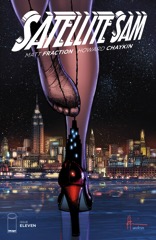 The writing on this issue of Satellite Sam is excellent. Fraction hits every subplot, sort of checks its temperature, stirs it a little, then combines a couple of them into the final scene of the comic.
 Just when I thought Fraction would never turn the series around, he delivers a fully fantastic issue. There’s no wasting time here, there’s no dawdling. At most he spends a few pages with the minor supporting cast, but it all turns out to be to prop up the main cast.
 What a terrible comic. Chaykin’s handling of The Shadow reminds of someone trying to catch a hot potato; whenever he does have a hold on it, it’s not for long enough and it always leaves that all right place for an unpredictable direction.
 With his third of four issues, Chaykin gets around to showing what his Shadow comic is actually going to be like.
 So after an entirely forward-looking first issue, Chaykin gets around to the flashbacks in the second. In some ways, since the Shadow isn’t the most familiar character, an origin is necessary. But Chaykin goes overboard. He feels the need to rationalize the magical city where the Shadow, back before he was the Shadow, finds himself. There’s too much confusion around the Shadow’s identity too; it’s too dense. The origin takes a whole fourth of the series and there’s got to be some stuff in there Chaykin doesn’t need.
 Howard Chaykin's The Shadow. He takes an interesting approach to bringing back a World War II era costumed adventurer–he lets everyone age while the Shadow is away. Most of the issue has various agents–people in their later years–getting viciously murdered.
 This issue, containing three different stories by two writers (Moore on the first and last, daughter Leah on the middle one) and three different art teams (Howard Chaykin on the first, Shawn McManus and Steve Mitchell on the second, regular artists Sprouse and Story on the third), is mostly awesome.
 Until the cliffhangers, Fraction has Sam back on course for the most part. Sure, he doesn’t know what to do with Michael, but everything else is going well enough as long as he has something, it’ll be enough. Or so one would think, because instead it’s just Fraction trying to inch the murder mystery forward without much commitment.