Lois Lane 1 (April 2014)

LlPulitzer Prize-winning–not to mention gainfully employed–journalist Lois Lane thinks in hackneyed phrases like “a thief in the night.”

About the only nice thing to say about Lois Lane–her first comic to herself in almost twenty years–is I like how writer Marguerite Bennett keeps the misspelling thing from Superman: The Movie. Sure, it might be a DC New 52 editorial decision and it’s not like Bennett does it well–or gets why it worked in the movie–but whatever.

The art, from a litany of folks who I’m not taking the time to list, isn’t bad. It’s not good, but it’s decent enough DC house style. No crazy proportion problems. The monsters look cool.

The story has to do with Lois being a good sister to Lucy, who’s had a girlfriend for five years and hasn’t told her sister. They need help. Just like this comic.

D- 

CREDITS

Nostalgia; writer, Marguerite Bennett; pencillers, Ig Guara, Meghan Hetrick-Murante, Emanuela Lupacchino and Diogenes Neves; inkers, Marc Deering, Meghan Hetrick-Murante, Ruy Jose and Guillermo Ortego; colorist, Hi-Fi Colour Design; letterer, John J. Hill; editor, Rickey A. Purdin; publisher, DC Comics.

Demon Knights 3 (January 2012)

001e9a17_medium.jpeg
Previously, I thought I could at least rely on the art in Demon Knights to be good, but Neves and Albert are slipping. Too much detail here, too little there. Some of it appears positively disjointed–one page looks like George Perez and the final page (the super soft cliffhanger) looks rushed. I wonder if they had to do a less gory version at the last minute.

This issue is the cast under siege and Cornell finally starts to recognize his problems. Besides the Shining Knight, the Demon and Vandal Savage, the cast all blurs together. There’s even a joke about it in dialogue.

Unfortunately, just because Cornell recognizes it doesn’t mean he does anything to alleviate it. This issue of Demon Knights is probably the best–the Shining Knight gender jokes alone give it that status–but it’s still not any good.

Cornell’s apparent lack of enthusiasm sinks it.

CREDITS

First Sacrifices; writer, Paul Cornell; penciller, Diógenes Neves; inker, Oclair Albert; colorist, Marcelo Maiolo; letterer, Jared K. Fletcher; editors, Chris Conroy and Matt Idelson; publisher, DC Comics.

Demon Knights 2 (December 2011)

Demon-Knights_Full_2-200x303.jpg
A few pages into Demon Knights, right after the first long fight sequence ends (Cornell’s all about fantasy creature fight scenes in this one), I realized the series’s big problem. Obviously, it’s Cornell, but specifically… he’s not making fun of it. He’s writing these characters in the Dark Ages and he’s got them using modern English. He’s even got them using twenty-first century colloquialisms. I’m shocked there’s not a Twitter reference it’s all so painfully hip.

But he’s not telling a joke or something. It’s not like A Knight’s Tale or whatnot. Cornell’s presenting it like these characters really talk this way. And we’re supposed to take them (and him) seriously.

The Neves and Albert art is slick but good. Except when it’s just the Demon alone, then the slickness gets to be too much. Etrigan shouldn’t be slick.

Knights is a bad comic. It’s not getting any better….

D 

CREDITS

They Shall Not Pass; writer, Paul Cornell; penciller, Diógenes Neves; inker, Oclair Albert; colorist, Marcelo Maiolo; letterer, Jared K. Fletcher; editors, Chris Conroy and Matt Idelson; publisher, DC Comics.

Demon Knights 1 (November 2011)

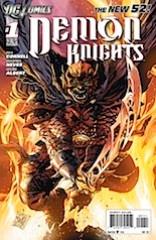
Demon-Knights_Full_1.jpg
You know, if Paul Cornell’s idea of high comedy is revealing Madame Xanadu has a thing for demons from hell… I’m not sure I want to see his low comedy.

If the first issue—and the large cast Cornell introduces—is any indication, Demon Knights is going to be a medieval team book with DC’s heroes of that era. Cornell goes crazy, having a girl pretend to be a boy so she can be a knight.

That detail is revolutionary… it’s not like it’s been a standard since the 1600s.

The first five pages are set in Camelot and I remembered Camelot 3000 and got all hopeful. Immediately out of Camelot, it veers towards the worse.

Cornell really likes cheap shocks. Besides Xanadu’s deceiving Jason Blood to keep the Demon around for sex and violence, Cornell tortures and kills a baby.

It’s contrived, boring, and painfully trying to be sensational.

CREDITS

Seven Against the Dark; writer, Paul Cornell; penciller, Diógenes Neves; inker, Oclair Albert; colorist, Marcelo Maiolo; letterer, Jared K. Fletcher; editors, Chris Conroy and Matt Idelson; publisher, DC Comics.