• Trillium 8 (June 2014)

    Trillium #8Lemire has a great device in this issue–lots of small panels full of conversation to show a rapid-fire exchange. Not sure if it's his own creation but it's a wonderful tool for pacing the reader while still having visually dynamic panels. They're just smaller panels.

    The good composition and pacing continues until about halfway through the comic, when it all goes to pot.

    Lemire goes for a really cheap ending to Trillium; really obvious, really self-indulgent (he changes styles at one point and I think photoshops in panels from earlier issues, regardless where the panels are from–he photoshops badly). The ending reveals how the series's pacing problems disabled it too much. The characters have changed too much, too quickly and the ending Lemire goes after needs a lot of thorough work.

    Lemire ignores the series's finest qualities for its finish.

    Oddly, I liked his art here more than anywhere else.

    D 

    CREDITS

    Two Stars Become One; writer and artist, Jeff Lemire; colorists, José Villarrubia and Lemire; letterer, Carlos M. Mangual; editors, Sara Miller and Mark Doyle; publisher, Vertigo

  • The Incredible Hulk 68 (May 2004)

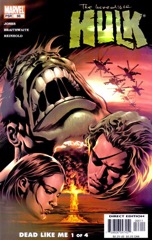
    The Incredible Hulk #68Jones gets the whole cast together and things finally start improving. Braithwaite draws Bruce as this vaguely awkward, aging pudgy guy. It’s a very interesting visualization of the character; it goes to making him seem a little less familiar even. Oddly enough, the second half of the issue has Jones’s most traditional use of Bruce Banner in many issues.
    But bringing the cast together–back at Nadia’s roadside restaurant–reveals another big problem with Jones’s run. It’s very small. Same people, same places; every time it seems like Jones is actually building outward, he just turns around and constricts.

    He doesn’t even bother coming up with an inventive villain this arc. Since the whole point is to put the characters in the same room again–somewhere he already had them at the end of the last arc–he just needs a disposable villain.

    Jones doesn’t plot Hulk well. The issue’s simultaneously okay and not.

    C+ 

    CREDITS

    Dead Like Me, Part Three: “Hello,” He Lied; writer, Bruce Jones; penciller, Dougie Braithwaite; inker, Bill Reinhold; colorist, Studio F; letterer, Randy Gentile; editors, John Miesegaes and Axel Alonso; publisher, Marvel Comics.

  • Juice Squeezers 4 (April 2014)

    Juice Squeezers #4So how does Lapham end the first Juice Squeezers series? Well, but with too much of an eye on the future. He opens up two new story lines in this issue–one out of the blue–and confirms another one will continue.

    Otherwise, the issue is good. Well, except when Lapham tugs on the heart strings. He leaves something else open I forgot about. Spending the last two-thirds of this issue setting up for the next series is rather disappointing. The scenes are still well-written, the characters are still strong. The art is phenomenal, particularly a talking heads sequence where one of the kids confronts the teacher who's in charge of the group.

    And the first third is awesome. Lapham somehow puts the kids in danger from giant bugs, but the bugs never seem too dangerous. Real death in the comic is unthinkable, something the cast believes too.

    The issue mostly works out.

    B 

    CREDITS

    The Great Bug Elevator, Part Four: Bug City; writer and artist, David Lapham; colorist, Lee Loughridge; letterer, Nate Piekos; editor, Jim Gibbons; publisher, Dark Horse Comics.

  • Dead Letters (2014) #1

    Dead Letters  1

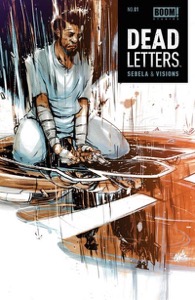
    Just fair warning, I’m going to be really mean to Dead Letters. I want to clarify right off Chris Visions doesn’t deserve any of it for his art. His art’s packed, frantic, detailed. It’s good art, if a little too much. But it’s too much of itself, which isn’t a bad thing.

    No, I’m going to rant and rave about Christopher Sebela, unoriginality, Hollywood desperation and maybe a little about crappy dialogue.

    Letters opens like the Bourne Identity except without trusting the reader, so Sebela has to make things obvious. Now, he’s trying to be confusing, wrapping the narrative up with flashbacks and amnesia. Being obvious doesn’t make any sense. And it plays out bad.

    The lead isn’t a spy though. He’s a generic bad ass criminal. Hollywood will undoubtedly come calling, cheaper budget, less exotic locations than a spy….

    Sebela’s dialogue is derivative, predictable, lousy.

    Except Visions, Letters’s atrocious.

  • DC Graphic Novel #1 - Star RaidersIf it weren't for the José Luis García-López art, I'm not exactly sure what Star Raiders would have going for it. But Raiders isn't "just a comic," it's the first in DC's line of graphic novels and the art is spectacular. García-López's alien worlds, space battles, everything else–it's all fantastic.

    Unfortunately Elliot S! Maggin's script is awful. Raiders is a sequel to the Atari Force comic, only to a small part of it. It's a tie-in to the Atari video game and it does about as well as any video game adaptation does. Terribly. Only Maggin's structure is the big problem.

    Let's see if I can break it down. Introduce character A, introduce characters B and C, follow all three, introduce characters D through H. Follow character E. Bring back character B, then immediately revert to character E. Repeat six times. Not really six; maybe twice. But the intermediary events are either lovely set pieces or boring expository things. Maggin's approach to science fiction is a heavy dose of Star Wars and then just some silly ideas–immortal old men, for example. Why immortal? How else can you have someone find out about something six hundred years before?

    Then there's the very small scale finish for the biggest battle the galaxy has ever seen. Pretty much everything conceptual about the story is nonsense. There isn't a single good moment in the entire thing, if you forget about the art. With the art, every moment's good. They're just really, really, really dumb.

    C- 

    CREDITS

    Writer, Elliot S! Maggin; artist, José Luis García-López; letterer, Orzecody; editor, Andrew Helfer; publisher, DC Comics.

  • Dead Letters #1Just fair warning, I’m going to be really mean to Dead Letters. I want to clarify right off Chris Visions doesn’t deserve any of it for his art. His art’s packed, frantic, detailed. It’s good art, if a little too much. But it’s too much of itself, which isn’t a bad thing.
    No, I’m going to rant and rave about Christopher Sebela, unoriginality, Hollywood desperation and maybe a little about crappy dialogue.

    Letters opens like the Bourne Identity except without trusting the reader, so Sebela has to make things obvious. Now, he’s trying to be confusing, wrapping the narrative up with flashbacks and amnesia. Being obvious doesn’t make any sense. And it plays out bad.

    The lead isn’t a spy though. He’s a generic bad ass criminal. Hollywood will undoubtedly come calling, cheaper budget, less exotic locations than a spy….

    Sebela’s dialogue is derivative, predictable, lousy.

    Except Visions, Letters’s atrocious.

    F 

    CREDITS

    Writer, Christopher Sebela; artist, Chris Visions; colorist, Ruth Redmond; letterer, Steve Wands; editors, Chris Rosa and Eric Harburn; publisher, Boom! Studios.

  • The Incredible Hulk 67 (April 2004)

    The Incredible Hulk #67It’s a Hulk without even Bruce Banner. And I can’t figure out why. Usually when Jones takes forever with an issue, there’s at least an imaginative conversation going on. Lots of literary references, whatever. But not this issue. Here’s it just Doc and Betty arguing while Nadia Blonsky is in danger.
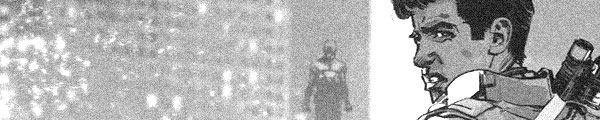
    Where’s Bruce? He left Nadia alone so she could be in danger and Jones could get a cliffhanger out of it.

    Nadia running from a variety of creepy things isn’t bad. If Jones had something else going on in the comic, it’d be a fine thing to fill the action quota. But Doc Samson playing with his lab equipment and Betty sounding bitter don’t offer anything. Jones is spinning his wheels to get through another issue and then he’ll rush to get Bruce back into it.

    It’s a standard approach on the book.

    The decent art helps a lot.

    C- 

    CREDITS

    Dead Like Me, Part Two: Bury Me Not; writer, Bruce Jones; penciller, Dougie Braithwaite; inker, Bill Reinhold; colorist, Studio F; letterer, Randy Gentile; editors, John Miesegaes and Axel Alonso; publisher, Marvel Comics.

  • Suicide Risk 12 (April 2014)

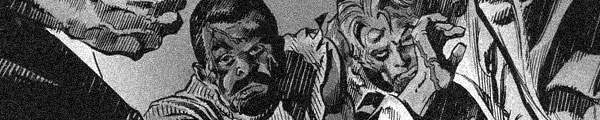
    Suicide Risk #12Carey continues to let Suicide Risk slide down further. It’s not a terrible issue, though the stuff with Requiem fighting his family and then leaving them when the mind control villain shows up is dumb. It doesn’t make any sense, but then Carey’s never known what to do with the family.
    There are some flashbacks to the villain world too. A bunch of supervillains having a battle with some nameless, indistinct good guys. Presumably.

    The issue doesn’t show any real signs of life until the end, when Carey moves from a flashback at Requiem’s trial to the mind of Leo Winters. Having the protagonist share his mind with a supervillain should provide some good moments. It doesn’t.

    Worse, Carey establishes the mind control villain so well the character should have been the series’s narrator for the whole thing.

    Carey’s trying to develop past the initial hook and he’s got nothing.

    C+ 

    CREDITS

    Seven Walls and a Pit Trap, Part Two; writer, Mike Carey; artist, Elena Casagrande; colorist, Andrew Elder; letterer, Ed Dukeshire; editors, Dafna Pleban and Matt Gagnon; publisher, Boom! Studios.

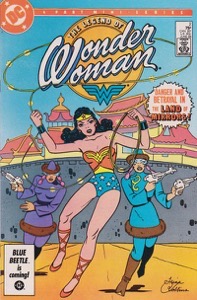
  • The Legend of Wonder Woman (1986) #4

    Lww4

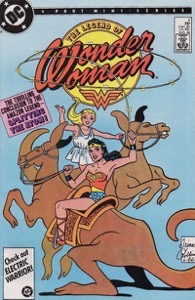
    And here Busiek and Robbins run into a big problem. They’re doing a last pre-Crisis story and so there needs to be some transition. Well, needs is a strong word. They put in some transition, which the bookend system they’re using requires. And it’s a nice enough transition, it’s just not the right one for this series.
    The resolution to the main story is phenomenal. There’s fighting, there’s personal growth, there’s romance. There are kangaroos used in battle. Busiek and Robbins balance the crazy story elements with the human conflict. And they do allow some relaxation for their cast….

    Before they cut forward to the modern day and deal with the Crisis stuff. The series, while excellent, is a perfect example of why a superhero comic’s worst enemy can often be itself. Even though it’s sublime, the issue’s politics stop it from being as rewarding as it should be.

  • The Legend of Wonder Woman #4And here Busiek and Robbins run into a big problem. They’re doing a last pre-Crisis story and so there needs to be some transition. Well, needs is a strong word. They put in some transition, which the bookend system they’re using requires. And it’s a nice enough transition, it’s just not the right one for this series.

    The resolution to the main story is phenomenal. There’s fighting, there’s personal growth, there’s romance. There are kangaroos used in battle. Busiek and Robbins balance the crazy story elements with the human conflict. And they do allow some relaxation for their cast….

    Before they cut forward to the modern day and deal with the Crisis stuff. The series, while excellent, is a perfect example of why a superhero comic’s worst enemy can often be itself. Even though it’s sublime, the issue’s politics stop it from being as rewarding as it should be.

    B+ 

    CREDITS

    Splitting the Atom; writers, Trina Robbins and Kurt Busiek; artist, Robbins; colorist, Nansi Hoolahan; letterer, L. Lois Buhalis; editor, Alan Gold; publisher, DC Comics.

  • The Private Eye 6 (27 March 2014)

    The Private Eye #6It’s an odd issue. There’s a lot at the hospital with the P.I.’s assistant recovering, then becoming the target of both the investigators and the bad guys. It’s all very dramatic and Martin does a good job laying on the thrills. Vaughan actually ends up using some of it for comic relief, which is a little odd.
    Otherwise, the issue’s spent with P.I. and his client as they discover things the bad guys are doing and talking about. Vaughan cuts back and forth, which is an adequate device though it’s a lot of treading water. Unless something major happens with the injured kid, this issue’s of the pointless, bridging variety. Vaughan’s not introducing any pertinent information. The future expository stuff isn’t pertinent.

    Even though there’s a lot of excellent art from Martin throughout, there isn’t really a great set piece.

    Vaughan is starting to feel disinterested on the comic.

    B- 

    CREDITS

    Writer, Brian K. Vaughan; artist, Marcos Martin; colorist, Muntsa Vicente; publisher, Panel Syndicate.

  • The Incredible Hulk 66 (March 2004)

    The Incredible Hulk #66Jones gets a far better art–Dougie Braithwaite on pencils, Bill Reinhold on inks–and decides to celebrate. Of course, his celebration is dragging his cast through the dirt. He’s got Bruce emotionally pounding on Nadia, who’s a fine enough regular supporting cast member so it’s too bad Jones didn’t establish her more, and then he’s got Betty pounding–literally–on Doc Samson.
    No one is happy how things are going or who they’re bedding down with. In all that unhappiness, Jones does do some explaining about off page things in the previous issues, but he also shows his hand. He wants to ruminate on the unhappiness of these characters; it’s unclear if he had any other point with his Hulk except to get them here.

    While the issue’s often finely executed, Jones doesn’t offer any glimpses of growth. All he’s setting up for is decay. Unpleasant to read decay.

    B- 

    CREDITS

    Dead Like Me, Part One; writer, Bruce Jones; penciller, Dougie Braithwaite; inker, Bill Reinhold; colorist, Studio F; letterer, Randy Gentile; editors, John Miesegaes and Axel Alonso; publisher, Marvel Comics.

  • All-New Ghost Rider 1 (May 2014)

    All-New Ghost Rider #1When DC relaunched Blue Beetle with a teen male Hispanic lead, wasn’t his last name Reyes? In a rare act of Marvel aping DC, the relaunched teen male Hispanic Ghost Rider has Reyes for a last name too.

    Maybe they’re related, like any property the Big Two are somehow trying to make relevant again has the last name Reyes.

    I wanted to like the Tradd Moore art on Rider but it’s too polished. There’s nothing kinetic to it. Moore’s also not able to make the comic seem less dumb, something any artist would struggle with given the lame script from Felipe Smith. Moore can’t drive car races, so one has to assume he can’t draw car chases either. Since both seem to be important in the comic, it’s a big problem.

    Smith’s script’s the real problem. It’s all unoriginal and pointless. The comic’s not worth reading, much less talking about.

    D- 

    CREDITS

    Engines of Vengeance, Part One; writer, Felipe Smith; artist, Tradd Moore; colorists, Nelson Daniel and Val Staples; letterer, Joe Caramagna; editors, Emily Shaw and Mark Paniccia; publisher, Marvel Comics.

  • The Legend of Wonder Woman (1986) #3

    Lww3

    Someone–Busiek or Robbins or both of them–came up with the structure of this series and all of a sudden it becomes clear this issue and it’s fantastic.

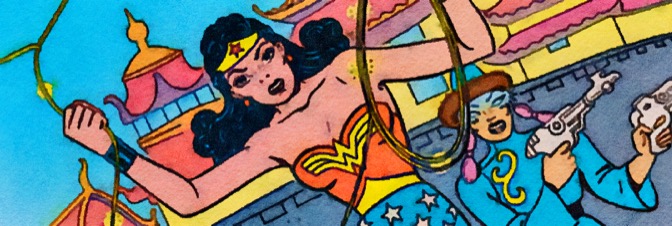
    Legend goes from being a nice homage series to something wholly original. Unless the old Wonder Woman comics are as well-plotted, in which case they don’t get enough credit.

    Busiek works up the revolt angle, with Wonder Woman starting imprisoned then getting free and fighting alongside Steve Trevor. There’s some wacky fake, but very amusing, atomic science in here too, but then comes the big moment. Busiek and Robbins work towards what should be a rewarding, if all action finish and then go past it.

    But if they’re padding for a fourth issue, it never feels like it. The characters, their decisions, all make sense. Busiek does a great job with Steve Trevor too.

    Awesome work with the brat too.

  • The Legend of Wonder Woman #3Someone–Busiek or Robbins or both of them–came up with the structure of this series and all of a sudden it becomes clear this issue and it’s fantastic.
    Legend goes from being a nice homage series to something wholly original. Unless the old Wonder Woman comics are as well-plotted, in which case they don’t get enough credit.

    Busiek works up the revolt angle, with Wonder Woman starting imprisoned then getting free and fighting alongside Steve Trevor. There’s some wacky fake, but very amusing, atomic science in here too, but then comes the big moment. Busiek and Robbins work towards what should be a rewarding, if all action finish and then go past it.

    But if they’re padding for a fourth issue, it never feels like it. The characters, their decisions, all make sense. Busiek does a great job with Steve Trevor too.

    Awesome work with the brat too.

    A- 

    CREDITS

    Inside the Atom Galaxy; writers, Trina Robbins and Kurt Busiek; artist, Robbins; colorist, Nansi Hoolahan; letterer, L. Lois Buhalis; editor, Alan Gold; publisher, DC Comics.

  • Rocky and Bullwinkle (2014) #1

    Rocky and Bullwinkle  Rocky  Bullwinkle  1

    I can’t decide if Rocky & Bullwinkle should or shouldn’t work as a comic book. Conceptually, I mean. I suppose I should mention it does work–and very well. Writer Mark Evanier and artist Roger Langridge adapt the source material’s sensibilities for the comics medium, which is exactly the way to go about adapting a property from another medium… yet so few ever do it.

    The all-knowing narrator works well in exposition boxes; Evanier ups it with Bullwinkle becoming psychic. His predictions interact both with the narrative and how Langridge illustrates that narrative. Very cool stuff.

    As for Langridge, I notice he’s working in a lot of simple, but intricate background activity. He’s keeping the reader’s eyes consuming even when the principals aren’t doing a lot.

    And then there’s the Dudley Do-Right intermediate story. Evanier sets it up as a series of really funny, somewhat inappropriate jokes.

    It’s an excellent comic.

  • Hawkeye 18 (May 2014)

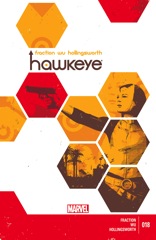
    Hawkeye #18Fraction gets some kudos for getting tough on Kate in L.A., but then he goes and does two really annoying things. First, he sets up Kate’s latest case as a way to get her back to New York and teamed up with Clint. It’s contrived. Second, the hard cliffhanger requires Kate be unaware of her surroundings. She’d probably be long dead if she were so unaware.
    Otherwise, it’s an excellent issue. Kate gets herself into another bunch of trouble, this time investigating an acquaintance’s past. There’s some good flashback stuff, giving the reader a look at Wu doing nineties period stuff and “realistic” supervillains.

    The art’s quite good the entire issue. Even though not much happens–it’s really just Kate investigating most of the time–Wu keeps things moving along.

    Sadly, Fraction seems hell-bent on running this series to exhaustion. This issue might be the first Kate issue not to be amazing.

    B 

    CREDITS

    Writer, Matt Fraction; artist, Annie Wu; colorist, Matt Hollingsworth; letterer, Chris Eliopoulos; editors, Devin Lewis and Sana Amanat; publisher, Marvel Comics.

  • The Incredible Hulk 65 (March 2004)

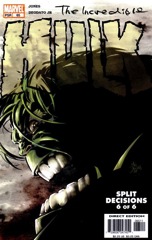
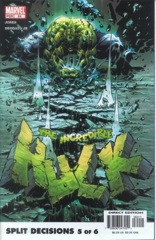
    The Incredible Hulk #65Here’s the thing. If Jones had structured this series better, been less concerned with diversions like the Absorbing Man, he might have been able to do a fantastic storyline regarding the Banner, the bunnies, Doc Samson, the evil conspiracy. It would have worked. The issue works to some degree just because Jones lets the characters all feel the weight of what’s occurring.

    Terrible Deodato art. His page composition, not panel composition, but his page by page layouts of panels is atrocious.

    Even though this issue’s a big wrap up–hopefully Jones will soft boot the title next issue–there’s a lot of good action sequences. There’s Samson and the bunnies going into the base, there’s Nadia and Bruce Banner. Jones is very deliberate about how he pulls one over on the reader, but it’s kind of all right. He’s doing the same thing to his characters.

    Shame about the art.

    B- 

    CREDITS

    Split Decisions, Part Six: Double Exposure; writer, Bruce Jones; artist, Mike Deodato Jr.; colorist, Studio F; letterer, Randy Gentile; editors, John Miesegaes and Axel Alonso; publisher, Marvel Comics.

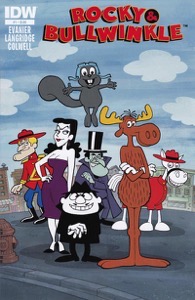
  • Rocky & Bullwinkle #1I can’t decide if Rocky & Bullwinkle should or shouldn’t work as a comic book. Conceptually, I mean. I suppose I should mention it does work–and very well. Writer Mark Evanier and artist Roger Langridge adapt the source material’s sensibilities for the comics medium, which is exactly the way to go about adapting a property from another medium… yet so few ever do it.

    The all-knowing narrator works well in exposition boxes; Evanier ups it with Bullwinkle becoming psychic. His predictions interact both with the narrative and how Langridge illustrates that narrative. Very cool stuff.

    As for Langridge, I notice he’s working in a lot of simple, but intricate background activity. He’s keeping the reader’s eyes consuming even when the principals aren’t doing a lot.

    And then there’s the Dudley Do-Right intermediate story. Evanier sets it up as a series of really funny, somewhat inappropriate jokes.

    It’s an excellent comic.

    A 

    CREDITS

    Writer, Mark Evanier; artist and letterer, Roger Langridge; colorist, Jeremy Colwell; editor, Sarah Gaydos; publisher, IDW Publishing.

  • Star Trek VI: The Undiscovered Country (1991, Nicholas Meyer)

    From the second scene of the Star Trek VI: The Undiscovered Country, it's clear director Meyer is going to be somewhat merciless in how he presents the film. It's not just a story about a sea change in the franchise's mythology or about the familiar cast members retiring, it's also about it being the final Star Trek movie.

    Meyer gets phenomenal performances out of his cast; there's the light stuff, usually with DeForest Kelley or Walter Koenig, but he also goes dark with William Shatner and Leonard Nimoy. Somehow, Meyer manages to balance the film between serious–it's about violent bigotry, after all–and a dark gray genial. The film opens with space disaster followed with a jolting dose of that bigotry.

    Playing a new crew member, Kim Cattrall gets the most comedic relief moments. Not as the target of them, but as the perpetrator. Meyer relies on her to be the audience's entry into some of the picture; she's the regular person among the titans. It's a nice narrative trick and one of the more successful ones. There are some less successful ones, which mostly get by due to the abilities of the actors. The big example is Shatner's character arc. It doesn't work because Shatner can't play it bigoted enough; Meyer tries to edit around it but still. Also less successful is Christopher Plummer's character. Plummer's great, but the part's too thin.

    At the same time, lots of subtle narrative moves work out great.

    The film's problematic, but incredibly successful.

  • Star Trek V: The Final Frontier (1989, William Shatner)

    In some ways, Star Trek V: The Final Frontier is an ambitious movie pretending to be popcorn entertainment pretending to be an ambitious movie. There's a lot of nonsense about self-help, not to mention the whole God thing, and none of it works. Partially, it doesn't work because David Loughery's script is too thin, but it also doesn't work because Final Frontier is paced as an action movie, not a self-reflective sci-fi outing.

    But there's a definite subtext–not quite subplot, the film ignores any subplots it starts–regarding the continued bond between William Shatner, Leonard Nimoy and DeForest Kelley. About the only thing the movie does really well is the character stuff, not just for those three principals (it's often a comedy showcase for Kelley), but also for the rest of the regular cast. Of course, the script forgets about developing these good character moments, but they're nice to have around.

    There's also a good performance from Laurence Luckinbill as the film's de facto antagonist. The handling of his character is another positive about the film. He gets more of a character arc than any of the regular cast.

    As far as directing, Shatner does a fine enough job. The action's fast-paced, with excellent editing from Peter E. Berger. Andrew Laszlo's photography is decent too. A lot of the special effects are fantastic. Except the end when it really needs them.

    The Jerry Goldsmith score's trying.

    The Final Frontier's about as good as any "Star Trek finds God" picture could be.

  • The Legend of Wonder Woman (1986) #2

    Lww2

    Right after I say Robbins doesn’t spend a lot of time on backgrounds… she spends a lot of time on backgrounds this issue. The difference is the setting. It’s a fantastical hidden city, not Washington D.C.–and, during the action sequence, the backgrounds do still fade away. So my observation seems about half right.

    There are lots of developments this issue. The little brat sidekick becomes a good character–or a better one and not just comic relief–and Steve Trevor stages a revolt in the atomic world. Busiek does a great job applying real emotion to the outlandish situations, not just with Trevor but with how the hidden city invasion plays out.

    The way Busiek and Robbins introduce the hidden city is cool too. They split Wonder Woman and the sidekick to cover more ground, but both threads inform the other.

    The adventure seems slight, but the creators’ imaginativeness keep things going.

  • The Legend of Wonder Woman #2Right after I say Robbins doesn’t spend a lot of time on backgrounds… she spends a lot of time on backgrounds this issue. The difference is the setting. It’s a fantastical hidden city, not Washington D.C.–and, during the action sequence, the backgrounds do still fade away. So my observation seems about half right.

    There are lots of developments this issue. The little brat sidekick becomes a good character–or a better one and not just comic relief–and Steve Trevor stages a revolt in the atomic world. Busiek does a great job applying real emotion to the outlandish situations, not just with Trevor but with how the hidden city invasion plays out.

    The way Busiek and Robbins introduce the hidden city is cool too. They split Wonder Woman and the sidekick to cover more ground, but both threads inform the other.

    The adventure seems slight, but the creators’ imaginativeness keep things going.

    B+ 

    CREDITS

    The Land of Mirrors; writers, Trina Robbins and Kurt Busiek; artist, Robbins; colorist, Nansi Hoolahan; letterer, L. Lois Buhalis; editor, Alan Gold; publisher, DC Comics.

  • Satellite Sam 7 (March 2014)

    Satellite Sam #7Fraction's doing less of an arc than a window into Mike–as in the new Satellite Sam–and his descent into obsession. It's funny, but I think Fraction's still trying to get keep the character as likable as possible. He's just over his head, trying to relieve his father's photography fetish.
    There are the subplots going too, of course. There's a great one with the disgraced writer on his way out and then the troubles of a new show going on. Not to mention a flashback to the original Satellite Sam and how he conducted himself, drafting a girl Friday who tracks down Mike for something here.

    The comic opens with the series's most explicit moment (so far). Chaykin choreographs it perfectly. There's some great stuff from long distance profile later one too. I love how Chaykin makes the comic about classic TV feel like classic TV with panel composition.

    Awesome issue.

    A 

    CREDITS

    Exposure; writer, Matt Fraction; artist, Howard Chaykin; letterer, Ken Bruzenak; editor, Thomas K.; publisher, Image Comics.

  • The Incredible Hulk 64 (February 2004)

    The Incredible Hulk #64Oh, good grief. When Deodato goes for artistic it’s a really bad page. Also when he goes for Hulk action. Hulk rips open a mountain. Is it any good? Nope, it’s boring.

    But the issue is otherwise not bad at all. Between the Hulk smashing the evil organization, which brings those two parts of the arc together, and Doc Samson and his bunnies–Sandra, Mr. Blue (nope, not spoiling because it doesn’t matter yet) and Nadia–fighting the mean little monsters. It’s effective stuff, the people in crisis, out of bullets. Not sure why the women had to take off their clothes but Jones is maybe trying to tell the reader Doc Samson shouldn’t be trusted.

    Then there’s the cliffhanger. Jones has always had problems with his big hook for the series. The cliffhanger just reestablishes the hook and the problem.

    The series is slowly improving, even with its problems.

    C 

    CREDITS

    Split Decisions, Part Five: Deja Vu; writer, Bruce Jones; artist, Mike Deodato Jr.; colorist, Studio F; letterer, Randy Gentile; editors, John Miesegaes and Axel Alonso; publisher, Marvel Comics.

  • Fatale 21 (March 2014)

    Fatale #21This issue, while obviously winding up to the big finish, is a bit of return to form. Brubaker takes the time to introduce a new character–one impervious to Jo's charms–and he's a nice addition. There's some levity amidst Jo's preparations.

    Speaking of Jo's preparations, Brubaker does go too far with a reveal in the last page or two. He makes Jo do something incredibly dumb. After showing her to be plotting and careful, she goofs. It doesn't work.

    But Jo's really back to being the mysterious femme fatale this issue. Nicolas is the protagonist, meeting Jo's sidekick, trying to figure out what's going on with her–he hasn't been the protagonist for a long, long time. And the series is only twenty-one issues in and the guy feels foreign to the captain's chair.

    It's an outstanding issue; still, it also shows how reductive Brubaker's being with the series's many intermediary details.

    B+ 

    CREDITS

    Writer, Ed Brubaker; artist, Sean Phillips; colorist, Elizabeth Breitweiser; publisher, Image Comics.

  • The Legend of Wonder Woman (1986) #1

    Lww1

    How far can unbridled enthusiasm take something? Well, if The Legend of Wonder Woman is any indication, unbridled enthusiasm can go a very long way.

    Kurt Busiek and Trina Robbins have the task of saying farewell to the pre-Crisis Wonder Woman. It opens in the present, so having Robbins’s Golden Age-inspired art showing modern events immediately forces the reader to adjust. For example, Robbins doesn’t spend a lot of time on backgrounds in action shots; her style forces the reader to pay attention to the establishing shots.

    But those panels aren’t empty. There are often a lot of people reacting. The time Robbins didn’t spend on detailed backgrounds goes into the background cast.

    The story itself is complicated pretending to be cute. Busiek concentrates quite a bit on character (Wonder Woman, the villain, Wonder Woman’s nasty little kid sidekick) before the big monster attack finish.

    The abrupt ending’s problematic though.

  • Miller’s Crossing (1990, Joel Coen)

    A lot of Miller’s Crossing is left unsaid. Between the hard boiled dialogue disguising character motivations and the lengthy shots of Gabriel Byrne silently reflecting, the Coen Brothers invite examination and rumination. They invite it a little too much.

    The film’s a perfect object, whether it’s how the opening titles figure into revealing conversation and to the finish or how the frequent fades to black control the viewer’s consumption of the film. All of the performances are outstanding. Every single moment is supports the whole.

    So what’s wrong with it? Too much control. Even the craziness–the film examines violence and the men who perform it–is choreographed. It’s an amazing example of filmmaking, but it’s all surface. All of the layers in Miller’s are baked in, not organic. The story’s too tight. A couple cameos in the second half, along with nods to other Coen pictures, offer some calculated relief.

    It’s actually kind of stagy.

    There’s also a vague homophobic quality… the closeted (it’s the thirties) gay guys are all misogynist psychopaths to one degree or another.

    But it’s a beautifully made, beautifully acted film. Byrne’s great in the lead, Marcia Gay Harden is excellent as the girl who comes between him and friend Albert Finney. Finney gives the film’s boldest performance, having to play a dim tough guy.

    Jon Polito’s awesome, J.E. Freeman, John Turturro–like I said before, it’s perfect. It’s confident, it’s thorough.

    It just doesn’t add up to as much as if it were messy.

    3/4★★★

    CREDITS

    Directed by Joel Coen; written by Joel Coen and Ethan Coen; director of photography, Barry Sonnenfeld; edited by Michael R. Miller; music by Carter Burwell; production designer, Dennis Gassner; produced by Ethan Coen; released by 20th Century Fox.

    Starring Gabriel Byrne (Tom Reagan), Marcia Gay Harden (Verna), John Turturro (Bernie Bernbaum), Jon Polito (Johnny Caspar), J.E. Freeman (Eddie Dane), Albert Finney (Leo), Mike Starr (Frankie), Al Mancini (Tic-Tac), Richard Woods (Mayor Dale Levander), Thomas Toner (O’Doole) and Steve Buscemi (Mink).


    RELATED

  • The Legend of Wonder Woman #1How far can unbridled enthusiasm take something? Well, if The Legend of Wonder Woman is any indication, unbridled enthusiasm can go a very long way.

    Kurt Busiek and Trina Robbins have the task of saying farewell to the pre-Crisis Wonder Woman. It opens in the present, so having Robbins’s Golden Age-inspired art showing modern events immediately forces the reader to adjust. For example, Robbins doesn’t spend a lot of time on backgrounds in action shots; her style forces the reader to pay attention to the establishing shots.

    But those panels aren’t empty. There are often a lot of people reacting. The time Robbins didn’t spend on detailed backgrounds goes into the background cast.

    The story itself is complicated pretending to be cute. Busiek concentrates quite a bit on character (Wonder Woman, the villain, Wonder Woman’s nasty little kid sidekick) before the big monster attack finish.

    The abrupt ending’s problematic though.

    B 

    CREDITS

    Legends Live Forever; writers, Trina Robbins and Kurt Busiek; artist, Robbins; colorist, Nansi Hoolahan; letterer, L. Lois Buhalis; editor, Alan Gold; publisher, DC Comics.

  • Honey, I Shrunk the Kids (1989, Joe Johnston)

    Honey, I Shrunk the Kids is a constant battle between trite and sincere. Except the special effects stuff; the special effects are astounding, especially the sequences where there's a mix of styles, between practical and optical, and a mix of sizes. Director Johnston does such an exceptional job making the fantastic palatable, it's too bad the script isn't less banal when it comes to the character work.

    Oddly, some of the character stuff is great. The relationship between the kids–Thomas Wilson Brown and Amy O'Neill are the teens, Jared Rushton and Robert Oliveri are their annoying little brothers–develops wonderfully once they're in crisis and have shared traumatic experiences. Brown, O'Neill and Rushton all give outstanding performances. Oliveri oscillates between grating and sympathetic. Unfortunately, the script decides to encourage the grating, which is one of Shrunk's many third act problems.

    Then there are the adults. Rick Moranis phones it in as the scientist dad of O'Neill and Oliveri, Marcia Strassman is effective as his suffering wife. Matt Frewer and Kristine Sutherland play Brown and Rushton's parents. Sutherland's great. Frewer's likable; he gets an actual character arc.

    Screenwriters Ed Naha and Tom Schulman bring a tone-deafness not just to how kids interact with their parents, but also how Strassman deals with Moranis. Makes one wonder if a script doctor handled the miniaturized kids versus the great outdoors while bonding. Not to mention the nice romance.

    Regardless of the bad finish, Shrunk's beautifully made and does have some very good stuff in it.

    1.5/4★½

    CREDITS

    Directed by Joe Johnston; screenplay by Ed Naha and Tom Schulman, based on a story by Stuart Gordon, Brian Yuzna and Naha; director of photography, Hiro Narita; edited by Michael A. Stevenson; music by James Horner; production designer, Gregg Fonseca; produced by Penney Finkelman Cox; released by Walt Disney Pictures.

    Starring Thomas Wilson Brown (Little Russ Thompson), Amy O’Neill (Amy Szalinski), Robert Oliveri (Nick Szalinski), Jared Rushton (Ron Thompson)Rick Moranis (Wayne Szalinski), Marcia Strassman (Diane Szalinski), Kristine Sutherland (Mae Thompson) and Matt Frewer (Big Russ Thompson).


    RELATED