 I'm trying to come up with a phrase to describe Sons of Anarchy–amoral entertainment, the amorality of entertainment. The problem with those two phrases are they're something difference, even if the vocabulary is similar.
With this issue of Anarchy, Brisson does a couple big things. First, he turns in one of the best licensed comics I've ever read–he and Couceiro do phenomenal work here. Couceiro's art is just getting better and better.
Second, Brisson plays with the idea of plot structure and epilogues and what goes where. Without the epilogue, this story isn't an action story, it's the story of these criminals working out a deal to stay alive in prison. Brisson tells this tale compellingly, but it's got a short present action and it's not all that big.
Until the epilogue, which I wasn't even expecting because Brisson paces so well.
Anarchy is getting to be a singular comic.
A-
CREDITS
Writer, Ed Brisson; artist, Damian Couceiro; colorist, Michael Spicer; letterer, Ed Dukeshire; editor, Dafna Pleban; publisher, Boom! Studios.

 Dave Cockrum must have refused to draw faces and made the inker do it. It might explain why the features on the characters this issue appear to slide around their faces, Frank Springer had to get them all filled in.
 This issue is the story of Kevin’s father. Kevin is the bad guy who has kidnapped Virginia with badder guy Huss.
 Writer Charles Soule isn't doing anything fresh with Letter 44 so why does it feel so new? Because he's doing thoughtful science fiction in an era where thoughtful science fiction isn't mainstream anymore. 44 feels like it could have been a movie–or TV mini-series–from the seventies and no one would have questioned it.
 Martin Pasko writes the heck out of this comic book. He’s got a really complicated plot and it makes for a fantastic, lengthy read. Pasko doesn’t just come up with a great reveal for the aliens, he’s also got the really cool subplots going. He runs two subplots through the comic, resolving one and then introducing the next. And those run under this intriguing main plot.
 If the first issue is any indication, Princess Ugg is going to be a rip-roaring good time. It’s kind of like a fish out of water story, only maybe a more appropriate description would be a (good-hearted) piranha in the goldfish tank story.
 It’s difficult to take Vampirella seriously with that costume. Even though writer Nancy A. Collins does come up with a decent plot and a couple good twists (and a lame soft cliffhanger), the costume hurts the comic quite a bit. It just says, “We aren’t that serious.”
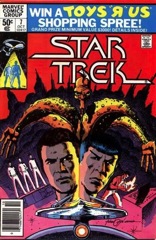 Tom DeFalco’s Trek script feels a little too generic. He doesn’t bring much personality to the principal cast members, saving it instead for Scotty and Uhura. She gives him a very clear bicep squeeze for support. It’s interesting.
 I've talked before about how Robinson constructs Five Weapons more as a deduction story than anything else. It's like Encyclopedia Brown, I think I said.
 Seriously? Seriously? Okay, so the bad guy who’s secretly gay and can’t accept it so he rapes other guys is named Huss. He’s the villain. I wonder why Lapham wanted to do this story arc. Bullets always had some kind of point, the way it revolved around a certain group of criminals. And then Virginia’s story too, of course.
 With John Carpenter breaking out the story with Eric Powell (who does the scripting), one has to wonder if Big Trouble the comic sequel is the same as a movie sequel would have been. Because it’s an odd opening, directly continuing the movie and then kind of going in reverse (to get protagonist Jack Burton back to Chinatown).

 Barr gives the Enterprise crew a mystery to solve. Unfortunately, it’s almost the same mystery as one of the television episodes. It’s like Barr took out one part just to make it fit better in a comic.
 There’s something really neat about C.O.W.L.. Writers Kyle Higgins and Alex Siegel don’t mess around with the setting–it’s early sixties Chicago and there’s a unionized team of superheroes defending the city. But it’s less a superhero comic than a police procedural.
 Okay, so the high school arc is apparently all about Virginia going up against that kid who went insane because he had a gay encounter. Actually, it’s rather homophobic. Not just that event and the outcome, but the series overall. This issue has the guy raping another kid (another guy).
 Tynion loses a lot of momentum with all the characters. He’s got two things going on–he’s got the kids who went into the woods and he’s got the school. The school has kids and adults. He splits the issue into two and a half–the kids in the woods, the adults at the school, then less on the kids at the school.

 Why is the only good scene in the issue–besides the apartment cast’s send-off, of course–when Soap meets the Punisher? The rest of the stuff with Soap is dumb, as are the other subplot resolutions, but there’s something about that scene. Maybe Ennis thinks of the reader as Soap, someone dumb enough to be amused even after a seagull tags you’re forehead.
 The Jason Howard art on Trees is probably going to be the best thing about it. While Warren Ellis definitely has an interesting idea–giant space aliens who don’t notice the human population and are apparently just gigantic columns (the titular Trees)–he does a roving eye thing with a lot of characters. Presumably they’ll be the cast.
 Some of Lapham’s problem is the lack of restraint. He’s let Bullets go all over the place, he’s let his art go to pot and he’s gone too far. Maybe he hyper-extended his narrative muscles too many times and they’re just damaged.
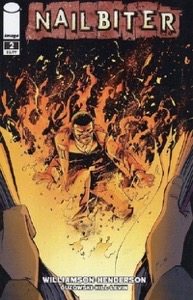
 It’s hard to say when being self indulgent is the right movie. Even with a good writer–and Williamson is a good writer–it can go wrong. It goes wrong this issue of Nailbiter. Williamson spends way too much time on the interview with the famous serial killer and lets this guy overshadow the protagonist.
 Ennis continues with the goofy issues. The dialogue out of this one is hideous. Ennis is going for cheap one liners. It’s awful.
 Well, this issue definitely delineates Wilson’s strengths when it comes to writing scenes. The opening where Kamala reveals her secret identity to Bruno is a fantastic, long scene. Wilson gets to do all the “I’m a superhero now” exposition and brainstorming about a costume amidst a sincere scene between two friends.
 Lapham is really enjoying his high school arc. It’s not as violent anymore because of Virginia getting the cops involved with the brawl. Or so Leon, who’s around to explain everything to Virginia because she’s become a caricature, says.
 Garth Ennis just made me cry.
 An issue long fight scene with the Punisher mostly getting his butt kicked. Ennis goes for light, edgy humor from the Russian. Nothing too far, but some of the jokes are still smart.
 The Stop Button