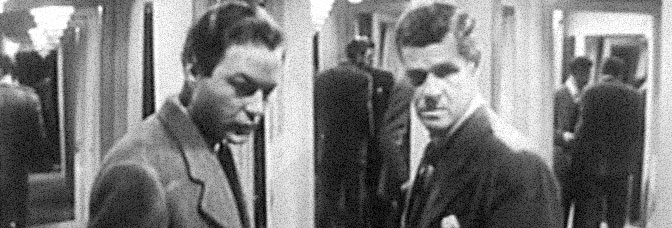
Fear in the Night shows just how far something can get on the gimmick. Bank teller DeForest Kelley wakes up one morning from the dream he killed someone. He then discovers evidence of his crime and, as he suspects he’s going mad, starts going a little mad.
If not totally mad, he does make some poor choices.
Luckily–or unluckily–Kelley’s brother-in-law (Paul Kelly) is a homicide detective.
Night doesn’t have good narration–though director Shane’s script does use it consistently–and Shane isn’t much of a director, but the film intrigues. The plotting is fantastic, with Shane withholding clues for so long I was wondering if he was ever even going to explain the mystery.
Shane handles the mystery in two parts. First, whether it’s real or not and then what–if it does turn out to be real–the consequences will be for the characters. Kelley’s also got a faithful girlfriend in Kay Scott and a concerned sister in Ann Doran. Shane gives Kelly a lot to do in terms of negotiating being a good husband and a homicide cop.
As a director, Shane’s mediocre at best but does have some creative visual flourishes.
Kelly is really good, even with some questionable dialogue, and he’s able to carry the film. Sometimes he has to carry Kelley through rough scenes; Kelley isn’t very good. He has a tough role but he also isn’t very good. He’s likable, however.
The whole thing is likable… but not very good.
 ★
★
CREDITS
Directed by Maxwell Shane; screenplay by Shane, based on a story by Cornell Woolrich; director of photography, Jack Greenhalgh; edited by Howard A. Smith; music by Rudy Schrager; produced by William H. Pine and William C. Thomas; released by Paramount Pictures.
Starring DeForest Kelley (Vince Grayson), Paul Kelly (Cliff Herlihy), Ann Doran (Lil Herlihy), Kay Scott (Betty Winters), Charles Victor (Captain Warner), Jeff York (Deputy Torrence) and Robert Emmett Keane (Harry Byrd).
RELATED

 What did I just read? Hogan’s back writing again and he does a decent enough job scripting, but the plotting is a disaster.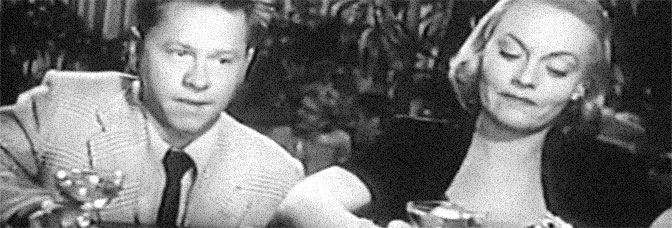

 I wanted Godzilla: Cataclysm to be good. Not before I started reading it, but as I read the first few pages where writer Cullen Bunn sets it all up. It’s got an intriguing ground situation–after the monster war, humans have to make do in their wrecked world. So it’s post-apocalyptic but not futuristic.
 Twenty-five issues into the series and Conway still hasn’t figured out a balance between the superhero stuff and the regular people stuff.
 I didn’t realize Starlight was a limited series. I guess it makes sense, given the creative team, but Millar sure didn’t pace it well for a finite run. Subplots would have been cool. I just thought he was padding it out.
 Sprouse is back for this fast-paced done-in-one with Tom, Tesla and Val on the moon helping Svetlana find her missing husband. There’s a nice opening with Telsa and Val–he’s still learning English and it’s frustrating her. Even though it’s Peter Hogan writing, he manages to continue Moore’s light comedic touch, but always with some seriousness behind the humor.
 I’m having a little trouble counting the reveals in this issue. It’s either three or four. Two of the biggest ones come before the end of the issue and then the cliffhanger reveal doesn’t even have the inkling of context. Williamson is having some fun.


 Naifeh partially recovers Ugg this issue with a fantastic flashback about Ülga’s motherhood and then he sets her up with a friend at school. One of the teachers is actually going to help her. That sequence, with her conversations with the teacher and the flashback, is excellent and it seems like the issue is going to go well.
 Moore brings it all together for the Tom Stone finale. He even gets around to a scene or two I really wasn’t expecting. It turns out there are drawbacks to a more emotional Tom Strong or Tom Stone. They play out unexpectedly for the characters, but maybe expectedly for the superhero comic book medium.
 Maybe it’ll all be a dream. Not the comic but me having spent the time reading it. Actually, that dismissal is a little unfair; I want to keep going with Terminal Hero, just to see if writer Peter Milligan ever finds anything original to say.
 Conway edits himself on Firestorm, which might by why no one told him having the female businessperson use “she” instead of “one” (referring to a hypothetical lawyer) sounds both sexist and dumb. Evil feminists out to get Firestorm, what can our hero do to stop them!
 If you think about it longer than fifteen seconds, Miskiewicz’s big reveal about 9/11 is offensive. It’d be offensive if it were about the death of Elvis Presley or the Battle of Verdun; he’s hijacking a real event to drive his story. See, 9/11 is apparently about these bad warlocks in the eighteenth century planting haunted wood on Manhattan.
 The Tom Stone story continues with Moore doing a combination alternate history lesson of the twentieth century–with Tom Stone and the good Saveen rehabilitating all the villains instead of fighting them–and wink at the traditional Tom Strong back story.
 Nightworld is off to a fine start. Artist Paolo Leandri does an excellent Kirby imitation, with Adam McGovern’s terse but verbose script–at least at the open–making the comic feel like something out of the seventies. Like a Charlton knock-off of Tomb of Dracula maybe.
 Sal Trapani inking Pat Broderick. I don’t even know where to start with the result… somehow the people look better than the superheroes, which isn’t how Broderick pencils usually work. Trapani inks them almost like comic strip characters, Ronnie and Martin in particular. It has to be seen to be understood.
 Oh, look, all She-Hulk needs is for Soule to not cop out on a story and for Pulido to come back on the art and the issue's outstanding.
 Jerry Ordway guest pencils for a special alternate history story. The shipwreck on the tropical island goes differently and so there’s never a Tom Strong. Instead, there’s a Tom Stone, son of Tom Strong’s mother and the ship captain. His understanding of racism firsthand–and still having the empathy to ignore it and help everyone–allows him to convince Saveen to become a science hero with him.
 Hawkins is one cruel writer. Until now, he’s always done an excellent job making Tales of Honor an engaging read, but this issue he works out comic book action tension better than maybe anyone ever has before. He makes the comic a page turner, using long expository paragraphs to pace the reader’s attention.

 There’s some more Killer Frost misandry goofiness. But not enough to impair the issue–what’s strangest about Killer Frost as the issue opens is how Conway sets her against another female scientist. He writes the human one fine; it’s just Killer Frost who he can’t seem to write with any sincere, empathetic depth. It’s odd.

 This issue, containing three different stories by two writers (Moore on the first and last, daughter Leah on the middle one) and three different art teams (Howard Chaykin on the first, Shawn McManus and Steve Mitchell on the second, regular artists Sprouse and Story on the third), is mostly awesome.
 So here’s the story to Captain Victory, near as I can tell–the captain of a starship gets cloned on death so he can continue to command. Pretty neat. Only the clones in this case end up in different places thanks to a time warp or wormhole. Dirty seventies New York and then some wasteland planet.
 The Stop Button