The Stop Button
blogging by Andrew Wickliffe
Category: 1943
-

We’re in the Army Now is somewhat inexplicably a rarity. It’s a Warner Bros. “training short” for the Army (during World War II) but in the public domain. It’s got no IMDb entry, no Google results outside a citation from Doug McClelland’s Eleanor Parker: Woman of a Thousand Faces book (with the wrong title), yet…
-

High concept propaganda picture without enough concern for executing that high concept; neither from writer Dalton Trumbo or director Fleming, leaving the cast to (ably) fend for themselves. After a protracted setup with Spencer Tracy doing a middling job romancing Irene Dunne, the story moves to Tracy mentoring new flier Van Johnson (who will eventually…
-

At one point during Hostages, I thought there might actually be a good performance in it somewhere. Czech freedom fighter Katina Paxinou faces off with her mother over her Resistance work. It has the potential for a good moment, turns out it’s just an adequate one (amid the sea of inadequate ones in the film).…
-

The Life and Death of Colonel Blimp runs two and three-quarters hours and takes place over forty years. The former’s passage is sublime, the latter’s is subtle. Directors Powell and Pressburger bookend the film in the present, then flashback. The lead at the start of the film is James McKechnie. He’s a lieutenant who gets…
-
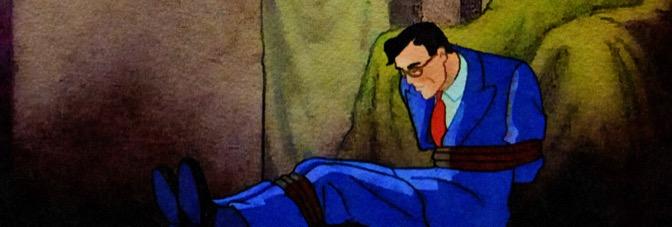
Secret Agent opens with this really exciting car chase. Clark (Bud Collyer) has just called in and been told to get to work on the right story, only then a car crashes through the drug store he’s in and so he hops on the back of it as it chases another car. Then the cops…
-
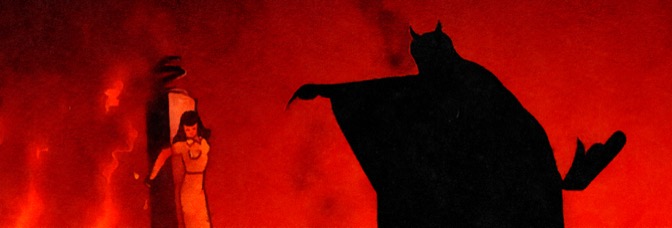
Sitting through the first third of Jungle Drums, I kept hoping the cartoon would keep the African natives in silhouette. I had zero confidence they wouldn’t do some racist caricature and, at least in silhouette, there would be specifics. The natives do get out of silhouette and they are racist caricatures, but… at least there’s…
-

If it weren’t for the needlessly racist finish from Lois (Joan Alexander), The Mummy Strikes would probably get a pass. Maybe. The action isn’t particularly impressive, but the Egyptian history lesson is pretty cool. Even if it’s all about young King Tush. Jay Morton’s script is (mostly) strong–it, Sparber’s direction, and animator Graham Place and…
-

Meshes of the Afternoon is a dream within a dream within a dream within a dream. But since they’re dreams, it’s really just the one dream, I suppose. A woman–presumably, because directors Deren and Hammid shoot from her point of view during the waking segment–comes up and takes a nap. On her way home, she’s…
-
Power of the Press runs a thin–not slim, but thin–sixty-four minutes. It’s paced better than expected (publicity stills suggest quite a few cut scenes); scenes never seem rushed, scenes never seem truncated. Instead, they’re just deliberate. Otto Kruger is a blue blood New York City newspaper publisher who dabbles in fascism. He couldn’t buy his…
-

For the majority of Batman’s fifteen chapters, the serial has a set formula when it comes to the action. Batman (Lewis Wilson) and Robin (Douglas Croft) get into fist fights with the same five or six thugs. Croft gets beat up early while Wilson takes on at least two of the villain, then two or…
-

Titling the final chapter, The Doom of the Rising Sun, might give away whether or not J. Carrol Naish succeeds with his awful plan–which Batman never quite defines and sort of forgets about anyway. The screenwriters try to drum up some excitement as Lewis Wilson and Douglas Croft finally face off with Naish. It’s rather…
-

The impossible occurs, one chapter until the finish, with The Executioner Strikes actually having a satisfying cliffhanger resolution. A somewhat satisfying one. Better than any of the others. After that high point, unfortunately, the chapter gets pretty bad for a while. First, it’s dumb, with Lewis Wilson revealing himself to the bad guys without costume,…
-

Despite the previous chapter suggesting a cliffhanger, turns out the resolution is more about Douglas Croft and William Austin’s impatience than anything else. But as Batman is now seventy-some percent complete, things start happening in Eight Steps Down. Though nothing about eight steps. There’s a narrative jump between one part of Lewis Wilson and Croft…
-

The chapter opens with Batman leaving some guy to get killed–it was hinted at in the cliffhanger, which resolves even more stupidly than I expected, but I sort of assumed Batman wasn’t going to get some guy killed. Nope, he’s fine with it. J. Carrol Naish gets more screen time this chapter than he has…
-

So, even though the title is A Nipponese Trap, there’s no trap in the chapter. Unless it’s when the bad guys bail out Lewis Wilson–in his thug disguise–so they can run him over. Except Douglas Croft and William Austin have already bailed him out, yet they don’t go to pick him up. The bad guys…
-

And now Batman is back to the misleading chapter titles. There aren’t spies in Flying Spies, there’s only one spy on the plane. After the laziest cliffhanger resolution in the series so far–and there have been some lazy ones–Lewis Wilson and Douglas Croft take a break from crimefighting (i.e. getting beat up by the same…
-

Incredibly, Douglas Croft’s Robin doesn’t get beat up this chapter. Sure, Lewis Wilson still manages to get pummeled, but Croft makes it through without being incapacitated once. Well, except in the cliffhanger resolution and then only temporarily. After quickly ridding themselves of Shirley Patterson–in a stunning display of callowness from Wilson (one has to be…
-

Lured by Radium actually does refer to the content of the chapter. It’s almost getting to be a habit for Batman. Unfortunately, all the serial’s other bad habits are in play here. The recap and resolution of the previous chapter takes a fifth of the runtime. Once again, boring resolution, but at least then Charles…
-

The best part of The Phoney Doctor is Charles Middleton. He’s the rough and tumble prospector, albeit one who falls for a phoney doctor, but he’s got personality and presence. He’s unexpected. Everything else in Batman, down to Batman and Robin getting beat up yet again, is predictable. The chapter opens with another lackluster resolution…
-

Poison Peril actually fits a lot into the chapter. Narrative too, not just racism. Lots of racism this time around, with the screenwriters rushing to fit in slurs. There’s the exceptionally weak cliffhanger resolution–it’s like they aren’t even cliffhangers as much as pauses in action–J. Carrol Naish plotting with a submarine, Shirley Patterson gets a…
-

Shockingly, The Living Corpse actually doesn’t involve a living corpse. It’s far from the most dynamic living corpse in cinema history, but it’s at least present in the chapter it entitles. The Corpse has most to do with J. Carrol Naish’s half of the chapter. He’s got two schemes, with one being his orders from…
-

When the chapter title refers to Slaves of the Rising Sun, I guess it means J. Carol Naish’s traitorous American henchmen. They really don’t do anything; well, Robert Fiske argues with Naish about Japan’s chances in the war to ill result, but otherwise, they don’t really do anything. They don’t even get enough personality to…
-

Despite a tantalizing title, The Mark of the Zombies has nothing to do with zombies’ marks. If there is a zombie, it’s Gus Glassmire, who’s just been electronically brainwashed by J. Carrol Naish. Glassmire still refuses to sell out the U.S. to Japan–it’s inexplicable why Naish asks him again, as nothing’s changed other than Batman…
-

While the resolution to the previous chapter’s cliffhanger is extremely lackluster, The Bat’s Cave sort of recovers as it goes along. It just has to get through Batman Lewis Wilson terrifying butler William Austin with the radioactive laser gun. Then it’s time for villain J. Carol Naish to order the kidnapping of Shirley Patterson and…
-

The first chapter of Batman introduces the main cast–Lewis Wilson and Douglas Croft as Batman and Robin (and their alter egos), villain J. Carrol Naish, damsel in distress Shirley Patterson–and establishes some of the ground situation. Naish is an evil Japanese agent (if Electric Brain is any indication, Batman is going to be exceptionally racist)…
-

Journey Into Fear has a number of insignificant problems, a couple significant ones, and one major one. The major one is Foster’s direction. It’s not bad, it makes good use of the sets, it even uses some of the supporting cast well, but it’s not frightening, it’s not exciting. Journey Into Fear, not just because…
-

On one hand, Five Graves to Cairo is a solid stage adaptation. Director Wilder, who adapted the play with Charles Brackett, makes it feel like a film. On the other hand, Cairo–partially because Wilder sticks to the setting so thoroughly and never opens up the film–doesn’t really go anywhere. After implying complications, it ends just…
-

The More the Merrier is a wondrous mix of comedy (both slapstick and screwball) and dramatic, war-time romance. Director Stevens is expert at both–that war-time romance angle is as gentle as can be, with Stevens relying heavily on leads Jean Arthur and Joel McCrea to be able to toggle between both. And they do, ably.…
-
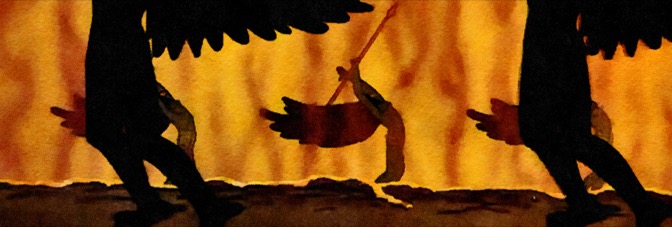
The Underground World is absolutely gorgeous. The animation has its issues, but how the animators light their characters and how director Kneitel composes the frames… just breathtaking. The story concerns Lois and Clark on an expedition to an underground cavern. Once they arrive, there’s trouble for Lois and they discover the totally absurd secret of…
-

Before it stumbles through its third act, I Walked with a Zombie’s biggest problem is the pacing. It’s exceedingly boring during the second act. Its second biggest problem is it’s too short. The second act plays so poorly because there’s not enough going on, there’s just not time for it in sixty-eight minutes. Otherwise, the…
 The Stop Button