Doomsday Clock 1 (January 2018)

Doomsday Clock #1There’s one big problem with Doomsday Clock. It exists.

And a lot of it is worse than one might expect. Apparently, in 1992, after the plan at the end of Watchmen didn’t work out, the United States elected Robert Redford president. Only he isn’t a hippie dippy Robert Redford, he’s President Trump. There’s even a wall.

So, you know, if you want to read Doomsday Clock to make fun of Geoff Johns’s writing… it provides a lot of opportunity. Is it worth reading for that reason? Depends on whether or not you want a lot of fodder for mocking Geoff Johns.

Or maybe you just want to see Gary Frank “Gary Frank” a Watchmen sequel. Only one where the DC Universe gets involved. And that crossover–albeit to a different, somewhat darker DCU (I think, has DC changed Superman’s origin lately)–gets to have the Watchmen panel layout.

You think Frank and Johns weren’t going to ape Watchmen down to the panel layouts. Please. Doomsday Clock is craven and desperate.

It also seems to be implying, after Watchmen, Nite Owl feels so shitty about Rorschach dying he takes up the mask, as it were, and lives his life aping him. Or something. It’s dumb. It’s a Watchmen sequel written by Geoff Johns. Of course it’s dumb.

It’s kind of sad how dumb it gets. Especially when Johns brings in some costumed villain sidekicks for NuRorschach. They’re terrible enough maybe they were in Before Watchmen. But I’ve blocked that previous desperate attempt from DC to turn Watchmen into a brand name from my memory.

I finished Before Watchmen though. I’m not sure I really want to see what Johns and Frank have cooked up for them in After Watchmen.

I do want to know if the team refers to themselves as The Watchmen though. I really, really hope they do. If you’re going to show the world you’re an exceptionally pedestrian writer, you might as well do it on a corporate Watchmen sequel.

Is Doomsday Clock worth the read to intellectually dissect it and roast it? For five dollars? In this economy?

CREDITS

That Annihilated Place; writer, Geoff Johns; artist, Gary Frank; colorist, Brad Anderson; letterer, Rob Leigh; editors, Amedeo Turturro and Brian Cunningham; publisher, DC Comics.
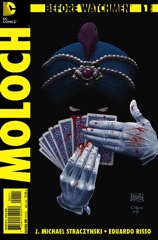
Before Watchmen: Moloch 2 (February 2013)

Straczynski turns Moloch into the martyr of Watchmen. And he gets away with it. Moloch’s such a broken soul, it’s feasible he’d bend to Adrian’s will. As for Adrian, who practically gets more page time here than Moloch, Straczynski seems to recognize what he and Moloch have in common… they’re both illusionists. Adrian’s convincing Moloch he’s doing the right thing, which includes killing lots of people.

The issue covers the time Moloch leaves prison–Adrian gives him a job fit for a member of the Red-Headed League–up until his death. Because Straczynski is so concerned with explaining another side of Adrian’s master plan, Moloch doesn’t really get to do much. He’s broken and sympathetic, nothing more. It’s too bad, since Straczynski writes him pretty well. He’s almost lovable.

Oh, and the pirate backup finally finishes. Higgins uses a lot of color for it but it’s still utter crap.

CREDITS

The Eleven-Thirty Absolution; writer, J. Michael Straczynski; artist, Eduardo Risso; colorist, Trish Mulvihill; letterer, Clem Robins. The Curse of the Crimson Corsair, Wide Were His Dragon Wings, Conclusion; writer, artist and colorist, John Higgins; letterer, Sal Cipriano. Editors, Camilla Zhang and Mark Chiarello; publisher, DC Comics.

Before Watchmen: Moloch 1 (January 2013)

882217Even though Moloch appears in the original Watchmen, there’s a lot more talk about him than show. J. Michael Straczynski turns the character into a quintessential sympathetic villain. He was born with deformed ears, leading to teasing in childhood and other tragedies later in life. Straczynski uses first person narration, making the reader identify with Moloch even more.

Straczynski recounts most of Moloch’s career this issue–presumably next deals with how he ties into the original series’s big reveal–and it moves at a nice pace. Eduardo Risso’s a great choice for the art; he handles the forties time period beautifully. He plays with a lot of false innocence visuals.

I’m a little surprised Straczynski was able to do so much with Moloch. It probably helps he didn’t try too hard and it’s only a two issue series. The brevity helps move it a whole lot.

It’s an unexpected success.

CREDITS

Forgive Me, Father, For I Have Sinned; writer, J. Michael Straczynski; artist, Eduardo Risso; colorist, Trish Mulvihill; letterer, Clem Robins. The Curse of the Crimson Corsair, Wide Were His Dragon Wings, Part Four; writer, artist and colorist, John Higgins; letterer, Sal Cipriano. Editors, Camilla Zhang and Mark Chiarello; publisher, DC Comics.

Before Watchmen: Dollar Bill 1 (March 2013)

894351It’s Steve Rude doing forties superheroes, so Dollar Bill always looks phenomenal. But it’s Len Wein writing and apparently he had a bunch of homophobic statements he wanted to make so he gave them to this forties superhero so he could get away with them. Lots of anachronisms–oh, and some good, old fashioned Jewish banker jokes.

But besides being mildly offensive, Bill isn’t a bad comic. The story of a newsreel superhero pretending it’s for real makes for an interesting read. Rude has beautiful compositions, whether static shots or action scenes. It’s just occasionally offensive. Well, maybe more dumb than offensive.

And the finale suggests magic in the Watchmen universe. Very special unoriginal narrative device magic. Wein’s a lazy guy.

It’s surprising all the Minutemen didn’t get one-shots. This guy isn’t even particularly interesting but they got a decently paced, beautifully illustrated, bad mainstream comic out of it.

CREDITS

I Want To Be In Pictures; writer, Len Wein; artist and letterer, Steve Rude; colorist, Glen Whitmore; editors, Camilla Zhang and Mark Chiarello; publisher, DC Comics.

Before Watchmen: Comedian 6 (June 2013)

BW COMED Cv6 solicitI’ve got to give Azzarello credit. He doesn’t just let Comedian get a little loose. He runs it entirely off the rails; with integrity, though. Definitely with integrity. Even when Rorschach and Nite Owl show up, Azzarello never lets the comic become a cheap tie-in.

Jones, on the other hand, probably never has a worse moment than those two guest stars. He does a terrible, terrible job with the scene. He does bad work throughout the issue–the end’s particularly confusing–but the guest star scene is inept beyond words.

It’s too bad Azzarello didn’t pull Comedian off. He got way too ambitious… if, by ambitious, one thinks of “Quantum Leap” as ambitious. In other words, his plotting is cheap, easy, predictable. But his writing of the scenes is so strong, one can almost forgive him.

But not with this finish. It’s just too damn slight. It’s a shame.

CREDITS

Eighties; writer, Brian Azzarello; artist, J.G. Jones; colorists, Alex Sinclair and Lee Loughridge; letterer, Clem Robins; editors, Mark Doyle, Camilla Zhang and Will Dennis; publisher, DC Comics.

Before Watchmen: Comedian 5 (March 2013)

897847Azzarello finally pushes too hard with the political history lesson and loses control of the series. It’s not a bad issue, just mediocre. Jones can’t draw Nixon, which is a problem.

Eddie barely figures into the comic at all. He’s trying to get through the jungle, fighting some Viet Cong–there are flashbacks to atrocities–but Azzarello sets it all against a report about his activities in Vietnam. It’s a familiar comic book device, maybe even one natural to the medium, but it changes the series’s natural progression. Just when Eddie was becoming a real character–or showing signs of being one–Azzarello removes his agency.

There’s barely anything to talk about with the issue, as Azzarello hinges it all on the big revelation Nixon is somehow involved. The issue might have worked better set against a history book than a CIA report.

Still, it’s not bad, just rather disappointing.

CREDITS

Kicks; writer, Brian Azzarello; artist, J.G. Jones; colorist, Alex Sinclair; letterer, Clem Robins; editors, Mark Doyle, Camilla Zhang and Will Dennis; publisher, DC Comics.

Before Watchmen: Comedian 4 (December 2012)

884588And another good one. Azzarello likes doing war comics; he should stick to them. Even though there are some confusing parts to the narrative–Azzarello fractures it without establishing the bookends–and the song lyric excerpts don’t work, it’s a successful issue.

Towards the end, Eddie and his gang drop acid before going on patrol. If Azzarello had structured the whole comic around the trip, it would have integrated much better. Instead, it feels like Azzarello’s just explaining a series of events. That approach is good since the writing’s good, but the fracture structure feels too forced.

And there are some changes to Eddie. Azzarello never goes into how the changes really effect him, but some are very obvious. There’s no judgment in Comedian. Following his movie inspirations, Azzarello just lets Eddie and company personify the insanity of the Vietnam War.

It’s not original at all, just darn good writing.

CREDITS

Conquistador; writer, Brian Azzarello; artist, J.G. Jones; colorist, Alex Sinclair; letterer, Clem Robins. The Curse of the Crimson Corsair, Wide Were His Dragon Wings, Part Six; writer, artist and colorist, John Higgins; letterer, Sal Cipriano. Editors, Mark Doyle, Camilla Zhang and Will Dennis; publisher, DC Comics.

Before Watchmen: Comedian 3 (November 2012)

876500It’s another surprisingly good issue.

Eddie’s on leave in Hawaii after he aggravated a riot while on leave in L.A. Azzarello structures the whole issue around him telling Bobby Kennedy (his strongest government supporter) about it.

Going between race riots and war protests, Azzarello manages to look do a nice little history issue. There’s not a lot of facts, but he definitely investigates the complications behind these things. And Eddie even gets a little character.

Eddie can’t have too much character, however, as Azzarello is moving him through the series as the reader’s guide through history. The other Watchmen superheroes haven’t shown up yet–and the brief mention of them this issue is a surprise–because they don’t work with what Azzarello’s doing.

This Comedian series is half done; it’ll be interesting to see if Azzarello can stay so gleefully disentangled from the original series in the second half.

CREDITS

Play With Fire; writer, Brian Azzarello; artist, J.G. Jones; colorists, Alex Sinclair and Tony Avina; letterer, Clem Robins. The Curse of the Crimson Corsair, The Evil That Men Do, Part Five; writer, artist and colorist, John Higgins; letterer, Sal Cipriano. Editors, Mark Doyle, Camilla Zhang and Will Dennis; publisher, DC Comics.

Before Watchmen: Comedian 2 (September 2012)

872690Yeah, Azzarello definitely enjoys writing Comedian. There’s a lot of Vietnam War history here, a little American political history and almost no Watchmen connection. The Comedian could just be anyone. Azzarello never gives him anything superhero specific.

So, as a comic, it’s good, but–and I can’t believe I’m saying it–it fails as a Before Watchmen title. Eddie’s a corrupt, kill-happy advisor. Azzarello gives him no special personality, not even a real character moment in the entire issue. There’s a little with him hanging out with Bobby Kennedy, but not enough to make an impression.

It’s a war history comic. Jones’s art isn’t great for the subject, but he handles it better than superhero stuff I guess. There’s definitely a morose tone to it.

I’m hoping Azzarello doesn’t even try tying into the original series.

The pirate backup, shockingly, has a plot point. I didn’t they even bothered.

CREDITS

I Get Around; writer, Brian Azzarello; artist, J.G. Jones; colorist, Alex Sinclair; letterer, Clem Robins. The Curse of the Crimson Corsair, The Devil in the Deep, Part Eight; writer, Len Wein; artist and colorist, John Higgins; letterer, Sal Cipriano. Editors, Mark Doyle, Camilla Zhang and Will Dennis; publisher, DC Comics.

Before Watchmen: Comedian 1 (August 2012)

872435I thought J.G. Jones was a better artist. I don’t know why exactly, but I did. His figures in Comedian are terrible. People change size, make no sense when standing next to one another. And his faces are even worse. It’s an ugly comic. I guess the editors didn’t think they could tell him to actually work at it.

Reading the creator team, I thought I’d have the problems with Brian Azzarello, but no. It’s all Jones. Azzarello does a really good job with the writing. Eddie’s still unlikable, but Azzarello gets how to make an unlikable character interesting to read.

There’s a great finish; the issue’s got a couple big historical moments. The first is somewhat slight, but Azzarello does wonders with the second.

I can’t imagine he’ll be able to maintain this level of quality plotting.

The pirate backup’s not the worst ever, but strangely annoying here.

CREDITS

Smile; writer, Brian Azzarello; artist, J.G. Jones; colorist, Alex Sinclair; letterer, Clem Robins. The Curse of the Crimson Corsair, The Devil in the Deep, Part Three; writer, Len Wein; artist and colorist, John Higgins; letterer, Sal Cipriano. Editors, Mark Doyle, Camilla Zhang and Will Dennis; publisher, DC Comics.