Category: Merrie Melodies cartoons
-
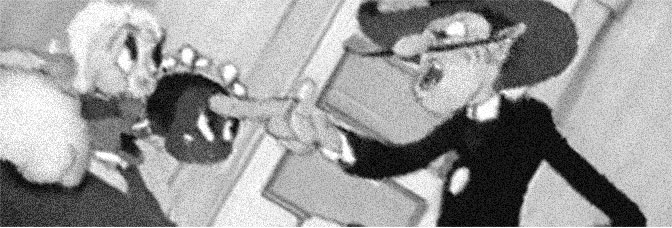
Uncle Tom's Bungalow manages to be both appallingly racist and a little progressive. Director Avery turning the slave trader into the devil, poking a little fun at the angelic white girl, general mocking of Southern cultural all around…. But Bungalow just isn't a good cartoon. Ben Harrison's script–with Tedd Pierce obnoxiously narrating–doesn't even include a…
-

Baby Buggy Bunny opens with its weakest sequence–a bank robbery. The perpetrator is a baby-sized thug who gets away by throwing on a bonnet and hopping in a carriage. Clearly there are some Baby Herman connections, especially later on when the robber and Bugs Bunny start battling. Bugs gets involved thanks to a runaway baby…
-

Russian Rhapsody is a strange–and very funny–cartoon. First, as a historical document, it's a Hollywood cartoon mocking Hitler (before the end of the war and the extent of his atrocities became clear). In Rhapsody, he's an obnoxious windbag and there are a bunch of good jokes at his expense. But once the first act is…
-
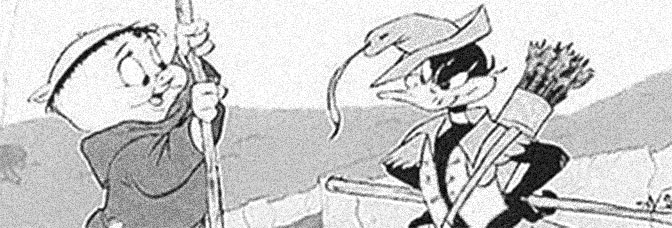
Robin Hood Daffy is an unappealing mix of pointless, dumb and bewildering. Besides Porky beating up Daffy (Porky’s Friar Tuck, Daffy’s apparently Robin–more on that one in a bit), Jones’s gags all seem recycled from a Wile E. Coyote cartoon. It’s Daffy swinging around to disastrous result. It’s never clear if Daffy’s actually Robin Hood…
-

Wild Wife is easily McKimson’s best cartoon (of those I’ve seen, anyway). I was going to start by talking about McKimson as an unlikely feminist, since Wife mostly concerns a housewife whose male chauvinist pig husband berates her for not getting enough done. The cartoon then flashes back to show exactly how full her day…
-

West of the Pesos is a hideous cartoon, with terrible animation and McKimson ripping off Wile E. Coyote and the Roadrunner. There’s not much to amuse oneself with during the insufferable six minute cartoon, but there are some places to try. First is the whole Speedy Gonsalez thing. I mean, Warner produced cartoons–not expensive, but…
-

I wonder if anyone involved in making The Last Hungry Cat ever owned a cat. The premise is (for a Freleng cartoon) quite good. Sylvester is haunted–by an Alfred Hitchcock-like narrator–after he “eats” Tweetie. There are a couple big logic problems. The major one involves cats. They don’t have remorse. It’s absurd Sylvester would feel…
-

Birds Anonymous should be really good. Its failings so how tied animation technique and writing are when it comes to a cartoon. The narrative, down to the scenic plotting, is fine. But the animation is bad so Birds flops. The most startling problem is the backgrounds. A more generous person might call them stylishly spare.…
-

Fresh Airedale opens without titles and I’m a little surprised to see it’s Chuck Jones. The animation is rather weak for the most part and, while there’s inventiveness, it’s chaste. The cartoon has either a mixed message or just a depressing one. It’s all about a sociopathic, Machiavellian airedale who does whatever he can to…
-

Duck Amuck is either very memorable or very predictable. If I have ever seen it, it was fifteen plus years ago. Yet I could guess a bunch of the plot twists, including the final one. That final reveal, which might make Amuck memorable, also undoes a lot of the neat stuff the cartoon does otherwise.…
-

A tough bulldog adopts an adorable kitten in Feed the Kitty; a story Jones liked so much he remade it. This one, the original, manages to be charming without saccharine, maybe because of the really strange objectification of the dog’s lady owner. She kicks up her skirt at one point, revealing her legs, and it…
-
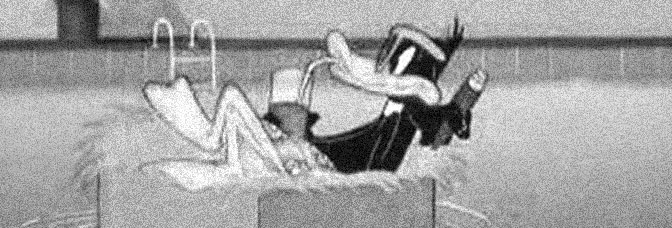
Once again, the boys at Warner Bros. have some problems with basic gender realities. Not only does Daffy Duck lay eggs (something he strongly infers in Golden Yeggs without getting graphic), neither do ganders. That incredible plot problem aside, Yeggs is a lot of fun. It starts on Porky Pig’s farm with a gander laying…
-

Rabbit Hood features some great voice work from Mel Blanc. Some of the responsibility falls on Jones and writer Michael Maltese, of course, since they put Bugs Bunny in Sherwood Forest with the Sheriff of Nottingham as an antagonist… but Blanc makes the cartoon memorable. Bugs has some great dialogue and Blanc nails it. That…
-

I’m missing why Speedy Gonzales is the good guy in Chili Weather. He’s trying to steal food (the theory being the factory has food so it should give food to his friends) and he tortures the guard cat. If one got really creative, he or she could interpret Weather as commentary on the Mexican government…
-

Frigid Hare ends on a strange note. It looks like Bugs Bunny and his newfound penguin friend are walking in place in front of the Northern Lights. The shot’s disconcerting since the rest of the cartoon is so strong. Bugs is in Antarctica, having made a wrong turn and wasted a few days of his…
-

A prerequisite for The Mouse That Jack Built is probably working knowledge of “The Jack Benny Program.” I have none, though I think I’ve heard the radio show before. But I certainly do not remember it enough for Mouse to make sense. It’s a strange concept for a cartoon–imagine Jack Benny is a cartoon mouse;…
-
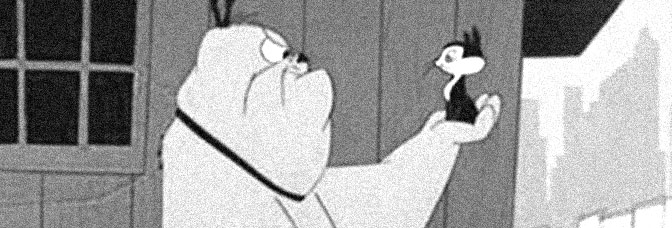
Cat Feud is almost too precious for its own good. In fact, the precious nature is what gets it into most of its trouble. The cartoon concerns a tough construction site guard dog who gets all mushy inside when he finds an adorable kitten. Trouble comes in the form of a stray cat, who is…
-

So all you need to make Daffy Duck an incredibly sympathetic character is Porky Pig. In Daffy Duck Slept Here, Porky’s a traveler in search of a hotel room. He ends up lodging with Daffy, only they haven’t met yet. Once they do, the majority of the hilarity ensues. And it is hilarity. Slept Here…
-
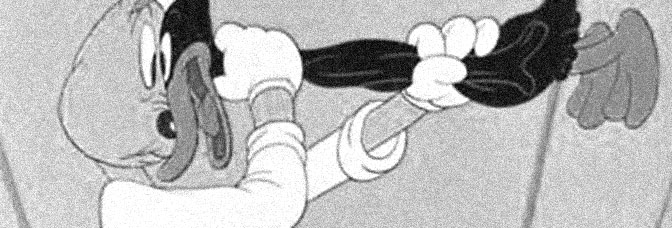
I wasn’t sure what I was going to say about Conrad the Sailor when it started. It seemed pretty simple–Conrad is a lame cat sailor and Daffy Duck makes fun of him. It was a simple case of Daffy being a bully. Maybe I could have done something about how cartoon icons are often callous…
 The Stop Button