Category: Cartoon
-
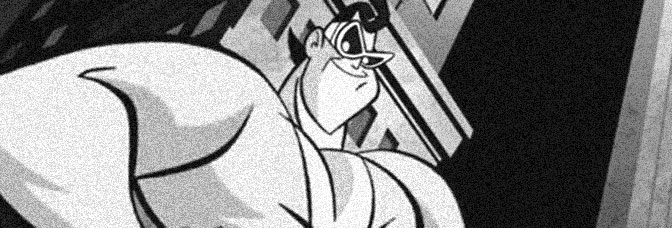
I wonder if Plastic Man producers Tom Kenny and Andy Suriano ever saw “Ren and Stimpy.” It’s not bad, just highly derivative of forty years of other cartoons without ever getting appropriate credit. Suriano takes enough time to put cute kitten pictures in a community service office (Plastic Man’s base of operations), but not enough…
-

I think Trail Mix-Up is supposed to be zany, what with the inclusion of an adorable beaver and a cuddly bear in Roger Rabbit and Baby Herman’s trek through the wilderness. It’s not very good, of course. Besides Droopy’s Jaws-related cameo and Jessica Rabbit showing up for a moment, there’s nothing memorable about it until…
-

Roller Coaster Rabbit is exceptionally overproduced. The animation is technically outstanding, just without any gags–Roger Rabbit makes a terrible cartoon protagonist because he’s an unlikable moron–but at the end it takes an odd turn towards the CG. There are some fire effects, there are a lot of spark effects, it’s as though Minkoff gave his…
-

Tummy Trouble goes out of its way to pay homage to Tex Avery (down to a Droopy cameo) and director Minkoff does a decent job of it. Not to say Tummy‘s successful, however. While Minkoff apes Avery all right, it’s a combination of too obvious and too reverential. Outside being an “original” Roger Rabbit cartoon,…
-
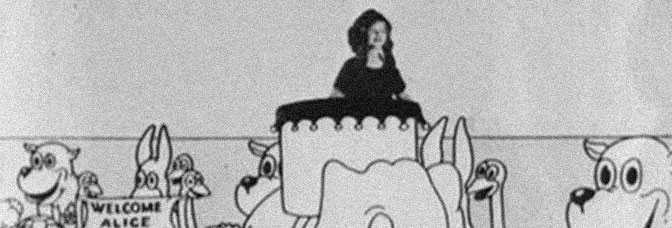
Depending on the process director Disney used to marry live action with animation, Alice’s Wonderland is either mediocre or just plain bad. If it’s the latter, Disney has no concept of perspective or, you know, shadows. The first three minutes are awesome. A little kid (Virginia Davis, in an awful performance–it’s probably Disney’s fault) visits…
-

There’s nothing good about The Saga of Windwagon Smith. The best thing about it is the extended opening titles, which eat up some of the runtime and lessen the cartoon’s awfulness. The animation happily plays at the nexus of lazy, incompetent and bad. Director Nichols–who cowrote–at least could’ve come up with an interesting visualization for…
-

As if Donald Duck couldn’t get weirder, he’s apparently got the hots for a female elephant in Working for Peanuts. But it’s not actually a Donald cartoon, it’s a Chip and Dale cartoon. The boys are after the peanuts–a delicacy they’ve just discovered–and the zoo has them. Donald’s the zookeeper, the elephant’s got the peanuts.…
-
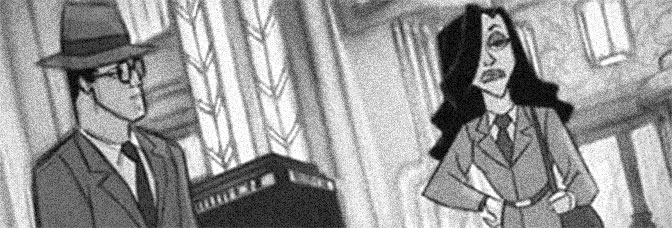
While it only runs a minute (I think), Superman Classic–which director Pratt describes as a “super fan film”–is pretty, well, super. Only the final moment disappoints, mostly because it’s a promise Pratt’s not going to keep. Classic is mostly hand drawn animation, which gives the cartoon the “fan film” feel occasionally, but Pratt professionally packages…
-

Bill Peet, who came up with the story for Susie the Little Blue Coupe and co-wrote the final script, must have thought American kids didn’t have enough depressing classic Russian literature in their lives. It’s a seriously disturbed, if fantastic, cartoon. Susie tells the story of a happy little car named, you guessed it, Susie.…
-

From the title, Little Tiger’s Can-Can Bug, one has to assume there is something lost in translation. The cartoon concerns two little tiger kittens who are working on a ship. They sing and they’re precious, but they don’t do much in Bug. There’s a grown-up tiger, a tuna boat captain–apparently the boat the two kittens…
-

The Iron Man‘s protagonist is not the Iron Man itself (himself?), which shows up after the halfway point. The protagonist is a cantankerous old man with some magic powers. He lives amongst all the adorable cartoon animals who sing and dance happily and he does what he can to ruin their days. He’s a bad…
-

Snow Time is another strange cartoon from Foster. It’s wintertime in cute cartoon animal land and everyone’s having a swell time skiing, synchronized skating and so on. Until this cat’s tail gets cut off because he’s messing around in a ski lane. But Foster and co-director Davis don’t follow his story. Presumably he’s just done……
-
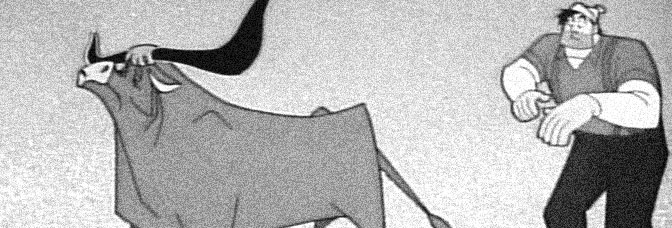
The beginning of Paul Bunyan is cute. It’s little Paul Bunyan (though a giant) growing up in Maine. Very cute. The song, which later becomes annoying, is well-used. Director Clark’s direction is pretty good throughout, though once Paul’s enormous ox, Babe, enters the picture, Clark loses control of the perspective. But that slip isn’t the…
-
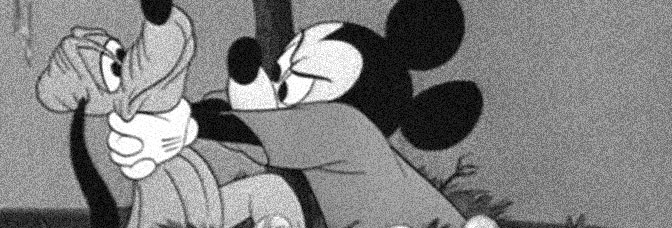
Pluto’s Christmas Tree gets off to a somewhat rocky start; it turns out, the animators spend more time on one nut than they do on Mickey Mouse. Besides looking perpetually hung over, Mickey’s also very loosely drawn. However, Tree soon picks up because Hannah’s direction is inspired and the animators excel on everything (except Mickey).…
-
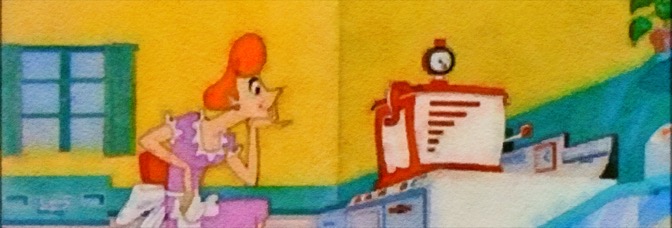
The House of Tomorrow is such a well-made cartoon, the technical aspects more than make up for some of the weak writing. However, that weak writing does make the cartoon an interesting historical artifact. First the technical stuff. Tomorrow is a tour through a house of 2050. The year’s made clear when the kitchenwares get…
-

Social Lion is such a truly awful cartoon, one would need to sit with pencil and paper to make notes on every moronic detail in its six minutes. Director Jack Kinney–brother to co-writer Dick Kinney, who, with Milt Schaffer, writes a lousy story–doesn’t have bad ideas, particularly during the Africa scenes. The animation is bad,…
-

The Story of Anyburg U.S.A. is an odd one. A small town decides to sue cars–personified here as cute, the windshields as big eyes–for all the auto accidents. Sadly, Anyburg opens with a lot more energy–the narrator goes on and on about homicides on the highway and such and it doesn’t seem Disney at all.…
-

Wood Choppers is not a good cartoon. The animation is weak and director Terry’s approach to the cartoon’s reality is anything goes. Dogs resurrect themselves after being turned into sausages and mice are able to reattach their heads and morph their tails into anything they can imagine. It’s exceptionally lazy. But there’s something amazing about…
-
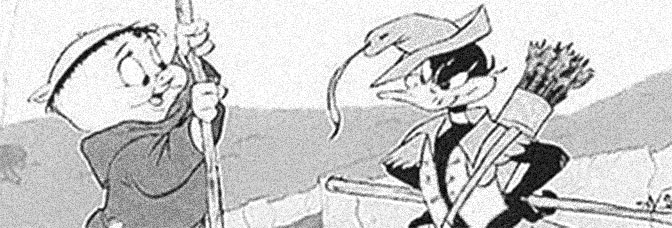
Robin Hood Daffy is an unappealing mix of pointless, dumb and bewildering. Besides Porky beating up Daffy (Porky’s Friar Tuck, Daffy’s apparently Robin–more on that one in a bit), Jones’s gags all seem recycled from a Wile E. Coyote cartoon. It’s Daffy swinging around to disastrous result. It’s never clear if Daffy’s actually Robin Hood…
-

Congo Jazz is a great example of how old Hollywood racism works. Having Bosko, the lead in the cartoon, be a little black kid isn’t really overtly racist… until Harman and Ising have him meet a couple monkeys. Guess who looks like who? And then, sort of confirming racists are morons, it turns out the…
-

Watching Bosko the Doughboy, I kept thinking, “too soon.” It’s a comedy cartoon about World War I, specifically trench warfare. In the cartoon, Bosko is the only human. The rest of combatants are animals–dogs, cows, a pig or two, a lot of birds. The battle scenes are graphic and, one has to assume at the…
-

Embarrassingly, I didn’t understand Hare Conditioned‘s title until I looked it up online. No, I won’t tell you. The cartoon is an enthusiastic chase through a department store, with star window attraction Bugs Bunny about to be shipped off the to taxidermy department. Bugs is likable here, partially because he’s opposite a heinous villain, the…
-

Instead of padding Goliath II out to an exhausting fifteen minutes, director Reitherman and writer Bill Peet should have concentrated on making it a good seven minute cartoon. Worse, there are animation problems every few frames in Goliath, like whoever photographed the cells didn’t know how to focus; at seven minutes, it might not look…
-

Are all Speedy Gonzales cartoons the same? Cannery Woe opens with starving Mexican mice needing Speedy to get them cheese. Sylvester is guarding the cheese. Woe does have a couple minor differences though. First, none of the mice have to whore off their sisters to Speedy. Second, he doesn’t even show up until the cartoon’s…
-

I hadn’t seen Here Today, Gone Tamale before, but I’ve seen Freleng’s subsequent Chili Weather. The setup is the same–these starving, but lazy, Mexican mice can’t steal any cheese from Sylvester the cat, so one of them whores out his sister to Speedy Gonzales. In Tamale, Sylvester is guarding a boat. In Chili, it’s a…
-

Wild Wife is easily McKimson’s best cartoon (of those I’ve seen, anyway). I was going to start by talking about McKimson as an unlikely feminist, since Wife mostly concerns a housewife whose male chauvinist pig husband berates her for not getting enough done. The cartoon then flashes back to show exactly how full her day…
-

Two Chips and a Miss is a weak seven minutes. While some of the fault is Hannah’s direction, it’s mostly just his animators. They’re incredibly lazy when it comes to their figures. Hannah’s even lazier when it comes to filling out the cartoon. Chip and Dale are both romancing a night club singer (a female…
-
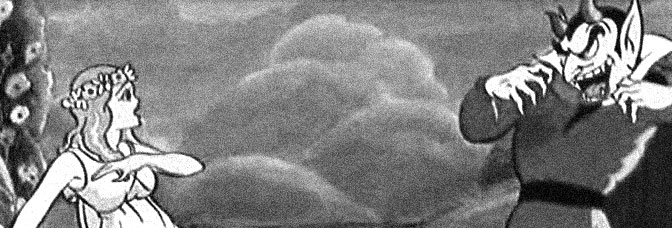
The Goddess of Spring is the story of Persephone and Pluto. She’s the Goddess of Spring, he’s the Lord of the Underworld. He kidnaps her, life on Earth gets very cold. The cartoon’s striking because of the movement. It’s hard to describe the animation. The figures are problematic (Persephone doesn’t have working elbows) but the…
-

West of the Pesos is a hideous cartoon, with terrible animation and McKimson ripping off Wile E. Coyote and the Roadrunner. There’s not much to amuse oneself with during the insufferable six minute cartoon, but there are some places to try. First is the whole Speedy Gonsalez thing. I mean, Warner produced cartoons–not expensive, but…
-

A Broken Leghorn never confronts its bleakness or meanness. It opens with Foghorn Leghorn doing a good thing, tricking a presumably barren hen into thinking she laid an egg. But then it turns out to be a baby rooster, so Foghorn spends the rest of the cartoon trying to kill the adorable little rooster. Mel…
 The Stop Button