 It’s another solid issue of Sally. There’s a lot with her and Tommy, which is nice because Sally cares a lot about him and Gischler handles their flirtation (for the first time, joint flirtation) really well.
Most of the issue takes place in a flooded city and artist Bettin does fine with the buildings and even the mutants, but he has some problems with the cast. Their faces become too generic at times; it reads fast, which helps a lot. Until it becomes clear Gischler has written himself into a hole and he’s going to get himself out as fast as possible.
So much happens over so few pages, it reads like Gischler is getting tired, which is too bad. Sally has been a great ride–and even continues to be, albeit too fast of one here–hopefully he’s got a nice finish for the series.
It really deserves one.
B
CREDITS
Writer, Victor Gischler; artist, Tazio Bettin; letterer, Tom Williams; publisher, Titan Comics.
 Gischler slows down a little too much this issue. Not enough to hurt Sally’s momentum exactly, but enough the cliffhanger feels protracted.
 Gischler finds the perfect mix of all action and enough story to get things along. Sally takes front and center, with her stranded party getting into trouble with some pirates. It leads to glorious ultra-violence, which both Gischler and Bettin relish in. Bettin has some slight problems on the art–it's a little too slick–but he delivers on the action, time and again.
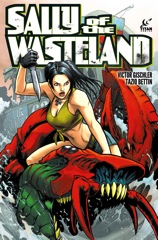 Sally of the Wasteland is great. It's going to be hard to talk about. Writer Victor Gischler has his post-apocalyptic setting and while it's tough and vicious and has a bunch of mutated animals, it's still humanist. It's thoughtful. Gischler starts with a relatively small cast and grows out from them, revealing the full setting. Or at least as full as he's going to reveal this issue.
 The last issue of Clown Fatale reads like the big showdown at the end of an eighties action movie with the lead clown in the Stallone role. Amusingly, Rosenzweig draws a Punisher stand-in with Stallone’s nose.
 Gischler doesn’t appear to be writing for a sequel series, which is both good and bad. Good because he’s taking this series on its own, bad because Clown Fatale is so much fun.
 I’ve never found Ferreyra’s art to be one of Kiss Me, Satan’s selling points. Gischler’s lunacy was always its brass ring. This issue, however, the art is what makes it work. There’s some good lunacy–Gischler seems to get how to use magic in a violent action story. With actual wonderment no less. But his final reveal is a little predictable.
 I wish Gischler would just take his time. It’s a good issue–lots of nice developments, brisk pace–but in his rush, he leaves out a lot of things he could expand on.
 This issue of Clown, Gischler goes for out and out absurd, profoundly sad and some other things. It’s a joy to read, even if the sad moments drag in some reality. Gischler’s not willing to write off the series as fluff; he’s trying to give it some actual content. Except that content is never as good as the funny stuff.
 I don’t know why I should keep reading Noir. It’s a perfectly serviceable comic for Dynamite to exploit a couple licenses they hold–The Shadow and Miss Fury–but there’s nothing else going on with it.