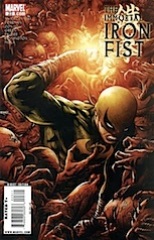
Immortal Weapons (2009) #3

Iw03

Who’s this Rick Spears guy and why have I never heard of him before? His origin of Dog Brother #1 is fantastic.

He opens it in late nineteenth century Hong Kong, where Dog Brother is something of a myth. Spears’s protagonists are these two orphans, trying to navigate the gangs, the British and the poverty. It’s sort of incredible how subtle Spears’s writing manages to be, given everything going on in the story.

Eventually, whether or not Dog Brother #1 has anything to do with the story doesn’t matter anymore. Spears gives his protagonists this tragic arc. He never pushes it or makes it melodramatic. He just lets all the awfulness play out.

Some fine art from Green… just a great piece of work.

The Iron Fist backup is messy. It’s too short, confusingly follows the previous installment and Diaz’s artwork is terrible. Swierczynski tries, but he can’t do much.

Immortal Weapons 3 (November 2009)

650161.jpg
Who’s this Rick Spears guy and why have I never heard of him before? His origin of Dog Brother #1 is fantastic.

He opens it in late nineteenth century Hong Kong, where Dog Brother is something of a myth. Spears’s protagonists are these two orphans, trying to navigate the gangs, the British and the poverty. It’s sort of incredible how subtle Spears’s writing manages to be, given everything going on in the story.

Eventually, whether or not Dog Brother #1 has anything to do with the story doesn’t matter anymore. Spears gives his protagonists this tragic arc. He never pushes it or makes it melodramatic. He just lets all the awfulness play out.

Some fine art from Green… just a great piece of work.

The Iron Fist backup is messy. It’s too short, confusingly follows the previous installment and Diaz’s artwork is terrible. Swierczynski tries, but he can’t do much.

CREDITS

Dog Brother #1 “Urban Legend”; writer, Rick Spears; artist, Timothy Green; colorist, Edward Bola. The Caretakers, Part Three; writer, Duane Swierczynski; artist, Hatuey Diaz; colorist, June Chung. Letterer, Nate Piekos; editors, Alejandro Arbona and Warren Simons; publisher, Marvel Comics.

The Immortal Iron Fist (2007) #27

Iff27

Swierczynski’s Iron Fist goes out with a whimper. He mimics Fraction’s last issue on the title. I’m not sure Swierczynski should have gotten to close, since he was just following Brubaker and Fraction–not to say his writing wasn’t occasionally quite good, it was just never original.

Foreman goes back to inking himself (I think) and it looks a little better than usual. It’s a dark, emotive style. Until the Lapham pages. They look out of place and, worse, lazy.

Swierczynski is more concerned getting Danny to the last page–expecting a baby, financially ruined–than doing it in any realistic manner. One has to wonder about editorial mandates, how much was about getting Danny set for his next series or whatever.

It’s too bad Swierczynski did ten or eleven issues on the series and never made an impression on his own. It’s still too much Brubaker and Fraction’s series.

The Immortal Iron Fist (2007) #23

Iff23

I think I’ll start with Foreman. He usually does an all right job, but he ends this issue on a terrible full-page panel of the (supposedly) first Iron Fist. He’s got this old guy warped to fit in the panel, his body proportions and perspective a complete mess. It’s terrible finish to the issue because it’s supposed to be scary. Instead it’s weak.

The issue opens with the revelation Davos is untrustworthy. It’s not clear if it’s just him or if it’s the Thunderer too. Swierczynski has a very strange storytelling method for Iron Fist. He contracts things Brubaker and Fraction introduced. For the most part, he sucks the potential out of them. He’s not predictable, he’s simply unoriginal. His Immortal Iron Fist feels like a copy of a copy of a copy. It’s dulled.

Every time Swierczynski seems to be getting better, he drops even further than before.

The Immortal Iron Fist 27 (August 2009)

595019.jpg
Swierczynski’s Iron Fist goes out with a whimper. He mimics Fraction’s last issue on the title. I’m not sure Swierczynski should have gotten to close, since he was just following Brubaker and Fraction–not to say his writing wasn’t occasionally quite good, it was just never original.

Foreman goes back to inking himself (I think) and it looks a little better than usual. It’s a dark, emotive style. Until the Lapham pages. They look out of place and, worse, lazy.

Swierczynski is more concerned getting Danny to the last page–expecting a baby, financially ruined–than doing it in any realistic manner. One has to wonder about editorial mandates, how much was about getting Danny set for his next series or whatever.

It’s too bad Swierczynski did ten or eleven issues on the series and never made an impression on his own. It’s still too much Brubaker and Fraction’s series.

The Immortal Iron Fist 23 (April 2009)

549883.jpg
I think I’ll start with Foreman. He usually does an all right job, but he ends this issue on a terrible full-page panel of the (supposedly) first Iron Fist. He’s got this old guy warped to fit in the panel, his body proportions and perspective a complete mess. It’s terrible finish to the issue because it’s supposed to be scary. Instead it’s weak.

The issue opens with the revelation Davos is untrustworthy. It’s not clear if it’s just him or if it’s the Thunderer too. Swierczynski has a very strange storytelling method for Iron Fist. He contracts things Brubaker and Fraction introduced. For the most part, he sucks the potential out of them. He’s not predictable, he’s simply unoriginal. His Immortal Iron Fist feels like a copy of a copy of a copy. It’s dulled.

Every time Swierczynski seems to be getting better, he drops even further than before.

CREDITS

Escape from the Eighth City, Chapter Two; writer, Duane Swierczynski; pencillers, Travel Foreman, Tonci Zonjic and Timothy Green; inkers, Tom Palmer, Mark Pennington, Zonjic and Green; colorist, Matt Milla; letterer, Nate Piekos; editors, Alejandro Arbona and Warren Simons; publisher, Marvel Comics.

The Immortal Iron Fist (2007) #21

Iff21

This issue might be Swierczynski’s best. It’s one of the done in one other Iron Fist issues and Swierczynski does something a little different. He does a future story. It really nicely fits the mythology Brubaker and Fraction established, while some descendant of Danny’s becoming the youngest Iron Fist.

But the Iron Fist of the future isn’t the protagonist, it’s a young girl growing up on a really lousy planet, apparently colonized by the Chinese (they know to call K’un-L’un for help). It’s an all action issue, with a lot of tension, and Swierczynski does a fantastic job with it all.

It doesn’t hurt he’s got Green on the art. Green’s able to mix future landscapes, Kung Fu and robots into something totally organic looking. It’s lovely to see.

Swierczynski’s also being subtle here. The ending is almost entirely given away early, if one does his or her math.

The Immortal Iron Fist 21 (February 2009)

if21.jpg
This issue might be Swierczynski’s best. It’s one of the done in one other Iron Fist issues and Swierczynski does something a little different. He does a future story. It really nicely fits the mythology Brubaker and Fraction established, while some descendant of Danny’s becoming the youngest Iron Fist.

But the Iron Fist of the future isn’t the protagonist, it’s a young girl growing up on a really lousy planet, apparently colonized by the Chinese (they know to call K’un-L’un for help). It’s an all action issue, with a lot of tension, and Swierczynski does a fantastic job with it all.

It doesn’t hurt he’s got Green on the art. Green’s able to mix future landscapes, Kung Fu and robots into something totally organic looking. It’s lovely to see.

Swierczynski’s also being subtle here. The ending is almost entirely given away early, if one does his or her math.

CREDITS

Wah Sing-Rand and the Mandate of Heaven; writer, Duane Swierczynski; artist, Timothy Green; colorist, Edward Bola; letterer, Artmonkeys Studios; editors, Alejandro Arbona and Warren Simons; publisher, Marvel Comics.