Monkey Prince (2022) #3

Mp3Monkey Face—sorry, Monkey Prince—sort of transcends this issue. The comic’s set over forty-five minutes to an hour, but isn’t a waste of decompression. Instead, Marcus the Monkey Prince has a very full after-school calendar. He gets some more training from the custodian, Mr. Zhu, who’s actually a mystical being (Shifu Pigsy), but most of his story has to do with dream girl Kaya.

Meanwhile, Shifu Pigsy will go on a demon hunt and determine the threat is even more imminent than he’d been thinking, and Marcus’s parents will have some workplace troubles. Marcus’s parents work for the Penguin, who has been possessed by the mystical villain, the Golden Horn. The Golden Horn is going to be Monkey Prince’s big bad—presumably, as Shifu Pigsy seems really worried about him.

Marcus isn’t interested in gold-plated Cobblepots, not when Kaya starts flirting with him. She’s got some questions about Monkey Prince and Marcus—like, why isn’t Marcus ever around when Monkey Prince is on the scene—and there’s also the matter of Kaya’s brother. Turns out it’s Marcus’s nemesis, The Riz, and he’s missing. Monkey Prince promises to find the missing dipshit.

At this point in the issue, writer Gene Luen Yang has completed a full enough comic book narrative gesture. He’s done character development, he’s done twists with Kaya, and there are the subplots with Pigsy and the parents. But then Monkey Prince delivers on the promise instead of kicking the can down the road for two more issues. Monkey Prince goes off to find the Riz, who’s being questioned by Boy Wonder Robin (the cover promises a Batman appearance, which thankfully doesn’t happen).

Monkey Prince and Robin have a fun, funny, and (gently) gross fight scene. Artist Bernard Chang does a good job throughout the issue, but something about the Robin fight just brings it all together. Visually, Monkey Prince is a strange combination. There’s the obvious “real-life” meets comic book, but there are also Chinese mystical beings in modernity as well as them interacting with men and boys in tights.

Good resolution, good cliffhanger. Yang’s doing a fantastic high school superhero comic here.

Oh, and the parents. I’ve been bearish on the parents, but this issue turns it around when they start Nick and Nora’ing as they contend with an even more dangerous Oswald Cobblepot.

Great stuff.

Monkey Prince (2022) #2

Monkey Prince  2Wait, is Batman just supposed to be a bad dad? Did DC really not think giving him a kid through? Or does Monkey Prince writer Gene Luen Yang just get to flash his bonafides and characterize Batman as a complete dipshit?

In addition to Batman attempting to gaslight and emotionally manipulate Robin (who’s now his son), which Robin calls out, we also find out Batman doesn’t tell Commissioner Gordon things like “I went into a high school and beheaded someone.” Is the natural conclusion of fascist, abusive Bat-dad is he’s a punchline?

Maybe, but seeing how little Batman cares about anything is still bizarre. Civilians, murder victims, whatever. Basically, he’s a tool, just like the school bully in Monkey Prince. Luckily for lead Marcus, his new school’s got plenty of non-tools around, including—sort of—Robin’s alter ego, Damian Wayne. Damian’s an annoying kid on the school newspaper who interrupts his interviews to take WayneTech Watch calls from his dad and mock him.

Marcus also gets to hang out with his crush, Kaya, and it’s adorable when he gets elated at the thought he’s on her radar (only to discover she’s part of the school’s mental health club, something Bruce Wayne probably ought to be paying for city-wide). He and de facto mentor Mr. Zhu have some long talks about Monkey Princing, and then there’s some more with Marcus’s parents.

I’m guessing Prince established Marcus was adopted last issue, but I’d forgotten. It doesn’t really change anything (yet?), but Yang’s setting him up for a big moment when he discovers his adorkable parents are actually supervillain support scientists.

Yang’s still in the setup phase of the series, though I did entirely miss the Penguin has been turned into “Golden Horn Penguin.” I blame artist Bernard Chang, who does an excellent job throughout—especially with the humor—but his one introduction shot to a mutated Penguin isn’t enough. I thought the mutant was eating Penguin, not Penguin mutated and eating other people.

Anyway.

Really strong issue, can’t wait for more, exactly what a teenage superhero comic should be.

Monkey Prince (2022) #1

Mp1I’m not up on modern Batman takes, but… has everyone just agreed he’s a dick? Monkey Prince starts with a Batman cameo, then brings him (and Robin) into it for the cliffhanger. In addition to him being a dick, does every new book have a Batman cameo for the sales? Though Batman’s only on one of the variant covers. Maybe you assume Batman will be in all DC #1s?

Enough with the rhetorical questions; enough with Batman. Monkey Prince isn’t about Batman, though his initial cameo gives away some of the hook—little kid Marcus Sun wakes up one night and hears a commotion in the living room of his family’s Gotham City apartment. He stumbles out, wiping the sleep from his eyes, and sees Batman beating up on his dad. Batman leaves after making some bad parent judgments (really, how’s Jason Todd again?).

Marcus never figures it out, but it’s pretty obvious his parents are supervillains. They turn out to be science hench-people who leave town soon after, living in all the big DC cities before ending up back in Gotham when Marcus is a teenager. Unfortunately, he’s still got PTSD from interrupting that Bat-fight, which causes a panic attack at the swimming pool. He makes the mistake of bumping into one of the school bullies, who then pushes Marcus into the pool.

The school custodian takes an interest, trying to encourage Marcus to work past his trauma, something Marcus initially refuses. When he tries to do it himself, Marcus discovers he’s, well, a monkey prince.

The issue hints at a rich cultural history for the character—in addition to the teenage son of bad guys, writer Gene Luen Yang’s front and center about how Marcus’s Chinese heritage affects his daily experiences, including his bully further attacking Marcus for having a white mom. It gives Marcus some more ground situation personality, which helps since he’s mostly just having panic attacks this issue. He also meets his presumable love interest; so far, Monkey Prince feels like a new teen superhero number one. With some asterisks, sure, but Yang’s not deviating too far from the playbook.

Bernard Chang’s art ably toggles between action paces—the superhero action’s much different than the bullying—and the character drama. Chang and Yang pace it rather well.

The series is off to a fine start.

New Super-Man: Coming to America (2017)

Nsm2

Coming to America collects six issues of New Super-Man. Three different two-parters. Coming to America is the middle one. No idea why they’d have picked it other than Eddie Murphy movie. It’s not the best of the two-parters. Might be the worst. Certainly does have the worst faces. Billy Tan pencils most of the issues, first and third arcs. Regular artist Viktor Bogdanovic does America and it’s lazy faces. No one has any personality in those issues. The expressions aren’t as bad as the lack of detail, but they’re not good. They made me–shudder–miss Tan (thinking he was Bogdanovic because I didn’t want New Super-Man to have art problems).
The middle story is also heavy on DC Rebirth continuity, which is a terribly mean thing to do. I want to avoid that nonsense like the plague. So having Lex and Superman Rebirth guest star doesn’t really do much for the comic. It’s kind of filler, just because writer Gene Luen Yang true desire seems to be introducing the New, Chinese Flash. And also because the relationship between Superman Rebirth and New Super-Man? There’s nothing special about it. It has no personality coming from either of them. Superman Rebirth is patient as Christ, New Super-Man is awestruck. Yawn.

But that brand crossover aside, everything else in Coming to America is a success for Yang. He doesn’t just build New Super-Man–Kenan–he also builds the other members of the JL China. Bat-Man and Wonder-Woman. They get this great arc together involving Bat-Man’s little sister and a nemesis. Excellent stuff. Yang seems to do better in pairs–Bat-Man and Wonder-Woman, then New Super-Man and New Flash.

The finale, which ends–quite frustratingly for a collection–on a big cliffhanger, has New Super-Man Zero returning. He’s the first attempt at a Chinese Super-Man and he’s far more powerful than Kenan. The real overarching story of this collection isn’t the Lex Luthor-funded trip to Metropolis, but Kenan’s relationship with his new mentor as he tries to unlock his superpowers. He’s got all the Superman powers, he just has a blocked qi. Once he’s able to unblock and properly channel his qi, Kenan gets some of the regular powers.

It seems like way too much of a plot device–which the artists integrate into the panels too, showing actual qi meters–but it always works out. Despite his obtuse arrogance, Kenan’s a great protagonist. His heart’s never too far away from the right place and the supporting cast ably brings him around.

Hopefully the art issues get resolved. Someone needs to tell Bogdanovic to slow down and take his time. Because, as distinct as Bogdanovic can be, the mood can be easily duplicated. Tan easily takes over the visuals on the comic. He’s more balanced than Bogdanovic, even if he’s bland. He’s consistent. Consistency is important.

Yang’s got a good pace throughout, he’s got a fantastic attention to character detail, he writes good action scenes. New Super-Man has it all.

New Super-Man Vol. 2: Coming to America (2017)

New Super-Man Vol. 2: Coming to AmericaComing to America collects six issues of New Super-Man. Three different two-parters. Coming to America is the middle one. No idea why they’d have picked it other than Eddie Murphy movie. It’s not the best of the two-parters. Might be the worst. Certainly does have the worst faces. Billy Tan pencils most of the issues, first and third arcs. Regular artist Viktor Bogdanovic does America and it’s lazy faces. No one has any personality in those issues. The expressions aren’t as bad as the lack of detail, but they’re not good. They made me–shudder–miss Tan (thinking he was Bogdanovic because I didn’t want New Super-Man to have art problems).

The middle story is also heavy on DC Rebirth continuity, which is a terribly mean thing to do. I want to avoid that nonsense like the plague. So having Lex and Superman Rebirth guest star doesn’t really do much for the comic. It’s kind of filler, just because writer Gene Luen Yang true desire seems to be introducing the New, Chinese Flash. And also because the relationship between Superman Rebirth and New Super-Man? There’s nothing special about it. It has no personality coming from either of them. Superman Rebirth is patient as Christ, New Super-Man is awestruck. Yawn.

But that brand crossover aside, everything else in Coming to America is a success for Yang. He doesn’t just build New Super-Man–Kenan–he also builds the other members of the JL China. Bat-Man and Wonder-Woman. They get this great arc together involving Bat-Man’s little sister and a nemesis. Excellent stuff. Yang seems to do better in pairs–Bat-Man and Wonder-Woman, then New Super-Man and New Flash.

The finale, which ends–quite frustratingly for a collection–on a big cliffhanger, has New Super-Man Zero returning. He’s the first attempt at a Chinese Super-Man and he’s far more powerful than Kenan. The real overarching story of this collection isn’t the Lex Luthor-funded trip to Metropolis, but Kenan’s relationship with his new mentor as he tries to unlock his superpowers. He’s got all the Superman powers, he just has a blocked qi. Once he’s able to unblock and properly channel his qi, Kenan gets some of the regular powers.

It seems like way too much of a plot device–which the artists integrate into the panels too, showing actual qi meters–but it always works out. Despite his obtuse arrogance, Kenan’s a great protagonist. His heart’s never too far away from the right place and the supporting cast ably brings him around.

Hopefully the art issues get resolved. Someone needs to tell Bogdanovic to slow down and take his time. Because, as distinct as Bogdanovic can be, the mood can be easily duplicated. Tan easily takes over the visuals on the comic. He’s more balanced than Bogdanovic, even if he’s bland. He’s consistent. Consistency is important.

Yang’s got a good pace throughout, he’s got a fantastic attention to character detail, he writes good action scenes. New Super-Man has it all.

CREDITS

Writer, Gene Luen Yang; pencillers, Billy Tan and Viktor Bogdanovic; inkers, Yanqiu Li, Haining, Jonathan Glapion, and Bogdanovic, and Tako Zhang; colorists, Yangfen Guo, Gadson, Michael Spicer, and Ying Zhan; letterer, Dave Sharpe; editors, Paul Kaminski and Eddie Berganza; publisher, DC Comics.

New Super-Man: Made in China (2017)

Nsm1

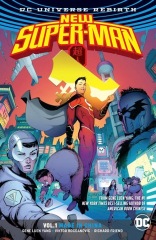
New Super-Man is a lot of fun. Writer Gene Luen Yang approaches it like a serious spoof and artists Viktor Bogdanovic and Richard Friend are very much in on the joke.

There’s a secret Chinese agency developing “The Justice League of China.” They need a “Superman” and pick Kong Kenan. Kenan is a high school bully who ends up on TV because of an uncontrollable urge to help people. Yang doesn’t look at that uncontrollable urge, but later in Made in China, Yang does give Kenan some redemption. His bullying, while bad, has its origins in his unresolved pain. He’s deep.

Luckily, Yang concentrates more on the fun than the hints at depth. There are a lot of big reveals in the second half of the book and everytime you have a reveal, it screws with depth. Yang tries, with one of the biggest reveals, to compensate with backstory, but it’s not enough. New Super-Man doesn’t have the wherewithal to do serious political comedy. Instead, it does a reasonable facisimile version. With bickering superhero teams. Because bickering superhero teams are fun.

Kenan has sidekicks in “Wonder Woman” and “Batman.” They both have not as memorable real names. Batman doesn’t like Kenan, which is simultaneously obvious and ingenious. By the finish, when the team is hanging out in their civilian clothes, Yang has completed China’s deftest character arcs. He’s building a strong superhero comic supporting cast, but he avoids obvious bonding moments. It’s cool. The relationships between all three, particularly “Superman” and “Wonder Woman,” are great.

The stuff with Kenan and his dad, which turns out to be extremely important not just for reveals and epical plotting and so on… well, it could be better. The dad’s a little too mysterious, too disinterested. Yang waits too long to work on the relationship. It starts as C plot and waits a real long time before rushing to join the A plot.

Bogdanovic and Friend’s art is good. They handle the action and just the general energy of the book. Kenan’s always antsy, physically impulse, even before he has superpowers. There’s a fine visual continuity to the characters as China goes on. Bogdanovic has an excellent sense of composition. There’s not as much detail as there could be, especially on faces, but the comic’s breezy enough it doesn’t register.

New Super-Man is a good time. Yang, Bogdanovic, and Friend build a solid character, solid pitch, with Made in China. Hopefully they keep Super-Man flying.

New Super-Man: Made in China (2017)

New Super-Man: Made in ChinaNew Super-Man is a lot of fun. Writer Gene Luen Yang approaches it like a serious spoof and artists Viktor Bogdanovic and Richard Friend are very much in on the joke.

There’s a secret Chinese agency developing “The Justice League of China.” They need a “Superman” and pick Kong Kenan. Kenan is a high school bully who ends up on TV because of an uncontrollable urge to help people. Yang doesn’t look at that uncontrollable urge, but later in Made in China, Yang does give Kenan some redemption. His bullying, while bad, has its origins in his unresolved pain. He’s deep.

Luckily, Yang concentrates more on the fun than the hints at depth. There are a lot of big reveals in the second half of the book and everytime you have a reveal, it screws with depth. Yang tries, with one of the biggest reveals, to compensate with backstory, but it’s not enough. New Super-Man doesn’t have the wherewithal to do serious political comedy. Instead, it does a reasonable facisimile version. With bickering superhero teams. Because bickering superhero teams are fun.

Young superheroes in trouble.
Kenan has sidekicks in “Wonder Woman” and “Batman.” They both have not as memorable real names. Batman doesn’t like Kenan, which is simultaneously obvious and ingenious. By the finish, when the team is hanging out in their civilian clothes, Yang has completed China’s deftest character arcs. He’s building a strong superhero comic supporting cast, but he avoids obvious bonding moments. It’s cool. The relationships between all three, particularly “Superman” and “Wonder Woman,” are great.

The stuff with Kenan and his dad, which turns out to be extremely important not just for reveals and epical plotting and so on… well, it could be better. The dad’s a little too mysterious, too disinterested. Yang waits too long to work on the relationship. It starts as C plot and waits a real long time before rushing to join the A plot.

New Super-Man is so Justice League there are Chinese knockoff Starro.
Bogdanovic and Friend’s art is good. They handle the action and just the general energy of the book. Kenan’s always antsy, physically impulse, even before he has superpowers. There’s a fine visual continuity to the characters as China goes on. Bogdanovic has an excellent sense of composition. There’s not as much detail as there could be, especially on faces, but the comic’s breezy enough it doesn’t register.

New Super-Man is a good time. Yang, Bogdanovic, and Friend build a solid character, solid pitch, with Made in China. Hopefully they keep Super-Man flying.

CREDITS

Writer, Gene Luen Yang; penciller, Viktor Bogdanovic; inker, Richard Friend; colorist, Hi-Fi Colour Design; letterer, Dave Sharpe; editors, Paul Kaminski, Eddie Berganza, and Bob Harras; publisher, DC Comics.